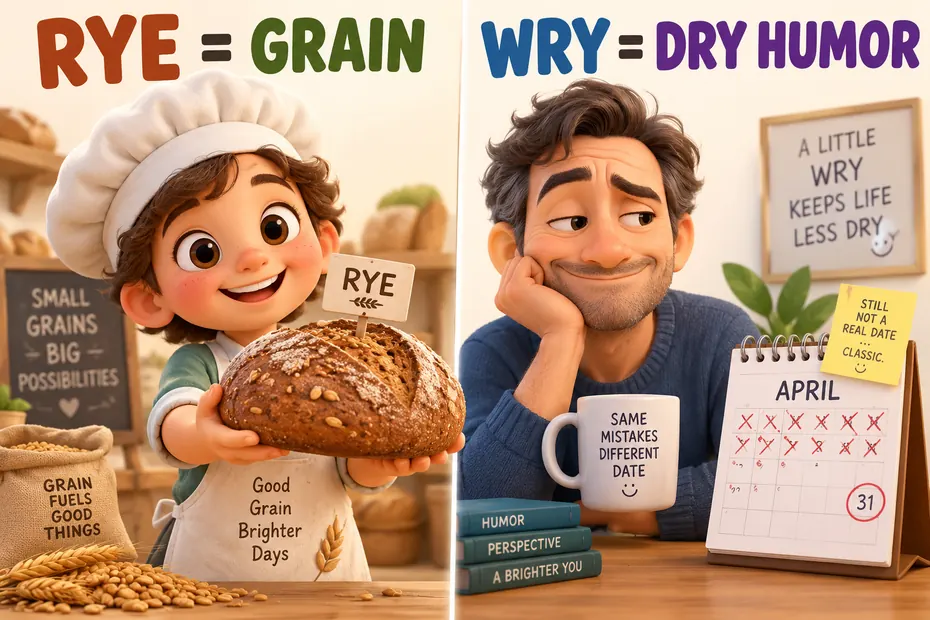
Rye vs wry: Rye names a cereal grain and can refer to products made from it, such as rye bread or rye whiskey. Wry describes dry, ironic amusement, often expressed in a smile or comment. Both sound like “rye,” /raɪ/, but their meanings and grammatical jobs differ.
Rye vs wry: choose the meaning first
Choose rye when the sentence concerns grain, flour, bread, or the drink. Choose wry when the sentence concerns an expression or a style of humor. The silent w is part of the adjective’s spelling; it does not change the pronunciation.
| Situation | Correct phrase | Why it fits |
|---|---|---|
| Ordering bread | a sandwich on rye | The word identifies the bread. |
| Discussing grain | a field of rye | The word names the crop. |
| Describing an expression | a wry smile | The word describes amused irony. |
| Describing a remark | a wry observation | The word describes the remark’s tone. |
| Combining the pair | a wry remark about rye bread | The first describes tone; the second identifies an ingredient. |
Cambridge’s rye entry records the grain and drink senses. Its wry entry emphasizes finding a difficult situation slightly amusing. This is more useful for ordinary writing than treating every wry expression as physical distortion or obvious mockery.

Write rye clearly in food and crop descriptions
In “The farmer planted rye,” rye is the thing planted. In “The baker added rye flour,” it helps identify the kind of flour. “I ordered rye bread” describes a product. If the context is already a sandwich order, “on rye” is concise; outside that context, add bread so the reader knows what you mean.
Food clarification for the older article: a product’s name alone does not establish its exact recipe, color, texture, or fiber content. Compare the particular bread’s ingredient list and nutrition information rather than assuming that every rye loaf has the same qualities. Likewise, “rye” should not be described as a variety of wheat; it is a distinct cereal grain.
The older 51% whiskey claim needs a geographic qualifier. The U.S. Alcohol and Tobacco Tax and Trade Bureau’s whisky guidance specifies a mash of at least 51% rye for the U.S. rye-whisky category. That is a labeling standard in a particular jurisdiction, not a universal definition of the English noun or every international product using the word.
Make wry humor visible in the situation
A wry expression often acknowledges that something has gone wrong without making a dramatic complaint. Consider this original scene: a traveler misses a train after arriving early at the wrong station and says, “At least I was punctual.” The mismatch between the achievement and the problem supplies the irony. Describing the remark as wry helps identify that restrained tone.
Compare three original descriptions. “She laughed loudly at the joke” describes an obvious reaction. “She gave a wry smile at the third delay” suggests amused resignation. “She made a cruel remark about the clerk” describes hostility. Do not use wry as an automatic synonym for funny, sarcastic, or insulting; choose the word that matches the scene.
For stronger writing, pair the adjective with evidence. Instead of “He was wry,” try “He gave a wry smile as the supposedly silent printer rattled again.” The concrete mismatch lets the reader understand the expression. You do not need to describe a dramatically twisted mouth whenever you use the adjective.
A two-step proofreading check
First identify what the uncertain word does. If it names a grain or food, use rye. If it describes a smile, joke, observation, or sense of humor, test wry. Then reread the complete sentence. A spelling checker may accept either spelling, so grammatical correctness alone does not settle the intended meaning.
- “The bakery sells wry bread.” Correct to rye bread when naming the food.
- “Her rye comment broke the tension.” Correct to wry comment when describing irony.
- “He made a wry joke about the rye.” Both spellings can fit when the joke concerns the grain or drink.
Frequently asked questions
Is the w in wry pronounced?
No. In ordinary contemporary English, wry and rye share the pronunciation /raɪ/. This makes them homophones: words with the same sound and different spellings or meanings. When proofreading a dictated sentence, ask what the speaker is describing rather than trying to hear a separate consonant at the beginning.
Is rye an adjective in rye bread?
The noun rye can modify another noun, as it does in rye bread or rye flour. That use identifies the ingredient or product type. Wry is the adjective for the ironic expression. A noun’s position before another noun does not make it interchangeable with a similar-sounding adjective.
Does wry always mean unkind?
No. A wry comment can be directed at the speaker’s own difficulty rather than at another person. The tone may suggest understated amusement or resignation. In dialogue, supply enough context to show the target of the joke. If a remark is deliberately hurtful, a more precise description may be cruel or mocking.
Which spelling belongs in a wry sense of humor?
Use wry sense of humor, with the silent w. The phrase describes a way of finding or expressing irony. Use rye only if you mean the cereal grain or a product associated with it. A character can have a wry sense of humor while eating rye bread.
Key Takeaways
- Rye refers to a grain used in the production of bread and whiskey, while wry is an adjective that describes something twisted or distorted in a humorous or mocking way.
- Rye bread is known for its dense texture, dark color, and distinct flavor, making it a popular choice for many.
- Rye whiskey has a spicy and robust flavor profile and must be made from a mash containing at least 51% rye grain.
- It is important to use the words “rye” and “wry” appropriately in different contexts to avoid confusion.
- Understanding the definitions and paying attention to the context will help in using these words correctly.
- Practice with examples can further enhance your understanding and usage of “rye” and “wry”.
What is Rye?
Rye refers to both a type of grain and the bread or whiskey made from it. It is a member of the wheat family and is known for its distinctive flavor and nutritional benefits.
Definition of Rye
Rye is a cereal grain that belongs to the grass family. It is closely related to wheat and barley but has a distinct taste and texture. Rye is typically grown in temperate regions and is a popular crop in countries such as Russia, Germany, and the United States.
Difference between Rye and Wry
While rye can refer to both a type of grain and the products made from it, wry is an adjective that means “twisted” or “ironic.” While these words may sound similar, they have different meanings and uses.
Rye Bread
One of the most popular applications of rye is in bread-making. Rye bread is known for its dense texture, dark color, and strong flavor. It has a higher fiber content compared to wheat bread and is often enjoyed for its distinct taste and nutritional benefits.
Rye Whiskey
Rye is also used to make a type of whiskey known as rye whiskey. This type of whiskey must be made from a mash that contains at least 51% rye grain. Rye whiskey has a spicy and robust flavor profile, which sets it apart from other types of whiskey such as bourbon.
Summarizing, rye is a versatile grain that is used to make various products, including bread and whiskey. It has a unique taste and nutritional benefits that make it a popular choice for many. While it may sound similar to the word “wry,” they have different meanings and should be used appropriately in different contexts.
What is Wry?
Wry is a word that is often confused with rye due to their similar pronunciation. But, they have distinct meanings and should be used appropriately in different contexts.
The word “wry” is an adjective that describes something that is twisted, distorted, or crooked in a humorous or mocking way. It can also refer to a facial expression characterized by a twisted or contorted mouth, often indicating amusement or sarcasm.
Here are a few examples to help illustrate the correct usage of “wry”:
- “She gave me a wry smile when she realized I pranked her.”
- “He told a wry joke that had everyone laughing.”
It’s important to note that “wry” is not related to the grain rye or its products like rye bread or rye whisky. These words have completely different meanings and contexts.
To summarize, “wry” is an adjective used to describe something that is twisted or distorted in a mocking or humorous way. It should not be confused with rye, which is a type of grain used to make bread and whiskey.
Now that we have a clear understanding of what “wry” means, let’s explore the differences between rye and wry in the next section.
Differences Between Rye and Wry
When it comes to the English language, it’s not uncommon to confuse similar-sounding words. Two such words that often cause confusion are “rye” and “wry.” While they may sound alike, they have entirely different meanings. Let’s explore the differences between these two words.
Rye:
- Definition: Rye is a noun that refers to a type of grain. It’s commonly used in the production of bread and whiskey.
- Example: “I love the taste of rye bread with its rich and slightly nutty flavor.”
- Key takeaway: Rye is a grain used in bread and whiskey production.
Wry:
- Definition: Wry is an adjective that describes something twisted or distorted, often in a humorous or mocking way.
- Example: “He gave a wry smile, knowing he had pulled off an elaborate prank on his friend.”
- Key takeaway: Wry describes something twisted or distorted in a humorous or mocking way.
Now that we understand the definitions of these words, it’s important to note that the key difference between “rye” and “wry” is their meaning. While “rye” refers to a type of grain used in food and drink production, “wry” describes something twisted or distorted in a humorous or mocking way.
So, next time you come across these words, remember their distinct meanings. Using the correct word in the right context can greatly enhance your writing and communication skills.
Continue reading to learn more about how to use these words correctly in sentences and to avoid any confusion in your writing.
Tips for Using Rye and Wry Appropriately
As a writer, it’s essential to use words accurately and appropriately to convey your message effectively. The words “rye” and “wry” may sound similar, but they have completely different meanings. Let’s explore some tips for using “rye” and “wry” appropriately to enhance your writing skills.
Understand the Definitions
To use “rye” and “wry” correctly, it’s crucial to understand their definitions:
- Rye: It refers to a type of grain commonly used in bread and whiskey production. The strong and distinct flavor of rye makes it a popular choice in various culinary applications.
- Wry: This word is an adjective that describes something twisted or distorted in a humorous or mocking way. It’s commonly used to convey irony, sarcasm, or a subtly mocking tone.
Pay Attention to Context
One of the keys to using “rye” and “wry” appropriately is to pay attention to the context in which they are used. Here are some tips to help you:
- Contextual Understanding: Familiarize yourself with common phrases or idiomatic expressions that include “rye” or “wry.” By understanding the typical contexts where these words are used, you can avoid any confusion.
- Tone and Intent: Consider the tone and intent of your writing. If you want to convey humor or sarcasm, using “wry” might be more appropriate. On the other hand, if you’re discussing baking or whiskey production, “rye” would be the correct choice.
- Synonyms and Antonyms: Expand your vocabulary by exploring synonyms and antonyms of “rye” and “wry.” This will help you capture the nuance and subtleties of these words and choose the most appropriate one for your writing.
Practice with Examples
To solidify your understanding of “rye” and “wry,” let’s explore some examples:
- “I love the distinct flavor of rye bread, especially when paired with smoked salmon.”
- “Her wry smile revealed her subtle mockery of the situation.”
- “He told a wry joke that had everyone laughing, even though its underlying sarcasm.”
- “The bartender recommended a rye whiskey with a smooth and spicy finish.”
Conclusion
Mastering the appropriate use of “rye” and “wry” can significantly enhance your writing and communication skills. By understanding their definitions and paying attention to context, you can ensure that your words convey the intended meaning and tone.
To become proficient in using these words, it is essential to familiarize yourself with common phrases and idiomatic expressions that incorporate “rye” and “wry.” This will enable you to recognize when and how to use them effectively.
Consider the tone and intent of your writing when choosing between “rye” and “wry.” The right word can add depth and nuance to your message, while the wrong word can cause confusion or misinterpretation.
Expanding your vocabulary by exploring synonyms and antonyms of “rye” and “wry” can also enhance your writing. This will give you alternative options to express your thoughts and ideas more precisely.
Remember, using the correct word in the right context is crucial for clear and effective communication. By implementing these tips, you can elevate your writing skills and ensure that your message resonates with your audience.
Frequently Asked Questions
Q: How can I use “rye” and “wry” correctly in my writing?
A: To use “rye” and “wry” appropriately, it’s crucial to understand their definitions and consider the context. Familiarize yourself with common phrases and idiomatic expressions that feature these words. Furthermore, pay attention to the tone and intent of your writing. To enhance your skills, explore synonyms and antonyms of “rye” and “wry.” Examples can also help solidify your understanding of their usage. Using the correct word in the right context will greatly improve your writing and communication abilities.


