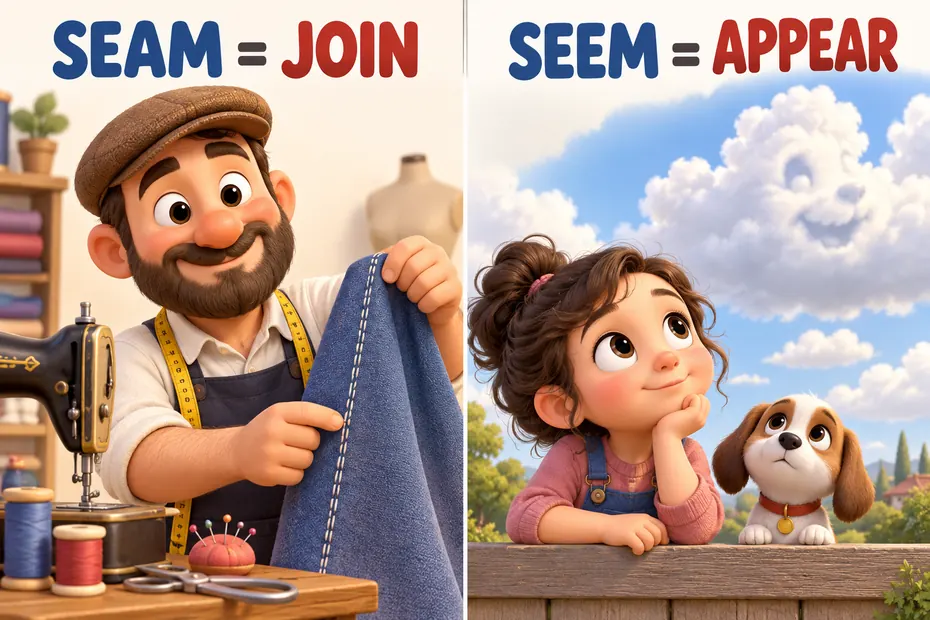
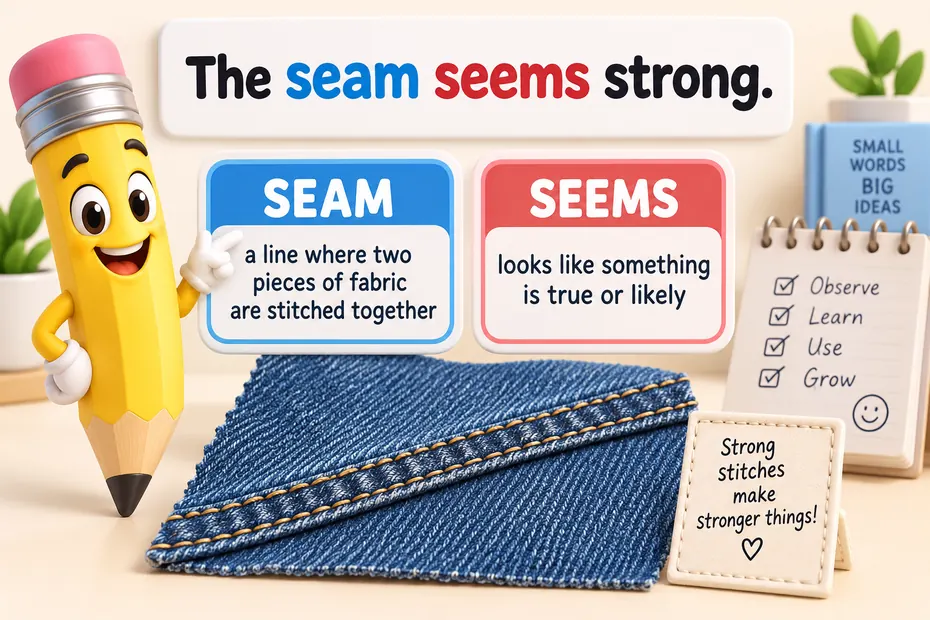
Seam vs seem: A seam is a join, usually the stitched line connecting pieces of fabric; seem means appear or give an impression. Both are pronounced /siːm/. Write “The seam seems strong”: the first word names the join, and the second describes your impression of it.

Seam vs seem: the quick spelling decision
Ask whether you are naming a physical join or describing an appearance. For a join in a jacket, bag, or ball, choose seam. For an impression about a person, object, or situation, choose seem. Sound alone cannot settle the spelling because these words are homophones.
| Meaning you need | Choose | Original example |
|---|---|---|
| A stitched join | seam | The side seam split during the game. |
| A layer of material in rock | seam | The map shows a narrow coal seam. |
| An appearance or impression | seem | The instructions seem clear. |
| A past impression | seemed | The repair seemed secure yesterday. |
| An apparent action | seem to + verb | The runners seem to understand the route. |
The dictionaries support a wider meaning for seam than sewing alone: the word can name a mineral layer and the raised join on certain sports balls. Cambridge’s seam entry records these senses. Context decides which meaning applies; the spelling remains the same.

Build a sentence with seem
Seem often links a subject to an adjective: “The explanation seems plausible.” Use seems with a singular third-person subject and seem with plural subjects: “One answer seems correct,” but “Both answers seem correct.” In the past, either subject takes seemed.
You can also use seem to followed by a verb: “The printer seems to work.” Use seem to be before a noun description: “Maya seems to be a careful editor.” Another pattern starts with it seems that: “It seems that the meeting has moved.” These are useful alternatives when an adjective alone would not express the idea.
Grammar clarification for the older guide below: the statement that seem is always followed by an adjective, noun, or clause is too restrictive. Infinitive constructions are also standard. In “Things are not as they seem,” the meaning is understood without a separate complement following the final word. The Cambridge seem entry illustrates these patterns.
With negatives, the auxiliary carries the tense: “The seams do not seem weak” and “The seam did not seem weak.” Avoid “does not seems” or “did not seemed.” With a question, write “Does the seam seem strong?” The singular subject requires does, while the main verb stays in its base form.
Use meaning to proofread, even in one sentence
Try substituting appears for seems. “The coat appears expensive” preserves the meaning of “The coat seems expensive,” so the double-e spelling is right. “The coat’s appears split” does not name a thing. In “The coat’s seam split,” the writer means the stitched join.
- Clothing: “The seam needs repair.” A specific join is damaged.
- Observation: “The repair seems neat.” The speaker describes an impression.
- Both: “These seams seem uneven.” The plural noun and plural verb have different jobs.
- Past tense: “The seam seemed secure until I pulled the fabric.” The join is the subject; the earlier impression is the verb.
For a memory aid, associate seam with the a in fabric and seem with see. A memory aid helps recall the spelling, but the sentence’s meaning remains the real test. Spell-checking software may accept either word because both are valid English spellings.
Frequently asked spelling questions
Is it coming apart at the seams or seems?
Write coming apart at the seams. The image is clothing whose joins are failing. The expression can also describe a project or organization losing its structure. “The production seems disorganized” uses the other spelling because seems describes how the production appears rather than naming its joins.
Does seem mean something is definitely true?
No. Seem signals an appearance or impression, which may later prove accurate or inaccurate. “The fabric seems waterproof” reports an impression; it does not establish that a waterproofing test was passed. If you have verified a fact, state the fact directly and explain the evidence when it matters.
Is a hem the same thing as a seam?
In a simple sewing description, distinguish the edge finish from the join. A hem finishes a fabric edge, while a seam joins pieces. Both may involve stitches, so “I can see stitching” is not enough to choose the technical term. Describe whether you mean the garment’s edge or the place where panels meet.
Can I write “there seems to be”?
Yes: “There seems to be a loose thread” is a standard construction. With a plural noun, use “There seem to be loose threads.” This pattern reports what appears to exist. If you name a stitched join instead, write “There is a seam along the side,” using the noun seam.
Have you ever found yourself confused between the words “seam” and “seem”? Don’t worry, you’re not alone. In this text, I’ll be shedding light on the proper usage of these two words and how to avoid common mistakes.
Seam, spelled S-E-A-M, refers to the line where two pieces of fabric are sewn together. On the other hand, seem, spelled S-E-E-M, is a verb that indicates an appearance or impression. While they may sound similar, the meanings and contexts of these words are quite distinct.
Understanding the difference between seam and seem is crucial for effective communication, both in written and spoken English. So, let’s immerse and explore the correct usage of these words, along with some helpful tips to ensure you never mix them up again.
Key Takeaways
- “Seam” refers to the line where two pieces of fabric are sewn together, while “seem” is a verb that indicates an appearance or impression.
- Understanding the difference between “seam” and “seem” is crucial for effective communication in written and spoken English.
- A seam is important in sewing and fashion design for creating structure and preventing fraying, while “seem” is used to express subjective perception or impression.
- “Seem” is always followed by an adjective, noun, or clause and cannot be used as a complete sentence.
- Using “seem” correctly allows us to convey opinions or observations about how something appears or appears to be.
- Using “seam” correctly refers to the physical joining of fabric pieces and ensures clear and accurate communication in sewing and tailoring.
What is a seam?
A seam is an important term in the world of sewing and fashion. It refers to the line where two pieces of fabric are joined together using stitches or other methods of fastening. Seams are essential for creating the structure and shape of garments, ensuring that they fit well and hold together.
The main purpose of a seam is to unite separate fabric pieces into a cohesive whole. It helps to prevent the fabric from fraying and unravelling, while also providing strength and durability. Seams can be found in various types of clothing, ranging from shirts and pants to dresses and jackets.
When constructing a seam, it is crucial to use the appropriate stitching technique and thread. This ensures that the seam is secure, sturdy, and visually appealing. Different types of seams, such as plain seams, French seams, or flat-felled seams, are used depending on the desired look and level of durability.
Understanding the concept of a seam is particularly important for individuals involved in sewing, tailoring, or fashion design. It allows them to create garments with precision, ensuring that each seam is well-executed and contributes to the overall quality of the finished product.
To conclude, a seam is a line where two pieces of fabric are joined together in sewing. It plays a vital role in maintaining the integrity of garments and ensuring they fit well. By understanding the definition and purpose of a seam, individuals can enhance their sewing skills and produce high-quality clothing.
What is seem?
Seem is a verb that is commonly confused with another similar word, “seam.” While the two words may sound alike, they have completely different meanings and uses in the English language. Understanding the difference between these two words is essential for effective communication and writing.
The word “seem” refers to the perception or appearance of something. It is used to express an opinion or observation about how something appears or appears to be. When we use “seem,” we are talking about our subjective perception or impression of something.
For example:
- It seems like it’s going to rain today.
- He seems tired after a long day at work.
- The movie seems interesting based on the trailer.
In these examples, we are expressing our perception or impression of something based on the information or evidence available to us. “Seem” allows us to convey our thoughts about the appearance or perception of a situation, person, or thing.
It is important to note that “seem” is always followed by an adjective, a noun, or a clause. It cannot be used on its own as a complete sentence.
To summarize, the word “seem” refers to the perception or appearance of something. It allows us to express our opinion or observation about how something appears or appears to be. Remember to always follow “seem” with an adjective, a noun, or a clause to properly convey your message. Understanding the difference between “seam” and “seem” will help ensure clear and accurate communication.
Differences between seam and seem
As a writer or communicator, it is important to differentiate between words that may sound similar but have distinct meanings. One such pair is “seam” and “seem.” Understanding the difference between these words will improve your writing and ensure effective communication. Let’s explore the definitions and usage of each term.
Seam: What is it?
A seam refers to the line where two pieces of fabric are joined together using stitches or other fastening methods. It plays a crucial role in creating the structure and shape of garments, preventing fraying and unraveling, and providing strength and durability. Seams are fundamental in sewing, tailoring, and fashion design, laying the foundation for creating well-constructed and aesthetically pleasing clothing.
Seem: Definition and Usage
On the other hand, seem is a verb that describes the perception or appearance of something. It is used to express an opinion or observation about how something appears or appears to be. “Seem” is always followed by an adjective, a noun, or a clause, and it cannot stand alone as a complete sentence.
For example:
- “The dress seems comfortable.”
- “It seems like it will rain today.”
- “She seems tired after the long day.”
Understanding the correct usage of “seem” is essential for effectively conveying your thoughts and opinions. Using it appropriately will ensure clarity and precision in your writing.
Key Differences
Now that we have defined both terms, let’s summarize the key differences between seam and seem:
| Seam | Seem |
|---|---|
| Refers to the line where fabrics are joined together | Describes the perception or appearance of something |
| Used in sewing, tailoring, and fashion design | Used to express an opinion or observation |
| Provides structure, strength, and durability to garments | Requires an adjective, noun, or clause to follow |
Remember, using these words correctly will not only prevent confusion but also enhance your communication skills. So, the next time you are writing or speaking, make sure to choose the right word between “seam” and “seem.”
Examples of seam in sentences
To further illustrate the concept and usage of “seam,” let’s take a look at some examples of how this word is used in sentences. These examples will help you understand the practical application of “seam” in everyday language.
- “I carefully stitched the seam of the dress to ensure a clean finish.”
- “The tailor added reinforcing stitches to strengthen the seam on the trousers.”
- “The seam on this jacket is sewn with precision and attention to detail.”
- “The seamstress used an invisible seam technique to create a seamless look.”
- “Make sure to press the seam open to reduce bulk and improve the garment’s appearance.”
By examining these sentences, you can see how “seam” is used to refer to the line or stitching that joins two pieces of fabric together. It signifies a physical connection and plays a crucial role in the construction and design of garments. Understanding the terminology and techniques related to seams is essential for anyone involved in sewing, tailoring, or fashion design.
It’s important to note that the examples given above highlight the specific usage of “seam” as a noun. It is used to describe the physical component rather than expressing any opinions or perceptions. This distinguishes it from the verb “seem,” which is used to convey a sense of appearance or perception.
In the next section, we will explore examples of how “seem” is used in sentences and discuss its distinct meaning and usage. Understanding the difference between “seam” and “seem” will allow you to enhance your communication skills and express your observations and opinions accurately. But first, let’s investigate into the concept of “seem” and its usage in the English language.
Examples of seem in sentences
To further clarify the usage of “seem,” I will provide you with some examples of how this word is used in sentences. Understanding these examples will help you grasp its meaning and allow you to use it appropriately in your own writing.
Here are some examples:
- The movie seems interesting; I would like to watch it.
- She seems tired today; maybe she didn’t get enough sleep.
- The new restaurant seems popular; there’s always a line outside.
- It seems that she has a lot of experience in this field.
- He seems to have a good understanding of the topic.
- The weather seems to be getting warmer; spring is coming.
- This decision seems logical, considering the facts presented.
- He seems happy with the result of the exam.
- The house seems spacious and well-designed.
As you can see from these examples, “seem” is used to express opinions or observations about something’s perception or appearance. It helps us convey our thoughts and impressions about a particular situation, person, or thing. By using “seem” followed by an adjective, a noun, or a clause, we provide insight into our perspective or feelings about the subject at hand.
It is important to note that “seem” cannot stand on its own as a complete sentence. It requires additional information to express the opinion or observation.
By incorporating these examples into your writing, you will develop a proficiency in using “seem” confidently and accurately. Remember to pay attention to the context and ensure that the adjective, noun, or clause you use after “seem” appropriately reflects your intended meaning.
Tips for using seam and seem correctly
When it comes to using the words “seam” and “seem” correctly, it’s important to understand their distinct meanings and how they should be used in different contexts. Here are some helpful tips to enhance your understanding and usage of these commonly confused words:
- Know the Definitions: To use “seam” and “seem” appropriately, it’s essential to grasp their individual meanings.
- “Seam” is a noun that refers to the line where two pieces of fabric are joined together using stitches or other methods of fastening. This word is used to describe the physical component of joining fabrics.
- On the other hand, “seem” is a verb that indicates the perception or appearance of something. It’s used to express an opinion or observation about how something appears or appears to be.
- Understand the Difference: The key distinction between “seam” and “seem” lies in their use.
- “Seem” is always followed by an adjective, a noun, or a clause. It cannot stand on its own as a complete sentence.
- In contrast, “seam” is a standalone word and refers to the physical joining of fabrics.
Understanding this difference is crucial for effective communication and writing.
- Use “Seem” to Express Opinions and Observations: “Seem” is widely used to convey opinions or observations about the perception or appearance of something. Here are a few examples:
- The weather seems unpredictable this weekend.
- He seems tired after a long day at work.
- That movie seems interesting based on the trailer.
- Use “Seam” to Refer to Fabric Joining: When you want to talk about the physical component of joining fabrics, use “seam” appropriately. Here are a few examples:
- She sewed a neat and sturdy seam on the dress.
- The tailor reinforced the seam to ensure durability.
- The shirt has a visible seam running down the center-back.
Remember, using “seem” correctly in your writing can enhance your ability to express your opinions and observations accurately. Utilizing “seam” appropriately will allow you to discuss the physical aspects of fabric joining with confidence.
Conclusion
Understanding the difference between “seam” and “seem” is crucial for effective communication and writing. In the world of sewing and fashion, a seam is the line where two pieces of fabric are joined together, while “seem” is a verb that expresses opinions or observations about the perception or appearance of something.
By grasping the terminology and techniques related to seams, individuals involved in sewing, tailoring, or fashion design can create garments that are structurally sound, prevent fraying, and provide strength and durability.
On the other hand, using “seem” correctly allows us to convey our thoughts and opinions about how something appears or appears to be. It is important to remember, “seem” is always followed by an adjective, a noun, or a clause and cannot stand alone as a complete sentence.
By incorporating the examples provided in this text into your writing, you can develop proficiency in using “seem” confidently and accurately. So, whether you’re joining fabrics together or expressing your perception of something, understanding the appropriate usage of “seam” and “seem” will enhance your communication skills.
Frequently Asked Questions
Q: What is a seam?
A: A seam is the line where two pieces of fabric are joined together using stitches or other methods of fastening. It creates the structure and shape of garments, prevents fraying and unraveling, and provides strength and durability.
Q: What is the difference between “seam” and “seem”?
A: “Seam” refers to the physical joining of fabrics, while “seem” is a verb used to express perceptions or appearances. “Seem” is always followed by an adjective, noun, or clause, and cannot be used on its own as a complete sentence.
Q: How can I use “seem” correctly?
A: To use “seem” correctly, express opinions or observations about the appearance or perception of something. For example, “The dress seems too small for her.”
Q: How can I use “seam” correctly?
A: To use “seam” correctly, refer to the physical component of joining two pieces of fabric together. For example, “The seam on the dress is perfectly straight.”
Q: Why is understanding the difference between “seam” and “seem” important?
A: Understanding the difference between “seam” and “seem” is important for effective communication and writing. Using the terms correctly ensures clear and accurate expression, especially in the fields of sewing, tailoring, and fashion design.


