
Liar, lier and lyre: the quick answer
A liar is a person who tells lies. A lier is one who lies in a position, as in lying down or lying in ambush. A lyre is a stringed musical instrument. All three have the pronunciation often written “ly-er,” so their sounds cannot tell you which spelling belongs in a sentence.
For most everyday references to dishonesty, choose liar. For music, choose lyre. Lier is a real but uncommon word; many modern sentences are clearer if you say “someone lying down” or “someone lying in wait.” A rare word is not necessarily wrong, but its meaning must fit.

Key facts
- Liar names someone who tells lies.
- Lier belongs to the positional sense of lie, not the false-statement sense.
- Lyre names an instrument, and can also name a music-holding clip.
- The plural forms are liars, liers, and lyres.
- Each word is a noun; the related verbs do not all follow the same spelling pattern.
Use liar for someone who tells lies
If your sentence describes a person giving false statements, liar is the spelling you want. “The fictional character was a practiced liar” describes dishonesty. “He admitted that he had been a liar” uses the same noun after a form of be. The meaning is documented in Merriam-Webster’s liar entry.
Do not assume that adding -er to lie will automatically produce the dishonesty noun. English spelling does not always follow a simple mechanical pattern. The established noun is liar, with an a. “She called him a lier” normally changes the intended meaning if she means he told falsehoods.
When writing about a real disagreement, it is often clearer to identify the disputed statement: “That account conflicts with the record” communicates a concrete issue. In a vocabulary exercise or fictional dialogue, liar remains the correct word for a person who tells lies. Choosing the right spelling and choosing the most useful wording are related but separate editing decisions.

Use lier for the positional sense
English has a verb lie meaning recline or occupy a position, alongside the verb lie meaning say something false. Lier belongs to the first family. The dictionary illustrates the meaning with someone lying in ambush. It does not define lier as an alternative spelling of the dishonesty noun. Merriam-Webster: lier.
Because lier is uncommon, “the lier on the couch” may make a reader stop and wonder whether you misspelled liar. In ordinary prose, “the person lying on the couch” will usually communicate the position more clearly. Use lier when you deliberately need that noun, perhaps in a discussion of vocabulary or an older expression.
Consider the original contrast “The person lying in wait was not necessarily a liar.” The first description concerns position and waiting; the second would concern false statements. The shared verb spelling lie is why this pair can feel confusing. Decide which meaning you intend before selecting the noun.
Use lyre for music
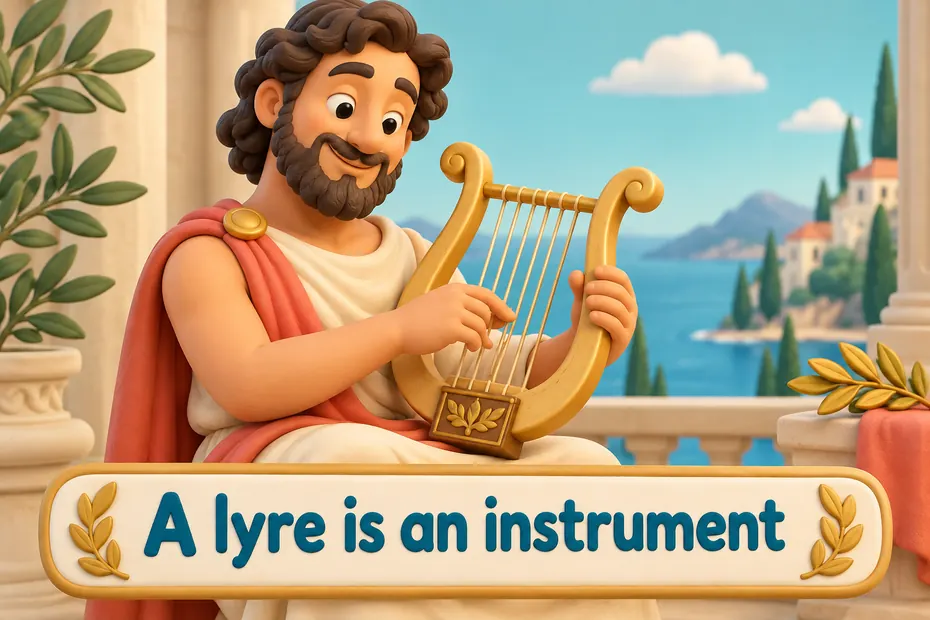
A lyre is a stringed instrument with an approximately U-shaped frame. The term is associated with ancient Greek song and recitation, although a present-day sentence can describe a replica or modern instrument. “The musician plucked the lyre” names the object being played. It does not describe the musician’s honesty or posture.
Lyre can also refer to a small clip that holds sheet music and attaches to an instrument. If a marching musician mentions attaching a lyre, the context may concern this holder rather than a separate stringed instrument. This second meaning is recorded in Merriam-Webster’s lyre entry.
In your own writing, include a clarifying noun when needed: “a lyre-shaped music holder” or “a replica lyre.” You do not need to explain the term every time, but a little context prevents a reader from imagining the wrong object.
Comparison table
| Meaning | Word | Original example |
|---|---|---|
| Person who tells falsehoods | liar | The story’s villain is a liar. |
| One lying in a position | lier | The glossary explained lier in wait. |
| Stringed instrument | lyre | A lyre stood beside the music books. |
| Music-holding clip | lyre | She attached the lyre before marching. |
Spelling and grammar checks
Use the meaning labels “falsehood,” “position,” and “music.” If falsehood fits, choose liar. If position fits and the noun is truly needed, choose lier. If music fits, check the lyre sense. A sentence can mention several of these ideas at once, so identify what the particular word names.
For plurals, simply add s: two liars, two liers, two lyres. For possession, add the apostrophe as needed: the liar’s account, the lyre’s strings, the lyres’ cases. The plural ending does not change the base spelling.
A useful memory cue is “a liar tells a lie; a lyre makes music.” For lier, keep the visible lie and think of lying in a position. These are study cues rather than explanations of historical word formation.
Practice with answers
Choose the noun: (1) The musician tuned the ___. (2) The dishonest character was a ___. (3) An old glossary used ___ for one lying in wait. (4) The museum displayed three ___.
Answers: (1) lyre; (2) liar; (3) lier; (4) lyres. In the final sentence, the plural still names musical instruments.
Frequently asked questions
Is lier a real word?
Yes, but it is uncommon. It concerns someone lying in a position, not someone telling falsehoods.
Is liar spelled with an e?
No. The dishonesty noun ends in -ar.
Can a lyre mean something besides the stringed instrument?
Yes. It can name a clip that holds sheet music on another instrument.
Will spellcheck catch the wrong choice?
It may not. All three are valid words. Proofread for meaning as well as spelling.
Ever wondered about the difference between “liar,” “lier,” and “lyre?” As a language enthusiast, I’ve often come across these three words that sound so similar but have distinct meanings. In this text, I’ll be diving deep into the correct usage of these words, helping you avoid embarrassing mistakes and enhance your communication skills. So, whether you’re a writer, a student, or simply someone who wants to sharpen their language prowess, this article is for you. Let’s unravel the mystery behind “liar,” “lier,” and “lyre” and learn how to use them appropriately.
Key Takeaways
- A liar is someone who intentionally tells falsehoods or deceives others, while “lier” is not a recognized word in the English language.
- Understanding the characteristics of a liar can help identify dishonesty and maintain trust in relationships.
- “Lyre” refers to a musical instrument with a rich history, while “liar” and “lier” are terms relating to deception.
- Using the correct term, whether it be “liar” or “lyre,” is crucial for effective communication.
- Remember to use the word “liar” when referring to someone who is intentionally dishonest or deceitful.
- Be aware that “lier” is not a legitimate word in English and should be disregarded.
What is a Liar?
Lies are a destructive force in language and communication. Understanding the concept of a liar is essential for effective communication and maintaining trust in relationships. Let’s jump into the definition of a liar and explore its nuances.
A liar, in simple terms, is someone who intentionally tells falsehoods or deceives others. They distort the truth for personal gain, to cover up mistakes, or to manipulate others. It’s important to note that lying is considered unethical and can have serious consequences in personal and professional contexts.
Here are a few key characteristics that define a liar:
- Intentional deception: A liar deliberately misrepresents the truth, often with the intent to mislead or manipulate others.
- False statements: Liars consistently make false statements, presenting them as facts or personal experiences.
- Inconsistent narratives: Liars may struggle to maintain consistency in their stories, as their lies become more complex and difficult to remember.
- Avoidance or deflection: When confronted with the truth or questioned about their lies, liars may resort to avoiding the topic or deflecting attention elsewhere.
- Lack of remorse: Liars often exhibit little to no remorse for their deceptive behavior, continuing to lie even when faced with the consequences.
Understanding the characteristics of a liar can help us identify when someone is being dishonest. As writers and communicators, being aware of these traits allows us to build trust and convey accurate information to our audience.
Now that we have explored the definition of a liar, let’s examine the differences between “liar,” “lier,” and “lyre.” But before we do that, let’s clarify the meaning of each word.
What is a Lier?
When it comes to the confusion between “liar” and “lier,” it’s important to understand the correct definitions of each term. In this section, I’ll clarify what a “lier” actually means and how it differs from a “liar.”
A “lier” is not a commonly used or recognized term in English. In fact, it is not listed as a legitimate word in reputable dictionaries. This may come as a surprise to some, considering that “liar” and “lier” look quite similar. But, it’s important to note that the correct term to use is “liar” when referring to someone who tells falsehoods or deceives others.
To further emphasize the difference, it’s worth mentioning that “liar” is often used as a noun, while “lier” simply does not have a widely accepted usage or definition. So, if you come across the term “lier,” it’s best to disregard it and use “liar” instead.
Summarizing, while “liar” is a well-established term to describe someone who intentionally tells falsehoods or deceives others, “lier” is not a recognized word in the English language. It is important to use the correct word to communicate effectively and avoid confusion.
Differences between “Liar,” “Lier,” and “Lyre”
In the previous section, we established that “lier” is not a legitimate word in English. Now, let’s briefly touch on “lyre” to differentiate it from “liar.”
A “lyre” is a musical instrument that belongs to the string family. It has a U-shaped crossbar with strings attached to it, and the musician plays it by plucking the strings. So, it’s quite clear that “lyre” is unrelated to the concept of lying or deceit.
To summarize, while “liar” refers to someone who tells falsehoods, “lier” is not a recognized word in the English language, and “lyre” is a musical instrument.
What is a Lyre?
A lyre is a musical instrument that has been used for thousands of years. It has a rich history and is often associated with ancient Greece and Rome. The lyre consists of a hollow body, usually made of wood, and strings that are stretched across the body.
The instrument is played by plucking or strumming the strings with the fingers or with a pick. The pitch of the notes produced can be adjusted by tightening or loosening the strings. The sound of the lyre is typically soft and melodic, making it a popular choice in ancient times for accompanying songs and poetry.
The lyre has a distinct and recognizable shape, with a curved body and a yoke or crossbar at the top. The number of strings can vary, but the most common arrangement is seven strings. But, some lyres can have as few as four strings, while others can have as many as twenty.
It’s important to note that the term “lyre” is not to be confused with the words “liar” or “lier.” The difference between these terms is significant.
- The word “lyre” refers specifically to the musical instrument described above.
- The word “liar” refers to a person who tells falsehoods or deceives others.
- The word “lier” is not a recognized word in the English language and should be disregarded.
So, when discussing musical instruments, we use the term “lyre.” When talking about someone who tells lies, we use the term “liar.” It’s crucial to understand and use the correct term to avoid confusion and miscommunication.
To conclude, a lyre is a beautiful and ancient musical instrument that has a rich history. By understanding the difference between “lyre,” “liar,” and “lier,” we can accurately and confidently use these words in the appropriate context. Remember, when it comes to music, it’s a lyre, but when it comes to deceptive individuals, it’s a liar.
Difference Between “Liar,” “Lier,” and “Lyre”
The difference between “liar,” “lier,” and “lyre” lies not only in their spelling but also in their meaning and usage. Let’s explore each term and clarify their distinctions.
“Liar”
When we talk about a “liar,” we are referring to a person who habitually tells falsehoods or deceives others. It’s important to note that “liar” is the correct term to use in this context, while “lier” is not recognized as a word in the English language. So if someone tells you that they’re a “lier,” you can kindly inform them of the correct term, “liar.”
“Lier”
As mentioned earlier, “lier” is not a recognized word in English. If you come across this term, it should be disregarded. There may be instances where people mistakenly use this word instead of “liar,” but it’s important to use the correct term to avoid confusion and miscommunication.
“Lyre”
Let’s shift our focus to something completely unrelated – the “lyre.” A “lyre” is a musical instrument with a rich history, often associated with ancient Greece and Rome. It has a distinct construction, typically consisting of a U-shaped body with strings attached to a crossbar or yoke.
The lyre is played by plucking the strings and is known for its soft and melodic sound. While “lyre” may sound similar to “liar” or “lier,” it is important to note that they have completely different meanings. So, if you hear someone mention a “lyre,” they are most likely referring to a musical instrument rather than someone who tells falsehoods.
Summarizing, the key takeaway here is to remember the distinction between “liar,” “lier,” and “lyre.” “Liar” refers to someone who deceives, while “lier” is not a recognized word in English and should be disregarded. Finally, a “lyre” is a musical instrument associated with ancient Greece and Rome. By using the correct term in the appropriate context, we can avoid confusion and ensure clear communication.
Remember, words have power, and using them accurately is essential for effective communication.
Tips for Using “Liar,” “Lier,” and “Lyre” Correctly
Understanding the correct usage of words is essential to effective communication. In this section, I’ll provide you with some useful tips for using the words “liar,” “lier,” and “lyre” correctly, to avoid confusion and ensure clarity in your writing and speech.
1. Understand the Difference:
- The word “liar” refers to a person who tells falsehoods or deceives others.
- On the other hand, “lier” is not a recognized word in the English language and should be disregarded as an error or typo.
- “Lyre,” on the other hand, is a musical instrument with a rich history, often associated with ancient Greece and Rome.
2. Know the Definitions:
- The dictionary definition of “liar” is someone who willfully says or writes something false with the intent to deceive.
- “Lyre” is defined as a small harp-like instrument with strings that are plucked with the fingers or a plectrum.
3. Use “Liar” Appropriately:
- When you want to describe someone who is intentionally dishonest, deceitful, or untruthful, use the word “liar.”
- For example, “I caught him in a web of lies, he’s a known liar.”
4. Avoid Using “Lier”:
- As mentioned earlier, “lier” is not a recognized word and should be avoided altogether in your writing and speech.
- If you come across this term, be sure to correct it to “liar” if it’s referring to someone who tells falsehoods.
5. Context Matters:
- Finally, it’s important to use the word “lyre” when referring to the musical instrument and not confuse it with “liar” or “lier.”
- For instance, “The musician skillfully played the lyre, filling the room with its soft and melodic sound.”
By keeping these tips in mind, you can confidently incorporate the words “liar,” “lier,” and “lyre” into your writing and speech, using them correctly and avoiding any misunderstandings or miscommunication.
Conclusion
Using the words “liar,” “lier,” and “lyre” correctly is crucial for effective communication. By understanding the distinctions between these terms, we can ensure clarity and avoid confusion in our writing and speech.
Firstly, it’s important to remember, “liar” refers to a person who tells falsehoods. This term is widely recognized and commonly used in everyday language. On the other hand, “lier” is not a recognized word and should be disregarded. Using “liar” instead will prevent any misunderstandings.
Also, “lyre” is a musical instrument associated with ancient Greece and Rome. It’s essential to use this term when referring to this specific instrument, as it adds precision and accuracy to our communication.
By incorporating these tips into our writing and speech, we can confidently navigate the proper usage of “liar,” “lier,” and “lyre.” This will ensure that our messages are clear and easily understood, preventing any potential misinterpretations.
Remember, using the correct term in the appropriate context is key. Let’s continue to communicate effectively by using these words appropriately.
Frequently Asked Questions
Q: What does “liar” mean?
A: “Liar” refers to a person who tells falsehoods or intentionally deceives others. It is crucial to use this word accurately to describe someone who is not telling the truth.
Q: Is “lier” a correct word?
A: No, “lier” is not a recognized word in the English language. It should be disregarded and not used in writing or speech.
Q: What is a “lyre”?
A: A “lyre” is a musical instrument that originated in ancient Greece and Rome. It consists of a U-shaped frame with strings attached across it and is played by plucking the strings.
Q: Why is it important to use the correct term?
A: Using the correct term ensures clarity and avoids confusion in communication. Properly using “liar” when referring to a person who tells falsehoods and knowing that “lyre” is a musical instrument prevents misunderstandings and misinterpretations.
Q: Can you provide examples of using each word correctly?
A: Certainly! Here are examples:
- “He is a compulsive liar.”
- “Let’s not waste our time discussing the non-existent word ‘lier.'”
- “The musician skillfully played the lyre during the concert.”
Q: How can I incorporate these words into my writing and speech?
A: By understanding the definitions and examples provided, you can confidently use “liar” to refer to someone who is not telling the truth, avoid using the non-existent word “lier,” and correctly describe the musical instrument “lyre” when relevant in your writing and conversations.


