
Indict means formally accuse someone of a crime, or accuse someone or something of a failing in a broader sense. Indite means write or compose. Both sound like “in-DYTE” in standard English. Use indict for an accusation and indite for composing words; indictment does not itself mean conviction.
Key facts about indict vs indite
- Indict and indite are separate verbs with different meanings.
- The c in indict is silent in the standard pronunciation.
- Indite refers to writing or composing, not criminal accusation.
- Indicted and indited keep their separate spelling families.
- A formal charge and a judgment of guilt are different events.

When should you write indict?
Write indict when the intended meaning is a formal criminal accusation. In the invented sentence “The grand jury voted to indict the suspect,” indict describes the charge-related action. It does not state that a trial has established guilt. Keep that distinction when summarizing a case, because changing the verb can change what readers believe happened.
Merriam-Webster’s indict entry records the formal-accusation sense and a broader sense of accusing something of a weakness or wrong. In “The essay indicts the policy’s failures,” the verb can be figurative. The sentence criticizes a policy; it does not literally describe a policy appearing as a criminal defendant.
The word’s forms include indicts, indicted, and indicting. “The report says the person was indicted” reports a formal accusation. Do not replace that statement with “was convicted” unless the separate conviction is established. A vocabulary distinction is especially useful in headlines, where a short verb carries much of the factual claim.

What does indite mean?
Indite means compose or put into writing. In the original example “She paused to indite a short verse,” the action is writing the verse. “He indited a message before leaving” describes a written message. Neither sentence concerns charges or a court proceeding, even though the verb sounds like indict.
Merriam-Webster’s indite entry confirms the writing and composing senses. The verb is a useful word to recognize in literary or deliberately formal prose. In ordinary instructions, “write” or “compose” is usually easier to understand. Choosing a simpler synonym can prevent readers from misreading an unfamiliar spelling as a legal accusation.
Compare “The poet indited a complaint” with “The critic indicted the system.” The first sentence says the poet wrote something. The second uses an accusation or criticism sense. A complaint can be either a piece of writing or an accusation, so identify the action you intend rather than selecting the spelling from the noun complaint alone.
Indict vs indite: comparison table
| Form | Meaning | Original example | Replacement check |
|---|---|---|---|
| indict | Formally accuse | A grand jury may indict a suspect. | Bring a formal charge |
| indict figuratively | Accuse of a failing | The essay indicts the flawed system. | Criticize or accuse |
| indite | Write or compose | She chose to indite a poem. | Compose |
| indited | Wrote or composed | He indited a farewell note. | Wrote |
How is an indictment different from a conviction?
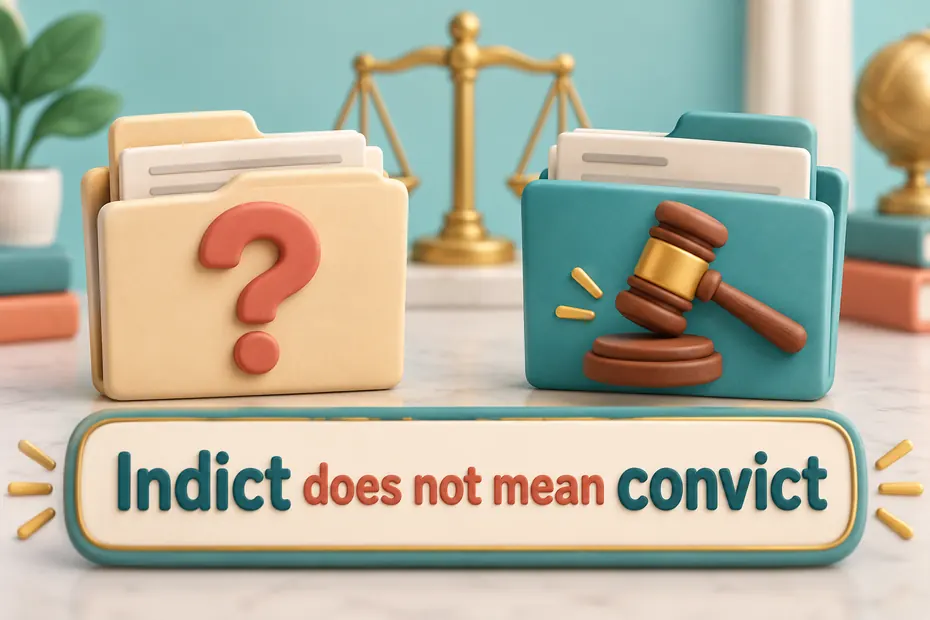
An indictment is a formal charge; a conviction is a judgment of guilt. The U.S. Courts glossary describes an indictment as a grand-jury charge that supports bringing a defendant to trial, and a conviction as a judgment of guilt. This distinction prevents “indict” from being treated as a synonym for “prove guilty.”
In a vocabulary exercise, “The person was indicted” leaves the eventual case outcome unstated. “The person was convicted” states a different outcome. These sample sentences are not reports about a real individual. When editing actual reporting, keep the verified procedural event and jurisdiction clear instead of assuming every accusation follows the same process.
Why does pronunciation not settle the spelling?
Both words are pronounced with the stressed syllable sounding like dyte. Indict includes a silent c, while indite has no c and ends in e. A spoken sentence about “inditing a poem” can therefore resemble one using indict. Meaning and the associated word family supply the distinction that sound cannot.
Try writing a plain-language version first. “She composed a poem” points toward indite if that literary verb is wanted. “The jury formally charged the suspect” points toward indict. Then return to the chosen word and check the ending: indited for writing, indicted for charging. Do not add or delete letters solely to match pronunciation.
A short proofreading exercise
Complete “The poet will ___ a verse,” “The grand jury may ___ the suspect,” and “The report ___ the policy for its failures.” The expected answers are indite, indict, and indicts. The first concerns composing, the second a formal accusation, and the third criticism. The different sentence meanings explain the spellings.
Frequently asked questions
Is indite just a misspelling of indict?
No. Indite is a valid verb meaning write or compose. It is the wrong choice only when the intended meaning is accusation. Conversely, indict is wrong when you simply mean writing a poem or message. In everyday prose, using write or compose can make the intended meaning easier for readers to recognize.
Do you pronounce the c in indict?
No, the c is silent in the standard pronunciation. Indict sounds like “in-DYTE,” which matches indite. The spelling remains indict for the accusation meaning even though the sound does not reveal the c. Use the meaning and forms such as indicted and indictment to keep the word family straight.
Does indicted mean guilty?
No. Indicted reports a formal charge, not a judgment of guilt. Convicted describes a different procedural result. In an actual news report, use the word supported by the case record and explain the context if needed. A charge-related statement should not be rewritten to imply that guilt has already been established.
Can indict be used outside criminal reporting?
Yes. Indict can figuratively accuse a person, practice, or system of a failing. “The review indicts the design’s shortcomings” expresses criticism rather than a literal criminal charge. Make that figurative context clear. If the intended action is composing the review itself, write, compose, or the literary verb indite is the relevant choice.
Earlier examples and explanation
Have you ever found yourself confused about the difference between “indict” and “indite”? Well, I’ll shed some light on this common language dilemma. In this text, I’ll explain the proper usage of these two words and help you avoid any embarrassing mistakes.
Indict and indite are often used interchangeably, but they actually have distinct meanings and applications. Understanding when to use each word can greatly enhance your writing and communication skills. So, let’s immerse and explore the nuances of these two terms.
From legal contexts to everyday conversations, mastering the appropriate usage of “indict” and “indite” will not only impress others but also ensure clarity in your communication. So, let’s unravel the mystery and become more confident in our language skills.
Key Takeaways
- “Indict” and “indite” are often confused but have distinct meanings and applications.
- “Indict” refers to the formal accusation of a crime, while “indite” is the act of composing or writing.
- Proper usage of “indict” is in legal contexts for formal accusations, while “indite” is used in literature, poetry, and creative writing.
- “Indict” carries legal implications and is associated with criminal charges, while “indite” emphasizes artistic skill and craftsmanship.
- Understanding the differences between “indict” and “indite” is crucial for accurate and clear communication.
- Using “indict” correctly ensures clarity in legal contexts, while using “indite” adds artistry and craftsmanship to creative writing.
What does “indict” mean?
As a writer, it is essential to have a thorough understanding of words and their proper usage. One pair of words that often causes confusion is “indict” and “indite.” In this section, I will focus on explaining the meaning of “indict” to help you use it appropriately in your writing.
Definition of “Indict”
“Indict” is a verb that refers to the official act of formally accusing someone of a crime. When a person is indicted, it means that a grand jury has found enough evidence to charge them with a criminal offense. This is a significant step in the legal process, as it initiates a criminal trial.
Difference Between “Indict” and “Indite”
It’s important not to confuse “indict” with “indite,” as they have distinct meanings. While “indict” relates to a formal accusation of a crime, “indite” is used to describe the act of composing, writing, or putting words on paper. The two words may sound similar, but their usage and contexts are quite different.
Let me provide you with an example to clarify the difference. If someone is suspected of committing a serious offense, a prosecutor may seek to indict them, formally charging them with the crime. On the other hand, inditing refers to the process of writing a poem, a novel, or a piece of literature.
Using “Indict” Appropriately
Now that we are clear about the meaning of “indict,” it is crucial to use it accurately in your writing. Here are a few tips to help you incorporate this word effectively:
- Use “indict” when discussing formal legal proceedings or accusations of criminal activity.
- Avoid using “indict” in everyday conversation or casual writing.
Remember, the correct usage of “indict” will enhance your writing and communication skills. It demonstrates your understanding of legal terminology and ensures clarity when discussing criminal matters.
By understanding the difference between “indict” and “indite,” you can avoid common errors and confidently use these words in the appropriate contexts. Now that we have delved into the meaning of “indict,” let’s move on to exploring the definition of “indite” in the next section.
What does “indite” mean?
Indite is a word that is often confused with “indict” due to their similar pronunciation. But, they have distinct meanings and should be used appropriately to avoid confusion in writing.
The definition of “indite” is quite different from “indict.” While “indict” refers to the official act of formally accusing someone of a crime, “indite” relates to the act of composing or writing, particularly in a skillful or poetic manner.
Here’s a closer look at the meaning and usage of “indite”:
- Definition: “Indite” means to write or compose something, especially in a well-crafted or artistic way. It involves the act of formulating thoughts and ideas into written form, often with careful attention to language and style.
- Usage: “Indite” is commonly used in the context of literature, poetry, and creative writing. It emphasizes the skill and craftsmanship involved in carefully constructing written works.
- Examples:
- The poet delicately indited a heartfelt sonnet.
- She indites beautifully crafted letters to her loved ones.
- The author skillfully indited a gripping novel that captivated readers.
Understanding the difference between “indite” and “indict” is crucial for accurate usage in writing. While “indite” focuses on the act of writing and composing, “indict” relates to formal accusations of a crime. By using these words appropriately, we can convey our thoughts clearly and avoid miscommunication.
Key differences between “indict” and “indite”
When it comes to the words “indict” and “indite,” it’s important to understand their distinctions to use them appropriately. Let’s jump into the key differences between these two often-confused words.
Definition of “Indict”
“Indict” is the official act of formally accusing someone of a crime. It is typically used in a legal context, where a grand jury or a prosecutor brings charges against a person suspected of committing an offense. This word carries the weight of legal proceedings and the potential consequences that follow.
On the other hand, “indite” refers to the act of composing or writing something, especially in a well-crafted or artistic manner. It is often used when discussing literature, poetry, or creative writing, emphasizing the skill and craftsmanship involved in constructing written works.
Here are a few more key points differentiating “indict” and “indite”:
- Usage: “Indict” is used in the context of formal accusations, often related to criminal proceedings. Meanwhile, “indite” is employed when discussing the act of writing or composing.
- Legal implications: While “indict” is associated with the legal process and the formal accusation of a crime, “indite” has no legal implications and is mainly used in artistic or literary contexts.
- Subject matter: “Indict” deals with criminal charges and legal matters, focusing on offenders and their alleged offenses. On the other hand, “indite” pertains to the creative process, emphasizing the artistry and skill involved in constructing written works.
- Connotation: “Indict” carries a more serious and weighty connotation due to its association with criminal accusations. In contrast, “indite” has a more positive connotation, highlighting the creativity and craftsmanship involved in writing.
Understanding the nuances and differences between “indict” and “indite” is important to ensure accurate and appropriate usage in your writing. Being aware of these distinctions will help you avoid confusion and effectively convey your intended meaning to your audience.
Now that we have explored the key differences, let’s move on to examine some examples of how to use these words in context.
Using “indict” correctly in legal contexts
When it comes to legal terminology, it’s crucial to use the right words to accurately convey your meaning. One commonly misused word is “indict.” Let me clarify its definition and how to use it correctly in legal contexts.
Indict is the official act of formally accusing someone of a crime. It is typically done by a grand jury or through a formal charging document issued by a prosecutor. It’s important to note that only a grand jury can indict someone; individuals or private entities cannot.
Here are a few key points to keep in mind when using “indict” in legal contexts:
- Proper usage: “The grand jury decided to indict the defendant on charges of fraud.” It’s important to use “indict” when referring to the formal accusation process in a legal setting.
- Legal significance: Indictments bring serious legal consequences and initiate the formal criminal process. They often lead to trials and potentially result in a conviction.
- Subject matter: “Indict” should only be used when referring to criminal accusations. It is not appropriate to use this word when discussing civil matters or other non-criminal issues.
By using “indict” correctly, you’ll ensure clear and accurate communication in legal contexts. Remember, a person can be indicted, but you cannot indict an object or an abstract concept.
Understanding the difference between “indict” and “indite” is essential to avoid confusion and miscommunication. In the next section, we’ll explore the meaning and usage of “indite,” which involves the act of composing or writing in a well-crafted or artistic manner.
Using “indite” correctly in creative writing
When it comes to creative writing, the proper usage of “indite” can add a touch of artistry and craftsmanship to your work. So let’s take a closer look at how to use this word appropriately and effectively.
What is “Indite”?
“Indite” is a verb that means to write or compose something, especially in a well-crafted or artistic way. It emphasizes the skill and careful construction involved in creating written works, making it a valuable term in the area of literature, poetry, and creative writing.
Using “Indite” in Context
To demonstrate the usage of “indite,” here are a few examples:
- “She skillfully indited a beautiful poem that touched the hearts of many.”
- “The author’s ability to indite complex characters and intricate plotlines is truly impressive.”
- “His eloquent writing style allows him to indite captivating stories that transport readers to different worlds.”
By utilizing “indite” in these examples, you can see how it conveys a sense of artistry and craftsmanship in the act of writing. It adds a layer of intentionality and attention to detail, elevating the overall quality of your work.
Importance of Understanding the Difference
Understanding the distinction between “indite” and “indict” is crucial to avoid miscommunication. While “indite” pertains to the act of composing or writing, “indict” refers to the formal accusation of a crime.
By using these terms accurately, you can effectively convey your ideas and ensure clear communication within your creative writing. So remember to use “indite” when discussing the act of writing with a sense of artistry and craftsmanship, and reserve “indict” for legal contexts where formal accusations are involved.
In the next section, we will investigate deeper into the key differences between “indict” and “indite,” exploring their usage, legal implications, subject matter, and connotation. Stay tuned for a comprehensive understanding of these commonly confused words.
Conclusion
To conclude, it is crucial to understand the distinction between “indict” and “indite” to ensure accurate and appropriate usage in writing. “Indict” refers to the official act of formally accusing someone of a crime, while “indite” relates to the act of composing or writing in a well-crafted or artistic manner. By using “indict” correctly in legal contexts, we can ensure clear and accurate communication, recognizing its legal significance and subject matter limitations.
On the other hand, incorporating “indite” into our creative writing adds artistry and craftsmanship to our work. It conveys a sense of intentionality and attention to detail, enhancing the overall impact of our literary and poetic expressions.
By grasping the nuances between these two words, we can avoid confusion and miscommunication. Understanding the proper usage of “indict” and “indite” is essential for effective writing, whether in legal or creative contexts.
Continue to use these words accurately, and your writing will convey the intended meaning with clarity and precision.
Frequently Asked Questions
1. What is the difference between “indict” and “indite”?
“Indict” is the official act of formally accusing someone of a crime, while “indite” means to write or compose something, especially in a well-crafted or artistic way.
2. How should “indict” be used?
“Indict” should be used accurately when formally accusing someone of a crime. It is important to understand its legal implications and subject matter limitations.
3. In what context is “indite” commonly used?
“Indite” is commonly used in literature, poetry, and creative writing to emphasize the skill and craftsmanship involved in composing written works.
4. What is the significance of understanding the difference between “indite” and “indict”?
Understanding the difference between “indite” and “indict” is important to avoid confusion and miscommunication when using these words in writing.
5. How does “indite” add artistry to writing?
“Indite” adds artistry to writing by conveying a sense of intentionality and attention to detail, particularly in the context of literature, poetry, and creative writing.


