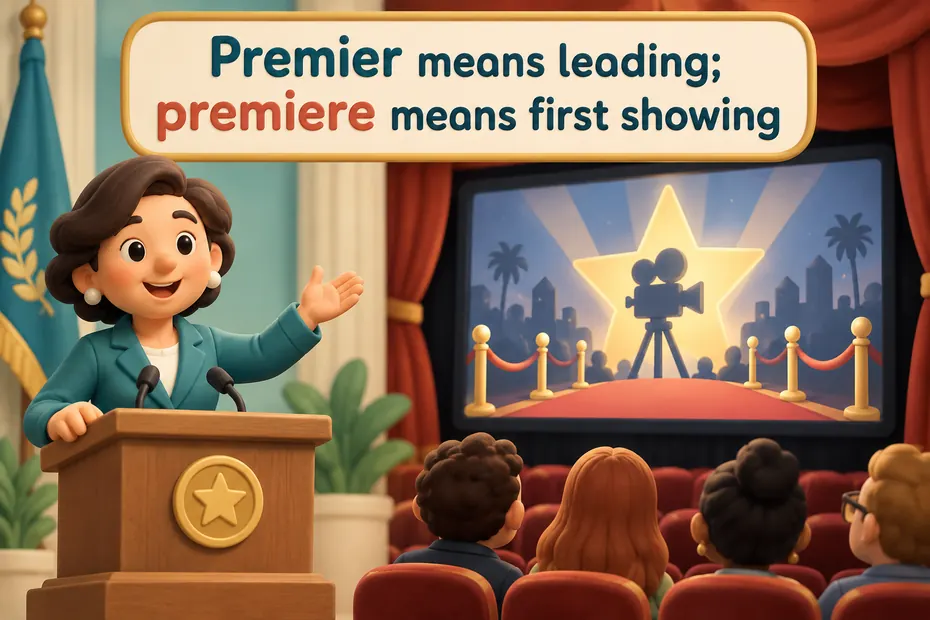
Premier usually means leading or first in rank as an adjective, and it can name a chief minister. Premiere usually means a first performance or showing and can be a verb for presenting one. Use “a premier theater” for status and “the play’s premiere” for its first performance.
Key facts about premier vs premiere
- Premier can describe rank or importance.
- A premiere is a first performance or exhibition.
- Premiere can be a noun or a verb.
- Premier can also name a government leader.
- Premier is recorded as a less common spelling of the verb premiere.
When should you choose premier?
Choose premier when describing something as leading or foremost. “A premier music school” makes a claim about the school’s standing. “The city’s premier venue” describes the venue’s importance. It does not tell you that a performance there is a first showing. Rank and timing are different ideas even when the same event involves both.
Merriam-Webster’s premier entry records the adjective’s rank and time senses, the government noun, and a less common verb spelling. For ordinary edited prose, “leading” is a useful replacement test for the adjective. “A leading research center” preserves the intended meaning of “a premier research center.”
Premier as a noun identifies an officeholder, not a performance. In “The premier addressed the assembly,” the premier is the person speaking. This grammar example does not identify a particular current official or country. If you are writing about a real government, verify the person’s actual title rather than substituting premier for every leadership role.
What does premiere mean?
Premiere commonly names a first performance or exhibition. “We attended the premiere of the play” describes the occasion. “The film’s premiere drew an audience” names its first showing. The final e helps distinguish this familiar entertainment noun from premier used to describe rank or to name a government leader.
Merriam-Webster’s premiere entry records noun and verb uses. As a verb, premiere describes a first public performance: “The play premieres on Friday.” The sentence tells readers when that first presentation happens. It does not claim that the play is the highest-ranking or best production.
Specify the scope when it matters. “The city’s premiere” can sound as though it means the city’s first screening, while “the film’s world premiere” makes a wider first-showing claim. If you have not verified the wider claim, use a narrower phrase such as “the local first screening.” A spelling choice cannot establish the event’s historical priority.
Premier vs premiere: comparison table
| Use | Common meaning | Original example |
|---|---|---|
| premier adjective | Leading or first in importance | She joined a premier dance company. |
| premier noun | Chief minister | The premier answered the question. |
| premiere noun | First performance | We booked seats for the premiere. |
| premiere verb | Present or appear for the first time | The show premieres this evening. |
| premier verb | Less common variant of premiere | Prefer premiere for a clear house style. |

Can premier be a verb?
Yes, dictionaries record premier as a less common spelling of the verb premiere. Therefore, it is too broad to say premier can never describe a first performance. In general writing, premiere is the clearer usual choice for that verb. “The documentary will premiere tomorrow” avoids making readers pause over the less familiar variant.
The useful editorial rule is a preference, not an absolute ban: reserve premier mainly for leading status or the political noun, and use premiere for a first performance. If you are editing under a publication’s established house style, follow that style consistently. Do not rewrite a quoted title merely because its original spelling differs from your preference.
How do you use the verb forms?
The common forms are premieres, premiered, and premiering. “The film premieres tomorrow” is present tense. “The film premiered last week” is past tense. “The company is premiering a new production” describes the company presenting it. These original examples show the grammatical pattern without announcing any actual release schedule.
Notice the subjects in “The play premieres” and “The company premieres the play.” The first focuses on the work appearing; the second focuses on who presents it. Both use premiere as a verb. Add a specific date only when the real schedule has been checked; the spelling itself does not guarantee the event will occur.
How can you proofread the distinction?
Ask what the word communicates. Is it ranking something, naming a government leader, or identifying a first showing? Then inspect its role in the sentence. “The premier venue hosted the premiere” uses the adjective for the venue and the noun for the event. One context can contain both meanings without making the words interchangeable.
Practice with “The ___ theater hosted the play’s ___” and “The series will ___ tonight.” The answers are premier, premiere, and premiere under the usual editorial preference. The first blank describes status; the remaining blanks identify or describe first presentations. Choosing by meaning is more dependable than guessing from a similar pronunciation.
Frequently asked questions
Is it movie premier or movie premiere?
For the first showing of a movie, write movie premiere. Premier usually describes leading status or names a government leader. Although premier is recorded as a less common verb variant, premiere is the ordinary noun for the event. “We attended the movie premiere” therefore makes the intended meaning clear.
Can a premiere happen at a premier venue?
Yes. Premiere describes a first performance, while premier describes the venue as leading or foremost. “The premiere took place at a premier venue” combines the meanings. In factual reporting, support the claim about the venue’s standing or choose a neutral description, such as “a major venue,” if that is more accurate.
Does premier always mean the best?
Premier can express leading rank, importance, or being first; it is not a measured score by itself. In promotional writing, calling a service premier makes a status claim. If precision matters, explain the basis for that claim. The adjective does not tell readers when a performance first occurred; that is the premiere sense.
Must premiere include an accent?
The ordinary English spelling is premiere. Merriam-Webster also records première as a less common variant. Choose a consistent spelling in your own prose, while preserving the official spelling of a title or quoted name. The final e remains the practical distinction from premier in the usual first-performance noun.
Earlier examples and explanation
Are you confused about when to use “premier” and when to use “premiere”? Well, you’re not alone. In this text, I’ll clear up the confusion and help you use these words appropriately. As a language expert, I’ve encountered this common mistake countless times, and I’m here to set the record straight. Whether you’re writing a blog post, an email, or a formal document, understanding the difference between “premier” and “premiere” is crucial for conveying your message accurately. So, let’s immerse and unravel the mystery behind these two words.
Key Takeaways
- “Premier” is primarily used as an adjective to describe something or someone that is first or highest in rank or importance, while “premiere” is a noun that refers to the first public performance, showing, or presentation of something.
- “Premier” can also be used as a noun to refer to a prime minister or the leader of a government.
- “Premiere” is predominantly used as a noun, but it can also function as a verb to describe the act of presenting or showcasing something for the first time.
- “Premier” is often used in formal or political contexts to refer to leaders or top-ranked entities, while “premiere” is commonly used in the entertainment industry to describe debut showings or presentations.
- Use “premier” when referring to top-ranking individuals, governments, or organizations, and use “premiere” to describe the first presentation or performance of an artistic or entertainment-related event.
What is the difference between “premier” and “premiere”?
##What is the Difference Between “Premier” and “Premiere”?
As a language expert, I often come across confusion between the words “premier” and “premiere.” Hence, it’s important to clarify the distinction between these two words and ensure their appropriate usage.
Let’s start by defining each word:
- “Premier”: This word is most commonly used as an adjective to describe something or someone that is first or highest in rank or importance. It can also be used as a noun to refer to a prime minister or the leader of a government.
- “Premiere”: On the other hand, “premiere” is a noun that refers to the first public performance, showing, or presentation of something, such as a movie, play, or musical composition. It can also be used as a verb to describe the act of presenting or showcasing something for the first time.
Now that we have established the definitions, let’s dive deeper into the differences between “premier” and “premiere”:
- Part of Speech:
- “Premier” can be used as both an adjective and a noun.
- “Premiere” is predominantly used as a noun, but it can also function as a verb.
- Meaning:
- “Premier” signifies prominence, superiority, or the highest ranking.
- “Premiere” refers specifically to the first public performance, showing, or presentation.
- Usage:
- “Premier” is often used in formal or political contexts to refer to leaders or top-ranked entities.
- “Premiere” is commonly used in the entertainment industry to describe debut showings or presentations.
It’s crucial to use “premier” when referring to top-ranking individuals, governments, or organizations, while “premiere” should be used to describe the first presentation or performance of an artistic or entertainment-related event.
To further illustrate the correct usage, here are a few examples:
- “I attended the premiere of the new movie last night.”
- “Our country’s premier has implemented several new policies.”
By understanding the distinctions between “premier” and “premiere,” you can confidently use these words correctly in your writing, whether it’s a blog post, an email, or a formal document.
Defining “premier”
When it comes to the confusing world of English words, one pair that often causes confusion is “premier” and “premiere.” In this section, I’ll focus on Defining “premier” and providing examples of its usage so that you can confidently use it in your writing.
“Premier” is an interesting word because it can function both as an adjective and a noun. As an adjective, it describes something or someone that is first or highest in rank or importance. For example, you might say, “She is the premier ballerina of the company,” or “This is the premier event of the year.” In these cases, “premier” emphasizes the top or most important position of someone or something.
As a noun, “premier” refers to the leader or head of a government or organization. It is commonly used in the political context, particularly in countries where the head of the government is referred to as the “prime minister.” For example, you might say, “The premier of the province made an important announcement today.” Here, “premier” is used to refer to the highest-ranking official in the provincial government.
It’s important to note that “premier” is primarily used in British English, while “prime minister” is more commonly used in American English. But, both terms refer to the same position.
To summarize, the key points to remember about “premier” are:
- As an adjective, it means first or highest in rank or importance.
- As a noun, it refers to the leader or head of a government or organization.
Using “premier” correctly adds precision to your writing and shows your grasp of accurate vocabulary. In the next section, I’ll discuss the word “premiere” and its distinct meaning. Stay tuned!
Defining “premiere”
As we investigate deeper into the confusion between “premier” and “premiere,” it’s essential to clarify the distinct meaning and usage of “premiere.”
What is the definition of “premiere”?
“Premiere” is a noun that refers to the first public performance or showing of a play, film, musical composition, or any artistic production. It signifies the grand unveiling or introduction of something new and significant to the public.
In the world of entertainment, a Premiere is an event that marks the highly anticipated launch or release of a new movie, play, or album. It is a momentous occasion where industry professionals, critics, and fans come together to witness and celebrate the debut of a creative work.
How is “premiere” different from “premier”?
While “premiere” and “premier” may sound similar, they have distinct meanings and functions. The primary difference lies in their classification as a noun and an adjective, respectively. “Premiere” denotes the event or act of unveiling something for the first time, while “premier” serves as an adjective describing the highest or most important rank or position.
Here’s a summary of the key differences:
| Word | Part of Speech | Meaning |
|---|---|---|
| Premiere | Noun | First public performance or showing of a play, film, or composition |
| Premier | Adjective | Highest or most important in rank or position |
- The highly anticipated premiere of the new superhero movie drew a massive crowd.
- The orchestra’s premiere of the symphony received rave reviews from music enthusiasts.
- I’m excited to attend the premiere of the Broadway show next week.
By understanding the precise definition and usage of “premiere,” we can avoid misusing it in our writing. In the next section, we will explore some common misconceptions and provide further examples to solidify our understanding of these two words.
When to use “premier”
One of the commonly confused words in English is “premier.” Understanding the correct usage of this word can greatly enhance your writing skills. Let’s investigate into the definition and appropriate usage of “premier.”
Definition of “Premier”
In its simplest form, “premier” is an adjective that refers to something or someone that is first or highest in rank or importance. It can also be used as a noun to specifically refer to the leader or head of a government or organization. The term is primarily used in British English for this purpose, while “prime minister” is more commonly used in American English.
Proper Usage of “Premier”
To ensure clear communication, it’s important to use “premier” appropriately. Here are a few guidelines to keep in mind:
- Highest rank or importance: Use “premier” to describe something that is considered the best or most important within a particular category. For example:
- “He is the premier expert in his field.”
- “We attended the premier event of the season.”
- Political or organizational leader: When referring to the leader or head of a government or organization, “premier” is commonly used in British English. For example:
- “The premier met with various world leaders to discuss trade agreements.”
- “The premier announced a new policy to tackle climate change.”
- Confusion with “prime minister”: In American English, “premier” is not commonly used to refer to the leader of a government. Instead, “prime minister” is the more appropriate term. For example:
- Correct: “The prime minister addressed the nation on the crisis.”
- Incorrect: “The premier addressed the nation on the crisis.”
- Using “premier” as a verb: Remember, “premier” is primarily used as an adjective or a noun, not as a verb. Avoid using it in sentences where a verb is needed. For example:
- Incorrect: “He premiered his latest film at the festival.”
- Correct: “He presented his
When to use “premiere”
As I continue to investigate into the confusion surrounding the words “premier” and “premiere,” it’s essential to understand when to use “premiere” correctly. Let’s take a closer look at the definition and usage of this word.
Definition of “Premiere”: The word “premiere” is primarily used as a noun and refers to the first public performance or showing of a play, film, musical composition, or any artistic production. It represents the exciting moment when something is introduced to the public for the very first time.
When considering the usage of “premiere,” keep the following guidelines in mind:
- Debut of Artistic Works: Use “premiere” when referring to the inaugural showing or performance of a creative work. For example:
- The premiere of the highly anticipated film took place last night.
- The premiere of the play dazzled the audience with its captivating performances.
- Exclusive Events: Employ “premiere” when describing an event that marks the first occurrence or unveiling of something special. For instance:
- I’m looking forward to attending the premiere of the fashion designer’s latest collection.
- This museum is hosting the premiere of a groundbreaking exhibition on modern art.
- Priority and Importance: Use “premiere” to emphasize the significance or prestigious nature of the event or object being discussed. For example:
- The city’s premiere art gallery showcases the finest works by renowned artists.
- The company’s premiere product received rave reviews from customers worldwide.
Remember, “premiere” is specific to denoting the first public performance or showing of something, while “premier” is used to describe something or someone that is first or highest in rank or importance.
In the next section, we’ll explore more examples and discuss the appropriate usage of the word “premier.” Stay tuned to strengthen your understanding of these commonly confused words.
Title: When to use “premiere”
The word “premiere” is primarily used as a noun and refers to the first public performance or showing of a play, film, musical composition, or any artistic production. It represents the exciting moment when something is introduced to the public for the very first time.
Common mistakes to avoid
When it comes to using the words “premier” and “premiere” appropriately, there are a few common mistakes that writers often make. Understanding these mistakes can help you avoid them and improve your overall writing skills. Let’s take a look at some of the most common errors and how to correct them:
- Confusing the Definitions: One of the primary mistakes is to confuse the definitions of “premier” and “premiere.” Remember, “premier” is used as both an adjective and a noun to describe something or someone that is first or highest in rank or importance. On the other hand, “premiere” is solely used as a noun to refer to the first public performance or showing of a play, film, musical composition, or any artistic production.
- Misusing “Premerie” as an Adjective: Another common mistake is using “premiere” as an adjective instead of a noun. It’s important to remember, “premiere” should only be used as a noun to describe the debut of artistic works or exclusive events. Using it as an adjective can lead to confusion and incorrect usage.
- Failing to Recognize Context: It’s crucial to pay attention to the context in which you’re using these words. Consider the meaning you want to convey and choose the appropriate word accordingly. If you’re referring to the leader or head of a government or organization, “premier” would be the correct choice. If you’re discussing the first public performance or showing of something, then “premiere” is the word you should use.
- Overusing “Premier” as a Synonym for “Best”: While “premier” does imply excellence, it’s important not to overuse it as a synonym for “best.” Reserve the use of “premier” for situations where it truly indicates the first or highest in rank or importance.
Conclusion
To conclude, it is crucial to understand the distinction between “premier” and “premiere” to ensure accurate and effective writing. Throughout this article, we have explored the definitions and usage of these two words, clarifying their meanings and providing examples to solidify understanding. We have learned that “premier” is primarily used in British English to refer to the leader or head of a government or organization, while “premiere” specifically denotes the first public performance or showing of a play, film, musical composition, or any artistic production.
By avoiding common mistakes such as confusing their definitions, misusing “premiere” as an adjective, failing to recognize context, and overusing “premier” as a synonym for “best,” we can improve our overall writing skills. Using “premier” and “premiere” appropriately not only enhances our communication but also showcases our attention to detail and command of the English language.
Remember, “premier” describes something or someone that is first or highest in rank or importance, while “premiere” refers to the debut of artistic works or exclusive events. By mastering the correct usage of these words, we can confidently navigate the intricacies of the English language and elevate the quality of our writing.
Frequently Asked Questions
Q: What is the difference between “premier” and “premiere”?
A: “Premier” is primarily used in British English to refer to a leader or head of a government or organization, while “premiere” is a noun that signifies the first public performance or showing of a play, film, musical composition, or any artistic production.
Q: Can “premiere” be used as an adjective?
A: No, “premiere” is strictly used as a noun to describe the first public performance or showing of something. It is not used as an adjective.
Q: What are common mistakes to avoid when using “premier” and “premiere”?
A: Avoid confusing their definitions, misusing “premiere” as an adjective, failing to recognize context, and overusing “premier” as a synonym for “best.” Understanding and avoiding these mistakes will improve your overall writing skills.
Q: How can I use “premiere” appropriately?
A: Use “premiere” as a noun to describe the debut of artistic works, exclusive events, and to emphasize priority and importance. Remember that “premiere” specifically denotes the first public performance or showing of something.
Q: Why is it important to use “premier” and “premiere” correctly in writing?
A: Using “premier” and “premiere” correctly in your writing helps to convey your message accurately and professionally. It ensures that you are using the right word for the specific context and avoids confusion or misunderstandings.


