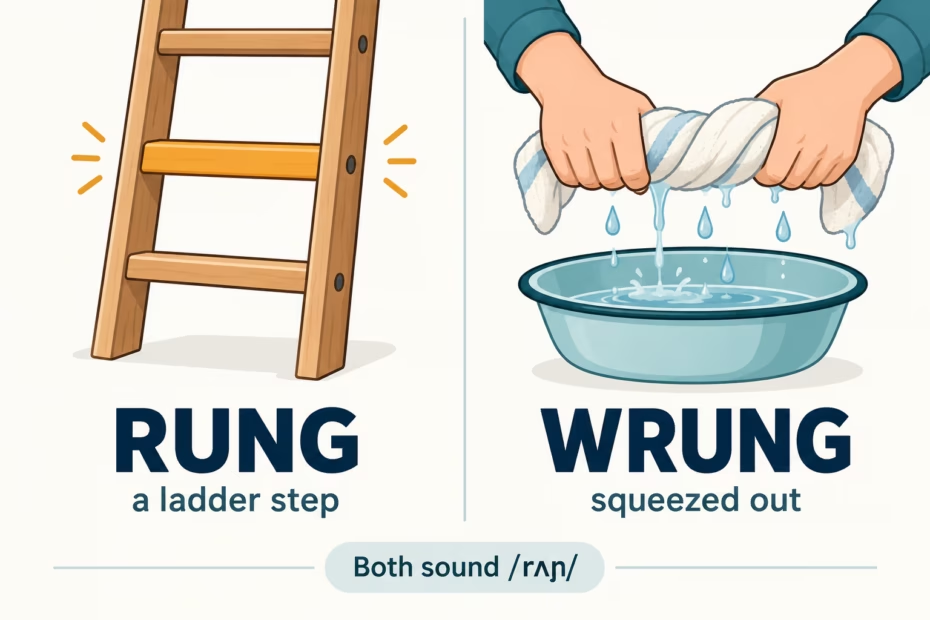
Rung vs. Wrung: The Quick Difference
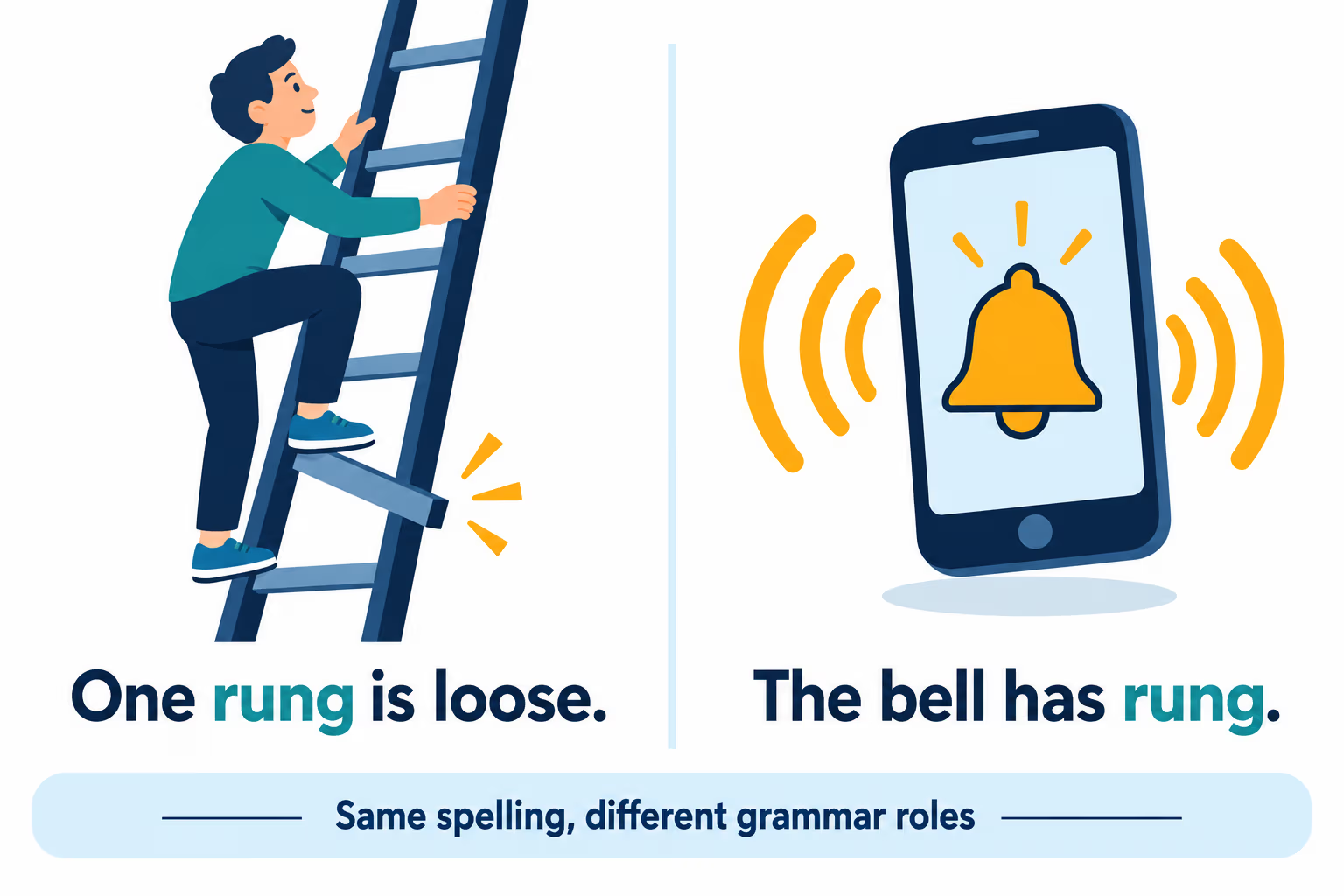
Rung has two common uses: it is a noun for a bar on a ladder, and it is the past participle of ring (as in a bell that has rung). Wrung is the simple past and past participle of wring, meaning to twist or squeeze something. The words sound alike, but the meaning and grammar decide which spelling fits.
| Word | Part of speech / verb form | Meaning | Example |
|---|---|---|---|
| rung | Noun | A crossbar or a level in a progression | One rung on the ladder was loose. |
| rung | Past participle of ring | Made a bell or phone sound; called (especially in British English) | The bell has rung twice. |
| wrung | Simple past or past participle of wring | Twisted or squeezed, often to remove liquid | She wrung out the cloth. |
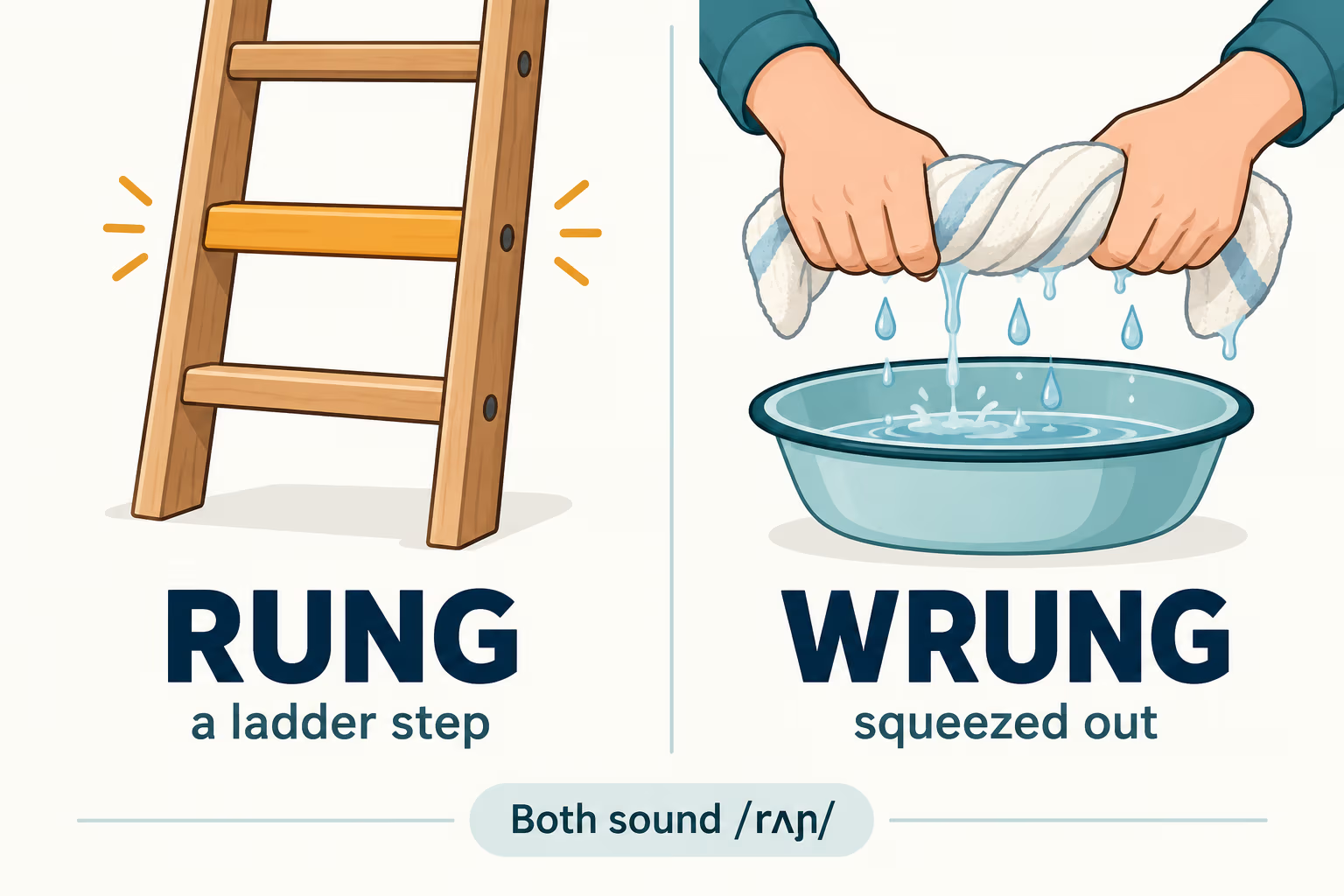
Fast test: if the sentence is about a ladder, rank, or level, use the noun rung. If it means “squeezed,” choose wrung. If the subject is a bell, alarm, or phone and the sentence uses has, have, or had, use rung as the participle of ring: “The alarm has rung.” In a simple past sentence, the usual form is rang: “The alarm rang.”
Correction: An older explanation later in this article incorrectly calls rung the present-tense form of ring. The correct forms are ring (present), rang (simple past), and rung (past participle).
Why Rung Has Two Meanings
English uses the same spelling rung for a ladder part and for the past participle of ring. Context makes the role clear. In “a rung is missing,” the article a and the verb is point to a countable noun. In “the bell has rung,” the auxiliary verb has signals a past participle. Cambridge Dictionary lists both the ladder-step noun and the past-participle form of ring under rung.
The verb forms are ring, rang, rung. Use rang for a completed action in the simple past: “The phone rang while I was cooking.” Use rung with a helping verb: “The phone has rung three times,” or “The phone had rung before I reached it.” This same pattern appears in “She rang the bell” and “She has rung the bell.”
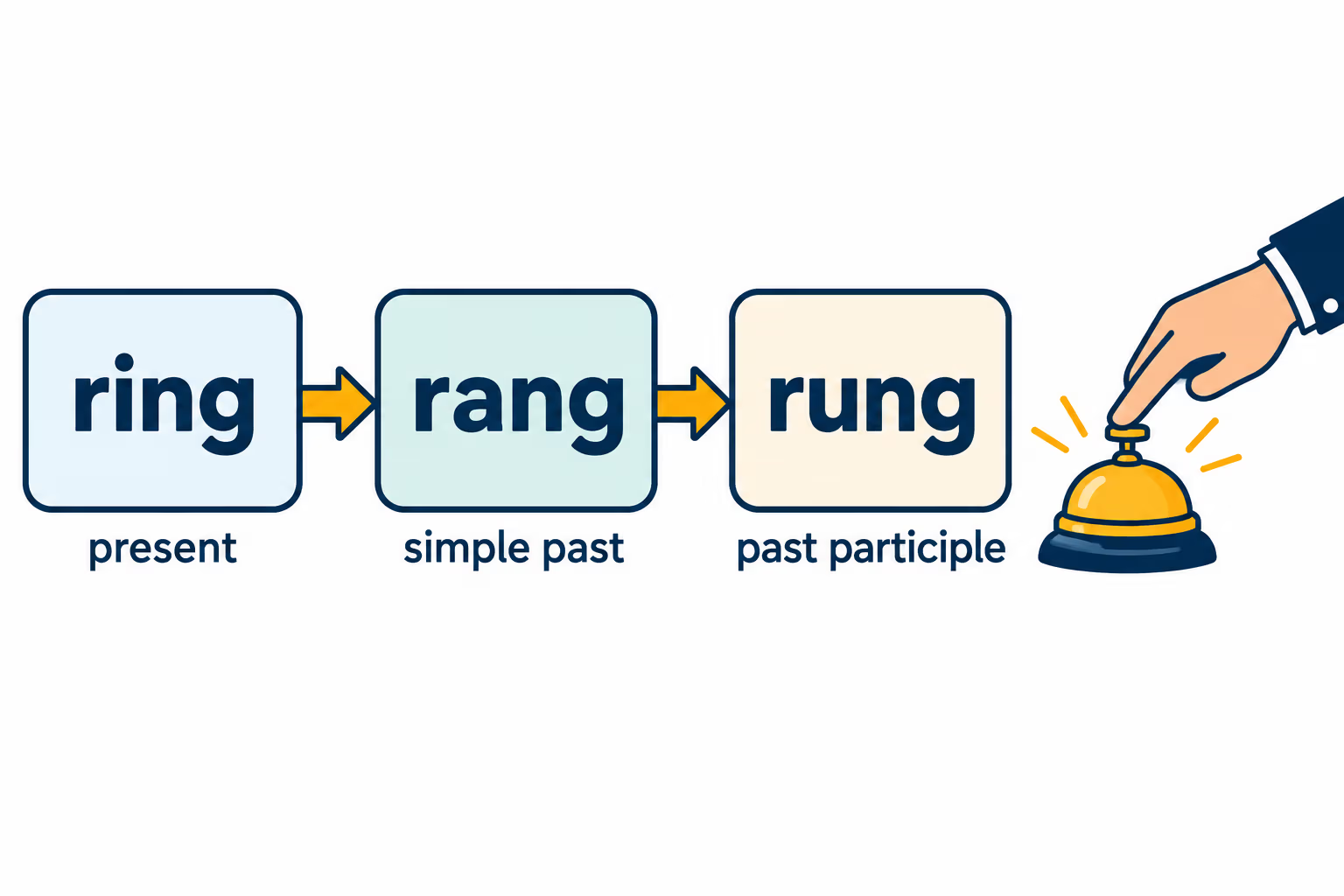
So rung does not mean only “ladder step,” and it is not the normal simple-past form of ring in standard contemporary English. Compare these sentences:
- Noun: He rested his foot on the bottom rung.
- Simple past verb: The school bell rang at noon.
- Past participle: The school bell has rung for the final time today.
When to Use Wrung
Wrung comes from the verb wring, whose forms are wring, wrung, wrung. The Cambridge entry for wrung identifies it as both the simple past and past participle of wring. The verb often describes twisting or squeezing something to force liquid out: “I wrung the water from the swimsuit,” or “The towel was wrung out and left to dry.”
Use wrung for a finished action in the simple past (“They wrung out the mop”) and after a helping verb (“They have wrung out the mop”). Because the past and participle forms are identical, the surrounding words show the tense:
| Form | Pattern | Example |
|---|---|---|
| Present | wring / wrings | I wring the cloth by hand. |
| Simple past | wrung | I wrung the cloth after washing it. |
| Past participle | has/have/had wrung | She has wrung out the cloth. |
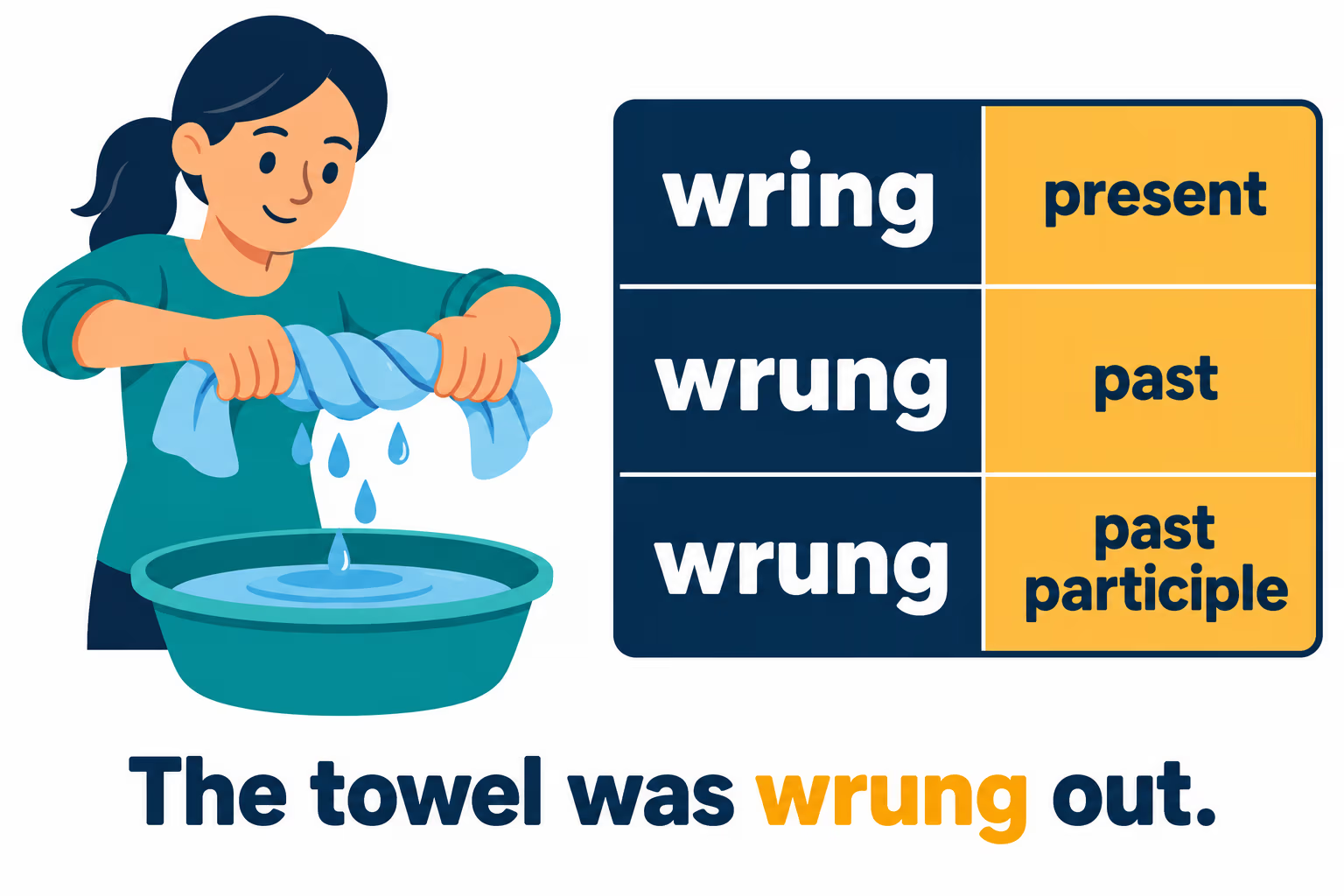
Wring can also be figurative. A person may “wring their hands” in worry, and a demanding experience may leave someone “wrung out,” meaning exhausted or emotionally drained. These expressions still relate to twisting or squeezing in an extended sense; they do not refer to a rung on a ladder or to a bell ringing.
Rung or Wrung? Examples Side by Side
- “She climbed to the next rung.” The word names a ladder crossbar.
- “The proposal moved him up a rung in the organization.” Here, rung is a figurative level.
- “The phone rang during dinner.” This is the simple past of ring.
- “The phone has rung twice.” This is the past participle of ring.
- “He wrung the water from the shirt.” This is the simple past of wring.
- “The shirt was wrung out before it went on the line.” This is a passive construction using the past participle.
Common Rung and Wrung Errors
Incorrect: “The alarm has rang.” Correct: “The alarm has rung.” After has, use the participle rung; rang is the simple past.
Incorrect: “She rung the bell yesterday.” Standard form: “She rang the bell yesterday.” Some dialects use forms differently in speech, but rang is the standard simple-past form for edited general English.
Incorrect: “He rung out the towel.” Correct: “He wrung out the towel.” The action is squeezing, so the verb is wring, whose past form is wrung.
Incorrect: “The ladder had a loose wrung.” Correct: “The ladder had a loose rung.” A ladder part is the noun rung.
Watch the phrase wrung out: it usually means squeezed dry or exhausted. By contrast, rung out can describe a sound that rang clearly (“The chime rung out across the hall”), but in everyday prose the phrasal verb is more often written rang out for the simple past or has rung out for the participle. The spelling depends on whether the verb is ring or wring, not on the shared sound.
A Quick Practice Check
- The phone has (rang / rung) all morning.
- She (rang / wrung) the bell once.
- He (wrung / rung) out the sponge.
- One ladder (wrung / rung) needs replacing.
Answers: 1. rung (past participle of ring); 2. rang (simple past of ring); 3. wrung (past of wring); 4. rung (noun for a ladder step). If you can identify whether the sentence means “step,” “make a sound,” or “squeeze,” the spelling becomes straightforward.
Source note: Cambridge Dictionary distinguishes rung as a ladder-step noun and the past participle of ring, and lists wrung as the past simple and past participle of wring. See its entries for rung, ring, and wrung.
Key Takeaways
- “Rung” is a noun that refers to a step on a ladder or similar structure, while “wrung” is the past tense and past participle form of the verb “wring.”
- “Rung” is used in the present tense, such as “I am standing on the top rung of the ladder,” while “wrung” is used in the past tense, such as “I wrung out the wet towel.”
- “Rung” can be used metaphorically to represent a step or stage in a process or progression, while “wrung” is used to describe the action of squeezing or compressing something forcefully.
- “Rung” should be used when referring to steps on a ladder or metaphorical progression, while “wrung” should be used when referring to squeezing or compressing something forcefully.
- Avoid using “rung” when referring to actions involving twisting or squeezing, and avoid using “wrung” when talking about steps or stages in a process.
- Proper usage of “rung” and “wrung” is crucial for effective communication and to avoid misunderstandings.
Understanding the Difference between “rung” and “wrung”
When it comes to English language, it’s not uncommon to encounter words that look or sound similar but have completely different meanings. This can be particularly confusing for students who are still learning the intricacies of the language. Two such words that often cause confusion are “rung” and “wrung.” In this section, I’ll help you understand the difference between these two words and how to use them appropriately.
Definition of “rung”: The word “rung” is a noun that refers to a step or a crosspiece on a ladder. It is commonly used to describe the horizontal support that you step on while climbing up or down a ladder.
Definition of “wrung”: On the other hand, “wrung” is the past tense and past participle form of the verb “wring.” It means to twist, squeeze, or compress something, often with force, to remove liquid or alter its shape.
Now that we have a clear understanding of the definitions, let’s further explore the difference between “rung” and “wrung.”
- “Rung” is a noun used to describe a physical step on a ladder, while “wrung” is the past tense and past participle form of the verb “wring.”
- “Rung” is used in the present tense, such as “I am standing on the top rung of the ladder.” On the other hand, “wrung” is used in the past tense, such as “I wrung out the wet towel.”
Summarizing, it’s important to remember, “rung” is a noun that refers to a ladder step, while “wrung” is the past tense and past participle form of the verb “wring.” By understanding the definitions and proper usage of these words, you’ll be able to use them appropriately in your writing and conversation.
But what about other words that sound similar? In the next section, we’ll explore more commonly confused words and guide you through their definitions and usage. Stay tuned!
When to Use “rung”
As an expert blogger, I aim to provide you with a clear and informative understanding of the difference between commonly confused words in the English language. In this section, we will investigate into the appropriate usage of “rung.” So, let’s jump right in!
- Definition of “Rung”: “Rung” is a noun that refers to a step on a ladder or a similar structure. It is an essential component that allows us to ascend or descend with ease. Think of it as the foothold that supports our progress.
Now that we have established the definition, let’s explore some scenarios in which “rung” would be used appropriately:
- Ladders and Stairs: If you are discussing the construction or usage of ladders, you will frequently encounter the term “rung.” For example, “I climbed up the ladder and carefully placed my foot on the next rung.”
- Metaphorical Usage: Sometimes, “rung” can be used metaphorically to represent a step or stage in a process or progression. For instance, “She felt proud as she climbed the rungs of corporate success.”
- Figurative Interpretation: In literature or poetry, “rung” can symbolize a barrier or obstacle that one needs to overcome. Consider this example: “She struggled to reach the top rung of societal acceptance.”
By understanding these contexts, you can confidently use “rung” in your written and spoken communication.
In the next section, we will move on to exploring the correct usage of “wrung.” So keep reading to enhance your knowledge of these commonly confused words.
Stay tuned for the upcoming section: “When to Use ‘Wrung’.”
Did you know that “rung” can also be used metaphorically to represent a step or stage in a process or progression?
When to Use “wrung”
As I mentioned earlier, the word “wrung” is often confused with “rung” due to their similar spellings. But, they have completely different meanings and applications. In this section, I will clarify when and how to use “wrung” correctly.
Definition of “wrung”
The word “wrung” is the past participle form of the verb “wring.” When something is “wrung,” it means that it has been squeezed or twisted forcefully to extract liquid or to compress it.
Examples of Using “wrung”
Here are a few examples that demonstrate the correct usage of “wrung”:
- After washing the clothes, I wrung out the excess water before hanging them to dry.
- She wrung her hands nervously as she awaited the test results.
- The wet cloth was wrung tightly to remove all the moisture.
As you can see, “wrung” is used to describe actions involving extracting or compressing liquid or substance through forceful twisting or squeezing.
Difference between “rung” and “wrung”
Although “rung” and “wrung” may sound similar, their meanings are completely different. “Rung” is a noun that refers to a step on a ladder or similar structure, whereas “wrung” is the past participle of the verb “wring.”
To avoid confusion, remember, “rung” is used when referring to steps on a ladder or figuratively as a step or stage in a process, while “wrung” is used when describing the action of squeezing or compressing something forcefully.
By understanding the distinction between these two words, you can confidently express yourself and avoid using them interchangeably.
So, to summarize, “wrung” should be used when referring to squeezing or compressing something forcefully, while “rung” is used when discussing steps on a ladder or a metaphorical progression.
Now that you have a clear understanding of when to use “wrung,” let’s move on to the next section, where we will explore some practical examples of both “rung” and “wrung” in sentences.
Common Mistakes to Avoid
One common mistake that individuals make when using “rung” and “wrung” is using them interchangeably due to their similar spelling. But, it is crucial to understand the distinction between these words to use them appropriately in communication.
One mistake to avoid is using “rung” when referring to actions involving twisting or squeezing. While “rung” is a noun that refers to a step on a ladder or similar structure, “wrung” is the past participle form of the verb “wring.” This means that “wrung” is used to describe actions involving extracting or compressing liquid or substance through forceful twisting or squeezing.
Another common mistake is using “wrung” when talking about steps or stages in a process. In this scenario, “rung” should be used instead. “Rung” can be used metaphorically to represent a step or stage in a process or progression. It can also be used figuratively to signify a barrier or obstacle that needs to be overcome.
To avoid these mistakes, it’s essential to understand the appropriate contexts in which “rung” and “wrung” are used. Here are a few examples to help clarify their correct usage:
- Correct: I climbed each rung of the ladder carefully.
- Incorrect: I wrung each rung of the ladder carefully.
- Correct: She wrung out the wet clothes before hanging them up.
- Incorrect: She climbed each wrung of the ladder carefully.
By making these distinctions, you can confidently express yourself and avoid confusion when using “rung” and “wrung.” Understanding the difference between these words will enhance your communication skills and help you avoid common mistakes that can undermine your message.
Remember, it’s essential to continually improve your language skills and stay vigilant to avoid falling into common traps and misunderstandings. Now that we have discussed the difference between “rung” and “wrung,” you are well-equipped to use these words appropriately and effectively in your writing and speech.
Should “rung” and “wrung” be Interchanged?
When it comes to the words “rung” and “wrung,” there is a clear distinction that should not be overlooked. While these words may sound similar, they have different meanings and uses in the English language. Understanding and correctly using these words is crucial for effective communication. Let’s explore why “rung” and “wrung” should not be interchanged.
Definition of “Rung”: “Rung” is a noun that refers to a step on a ladder or a similar structure. It is used to describe a horizontal piece that connects the uprights, providing a foothold for climbing. For example, “I climbed up the ladder and reached the top rung.”
Definition of “Wrung”: On the other hand, “wrung” is the past participle form of the verb “wring.” It is used to describe actions involving twisting or squeezing. For instance, “I wrung out the wet towel to remove excess water.” In this sentence, “wrung” indicates the action of squeezing the towel tightly.
The difference between these two words is clear: “rung” is a noun related to a ladder or similar structure, while “wrung” is the past participle of “wring,” describing an action of twisting or squeezing. Confusing the two can lead to miscommunication and misunderstandings.
To further illustrate the correct usage, here are a few examples:
-
Correct usage of “rung”:
- “He climbed the ladder and reached the top rung.”
- “The ladder has ten rungs in total.”
- “She wrung out the wet clothes before hanging them to dry.”
- “He wrung his hands nervously as he waited for the news.”
To conclude, it is vital to understand the difference between “rung” and “wrung” to use them appropriately in speech and writing. Interchanging these words can lead to confusion and may convey the wrong meaning. By familiarizing ourselves with their definitions and examples, we can confidently express ourselves and avoid common mistakes. So, let’s remember the importance of using “rung” and “wrung” correctly and strive for clear and effective communication.
Conclusion
Understanding the difference between “rung” and “wrung” is crucial for effective communication. By using these words appropriately, you can convey your message clearly and avoid any confusion or misunderstandings.
Throughout this article, we have explored the distinction between these two words. “Rung” is a noun that refers to a step on a ladder or similar structure, while “wrung” is the past participle form of the verb “wring” and describes actions involving twisting or squeezing.
It is important to note that interchanging “rung” and “wrung” can lead to miscommunication. By using the correct word in the appropriate context, you can express yourself confidently and accurately.
Remember, “rung” and “wrung” have different meanings and uses. By familiarizing yourself with their definitions and examples provided in this text, you can enhance your language skills and become a more effective communicator.
So, next time you encounter these words, remember their distinctions and use them correctly. By doing so, you will demonstrate your command of the English language and ensure that your message is understood exactly as intended.
Frequently Asked Questions
What is the difference between “rung” and “wrung”?
“Rung” is a noun that refers to a step on a ladder or similar structure. On the other hand, “wrung” is the past participle form of the verb “wring” and describes actions involving twisting or squeezing. It is important to understand the distinction between these words to use them correctly in communication.
Why should I avoid using “rung” and “wrung” interchangeably?
The words “rung” and “wrung” have different meanings and uses. Confusing them can lead to miscommunication and misunderstandings. To prevent confusion, it’s crucial to understand the contexts in which each word is appropriate and use them accordingly.
Can you provide examples of correct usage?
Certainly! Here are some examples:
- She climbed up the ladder, placing her foot on each rung.
- He wrung out the wet cloth before hanging it up to dry.
Remember, using the correct word in the right context is key to clear and effective communication.


