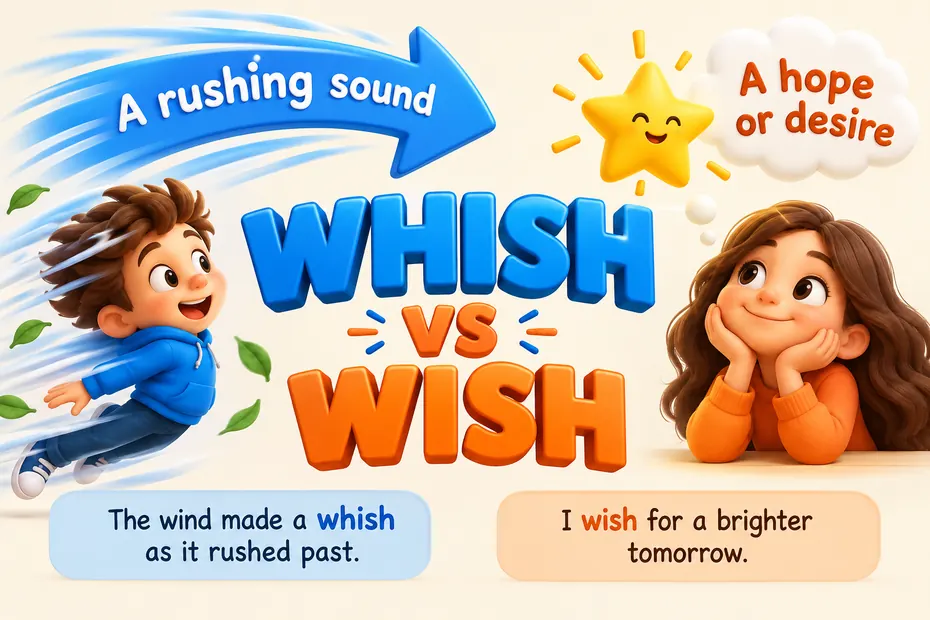
Whish vs wish: Use wish for a desire or an expression of goodwill, as in “I wish you success.” Use whish for a rushing or swishing sound, or movement accompanied by that sound. Whish is a real dictionary word; it is not an alternative spelling of the desire verb.
Whish and wish at a glance
- Wish can be a verb or a noun connected with desire.
- Whish can be a verb or a noun connected with sound and movement.
- The past forms are wished and whished.
- The noun plurals are wishes and whishes.
- Check the intended meaning before treating whish as a typo.
Is whish a real word?
Yes. Merriam-Webster lists whish as a noun and verb connected with a rushing sound or movement. The original article below repeatedly calls it a variant or misspelling of wish; those statements need this correction. It is a spelling error only when the writer intended the desire-related word.
“The arrow whished through the air” describes movement and sound. “I wish I could fly” describes desire. Replacing whished with wished in the arrow sentence changes the meaning rather than merely modernizing the spelling. If a sound word seems unfamiliar, consult a dictionary before removing its extra letter.

Which word belongs in each sentence?
| Intended meaning | Original example | Choice |
|---|---|---|
| Express goodwill | We wish you a pleasant journey. | Wish |
| Want a different situation | I wish I had more time. | Wish |
| Have a desire | Her wish was to learn the violin. | Wish |
| Make a rushing sound | The curtain moved with a soft whish. | Whish |
| Move with that sound | The paper airplane whished past the shelf. | Whish |
For greetings and messages, wish is the expected word: “I wish you well,” “We wish you luck,” and “Best wishes.” The phrase “Best whishes” is a typo in an ordinary greeting. In descriptive fiction, however, whish may be deliberate sound imagery, just as a writer may choose swish or whoosh.
How do you write present and past wishes?
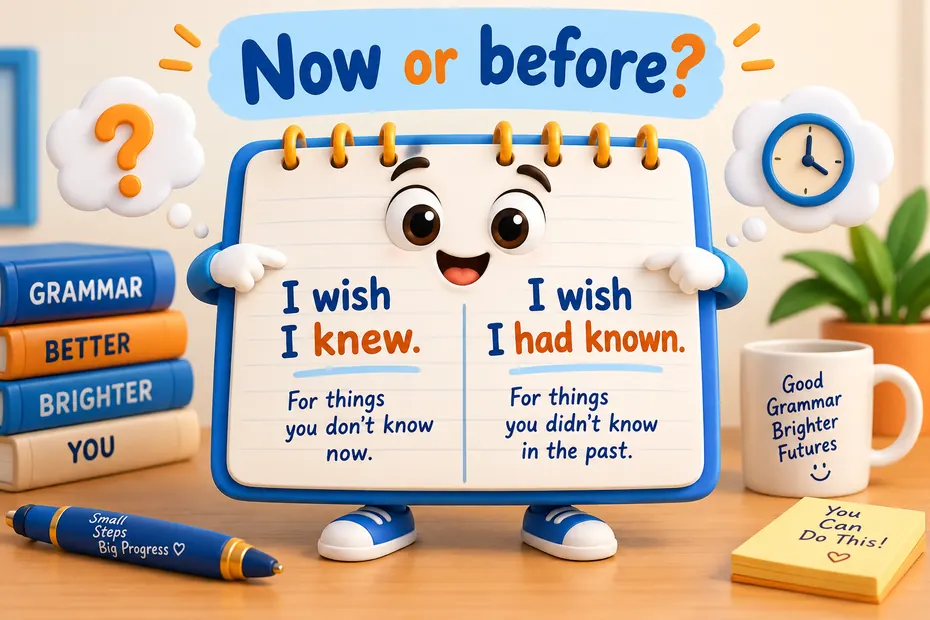
The British Council’s wish grammar lesson distinguishes present unreal wishes, past regret, and annoyance with would.
For an unreal present situation, a past-form clause commonly follows wish: “I wish I knew the answer.” For regret about an earlier event, use a past perfect clause: “I wish I had known the answer.” The time expressed by the whole construction matters more than the surface appearance of one verb.
The earlier article’s explanation that “I wish I was there” specifically means an unchangeable past event is too simple. A clear past-regret model is “I wish I had been there.” For a hypothetical present situation, “I wish I were there” is a standard model, while informal usage can also include was. Do not use the was/were contrast alone to assign past versus present time.
For an achievable future outcome, hope often provides a more natural pattern: “I hope the bus arrives soon.” “I wish the bus would arrive” expresses dissatisfaction with the delay. The two statements are close in subject matter, but the speaker’s attitude differs. Match the construction to the message.
Original examples to practice
- I wish you a successful first day.
- The child made a wish before blowing out the candles.
- She wished she had brought her umbrella.
- I wish I could play that song.
- The fabric whished as he shook it out.
- We heard the whish of the passing sled.
- The dart whished toward the target.
- They sent their best wishes with the card.
A quick editing check is to label each sentence desire, goodwill, or sound/movement. Then compare the spelling with the label. This catches an accidental “whish you well” without incorrectly removing the sound word from a passage about rustling fabric or a fast-moving object.
Frequently asked questions about whish vs wish
Does wish always mean something impossible?
No. Wish can express goodwill, as in “We wish you success,” and it can describe a desire more generally. Some grammar constructions express an unreal situation or regret, but those uses do not cover every meaning. Read the entire expression before deciding whether an unattainable outcome is implied.
Can whish be a noun?
Yes. “A whish of air passed the window” uses the sound word as a noun. In that construction, a introduces one sound. “Her wish was granted” also contains a noun, but that noun describes a desire. Both words can occupy similar grammatical positions while conveying different meanings.
Is best whishes a correct greeting?
For an ordinary greeting, write best wishes. The expression sends goodwill rather than describing a sound. The existence of the separate word whish does not make it interchangeable with wish. A spelling checker may recognize both, so proofreading the message remains necessary.
Should a writer avoid an unfamiliar sound word?
Not automatically. If whish conveys the intended sound, it can serve descriptive writing. For readers who may not know it, a context such as “a whish of air” helps. If sound is irrelevant and the sentence concerns desire, choose wish; clarity comes from matching meaning rather than frequency alone.
References: The word distinction follows the dictionary entries for whish and wish. The examples are original.
Original whish and wish guide
Key Takeaways
- “Wish” is the correct and widely accepted spelling and usage in standard English, while “whish” is a rarely used variant or misspelling.
- “Wish” is a verb that expresses a desire, hope, or intention for something to happen, while “whish” is not widely recognized or commonly used.
- Using “whish” instead of “wish” can lead to confusion or misunderstanding, as it is not commonly understood by native English speakers.
- “Wish” is a versatile word that appears in various idioms, expressions, and commonly used phrases, while “whish” is less popular and not recognized by many.
- It is important to use “wish” correctly when expressing desires or hopes, as using “whish” can be seen as incorrect or nonstandard.
- “Whish” can be used as a sound effect or onomatopoeic word for artistic or expressive purposes but is not commonly used in everyday or formal English.
What is the difference between “whish” and “wish”?
Let’s start by clarifying the definition of both “whish” and “wish.” While “wish” is a commonly used English word, “whish” is actually a rarely used variant or misspelling. The primary difference lies in their meanings and accepted usage.
Here’s a breakdown of the key differences between “whish” and “wish”:
- Definition: “Wish” is a verb that expresses a desire, hope, or intention for something to happen or exist. It can also be used as a noun to express a desire or longing. On the other hand, “whish” is a less recognized form of “wish” and is often considered a misspelling.
- Accepted Usage: “Wish” is the correct and widely accepted spelling and usage in standard English. It is used in a variety of contexts and is an important part of everyday communication. But, “whish” is not widely recognized or commonly used. It may be perceived as a mistake, and using it could lead to confusion or misunderstanding.
- Popularity: “Wish” is a common and frequently used word in the English language. It appears in various idioms, expressions, and commonly used phrases. In contrast, “whish” is less popular and not recognized by many native English speakers.
- Correctness: “Wish” is the correct and preferred term when expressing desires or hopes. Using “whish” in its place can be seen as incorrect or nonstandard.
To further illustrate the difference, here are some examples:
- “I wish I could travel the world.”
- “She wishes for a better future.”
- “He wished upon a star.”
As you can see, the word “wish” is versatile and widely used to convey desires and hopes in various contexts. Its usage is well-established and easily understood by English speakers.
To conclude, the main difference between “whish” and “wish” lies in their definitions, accepted usage, and popularity. While “whish” may be an alternative form, it is not commonly recognized and is considered a misspelling. To ensure clear communication, it is recommended to use the word “wish” instead.
Common mistakes to avoid when using “whish” and “wish”
As a language expert, I understand that the English language can be tricky, especially when it comes to similar-sounding words like “whish” and “wish.” In this section, I’ll guide you through some common mistakes to avoid when using these words.
Understanding the Difference Between “Whish” and “Wish”
To begin, let’s clarify the definition of each word. “Wish” is a commonly used verb that expresses a desire or hope for something. On the other hand, “whish” is a rarely used variant or misspelling that is not widely recognized or commonly used in standard English.
Mistake 1: Using “Whish” Instead of “Wish”
One of the biggest mistakes people make is using “whish” instead of “wish” in their writing. It’s important to remember, “whish” is not the correct spelling or accepted usage in standard English. By using “whish,” you risk confusing your readers and compromising the clarity of your message.
Mistake 2: Incorrectly Using “Wish” in Context
While “wish” is the correct word to use in most situations, it’s essential to understand its proper usage in context. Here are a few common mistakes to avoid:
- Using “wish” when you mean “want” or “desire”: While the two words are related, “wish” specifically refers to expressing a desire or hope, whereas “want” or “desire” implies a stronger preference or need.
- Confusing past and present tense: Remember to use the appropriate tense when expressing a wish. For example, “I wish I were there” is correct for a hypothetical or contrary-to-fact situation, while “I wish I was there” is appropriate for a past event that cannot be changed.
Conclusion
By understanding the difference between “whish” and “wish” and avoiding the common mistakes discussed above, you can confidently use “wish” in your writing and ensure clear communication. Remember, “wish” is the correct and widely accepted word, while “whish” is a rarely used variant or misspelling.
How to use “whish” correctly
Now that we have clarified the difference between “whish” and “wish” and emphasized that “whish” is a rarely used variant or misspelling, let’s take a closer look at how to use “whish” correctly.
First and foremost, it’s important to note that “whish” is not commonly used in standard English. In fact, it may even be considered incorrect in many contexts. But, there are a few instances where you might encounter this word:
- Sound Effects: In literature or creative writing, “whish” can be used to describe a sound effect, typically associated with something moving quickly. For example, “The whip whished through the air, creating a sonic boom.” Keep in mind that this usage is more artistic and poetic in nature, rather than everyday communication.
- Onomatopoeia: Similar to the above, “whish” can also be used as an onomatopoeic word to mimic the sound of something cutting through the air. For instance, “The arrow whished past my ear, narrowly missing its target.” Again, this usage is more expressive and may not be appropriate for formal writing.
It’s vital to understand that these instances of “whish” are exceptions, and they are not commonly used in everyday or formal English. In most cases, it’s best to stick with the more widely accepted and standard word – “wish.”
So, let’s recap: “Whish” is a rarely used variant or misspelling that should generally be avoided in favor of “wish.” The majority of the time, “wish” is the correct and accepted way to express a desire or hope.
Remember, effective communication relies on using words accurately and appropriately. By using “wish” correctly, you will ensure clear and concise expression of your thoughts and intentions.
How to use “wish” correctly
When it comes to using the word “wish,” it’s essential to have a clear understanding of its meaning and proper usage. Let’s explore some key guidelines to help you use “wish” correctly.
Definition of “Wish”
To begin, let’s establish the definition of “wish.” As a verb, “wish” conveys a desire or hope for something that is not currently true or achievable. It often indicates a longing for a different outcome or situation.
Difference Between “Wish” and “Whish”
Before we investigate into the correct usage, let’s clarify the difference between “wish” and “whish.” While “wish” is a widely accepted and standard word, “whish” is not commonly used in standard English and may even be considered incorrect in many contexts.
Proper Usage of “Wish”
Let’s discuss some key scenarios where “wish” is used appropriately:
- Expressing Desires: We use “wish” to express our desires or hopes for something that is not currently true. For example:
- “I wish I could travel the world.”
- “She wishes she had more time to spend with her family.”
- Expressing Regrets: “Wish” can also be used to express regrets about the past or present situations that cannot be changed. For example:
- “I wish I hadn’t said those hurtful words.”
- “They wish they could have attended the concert last night.”
- Talking About the Future: In some cases, “wish” can be used to express hopes or desires for future situations. For example:
- “I wish you a successful career.”
- “We wish you a happy and prosperous New Year.”
Conclusion:
Understanding how to use “wish” correctly is crucial for effective communication. It allows us to express our desires, hopes, and regrets with precision and clarity. By following the guidelines discussed above, you can confidently use “wish” in your everyday conversations and written expressions. So, remember to choose your words wisely, and let your wishes be heard.
Tips for improving your grammar and vocabulary when using “whish” and “wish”
As a language enthusiast, I understand the importance of honing your grammar and vocabulary skills to effectively communicate in English. When it comes to words like “whish” and “wish,” confusion can arise due to their similar spellings. To help you navigate these commonly confused words, I’ve compiled a few tips to improve your understanding and usage.
1. Understand the difference
To start, it’s crucial to grasp the distinction between “whish” and “wish.” While “wish” is a commonly used verb expressing a desire or hope for something that is not currently true or achievable, “whish” is not commonly used in standard English. In fact, it may even be considered incorrect in many contexts.
2. Learn the definition of “wish”
To enhance your usage of “wish,” let’s investigate into its definition. “Wish” is a verb that conveys a longing or desire for something that is currently unattainable. It’s often used to express hopes, dreams, or regrets. Familiarize yourself with this definition and consider various scenarios where “wish” is appropriately used.
3. Practice using “wish” correctly
Improving your grammar and vocabulary takes practice. To refine your usage of “wish,” incorporate it into your everyday conversations and writing. Here are some examples to help you get started:
- Expressing desires: “I wish I could travel the world.”
- Expressing regrets: “I wish I hadn’t eaten that entire cake.”
- Talking about the future: “I wish I’ll be able to attend the party tomorrow.”
By integrating “wish” into your language practice, you’ll become more comfortable with its correct usage and develop a strong command of this important verb.
Remember, the key to improving your grammar and vocabulary is consistency and practice. Foster a habit of using “wish” appropriately, and soon it will become second nature to you.
As we continue our exploration of commonly confused words, it’s important to note that understanding the nuances of language can greatly impact your ability to communicate effectively. With that in mind, let’s dive deeper into the proper usage of “whish” and “wish” to further enhance your language skills. Stay tuned for more valuable insights in the next section.
Conclusion
Mastering the proper usage of “wish” and “whish” is crucial for enhancing your grammar and vocabulary skills. Throughout this article, I have emphasized the significance of understanding the distinction between these two words. “Wish” is commonly employed to convey desires, hopes, and regrets, while “whish” is not typically used in standard English.
By practicing the correct usage of “wish,” you can effectively express your desires, regrets, and discuss future possibilities. Consistency and practice are key in improving your grammar and vocabulary. Remember, language nuances play a vital role in effective communication.
I hope this article has provided you with valuable insights into the appropriate use of “wish” and “whish.” Understanding these nuances will undoubtedly enhance your language skills and help you become a more confident communicator. Stay tuned for more insightful content in the upcoming sections. Happy writing!
Frequently Asked Questions
Q: What is the difference between “whish” and “wish”?
A: “Whish” is not commonly used in standard English, while “wish” is commonly used to express desires, hopes, and regrets.
Q: How can I improve my grammar and vocabulary when using “wish”?
A: Practice using “wish” correctly and consistently. Examples include expressing desires, regrets, and talking about the future.
Q: Why is understanding the difference between “whish” and “wish” important?
A: Understanding the nuances of language can greatly impact effective communication, ensuring accurate expression of desires, hopes, and regrets.
Q: What should I do to improve my grammar and vocabulary overall?
A: Consistency and practice are key. Continually engage in activities that challenge and expand your language skills.
Q: Will the article provide more insights on improving grammar and vocabulary?
A: Yes, the article hints at further insights in the next section, allowing for continued learning and growth in language proficiency.


