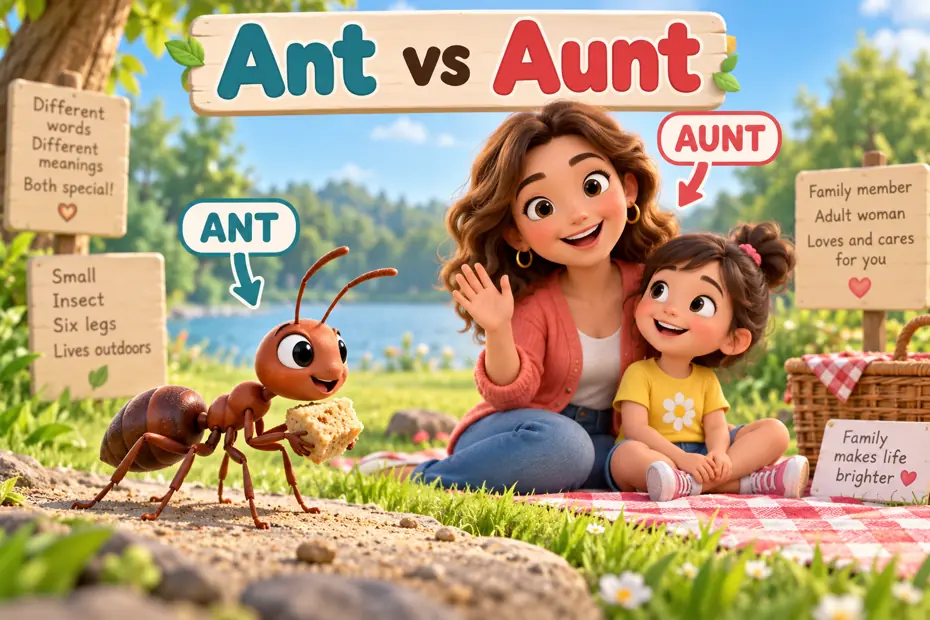
Ant vs aunt: an ant is an insect; an aunt is a family member, such as a parent’s sister or an uncle’s or aunt’s wife. The words sound alike in some accents, but not all. Choose the spelling by meaning rather than by the pronunciation you hear.
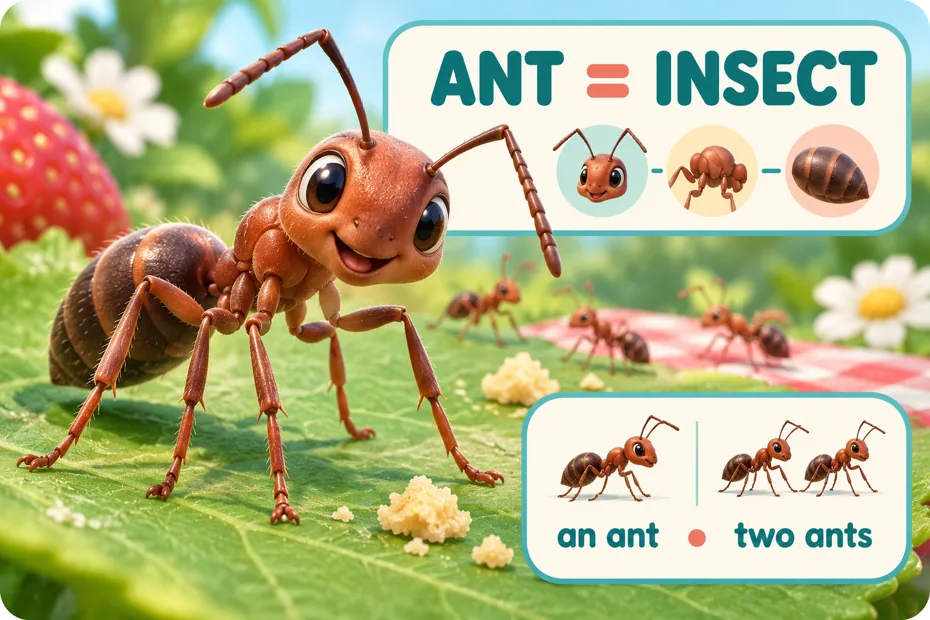
- Ant names the insect; its plural is ants.
- Aunt names a relative; its plural is aunts.
- Both nouns take an: an ant and an aunt.
- American dictionaries recognize both “ant” and “ahnt” pronunciations of aunt.
- Use Aunt Maya as a name-like title, but my aunt as an ordinary relationship description.
Ant vs aunt: which spelling fits your sentence?
Use ant when you mean the insect and aunt when you mean the relative. A reliable editing test is to replace the questionable word with “insect” or “relative.” “My relative sent a birthday card” works; “my insect sent a birthday card” changes the intended story.
| Meaning or form | Ant | Aunt |
|---|---|---|
| Ordinary meaning | A social insect | A female family member |
| Singular example | An ant crossed the path. | An aunt joined the celebration. |
| Plural | Ants gathered around the crumbs. | My aunts live nearby. |
| One owner’s possessive | The ant’s nest | My aunt’s coat |
| Several owners’ possessive | The ants’ nest | My aunts’ photographs |
| Useful context clues | Colony, nest, antennae, insect | Family, niece, nephew, parent |
These context clues help, but they are not grammatical restrictions. An aunt can study a colony, and an ant can appear in a family photograph. Identify what the noun actually names. Do not let a nearby word override the intended subject.
Do ant and aunt always sound the same?
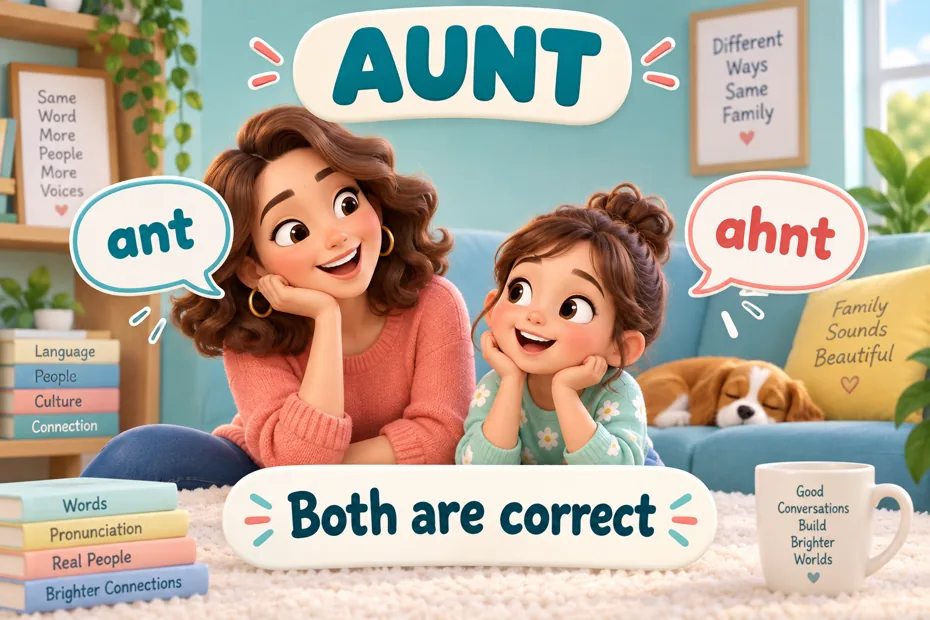
Ant and aunt are homophones only for speakers who pronounce them alike. Merriam-Webster lists two pronunciations for aunt, commonly represented as “ant” and “ahnt,” while its insect entry uses “ant.” A speaker who uses the second aunt pronunciation distinguishes the pair in speech. See the dictionary’s aunt entry and ant entry.
Neither aunt pronunciation changes the spelling or family relationship. A learner should listen to the English variety they are learning and to the individual’s preferred family usage. Correcting someone merely because their pronunciation differs from yours confuses regional speech with a spelling error.
How do you write aunt names and possessives?
Capitalize Aunt when it functions as a title before a name or substitutes for a name in direct address: “Aunt Maya is here” and “Thank you, Aunt.” Use lowercase for an ordinary relationship noun: “My aunt Maya is here.” A sentence’s first word is capitalized independently of this distinction.
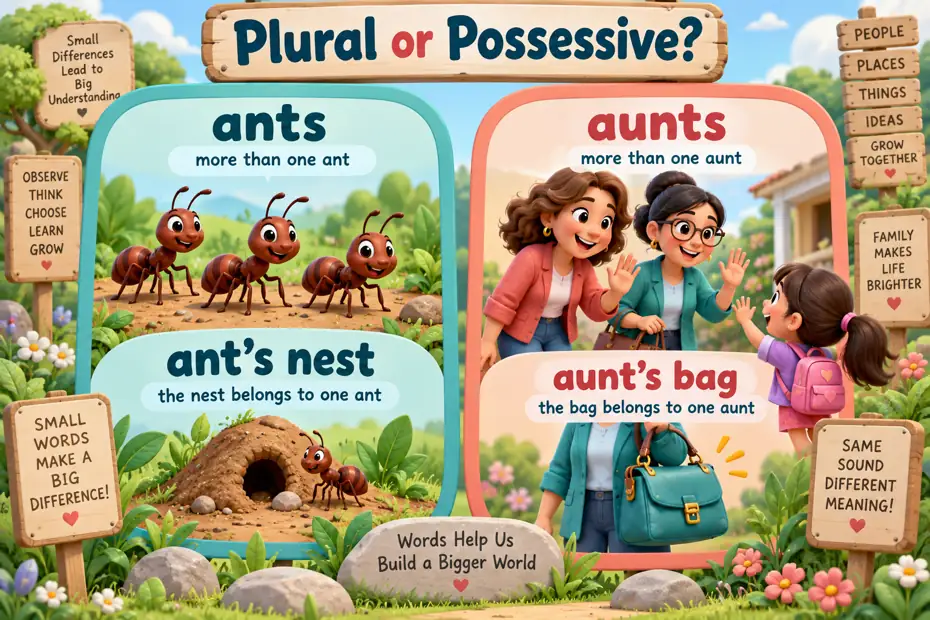
For possession, add an apostrophe and s to the singular: “my aunt’s bicycle.” With a regular plural already ending in s, add only the apostrophe: “my aunts’ bicycles.” The same pattern gives “the ant’s trail” and “the ants’ trail.” The apostrophe marks ownership; it does not turn an insect into a relative.
A practical spelling cue is the extra u in aunt: pair it with uncle, another family word beginning with u. This is a memory aid, not an explanation of the word’s origin. For ant, picture the short insect word on a small creature.
Examples and a short proofreading exercise
Compare “My aunt watched an ant carry a crumb” with “The ants crawled beneath my aunt’s chair.” Each sentence includes both meanings, so pronunciation alone cannot supply the spelling. The writer must track who is the person and which creatures are the insects.
- “My ___ teaches music.” Choose aunt: the subject is a relative.
- “An ___ climbed the windowsill.” Choose ant: the subject is an insect.
- “Both of my ___ came to dinner.” Choose aunts: the sentence names two relatives.
- “The ___ antennae moved.” Choose ant’s for one insect’s antennae; choose ants’ if several insects are intended.
A spellchecker may accept both ant and aunt because both are correctly spelled words. Read the sentence for meaning after checking the letters. In a voice transcription, review every family reference especially carefully if your pronunciation of aunt matches ant.
Clarifications to the original discussion below
The older material calls ant and aunt homophones without qualifying the speaker’s accent; the pronunciation distinction above supplies that qualification. Its suggestion that people cannot carry food in their mouths is also incorrect: that action cannot identify an insect by itself. “My aunt carried food in her mouth” may be unusual wording, but the subject remains a person.
The original material is retained below for continuity. For ant vs aunt, the dependable rule is meaning first: insect means ant; family member means aunt. Pronunciation can support understanding, but does not decide the spelling.
Frequently asked questions
Is it “an aunt” or “a aunt”?
Write an aunt. Both common pronunciations begin with a vowel sound, so the indefinite article is an. The same rule gives an ant. A descriptive word can change the article: “a kind aunt” starts with the consonant sound in kind.
Can aunt refer to a relative by marriage?
Yes. An aunt need not be a parent’s biological sister. Merriam-Webster also includes the wife of an uncle or aunt. Families may use the title more broadly for close family friends, but a formal family-tree explanation should specify the actual relationship rather than infer it from the title alone.
Are auntie and aunty names for an insect?
No. Auntie and aunty are familiar forms of the family word. They do not replace ant in ordinary insect descriptions. A birthday message might say “Dear Auntie,” while a nature observation should say “I found an ant.” Follow the person’s preferred form in a personal message.
Does adding s make ant or aunt possessive?
No. Ants and aunts are ordinary plurals. Possession needs an apostrophe: one aunt’s bag, two aunts’ bags, one ant’s nest, several ants’ nests. Decide whether you mean one owner or several before placing the apostrophe. An apostrophe is unnecessary merely because the noun is plural.
Have you ever found yourself confused between the words “ant” and “aunt”? I know I have! These two words may sound similar, but their meanings couldn’t be more different. In this text, I’ll guide you through the proper usage of “ant” and “aunt” so you can confidently choose the right word in any situation.
First, let’s clarify the difference between an “ant” and an “aunt.” An “ant” refers to a small insect that is often seen scurrying around in groups, while an “aunt” is a family member, typically a sister of one’s parent. Though they may sound alike, using the wrong word can lead to confusion and misunderstandings.
So, whether you’re writing a formal email or having a casual conversation, knowing when to use “ant” and when to use “aunt” is essential. Let’s immerse and explore the nuances of these two words, so you can communicate with clarity and precision.
Key Takeaways
- “Ant” refers to a small insect, while “aunt” is a family member.
- Proper usage of “ant” and “aunt” is important to avoid confusion and misunderstandings.
- Common mistakes include misunderstanding the difference, spelling errors, lack of context, confusion between homophones, and assuming others will understand.
- To use “ant” and “aunt” appropriately, understand their definitions, use them in context, be mindful of homophones, and check your spelling.
The Difference between “Ant” and “Aunt”
As an expert blogger, I often come across words that are commonly confused or misused in the English language. One such pair of words that can easily lead to confusion is “ant” and “aunt.” While they may sound similar, they have completely different meanings. Let me explain the difference between “ant” and “aunt” to help you use them appropriately.
Firstly, “ant” refers to a small insect that belongs to the family Formicidae. It is known for its highly organized social structure and its ability to carry several times its own body weight. Ants are found worldwide and play a significant role in ecosystems by scavenging and decomposing organic matter.
On the other hand, “aunt” is a family member, specifically a sister of one’s parent or the wife of one’s uncle. Aunts often hold a special place in our lives, providing guidance, support, and love. They can be a source of wisdom and emotional support during different phases of our lives.
Now that we have clarified the definitions of “ant” and “aunt,” it is important to understand why it’s crucial to use these words correctly. Misusing these words can lead to confusion and misunderstandings in communication. Imagine if someone were to say, “I saw my aunt carrying food in its mouth.” It would create confusion as aunts are humans and do not have the ability to carry food in their mouths like ants do.
To further highlight the difference between “ant” and “aunt”, let’s look at a few examples:
- “I saw an ant carrying a breadcrumb.”
- “I’m going to visit my aunt this weekend.”
Understanding the nuances of these two words is essential for effective communication. So, whether you’re talking about a tiny insect or a beloved family member, always remember to use “ant” and “aunt” appropriately to avoid confusion.
Now that we’ve explored the difference between “ant” and “aunt”, let’s move on to another pair of words that are often mistakenly interchanged.
Common Mistakes in Using “Ant” and “Aunt”
As I mentioned earlier, the confusion between “ant” and “aunt” is quite common. Many people mistakenly use these words interchangeably, which can lead to misunderstandings in communication. Let’s explore some of the common mistakes that people make when using “ant” and “aunt.”
- Misunderstanding the Difference: One of the main mistakes is not understanding the fundamental difference between these two words. “Ant” refers to a small insect, while “aunt” is a familial term for a female relative, typically one’s parent’s sister.
- Spelling Errors: Another common mistake is misspelling these words. It’s important to remember, “ant” and “aunt” have different spellings. Using “aunt” when you mean “ant” or vice versa can create confusion and make your writing or conversation unclear.
- Lack of Context: The incorrect usage of “ant” or “aunt” often occurs because of a lack of context. Consider the following example: “I saw a big ant in the kitchen.” Here, it’s clear that “ant” refers to the insect. But, if someone says, “I went shopping with my aunt,” it’s apparent that they are referring to a family member. Providing context can help avoid confusion.
- Homophones: “Ant” and “aunt” are homophones, which means they sound the same but have different meanings. People often confuse homophones, leading to errors. It is crucial to understand the meanings of both words and how they are used in different contexts.
- Assuming Everyone Will Understand: Sometimes, people assume that others will automatically know what they mean when they use “ant” or “aunt” incorrectly. But, it’s important to communicate clearly and accurately to ensure that your message is understood by everyone.
To summarize, the key to avoiding mistakes with “ant” and “aunt” is to understand their definitions, spell them correctly, provide context, and be mindful of their distinct meanings. By being aware of these common mistakes, you can improve your language skills and effectively communicate with others.
Remember, accuracy and clarity in language usage are essential for effective communication. Now that we’ve explored the common mistakes, let’s move on to understanding the differences between “ant” and “aunt”.
Tips for Using “Ant” and “Aunt” Appropriately
Let’s investigate into some tips to help you use the words “ant” and “aunt” appropriately and avoid any confusion.
- Understand the Difference:
It’s crucial to grasp the distinction between “ant” and “aunt.” Here’s a quick breakdown:
- “Ant” refers to a small insect that belongs to the family Formicidae.
- “Aunt” is a family member, typically a sister of one’s parent.
- Familiarize Yourself with the Definitions:
To use these words correctly, it’s essential to be familiar with their respective definitions. Here they are:
- “Ant”: a small insect typically living in large colonies and forming highly organized social structures.
- “Aunt”: a sibling of one’s parent or the spouse of one’s uncle.
- Use Them in Context:
Providing context when using “ant” or “aunt” can help to eliminate any ambiguity. For example:
- When discussing insects: “I spotted an ant carrying a piece of food back to its nest.”
- When referring to family: “My aunt is visiting us next week.”
- Be Mindful of Homophones:
Homophones can be easily mistaken for each other, leading to confusion in writing or conversation. “Ant” and “aunt” are examples of homophones. To avoid mix-ups, it’s crucial to carefully consider the context and meaning. - Check Your Spelling:
Spelling errors can also contribute to the confusion between “ant” and “aunt.” Always take a moment to double-check your spelling to ensure accuracy and clarity.
Remember, using the correct word is essential for effective communication. By understanding the difference, familiarizing yourself with the definitions, using them in context, being mindful of homophones, and checking your spelling, you can confidently use “ant” and “aunt” appropriately.
No conclusion paragraph or sentence provided.
Examples of “Ant” and “Aunt” in Context
When it comes to using “ant” and “aunt” appropriately, it’s crucial to understand the difference between the two and how they fit into context. Let’s explore some examples to help clarify their usage:
- “Ant”:
- Definition – An insect of the family Formicidae, typically living in complex social colonies and characterized by a segmented body, six legs, and antennae. Examples include species like the fire ant, carpenter ant, and army ant.
- Example 1: Last weekend, I saw a line of ants making their way towards the picnic table.
- Example 2: My mom always tells me not to leave food out overnight, as it attracts ants.
- “Aunt”:
- Definition – The sister of one’s parent. It can also refer to a woman who is married to one’s uncle, regardless of blood relation. A person’s aunt is traditionally a respected family member and can provide guidance and support.
- Example 1: My aunt Mary is coming over for dinner tonight. She makes the most delicious apple pie!
- Example 2: I’m really close to my aunt on my dad’s side. She always listens, understands, and gives the best advice.
- How to use them correctly:
- When referring to the insect, use “ant.” For example: “I saw an ant crawling on the ground.”
- When talking about a family member, use “aunt.” For example: “My aunt is my mom’s sister.”
Understanding the difference between “ant” and “aunt” is essential for effective communication. Being aware of their definitions and using them in the appropriate context will help avoid confusion and ensure accuracy in your writing and conversations.
Remember to check your spelling when using these words, as mistaking one for the other can lead to misunderstandings or ambiguity.
Conclusion
Understanding the difference between “ant” and “aunt” is crucial for effective communication and avoiding misunderstandings. By familiarizing ourselves with the definitions of these words and using them appropriately in context, we can ensure clarity and accuracy in our writing.
Throughout this article, we have explored various tips for using “ant” and “aunt” correctly. We have learned to be mindful of homophones and to check our spelling to avoid confusion. Examples have been provided to illustrate the proper usage of these words in different contexts.
By following these guidelines, we can confidently navigate the distinction between “ant” and “aunt” in our everyday language. This not only enhances our communication skills but also showcases our attention to detail and linguistic expertise.
Remember, the little difference between “ant” and “aunt” can have a big impact on the meaning of a sentence. So, let’s continue to use these words appropriately and accurately to ensure effective communication in all our written and spoken interactions.
Frequently Asked Questions
Q: What is the article about?
The article provides tips for using the words “ant” and “aunt” appropriately and avoiding confusion.
Q: Why is it important to understand the difference between “ant” and “aunt”?
Understanding the difference between “ant” and “aunt” is crucial for accurate communication and to avoid misunderstandings.
Q: How can I use “ant” and “aunt” correctly?
To use “ant” and “aunt” correctly, it is important to understand their definitions, use them in context, be aware of homophones, and check spelling for accuracy and clarity.
Q: Can you give examples of using “ant” and “aunt” in different contexts?
Sure! Example 1: “My aunt gave me a present.” Example 2: “The ant climbed up the tree.”
Q: How does using “ant” and “aunt” correctly help in effective communication?
Using “ant” and “aunt” correctly ensures that your message is accurately conveyed, preventing confusion and maintaining clarity in your communication.


