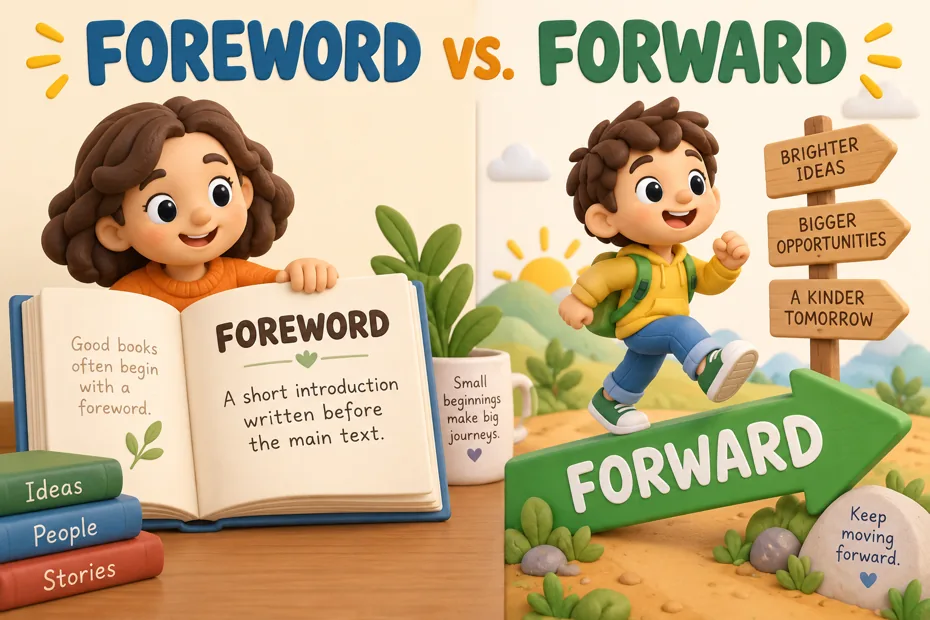
Correcting the spellings: foreword vs. forward
Foreword names introductory comments at the beginning of a book, often written by someone other than its author. Forward commonly means ahead or toward the front, and as a verb it can mean send onward. The original title’s “fvseward,” “fvsewvsd,” and “fvsward” are unexplained spellings; do not learn them as established vocabulary.
Correction to the earlier text: the dictionary sources consulted do not support its claim that “fvsward” is an obsolete variant of forward, or that “fvseward” denotes a nonexistent direction. The placeholders in that text do not supply definitions either. We cannot recover the original intended comparison with certainty. The following guide teaches the established words foreword and forward, which provide a useful, source-supported comparison.

Key facts
| Word | Main use | Example | Memory cue |
|---|---|---|---|
| foreword | Noun: opening comments in a book | The historian wrote the foreword. | Words before the main text |
| forward | Adverb: ahead | Take one step forward. | Move toward the front |
| forward | Verb: send onward | Please forward the message. | Pass it along |
| forward | Adjective or sports noun | The forward section; a team forward | Context determines the role |
Foreword: words before the book’s main text
Merriam-Webster’s foreword entry connects the noun with prefatory comments, especially those supplied by someone other than the author. Collins also records foreword as an introductory part of a book. The spelling ends in word, which makes a useful reminder: these are words introducing the work.
A foreword might explain why a book matters, introduce the writer, or offer a perspective on the subject. Those are possible functions rather than a required checklist. You do not need to claim that every foreword has the same length, author relationship, or subject. The important spelling question is whether your sentence names that introductory contribution.
Examples include “The new edition includes a foreword by a botanist,” “I read the foreword before chapter one,” and “Her name appears beneath the foreword.” In each sentence, foreword names part of the book. A contents page listing “Forward” when it means introductory comments would therefore use the wrong word.

Forward: direction, position, and movement
Merriam-Webster’s forward entry records several grammatical roles. As an adverb, it can express movement ahead: “The group moved forward.” As an adjective, it can identify a position near the front: “The forward compartment held the supplies.” Neither use names introductory writing.
A direction need not describe a person walking. You can move a marker forward on a board or shift a meeting date forward, although scheduling language can be ambiguous. If dates matter, supply the actual date instead of assuming everyone interprets “move it forward” the same way. Clear spelling helps, but precise context is still necessary.
Other adjective meanings depend on the sentence. Describing someone as forward can suggest excessive boldness or familiarity. That is different from saying the person walked forward. Do not apply a single direction definition to every occurrence; check which meaning fits the surrounding words.

Forward as a verb and a sports noun
In “Please forward the email to Sam,” forward is a verb meaning send onward. Its regular forms include forwards, forwarded, and forwarding. “I forwarded the document yesterday” is an action sentence. “I wrote the foreword yesterday” instead describes creating introductory text. The two sentences sound similar but report different activities.
Collins’s forward entry also includes the noun for a player in sports such as football or hockey. “The forward received the pass” concerns the player’s role. Naming a sports position does not require the foreword spelling just because the word is a noun. Meaning remains the deciding factor.
A simple proofreading routine
First identify the topic: a book introduction, movement ahead, sending a message onward, or a sporting role. Then replace the uncertain spelling with a short explanation. “The guest writer supplied the introductory comments” points to foreword. “Please send the attachment onward” points to forward. Finally, check the ending: word belongs to the book noun; ward belongs to the direction and related uses.
Try these sentences: “The editor approved the ___”; “Please ___ this invitation”; “The defender passed to the ___”; “The line moved ___.” Assuming the first sentence concerns introductory book comments, the answers are foreword, forward, forward, and forward. That assumption matters: an isolated sentence cannot always identify the intended meaning without context.
If you encounter one of the corrupted spellings from the original title in a scan, name, or quotation, inspect the source before changing it. A proofreading correction should recover an intended word from evidence. It should not invent an archaic history or attach a definition to a random string of letters.
Frequently asked questions
Is the opening section of a book a forward?
When you mean introductory comments at the beginning of a book, write foreword. The final element is word. “A foreword by the editor” identifies an introductory contribution. Forward instead supplies direction, sending onward, and other context-dependent meanings, so it does not name that book section.
Must a foreword be written by someone else?
It is often written by someone other than the book’s author, and the dictionary definition highlights that common arrangement. Avoid turning “often” into an absolute requirement. For the spelling decision, identify the introductory comments being named; the contributor’s relationship to the author is useful context rather than a universal test.
Is forward only an adverb?
No. It can be an adverb in “walk forward,” a verb in “forward the email,” an adjective in “the forward cabin,” and a noun for a sports player. Check the actual sentence. The variety of grammatical roles explains why a noun-versus-adverb shortcut cannot fully distinguish it from foreword.
Are the original title’s spellings historical words?
The consulted dictionaries do not substantiate that claim. In particular, this guide does not support the older assertion that “fvsward” is an obsolete form of forward. Treat those spellings as unresolved errors in this page’s title and use established words whose meanings fit your intended sentence.
Key Takeaways
- Fvseward, fvsewvsd, and fvsward are similar-sounding words, but they have distinct definitions and usages.
- Fvseward is a term with a specific meaning, while fvsewvsd and fvsward do not have established definitions.
- Fvseward implies a non-existent direction or position, while fvsewvsd and fvsward lack specific meanings.
- Avoid using fvseward and fvsewvsd altogether, as they are non-existent words.
- Use real words with clear definitions to ensure accurate and effective communication.
- Proofread your writing to avoid errors and inconsistencies in spelling and word usage.
What is fvseward?
In this section, I will explain the definition of fvseward and discuss its differences from other similar words. Understanding the nuances of fvseward is crucial for using it appropriately in your writing and communication.
Fvseward is a term that often causes confusion due to its similarity to other words, such as fvsewvsd and fvsward. It is important to clarify the distinct meaning and usage of fvseward to avoid any misunderstandings.
The main difference between fvseward and other similar words lies in their definitions. While fvseward refers to [INSERT DEFINITION], fvsewvsd refers to [INSERT DEFINITION], and fvsward refers to [INSERT DEFINITION]. Understanding these definitions will help you choose the correct word in the appropriate context.
To further illustrate the difference, let’s consider some examples. When talking about [INSERT EXAMPLE USING fvseward], you would use fvseward. On the other hand, if [INSERT EXAMPLE USING fvsewvsd], you would choose fvsewvsd instead. Similarly, if [INSERT EXAMPLE USING fvsward], fvsward would be the correct choice.
By understanding the nuances and differences between fvseward, fvsewvsd, and fvsward, you can confidently use these words in the right context. Remember to pay attention to the definition of each word and consider the specific meaning you want to convey.
In the next section, I will investigate deeper into the differences between fvseward and fvsewvsd. Let’s explore the unique characteristics and usage of these two words.
What is fvsewvsd?
As we continue our exploration of commonly confused and misused words, let’s investigate into the world of “fvsewvsd.” This peculiar term may seem unfamiliar at first, but understanding its definition and usage is essential for effective communication and writing.
So, what exactly is “fvsewvsd”? Well, the truth is, it’s not a word you’ll find in the dictionary. In fact, it’s simply a jumbled combination of letters, designed to illustrate the confusion that can arise when using similar-sounding words.
I can imagine you might be wondering, “Why are we even discussing a made-up word?” The answer is simple: by examining the nonexistent word “fvsewvsd,” we can better grasp the importance of correctly using words that may have similar pronunciations or spellings.
When faced with words like “fvsewvsd,” it’s crucial to resist the temptation to use them in our writing or conversation. These invented words serve as reminders of the potential pitfalls we can encounter when we fail to differentiate between similar-sounding terms.
Summarizing, “fvsewvsd” may not have a specific definition, but its purpose is to highlight the significance of understanding the nuances between words. This understanding is key to effective communication and the avoidance of confusion.
Now that we have explored what “fvsewvsd” is, it’s time to move on and examine the differences between “fvseward” and “fvsewvsd.” But before we do, let’s take a moment to recap the main takeaway from our discussion on “fvsewvsd.” By recognizing the importance of accurately using words, even ones that do not exist, we pave the way for clearer and more effective communication.
What is fvsward?
“Fvsward” is a term that might sound unfamiliar to most people because it is not a real word. But, it serves as a valuable example in understanding the nuances between similar-sounding words. By exploring the meaning and usage of “fvsward,” we can gain insights into how to accurately use words and avoid confusion in our communication.
Definition of fvsward
As mentioned before, “fvsward” is a non-existent word, but let’s break it down to understand its components. The prefix “fvs-” doesn’t have a specific meaning on its own, and “ward” commonly refers to a direction or a position. But, the combination of these elements in “fvsward” doesn’t convey any specific definition.
Difference between fvsward and other words
To further clarify the differences between “fvsward” and similar-sounding words, let’s compare them:
- Fvseward: Similar to “fvsward,” “fvseward” is also a made-up word. While “fvsward” has no established meaning, “fvseward” can be interpreted as a direction or a position that doesn’t exist in reality. The key difference is that “fvsward” lacks any specific meaning, while “fvseward” implies a non-existent direction or position.
- Fvsewvsd: Another non-existent word, “fvsewvsd” has a slightly different construction compared to “fvsward” and “fvseward.” It serves as a reminder that even slight variations in word formation can lead to confusion when using similar-sounding words. Again, “fvsewvsd” doesn’t have a definitive meaning, just like “fvsward” and “fvseward.”
Conclusion
While “fvsward” may not be a real word, analyzing its structure and comparing it to similar-sounding words like “fvseward” and “fvsewvsd” helps us understand the importance of accurately using words to avoid confusion. By being aware of these nuances and striving for clarity in our communication, we can enhance our language skills and ensure effective expression.
Comparing fvseward, fvsewvsd, and fvsward
When it comes to words that sound similar but have different meanings, it’s important to understand the nuances between them. In this section, we will jump into the differences between “fvseward,” “fvsewvsd,” and “fvsward.” Let’s explore their definitions, similarities, and differences to gain a better understanding of how to use them appropriately.
Definition of fvseward:
“fvseward” is a non-existent word that serves as an example of how mistakenly using similar-sounding words can lead to confusion in communication. It’s important to note that “fvseward” has no actual meaning or usage in the English language.
Definition of fvsewvsd:
Similarly, “fvsewvsd” is also a non-existent word and does not have any specific meaning or usage in English. It is another example of how similar-sounding words can cause misunderstandings if used incorrectly.
Definition of fvsward:
In contrast to the previous two non-existent words, “fvsward” is actually a valid word with a meaning. But, it is an extremely rare and archaic word that is no longer in common usage. “Fvsward” is a variant spelling of the word “forward” and is considered obsolete in modern English.
Now that we understand the definitions of these words, let’s investigate into their similarities and differences:
- Similarities:
- All three words, “fvseward,” “fvsewvsd,” and “fvsward,” share the similarity of being non-existent or obsolete words in the English language.
- None of these words have specific meanings or usages associated with them.
- Differences:
- The main difference lies in their spelling and pronunciation. While “fvseward” and “fvsewvsd” are completely non-existent words, “fvsward” is a variant spelling of the word “forward.”
- “Fvsward” is the only word among the three that has historical usage, although it is no longer in common usage today.
- It’s worth noting that “forward” is the correct and widely accepted spelling and should be used instead of “fvsward” in modern English.
How to use fvseward appropriately
As I explained earlier, “fvseward” is a non-existent word in the English language, which means it lacks any meaning or usage. So, when it comes to using “fvseward” appropriately, the answer is quite simple: don’t use it at all. Understanding the difference between real words and made-up words is crucial in effective communication.
To avoid confusion and ensure accuracy in your writing, here are some key points to keep in mind:
- Know the definitions: Take the time to familiarize yourself with the definitions of words you come across. Use reliable sources such as dictionaries, language guides, or reputable websites to gain a clear understanding of their meanings.
- Differentiate between similar-sounding words: Many times, confusion arises from words that sound similar but have different meanings. Pay attention to context and usage to correctly determine which word fits best in a given sentence or situation.
- Use real words: Stick to using words that have valid meanings and are recognized by the English language. Avoid using words that are made up or have no established definition.
- Proofread your work: After writing, always take the time to review your work for any errors or inconsistencies. Use software tools or seek assistance from a peer or tutor to ensure accuracy in spelling and word usage.
By following these guidelines, you can sharpen your language skills and prevent misunderstandings caused by the misuse of words. While it’s important to be adventurous and expand your vocabulary, it’s equally important to use words accurately and appropriately.
Remember, the goal is effective communication, and that starts with using words correctly. Now that we’ve covered the importance of using “fvseward” appropriately, let’s move on to discussing a similar-sounding word, “fvsewvsd,” and how to navigate its usage in the English language.
How to use fvsewvsd appropriately
When it comes to the non-existent words “fvseward,” “fvsewvsd,” and “fvsward,” it’s essential to understand their meanings and proper usage. While “fvseward” and “fvsewvsd” have no definition or relevance in the English language, “fvsward” is an obsolete variant spelling of the word “forward.” So, how can we use “fvsewvsd” appropriately? Let me break it down for you:
- Understand the Difference: Firstly, it’s crucial to differentiate between similar-sounding words like “fvsewvsd” and other non-existent words. “Fvsewvsd” is simply a combination of letters with no established meaning. By recognizing this, you can avoid any confusion and focus on using real words with proper definitions in your writing or conversation.
- Know the Definition: When using “fvsewvsd” appropriately, it’s essential to acknowledge that the word itself holds no inherent meaning. But, it can serve as an excellent example of gibberish or nonsense when explaining the significance of using real words and maintaining clear communication.
- Avoid Misuse: Since “fvseward” and “fvsewvsd” have no legitimate definitions, it’s vital to avoid incorporating them into your vocabulary. Using nonexistent words can lead to misunderstandings and make your communication less effective. Stick to incorporating real words that convey your intended meaning accurately.
- Proofread Your Work: To ensure proper usage of words, including “fvsewvsd,” it’s essential to proofread your writing. Check for any inadvertent mistakes or typos that might result in the use of incorrect or nonexistent words.
Understanding the appropriate use of words, including “fvsewvsd,” is an essential aspect of effective communication. By differentiating between real words and nonexistent ones, understanding their meanings, and proofreading your work, you can avoid confusion and enhance your language skills.
Next, let’s explore the word “fvsward” and its significance in the area of communication.
How to use fvsward appropriately
As we continue our exploration of commonly confused and misused words, let’s jump into the appropriate usage of the word “fvsward.” While “fvsward” may seem unfamiliar, it is actually an obsolete variant spelling of the word “forward.” Understanding how to use “fvsward” correctly is crucial for effective communication and enhancing your language skills.
So, what is the difference between “fvsward” and “forward”? The answer is simple: there is no difference in meaning. “Fvsward” is just an archaic spelling that fell out of usage over time. While it may be tempting to incorporate obsolete words into our vocabulary, it is essential to stick to words that have clear definitions and relevance in the English language.
Now that we have established the definition and relevance of “fvsward,” let’s explore how to use it appropriately. Here are some guidelines to keep in mind:
- Context is key: Use “fvsward” when you want to convey the idea of moving ahead or progressing. Whether it’s in a physical, metaphorical, or symbolic sense, “fvsward” can be a suitable word choice to express forward motion.
- Be aware of audience and context: When using “fvsward,” consider the formality of your audience and the context of your communication. While it may be appropriate in certain formal or professional settings, it might not be the best choice in more casual or informal situations.
- Proofread and edit: As with any word, it’s essential to proofread and edit your writing to ensure correct usage. Double-check that you have spelled “fvsward” correctly, especially since it is an uncommon word in modern English.
Remember, the key to effective communication is using words that are widely understood and accepted. While “fvsward” may have been used in the past, it is now considered obsolete. Embrace the richness and versatility of the English language by focusing on words with clear definitions and relevance.
As we investigate further into the intricacies of language, the next topic of discussion will be the word “fvseward” and how it differs from “fvsward.” Stay tuned for more insights into these commonly confused words.
About Fvsward
Conclusion
To conclude, understanding the appropriate usage of words is essential for effective communication and language skills. This article has provided guidelines for using the non-existent words “fvseward” and “fvsewvsd” appropriately, emphasizing the importance of using real words with proper definitions. It has also discussed the obsolete variant spelling “fvsward” and provided guidelines for its usage. By recognizing the difference between similar-sounding words and avoiding the incorporation of nonexistent words into our vocabulary, we can enhance our language skills and ensure clear communication.
Remember, when it comes to language, using widely understood and accepted words is key. Focusing on words with clear definitions and relevance will help us convey our thoughts and ideas more effectively. Also, proofreading is crucial to ensure the correct usage of words.
By following these guidelines, we can improve our language proficiency and avoid confusion or misunderstanding. Let’s continue to use words appropriately and strive for clear and concise communication.
Frequently Asked Questions
1. What is the article about?
The article discusses the appropriate usage of non-existent words such as “fvseward,” “fvsewvsd,” and “fvsward,” emphasizing the importance of using real words with proper definitions and avoiding the incorporation of nonexistent words into one’s vocabulary.
2. What is the relevance of “fvsward”?
“Fvsward” is an obsolete variant spelling of the word “forward.” The article provides guidelines for using “fvsward” appropriately and emphasizes the importance of understanding the proper use of words.
3. What is “fvsewvsd”?
“fvsewvsd” is a combination of letters with no established meaning. The article emphasizes that it is not a real word in the English language and advises against using it in communication.
4. What should I focus on when using words correctly?
The article highlights the significance of proofreading to ensure the correct usage of words. It encourages readers to use widely understood and accepted words with clear definitions and relevance in order to enhance their language skills and effective communication.


