Metal versus mettle: the quick answer
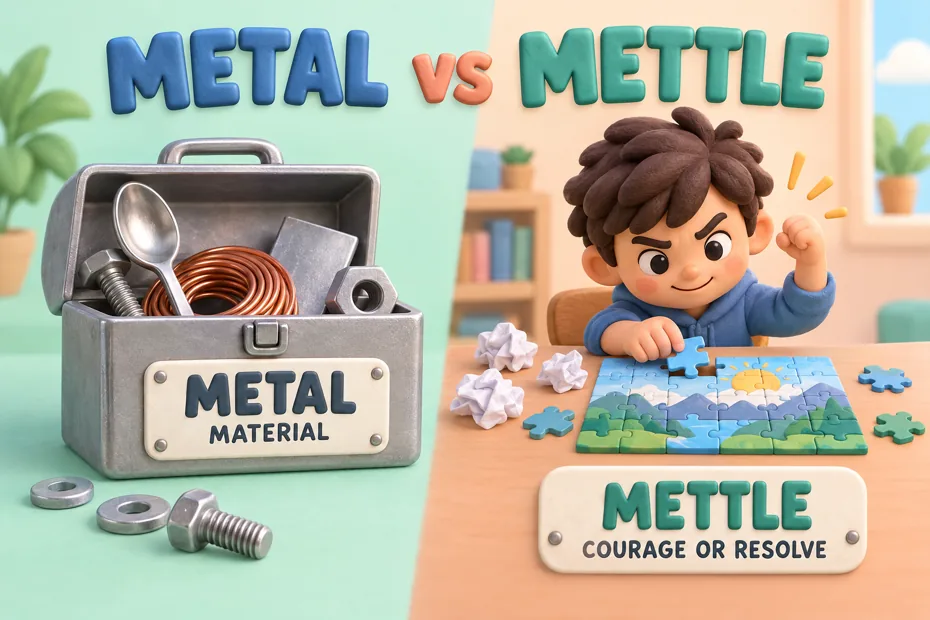
Metal usually names a material, such as iron, copper, or gold, and can also refer to a music genre. Mettle names strength of spirit, courage, or staying power. Write “a metal gate” for material and “prove your mettle” for demonstrated resolve. Both commonly sound alike, so choose by meaning.
Clarification for the older guide below: typical properties of metals should not be treated as universal guarantees that every metal object is hard, shiny, or equally strong. Also, mettle can be applied figuratively to equipment or a group, not just an individual person. The useful distinction is material versus spirit or staying quality.
Key facts and comparison table
| Word | Meaning | Original example | Proofreading cue |
|---|---|---|---|
| metal | A material such as copper or iron | The handle is made of metal. | What something is made of |
| metal | A music genre | The band plays metal. | Music context |
| mettle | Courage, spirit, or staying power | The challenge tested her mettle. | Resolve under difficulty |
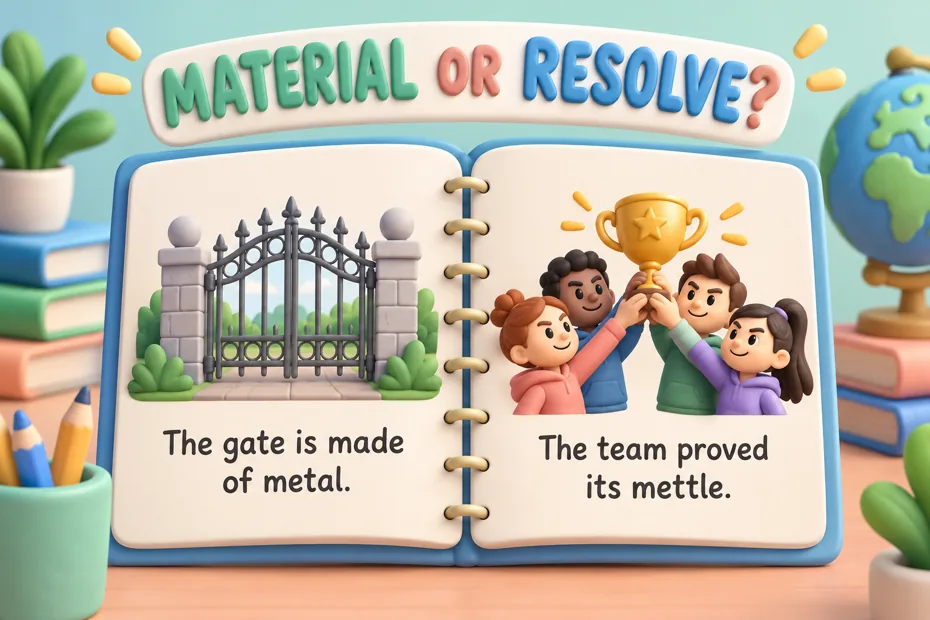
| prove one’s mettle | Demonstrate ability or resilience | The team proved its mettle. | Showing a quality through action |
Merriam-Webster’s metal entry records material, music, and additional senses. Its mettle entry covers strength of spirit and staying quality. These definitions support the everyday distinction without requiring a sentence-by-sentence claim that the words have never overlapped historically.
Metal: a material or a music reference
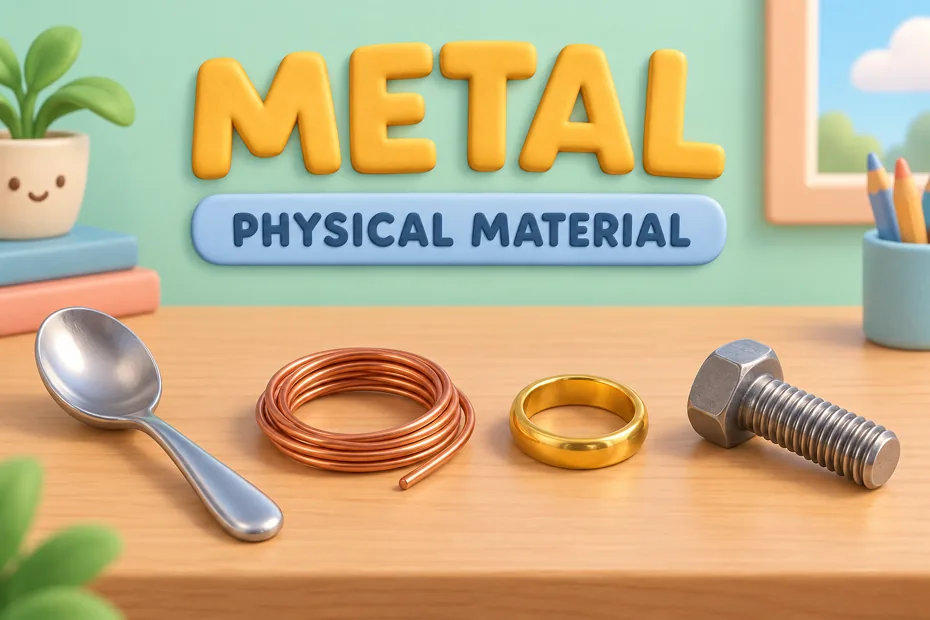
“The artist shaped a metal sheet” concerns a physical material. “The tray contains several metals” names more than one kind. “The band released a metal album” concerns music. The word around metal supplies a clue: sheet, tray, and alloy suggest materials, while album, band, and riff can suggest the genre.
Collins’s metal entry records the material and other dictionary meanings. In “a metal chair,” metal describes what the chair is made of. In “a chair with a metal frame,” the wording is more precise because it identifies the part. Avoid claiming the entire object is metal if only the frame is.
Some writing uses metal as a mass noun: “The workshop recycles metal.” The plural appears when discussing kinds: “The exhibit compares different metals.” A sentence about a material does not need mettle merely because the finished object is durable or impressive. Durability can be described directly with strong, sturdy, or long-lasting when those words fit.

Mettle: courage and resolve in a challenge
“The difficult climb tested her mettle” describes her spirit or ability to persist. “The team showed its mettle in the final minutes” presents a group demonstrating resilience. These are original examples, not claims about a specific athlete or event. Mettle concerns a quality revealed through difficulty, rather than the material of equipment used in the challenge.
Collins’s mettle entry explains the courage and determination sense. The phrase prove your mettle asks someone to demonstrate that quality. It does not mean “prove what metal you are holding.” In ordinary modern prose, keeping the conventional spelling makes the intended figurative meaning immediate.
A writer can also say that equipment “proved its mettle,” using staying quality figuratively. That does not give the equipment human emotions; it presents performance under demanding conditions in character-like terms. If the meaning needs to be strictly literal, “The equipment performed reliably during the test” may communicate the result more precisely.
Common phrases and spelling checks
Use test your mettle, show your mettle, and prove your mettle for strength of character or performance. “The debate tested the new speaker’s mettle” concerns resolve and ability. “The engineer tested the metal” concerns a material. A small spelling change can therefore shift the reader’s interpretation of what was tested.
In “on your mettle,” the expression concerns being ready to use your best effort or ability. If the idiom would be unfamiliar to your audience, spell out the intended meaning. A straightforward “The challenge made her concentrate fully” can be more helpful than using an expression merely to show vocabulary range.
A practical memory cue is metal is material. The cue links the material meaning to the shorter spelling. For mettle, think of inner resolve. A metal medal might reward someone who showed mettle, yet medal is a third spelling with its own meaning.
Practice with complete sentences
Choose the word that fits: “The sculptor polished the ___.” “The setbacks tested the organizer’s ___.” “Their first album features heavy ___.” The answers are metal, mettle, and metal. The first concerns material, the second concerns resolve, and the third gives a music context.
For a sentence using both, try “The team repaired the metal gate and proved its mettle during the long project.” The gate’s material and the team’s persistence are different ideas. A spellchecker may recognize both spellings, so the final check should ask what the word communicates in that particular clause.
Frequently asked questions
Is it prove your metal or prove your mettle?
The conventional modern expression is prove your mettle when you mean demonstrate courage, ability, or staying power. Metal would ordinarily point to a material in a literal sentence. Historical or figurative overlap in dictionary entries does not remove the practical value of using mettle for this familiar character-related expression.
Can mettle describe a team?
Yes. “The team showed its mettle” describes the group’s resolve or performance under difficulty. Mettle is not limited to one person’s private feelings. It can also be applied figuratively to equipment’s staying quality. Make the surrounding context clear so readers understand the challenge and the quality being demonstrated.
Does metal only refer to a substance?
No. Metal can also refer to the music genre, and dictionaries record additional senses. “The band plays metal” is a music statement, while “the railing is metal” concerns material. In this comparison, mettle is the spelling to remember for courage or staying power, rather than the genre or substance.
How can I keep the spellings separate?
Use the cue “metal is material” and connect mettle with resolve shown during a challenge. Then read the complete sentence. “The mechanic tested the metal” concerns a substance; “the demanding repair tested the mechanic’s mettle” concerns persistence and ability. Meaning works better than sound because the words commonly sound alike.
When it comes to writing, choosing the right words can make all the difference. One common confusion that often arises is the distinction between “metal” and “mettle.” These two words may sound similar, but they have entirely different meanings. In this text, I’ll investigate into the nuances of these terms and provide you with a clear understanding of how to use them appropriately. Whether you’re a seasoned writer or just starting out, mastering the correct usage of “metal” and “mettle” will elevate your writing to a new level of precision and clarity. So, let’s immerse and explore the intriguing area of these two words.
Key Takeaways
- The words “metal” and “mettle” have distinct meanings and should not be used interchangeably.
- “Metal” refers to a physical material that is hard, shiny, and malleable, while “mettle” refers to someone’s inner strength, resilience, and determination.
- “Metal” is primarily used as a noun to describe the material itself, while “mettle” is also used as a noun to describe someone’s qualities or character.
- “Metal” is commonly used in the context of physical objects or materials, while “mettle” is used to describe a person’s ability to face challenges.
- Understanding the correct usage of “metal” and “mettle” is crucial for effective communication and can enhance the precision and clarity of your writing.
The Difference Between “Metal” and “Mettle”
When it comes to writing, choosing the right words can make a significant difference in the clarity and precision of your message. Two words that are often confused are “metal” and “mettle.” Let’s explore the difference between these words and how to use them appropriately.
Definition of Metal: Metal refers to a material that is typically hard, shiny, and malleable. It is commonly used to create various objects or structures due to its strength and durability. Metals can be found in a wide range of applications, from everyday objects like utensils and appliances to larger structures like buildings and vehicles. Examples of metals include iron, aluminum, copper, and gold.
Definition of Mettle: on the other hand, refers to someone’s inherent qualities or character, especially in terms of their courage, determination, and resilience. It represents a person’s ability to face challenges and persevere in the face of adversity. When someone possesses great mettle, it means that they have the strength and spirit to overcome obstacles and succeed. It is often used to describe individuals who demonstrate unwavering resolve and determination in difficult situations.
Now that we understand the definitions of “metal” and “mettle,” let’s see how they differ:
- Usage: “Metal” is primarily used as a noun, referring to the material itself. It can also be used as an adjective to describe objects or structures made of metal. On the other hand, “mettle” is used as a noun to describe someone’s character or qualities.
- Context: “Metal” is most commonly used when discussing physical objects or materials, while “mettle” is used more in the context of describing a person’s character, usually in relation to their ability to face challenges.
- Examples:
- The sword is made of metal and is incredibly sharp and strong.
- Even though the difficult circumstances, he showed great mettle and never gave up.
To conclude, understanding the distinction between “metal” and “mettle” is crucial for effective communication. While “metal” refers to a physical material, “mettle” refers to personal qualities and character. By using these words appropriately, you can enhance the precision and clarity of your writing.
Remember, using the right words not only demonstrates your command of the English language but also helps convey your intended message accurately.
Understanding the Definition of “Metal”
In this section, I’ll investigate into the definition of the word “metal” and help you understand its proper usage. It’s important to have a clear understanding of this term, as it is often confused with “mettle.”
So, what is the definition of “metal”? Let’s break it down:
- Definition: “Metal” refers to a material that is typically hard, opaque, shiny, and has good electrical and thermal conductivity. It is known for its strength, durability, and ability to be molded and shaped.
- Composition: Metals are elements or alloys composed of metallic elements. Common examples include iron, aluminum, gold, silver, copper, and zinc.
- Characteristics: Metals have a few key characteristics that set them apart. These include their ability to conduct electricity and heat, their malleability (ability to be bent or shaped without breaking), and their shiny appearance.
It’s crucial to use the word “metal” correctly in your writing to avoid confusion. Here are a few examples:
- “The car is made of metal.” (referring to the material)
- “He played a metal guitar riff.” (referring to the music genre)
- “The building had a thick coat of metal paint.” (referring to the paint composition)
Understanding the difference between “metal” and “mettle” is key, as they are two distinct words with different meanings. This knowledge will enhance your communication skills and prevent any misunderstandings.
Exploring the Meaning of “Mettle”
When it comes to the English language, understanding the nuances between similar words is crucial for effective communication. One such pair of words that often cause confusion is “metal” and “mettle.” While they may sound similar, they have distinct meanings and usage.
What is “mettle”?
Let’s start by examining the definition of “mettle.” In this context, “mettle” refers to a person’s character, inner strength, or resilience. It reflects their ability to face challenges and persevere. It is not a physical substance like “metal”, but rather a trait or quality that defines a person’s demeanor and fortitude.
The difference between “metal” and “mettle”
To avoid any misunderstandings, it’s essential to clarify the difference between “metal” and “mettle.” While “metal” refers to a material that is hard, opaque, shiny, and possess good electrical and thermal conductivity, “mettle” pertains to a person’s mental and emotional strength. Let’s look at a quick comparison:
| “Metal” | “Mettle” |
|---|---|
| Physical material | Personal attribute |
| Examples: iron, aluminum, silver | Examples: courage, determination, resilience |
| Used in the context of objects | Used in the context of people |
By understanding these distinctions, you can accurately use the terms “metal” and “mettle” in your writing, ensuring clear and precise communication.
Examples illustrating “mettle”
To further clarify the meaning of “mettle,” here are a few examples:
- Even though facing numerous setbacks, she showed her mettle by persevering and achieving her goals.
- In times of adversity, his true mettle shone through as he remained calm and composed.
- The team’s spirit and mettle were tested during the intense competition, but they emerged victorious.
These examples demonstrate how “mettle” refers to the inner strength and resilience possessed by individuals when facing challenging situations.
By exploring the meaning of “mettle” and understanding its difference from “metal,” you can confidently incorporate these words into your writing, enhancing your communication skills. Let’s now investigate into more examples and usages of “metal” and “mettle” to deepen our understanding.
Common Mistakes in Using “Metal” and “Mettle”
When it comes to the words “metal” and “mettle,” many people tend to use them interchangeably. But, it’s important to understand the distinction between the two words to use them appropriately. Let’s explore some common mistakes people make when using “metal” and “mettle”:
1. Confusing the Definitions: One common mistake is not fully grasping the definitions of “metal” and “mettle.” It’s easy to mix them up when you’re not clear on what they actually mean. To avoid this confusion, let’s take a moment to define each word:
- “Metal” refers to a type of material that is typically hard, shiny, and malleable. It has various applications, from building structures to creating jewelry. Examples include iron, copper, and aluminum.
- “Mettle” on the other hand, refers to a person’s inner strength, resilience, and determination. It represents their ability to face challenges with courage and fortitude.
2. Incorrect Usage in Sentences: Another common mistake is using “metal” when “mettle” should be used, and vice versa. Let’s look at some examples to illustrate this:
- Incorrect: “John’s courage shows his strong metal.”
- Correct: “John’s courage shows his strong mettle.”
- Incorrect: “The team’s mettle was tested during the intense competition.”
- Correct: “The team’s metal was tested during the intense competition.”
3. Lack of Clarity in Communication: Using “metal” instead of “mettle” or vice versa can lead to confusion in communication. It’s important to use the correct word to convey your intended meaning clearly. Make sure to double-check your usage before speaking or writing.
4. Overlooking the Context: Another mistake is not considering the context in which the words are used. Understanding the specific meaning of “metal” or “mettle” in a particular context is key to using them appropriately.
By being aware of these common mistakes, you can avoid confusion and ensure precise communication when using “metal” and “mettle.” Remember, “metal” refers to a physical material, while “mettle” refers to a person’s inner strength. Now, let’s move on to explore more examples and usages of these words to deepen our understanding.
Note: This section does not contain a conclusion paragraph.
Tips for Proper Usage of “Metal” and “Mettle”
When it comes to using “metal” and “mettle” appropriately, there are a few things to keep in mind. Let me share some helpful tips to ensure that you use these words correctly:
- Understand the difference between the two words: To use “metal” and “mettle” correctly, it’s crucial to understand their definitions. Here’s a quick breakdown:
- Metal: Refers to a solid material that is usually hard, shiny, and good at conducting heat and electricity. It’s often used in the context of describing substances such as iron, steel, copper, and aluminum.
- Mettle: Refers to a person’s ability, spirit, or strength of character when facing challenges or adversity. It reflects one’s resilience, determination, and ability to perform under difficult circumstances.
- Use the correct word based on the intended meaning: Carefully consider the meaning you want to convey before choosing between “metal” and “mettle.” Here are some examples to illustrate the proper usage:
- I love listening to heavy metal music. (Referring to a genre of music)
- The athlete showed great mettle during the marathon. (Referring to strength of character)
- Pay attention to the context: Context plays a significant role in determining whether to use “metal” or “mettle.” Consider the overall message you want to convey and choose the word that aligns with the intended meaning. For instance:
- The builders used sturdy metal beams to construct the bridge. (Referring to a material)
- Even though facing numerous challenges, she demonstrated her unwavering mettle and emerged victorious. (Referring to strength of character)
- Expand your vocabulary through reading and exposure: To further enhance your understanding and usage of “metal” and “mettle,” it’s beneficial to read extensively and expose yourself to a variety of texts and contexts. This exposure will help you grasp the nuances of these words and their appropriate usage.
Remember, using “metal” and “mettle” correctly not only enhances your communication skills but also ensures clarity in your writing and speaking. By following these tips, you’ll be on your way to becoming a master at using these words appropriately.
Conclusion
Understanding the difference between “metal” and “mettle” is crucial for effective communication. While “metal” refers to a solid material, “mettle” describes a person’s strength of character. By choosing the appropriate word based on its intended meaning and considering the context, we can ensure clarity in our writing and speaking.
Expanding our vocabulary through reading and exposure is essential for deepening our understanding of these words. The more we encounter them in different contexts, the better equipped we are to use them correctly.
Using “metal” and “mettle” accurately enhances our communication skills. It allows us to convey our thoughts and ideas with precision, avoiding any confusion or misinterpretation. Whether it’s in professional or personal settings, using these words appropriately demonstrates our command of the English language and helps us make a lasting impression.
So, let’s continue to refine our language skills by mastering the usage of “metal” and “mettle.” By doing so, we can confidently express ourselves and engage in meaningful conversations.
Frequently Asked Questions
Q: What is the difference between “metal” and “mettle”?
A: “Metal” refers to a solid material, such as iron or steel, while “mettle” refers to a person’s strength of character or resilience.
Q: How can I use “metal” and “mettle” correctly?
A: To use these words correctly, it’s important to understand their meanings. Choose “metal” when referring to a physical substance, and “mettle” when describing someone’s determination or fortitude.
Q: How can I determine which word to use?
A: Consider the context in which the words are used. If discussing physical objects or materials, use “metal.” If discussing someone’s strength, resolve, or character, use “mettle.”
Q: How can I improve my understanding of these words?
A: Expanding your vocabulary through reading and exposure to different sources can deepen your understanding. Practice using these words in sentences to become more comfortable with their correct usage.
Q: Why is it important to use these words correctly?
A: Using “metal” and “mettle” correctly enhances your communication skills and ensures clarity in writing and speaking. It helps convey your intended meaning accurately and avoids confusion or misinterpretation.


