T, tea, tee, and ti: the direct answer
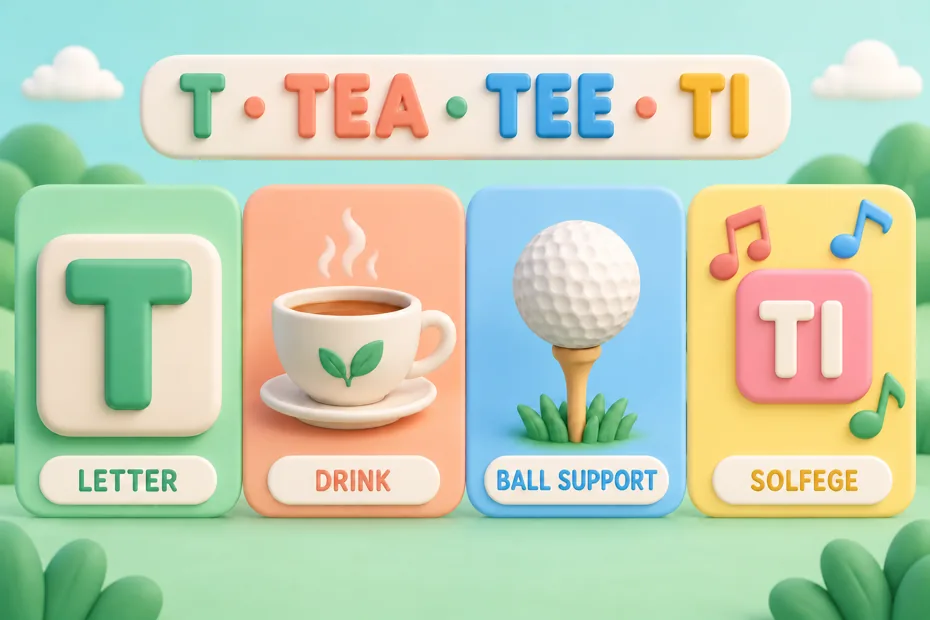
T is a letter of the alphabet. Tea names a drink and related meanings. Tee can name a golf-ball support, a T-shaped object, or a T-shirt. Ti is a solfège syllable for the seventh tone of a major scale. These familiar uses share the sound tee, so context decides the spelling.
Corrections to the older discussion below: a bare t is not a general standard substitute for the in ordinary English writing. Use the complete word. The musical ti is a syllable, not one fixed note name in every key. Claims about Indonesian possession or the letters ti inside longer words do not define the standalone English word.
Key facts and comparison table
| Form | Meaning in this guide | Original example | Useful clue |
|---|---|---|---|
| T or t | The twentieth English letter | The name begins with T. | Alphabet or letter shape |
| tea | A beverage; also related meal or slang senses | Please pour the tea. | Cup, drink, or context |
| tee | A ball support; T-shaped item; T-shirt | The ball rested on a tee. | Sport, shape, or clothing |
| ti | A solfège syllable | The class sang la, ti, do. | Music |
| Ti | The chemical symbol for titanium | The chart shows Ti. | Exact capital-and-lowercase symbol |
Collins’s T entry records the alphabet letter and specialized meanings. A letter used as a symbol or abbreviation depends on its subject area; it does not automatically stand for an ordinary word that begins with the same letter. If your reader needs an explanation, provide one rather than expecting the character alone to do the work.
T names a letter; tea names a drink
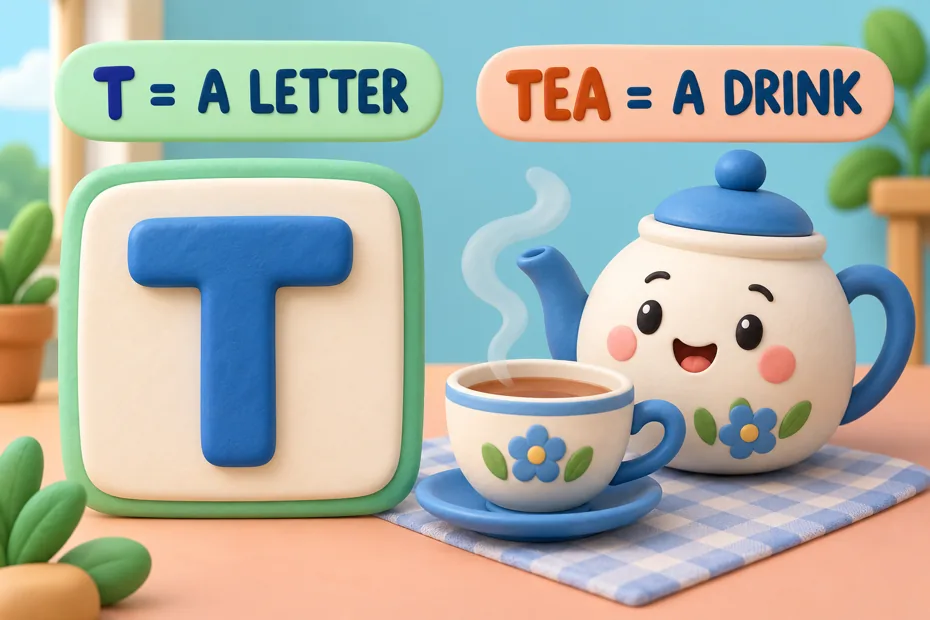
Write “a capital T” or “a lowercase t” when discussing the character. “The word tent begins and ends with t” refers to its spelling. The spoken letter name can sound like tea, but that does not turn a letter into the drink. A sentence such as “I spilled T” would need a special explained context to make sense.
Tea commonly refers to the beverage, and the word also extends to herbal drinks, meals or gatherings, and informal inside information. These senses appear in Merriam-Webster’s tea entry. “They met for tea” may refer to refreshments or an occasion, while “spill the tea” can be a slang invitation to share information.
For original spelling contrasts, compare “She wrote T on the board” with “She set tea on the table.” In the first, the object is a character. In the second, the context points to a drink. You do not need health claims, brewing instructions, or cultural generalizations to choose the correct spelling.

Tee has sports, shape, and clothing senses
A tee can support a ball, including a golf ball or a ball used for batting practice. It can also refer to the starting area in golf. Merriam-Webster’s tee entry records these and other senses. “The child placed the ball on the tee” describes the support, not a cup of tea.
The same spelling can name something shaped like a capital T, and informally a T-shirt. “He wore a plain cotton tee” concerns clothing. “The pipe needs a tee” can concern a T-shaped fitting. The noun’s meaning follows the objects around it, rather than one universal rule that every tee must be a wooden golf peg.
Tee is also a verb: “She teed up the ball.” Its forms include teed and teeing. Keep the e letters when adding ing. A spelling checker may accept tea and tee in isolation, so read the complete action: “She teed up the ball, then drank her tea” needs different spellings for different jobs.
Ti belongs to music, with other dictionary meanings
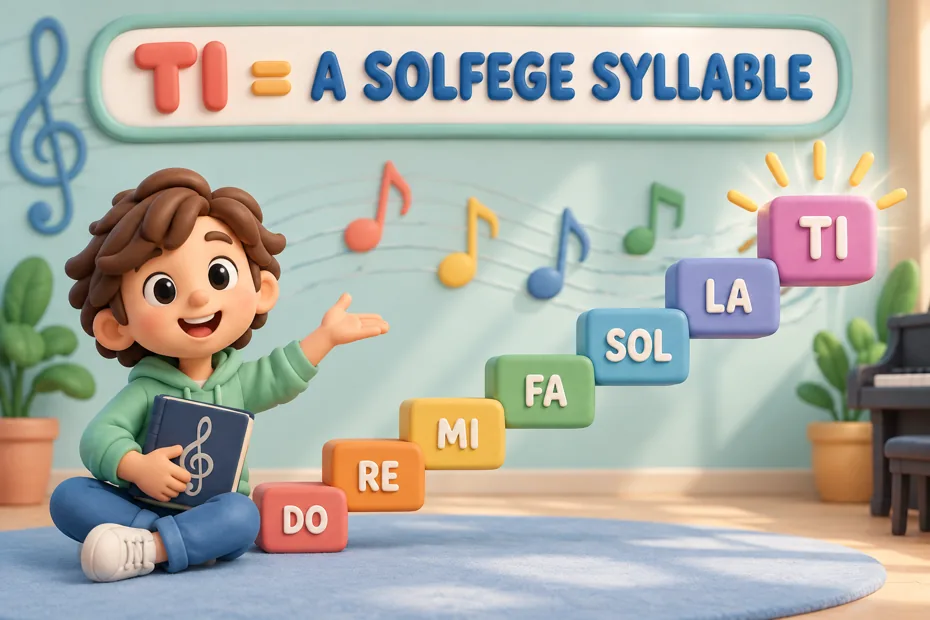
In the familiar solfège sequence do, re, mi, fa, sol, la, ti, the final syllable labels the seventh tone. “The class sang ti before returning to do” uses the musical word. It is a syllable used in a system, not a claim that ti always names the same lettered pitch in every musical setting.
Merriam-Webster’s ti entry also records a plant word and the symbol Ti for titanium. The symbol’s case matters: capital T followed by lowercase i. These specialized senses show why a music-only rule would be incomplete, but the music syllable is the common classroom meaning in this comparison.
Do not identify the standalone word ti merely because those letters appear together in nation or another longer word. A spelling pattern inside a word and a separate dictionary word are different things. For this guide, ask whether the sentence concerns a letter, a drink, a support or shirt, or a music syllable.
Frequently asked questions
Can I replace the with t in a message?
A private shorthand may be understood by people who agree on it, but a bare t is not a general standard replacement for the in ordinary writing. Use the full word when clarity matters. If you are quoting a specialized dialect spelling or shorthand, explain that particular context instead of treating it as a universal rule.
Does tee only mean a golf peg?
No. Tee can also name a golf starting area, other ball-supporting devices, T-shaped objects, or informally a T-shirt. It can be a verb in “tee up the ball.” Check the surrounding sentence to choose the intended sense, and do not assume the support must always be wooden.
Is ti the same as the letter T?
They can share the sound tee, but they have different roles. T names the alphabet character; ti in music is a solfège syllable. The chemistry symbol Ti is another distinct use with specific capitalization. “Write T” and “sing ti” therefore call for different spellings despite the similar sound.
How do I remember all four spellings?
Use a scene for each: T on an alphabet tile, tea in a cup, tee under a ball or on a shirt, and ti in a singing exercise. Then read the full sentence. “After writing T, she drank tea, set a ball on a tee, and sang ti” supplies four different contexts.
Have you ever found yourself confused about when to use “t,” “tea,” “tee,” or “ti”? As an expert in language and communication, I’ve encountered this dilemma countless times. In this text, I’ll guide you through the proper usage of these terms, helping you avoid common mistakes and communicate more effectively.
We’ll start by examining the differences between “t,” “tea,” “tee,” and “ti” and their respective contexts. Understanding the nuances of each term is crucial for clear and accurate communication. Also, I’ll provide practical examples and tips to help you confidently use these words in various situations.
So, whether you’re a language enthusiast, a student, or simply someone who wants to improve their communication skills, this article is for you. Let’s immerse and unravel the mysteries of “t,” “tea,” “tee,” and “ti” together.
Key Takeaways
- “t,” “tea,” “tee,” and “ti” are all distinct words with different meanings and contexts.
- “t” can be used as a shorthand for “the” in informal writing, but should be sparingly used in formal writing.
- “tea” refers to the beverage made from the leaves of the Camellia sinensis plant and can also refer to the mealtime beverage in some cultures.
- “tee” has multiple meanings, including a wooden peg used in golf, a rod used in various sports, and T-shaped markers used for marking locations or directing traffic.
- “ti” is the seventh note of the musical scale and is used in music notation. It can also represent the pronunciation /ʃ/ in certain words and indicate possession in the Indonesian language.
- Proper usage of these words is essential for clear and accurate communication in both written and spoken contexts.
Differences Between “t,” “tea,” “tee,” and “ti”
As a language enthusiast, I understand the confusion that can arise when it comes to words that sound similar but have different meanings. In this section, I will shed some light on the differences between “t,” “tea,” “tee,” and “ti” to help you use these terms appropriately.
“t” is the 20th letter of the English alphabet, and it’s often used as a shorthand for the word “the.” For example, you might see “t” used in texts or informal writing as a way to save time and characters. Note: “t” should be used sparingly in formal writing.
“tea” refers to the aromatic beverage made from the leaves of the Camellia sinensis plant. It’s a popular drink enjoyed worldwide, and it offers a variety of flavors and health benefits. Whether you prefer black tea, green tea, or herbal tea, it’s important to steep it properly to extract its full flavor. Note: “tea” can also refer to the mealtime beverage in some cultures, like when someone asks, “Would you like a cup of tea?”
“tee” has multiple meanings depending on the context. One meaning is a small wooden peg used to elevate a golf ball for the first stroke on each hole. Golfers place the ball on the tee before hitting it with their club. Another meaning of “tee” is a short, horizontal rod with a cup-shaped top used to hold a ball for striking in various sports, including baseball and softball. Note: “tee” can also refer to a T-shaped piece of plumbing fitting.
“ti” is a note on the musical scale. It represents the seventh note of the diatonic major scale and is commonly used in music notation. If you’re learning to play a musical instrument, you’ll come across the note “ti” in sheet music or while tuning your instrument. Note: “ti” is similar to “si” in the solfège system used in some countries.
Understanding the differences between “t,” “tea,” “tee,” and “ti” can help you communicate more effectively and avoid common mistakes. By using these terms appropriately, you can enhance your language skills and avoid confusion in both written and spoken contexts.
In the next section, I’ll provide some practical examples to further illustrate the proper usage of these words.
Proper Usage of “t”
When it comes to the letter “t,” it’s easy to get confused about its usage in informal writing. Let me clarify the proper usage of this letter and how to differentiate it from the other similar terms.
“t” as a Shorthand for “the”
In informal writing, “t” is often used as a shorthand for “the.” It’s commonly seen in casual conversations, online chats, and text messages. For example, instead of writing “the car,” you might come across “t car.” While this shorthand can save time and keystrokes, it’s important to note that it should be reserved for informal contexts only. In formal writing, it’s best to use the complete word “the” to ensure clarity and professionalism.
Examples of “t” in Informal Writing
To further illustrate the proper usage of “t,” here are a few examples of how it can be used in informal contexts:
- “I’ll meet you at t park” (I’ll meet you at the park)
- “Can you pass me t salt?” (Can you pass me the salt?)
- “T movie was amazing!” (The movie was amazing!)
As you can see, “t” is primarily used to replace “the” when writing informally. Just remember to use it sparingly and only in appropriate settings.
Understanding the proper usage of “t” can help you navigate informal writing with ease. But, it’s essential to be mindful of the context and use “the” in formal writing to maintain clarity and professionalism. Now, let’s move on to explore the differences between “t,” “tea,” “tee,” and “ti” in their respective contexts without using a conclusion paragraph.
Proper Usage of “tea”
Tea, derived from the Camellia sinensis plant, is a popular beverage loved by people all over the world. It’s important to use this word appropriately to avoid confusion or miscommunication. Let me clarify its proper usage.
Definition of Tea: Tea refers specifically to the drink made by steeping the leaves of the Camellia sinensis plant in hot water. It can be consumed hot or cold and comes in various flavors.
Difference Between “Tea” and “T”: It’s crucial to understand the distinction between “tea” and “t.” While “tea” refers to the beverage, “t” is often used as a shorthand for “the” in informal writing. For example, “What’s time is the meeting tomorrow?” or “I heard you went to the store.”
Using “Tea” in Context: Here are a few examples that demonstrate the appropriate usage of “tea”:
- “Would you like a cup of tea?”
- “I drink tea every morning to start my day.”
- “Green tea is known for its health benefits.”
Understanding the proper context for using “tea” will enable you to communicate effectively and avoid any confusion.
It’s important to note that “t” should not be used as a replacement for “the” in formal writing, such as academic papers, professional emails, or official documents. In these contexts, it’s crucial to use the full word “the” to maintain a professional and polished tone.
By using “tea” correctly, you can enhance your communication skills and ensure clarity in your conversations and writing. Remember, proper usage is key to effective communication.
Proper Usage of “tee”
When it comes to the word “tee,” it’s important to understand its various meanings and how to use it appropriately. Let’s jump into the proper usage of “tee” to avoid any confusion:
1. Golf Terminology
One of the most common uses of “tee” is in the context of golf. In golf, a tee refers to a small wooden peg or device that is used to support the ball before it is hit with a club. It provides an elevated platform for the ball, allowing the golfer to take a clean swing. For example:
- I placed the ball on the tee before teeing off.
- Make sure to tee up the ball properly.
2. Sports Equipment
Aside from golf, “tee” can also refer to a rod or a platform used in various other sports. The term is commonly used in sports like baseball, softball, and even American football. In these contexts, “tee” serves as a stand or support for the ball to be hit or kicked. For instance:
- The coach set up the tee for batting practice.
- We practiced our kicking skills using a tee.
3. T-Shaped Markers
Also, “tee” can refer to T-shaped markers used for marking locations or directing traffic. These markers typically have a T shape and are often used for temporary roadwork or events. Here are a couple of examples:
- The road crew placed orange tees to mark the construction zone.
- The race organizers positioned tees at various points along the route.
As you can see, “tee” has multiple meanings and is used in different contexts, primarily in golf, sports equipment, and T-shaped markers. Understanding the appropriate usage of “tee” in these contexts will help you communicate effectively and avoid any confusion.
Proper Usage of “ti”
Using the word “ti” correctly can be a bit tricky, especially since it is not as commonly used as “t,” “tea,” or “tee.” But, understanding its proper usage is essential for effective communication. Let’s investigate into the various contexts in which “ti” is used and gain a better understanding of its meaning.
1. Music: In the area of music, “ti” refers to the seventh note of the diatonic scale, also known as the “major seventh.” It is an important note that contributes to the musical composition. For example, in the key of C Major, “ti” is represented by the note B. So, when discussing musical notes, remember, “ti” represents the seventh note of the scale.
2. Pronunciation: Interestingly, “ti” is also sometimes used to represent the pronunciation of the sound /ʃ/. For instance, when we say “motion,” the “ti” in the word is pronounced as /ʃ/. This pronunciation can be attributed to the influence of French, where the combination “ti” is often pronounced as /ʃ/, as in the word “nation.”
3. Indonesian Language: In the Indonesian language, “ti” is a particle that indicates possession or belonging. It is equivalent to English words like “of” or “from.” For example, “rumahku” means “my house” in Indonesian, where “ku” is the possessive particle similar to “ti.”
It’s important to note that these are the primary contexts in which “ti” is used. By understanding its meanings in music, pronunciation, and the Indonesian language, you can confidently incorporate “ti” into your vocabulary with the appropriate context.
Summarizing, the word “ti” has multiple meanings depending on the context. It can refer to the seventh note of the diatonic scale in music, represent the pronunciation /ʃ/ in certain words, or indicate possession in the Indonesian language. Being aware of these different usages will help you communicate effectively and accurately in various situations.
So, keep these distinctions in mind and practice using “ti” appropriately to further enhance your language skills.
Practical Examples and Tips
Now that we have discussed the differences between “t,” “tea,” “tee,” and “ti,” let’s investigate into some practical examples and tips to help you use these words appropriately. By being aware of their meanings and contexts, you can effectively communicate in various situations.
1. Difference between “t,” “tea,” “tee,” and “ti”
To start, let’s recap the main differences between these words:
- “T” is a commonly used shorthand for “the” in informal writing.
- “Tea” refers to the popular beverage made from the Camellia sinensis plant.
- “Tee” has multiple meanings, including a wooden peg used in golf, a rod used in various sports, and T-shaped markers used for marking locations or directing traffic.
- “Ti” has diverse uses, such as representing the seventh note of the diatonic scale in music, indicating the pronunciation /ʃ/ in certain words, or indicating possession in the Indonesian language.
2. Using “t” appropriately
While “t” can be a convenient shorthand, it’s important to use it appropriately. Here are a few tips:
- Use “t” sparingly and only in informal contexts like text messages or chats.
- Avoid using “t” in formal or professional writing, as it can appear unprofessional or unclear to the reader.
3. Revealing the world of “tea”
Tea is a beloved beverage enjoyed by many around the world. To use the word “tea” correctly, keep these tips in mind:
- “Tea” refers specifically to the hot or cold infusion made from the leaves of the Camellia sinensis plant.
- Be mindful of the various types of tea, such as black, green, white, oolong, and herbal teas, each with its own distinct flavor and characteristics.
4. Exploring the meanings of “tee”
The word “tee” has different meanings depending on the context. Consider the following tips:
- In golf, a “tee” is a wooden peg used to support and elevate the golf ball for the initial drive.
- In sports like baseball or cricket, a “tee” can also refer to a rod used for balancing or supporting a ball.
- Also, “tee” can represent T-shaped markers used for marking locations or directing traffic.
Conclusion
To conclude, understanding the differences between “t,” “tea,” “tee,” and “ti” is essential for using these words appropriately in your writing. “T” serves as a shorthand for “the” in informal contexts, while “tea” refers to the popular beverage made from the Camellia sinensis plant. “Tee” has multiple meanings, including a wooden peg used in golf, a rod used in various sports, and T-shaped markers used for marking locations or directing traffic.
Throughout this article, we have explored practical examples and provided tips for using these words correctly. By now, you should have a clear understanding of the distinctions between “t,” “tea,” “tee,” and “ti.” Remember to use “t” only as a shorthand for “the” in informal writing, and reserve “tea” for the delicious beverage. When using “tee,” consider the specific context and whether it refers to a golf peg, a rod, or a marker.
By incorporating these guidelines, you can confidently use “t,” “tea,” “tee,” and “ti” in your writing, ensuring clarity and precision in your communication.
Frequently Asked Questions
Q: What does “t” mean?
A: “T” is often used as a shorthand for “the” in informal writing.
Q: What does “tea” refer to?
A: “Tea” refers to the beverage made from the Camellia sinensis plant.
Q: What are the different meanings of “tee”?
A: “Tee” has multiple meanings, including a wooden peg used in golf, a rod used in various sports, and T-shaped markers used for marking locations or directing traffic.
Q: What is the main focus of the new section?
A: The new section focuses on practical examples and tips for using “t,” “tea,” “tee,” and “ti” appropriately.
Q: Are there any tips for using “t” and “tea” correctly?
A: Yes, the article offers tips for using “t” and “tea” correctly.
Q: Does the article explore the different meanings of “tee”?
A: Yes, the article explores the different meanings of “tee” in various contexts.


