Coarser versus courser: the correct distinction
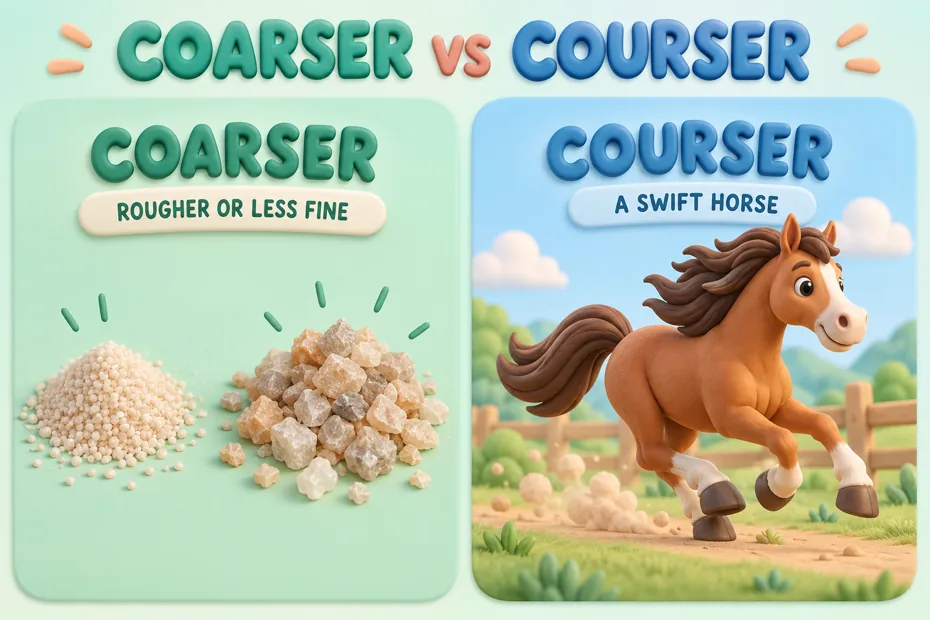
Coarser is the comparative of coarse: rougher, less fine, or less refined. Courser is a noun with meanings including a swift horse, a coursing dog, or a type of running bird. Write “coarser sand” for a texture comparison and “a courser” when the intended meaning is the animal noun.
Correction to the older article below: courser is not an adjective meaning rougher or less refined in behavior. That meaning belongs to coarser, which can describe language or manners as well as physical texture. The claim that one spelling describes rough objects and the other describes rough people is incorrect.
Key facts and comparison table
| Word | Grammar | Meaning | Original example |
|---|---|---|---|
| coarser | Comparative adjective | Rougher or less fine | This sand is coarser than that sand. |
| coarser | Comparative adjective | Less refined in language or manners | The later jokes became coarser. |
| courser | Noun | A swift or spirited horse | The tale describes a galloping courser. |
| courser | Noun | A bird or a coursing-related animal or person | The bird guide lists a courser. |
Merriam-Webster lists coarser as the comparative form of coarse and gives both physical and figurative meanings. Its courser entry supplies distinct noun senses. Similar pronunciation does not make courser a substitute for the adjective.
Coarser compares roughness or fineness
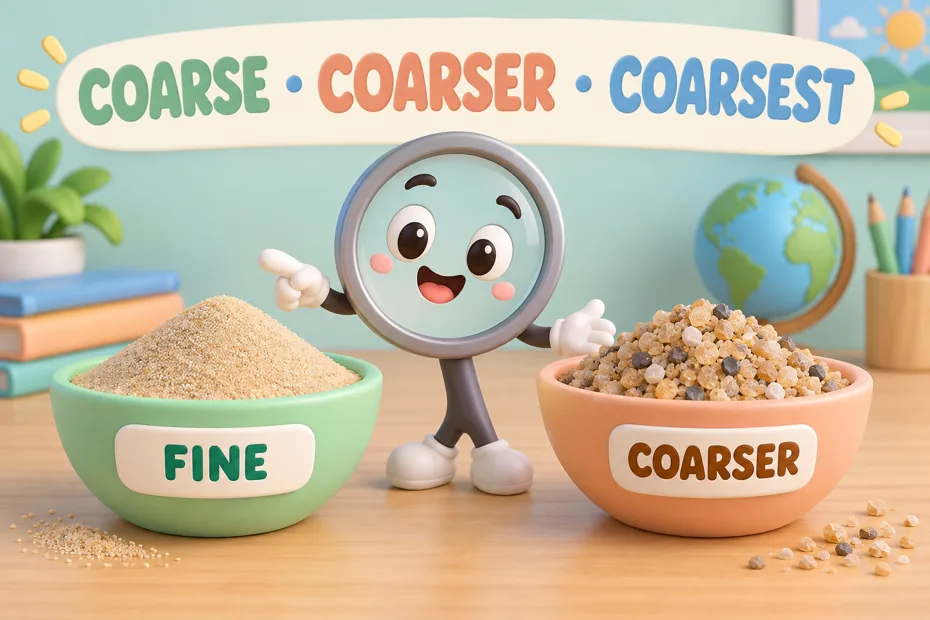
The basic series is coarse, coarser, coarsest. “The first sample is coarse.” “The second sample is coarser.” “The third is the coarsest of the three.” A comparison can be explicit with than, or understood from nearby sentences. The adjective tells us how the quality of one sample relates to another.
For particles, coarser often concerns relatively larger pieces: “The second jar contains coarser grains.” For fabric, it can describe a rougher texture: “The work apron feels coarser than the scarf.” Avoid assuming that coarser always means worse. A particular task may call for a less fine material; the adjective itself describes a quality rather than settling which option is best.
Collins’s coarser entry identifies the word as a form of coarse. You can often test the spelling by replacing it with rougher or less fine. “The mixture became rougher” fits the physical sense; “the mixture became a swift horse” plainly does not.

Coarser also describes language and manners
“His language became coarser during the argument” describes a change toward less refined or more vulgar wording. “The second performance used coarser humor” compares the tone of two performances. These uses retain the oa spelling because they still belong to coarse, even though no physical surface is involved.
This point corrects the main confusion in the earlier text. The difference is not objects versus people. A person’s speech, a fabric’s texture, and a jar’s grains can all be described as coarser when an appropriate comparison exists. Courser does not become an adjective merely because the sentence mentions a person or animal.
Coarsely is the related adverb, and coarseness is the noun for the quality. “He spoke coarsely” and “the coarseness of the cloth” therefore need different endings from coarser. Read the grammatical role as well as the meaning: an action modifier, a quality, and a comparison do different jobs.

Courser names something; it does not compare roughness
A courser can be a swift or spirited horse, especially in a literary description. “The knight mounted a courser” names the animal. “The horse had a coarser mane than its companion” compares texture. Those original examples can describe the same horse while requiring different spellings and grammatical structures.
Collins labels the swift-horse sense literary and also records a coursing dog or person, plus running birds called coursers. A reader encountering the word in a wildlife guide should therefore not assume it must be a horse. Context identifies which noun sense fits.
The plural is coursers: “The story describes two coursers.” Coarser is not a plural noun in these examples; it modifies another noun or follows a linking verb. Compare “two coursers crossed the field” with “the field had coarser soil.” Counting animals and comparing texture are different tasks.
Frequently asked questions
Does courser mean a rude person?
No. Courser is not the comparative adjective for rude or unrefined behavior. Coarser is the relevant form of coarse in “coarser manners” or “coarser language.” Courser has separate noun meanings, including a swift horse and coursing-related or bird senses. Check the intended dictionary entry before using an unfamiliar word.
Can coarser describe food?
Yes, when you are comparing a relevant quality such as grain or texture. “This batch has coarser crumbs than the last batch” is an original example. It does not automatically mean the food is inferior. Identify the specific texture or particle difference rather than treating the adjective as a general judgment.
Is a courser always a horse?
No. A swift or spirited horse is one sense, but dictionaries also record birds called coursers and meanings connected with coursing dogs or people. The surrounding text tells you which one applies. A bird guide and a medieval-style story may use the same noun with different animal references.
How can I remember the spelling?
Keep coarser in the coarse family: coarse, coarser, coarsest. Associate courser with an animal noun you might encounter in a story or field guide. Then test the sentence: “The courser ran across coarser ground.” One word names the animal; the other compares the ground’s texture.
Key Takeaways
- Coarser and courser are two distinct words that are often confused due to their similar spellings.
- Coarser refers to the texture or quality of something, such as rough or uneven materials or food.
- Courser is used to describe the behavior or characteristics of a person or animal, indicating roughness or lack of refinement.
- It is important to use these words correctly to accurately convey your message and avoid confusion.
- Coarser cannot be used interchangeably with courser as they have different meanings and usage.
- Pay attention to the context in which these words are used and ensure you are using the correct spelling for the intended meaning.
Definition of Coarser and Courser
Coarser and courser are two words in English that are often confused due to their similar spellings. In this section, I’ll clarify the difference between these words and provide their definitions to help you use these words appropriately.
What is Coarser?
When we talk about something being coarser, it refers to its texture or quality. This word is commonly used to describe materials or substances that have a rough or uneven texture. For example, sandpaper is considered coarser than silk fabric because it feels rough to the touch. Coarser can also be used to describe the taste or texture of food, such as coarser-grained salt or coarser ground coffee.
What is Courser?
On the other hand, courser is a word that is used to describe an animal or a person’s behavior. When we say something is courser, it means that it is rough or lacking refinement. For example, a courser description of a person might mean they are less refined in their manners or speech. When it comes to animals, a courser breed would refer to a breed that is known for its stamina, agility, or speed.
So, the main difference between coarser and courser lies in their usage and meaning. Coarser refers to texture or quality, while courser refers to behavior or the characteristics of animals or people.
Remember, using these words correctly is important to accurately convey your message and avoid confusion.
Common Misconceptions
Many people have difficulties distinguishing between similar words in English, and “coarser” and “courser” are no exception. Let’s clear up some common misconceptions surrounding these words.
The Difference Between “Coarser” and “Courser”
- Definition of “Coarser”: “Coarser” is an adjective used to describe the texture or quality of something. It indicates that the item in question is rougher, less refined, or of lower quality. We use “coarser” when discussing things like rough fabrics, grainy food, or rough surfaces.
- Definition of “Courser”: On the other hand, “courser” is an adjective that describes the behavior of a person or animal. It suggests roughness or a lack of refinement in their actions or demeanor. Unlike “coarser,” “courser” is used to express a person or animal’s rough or less refined traits rather than the texture or quality of an object.
Now that we have a clear understanding of the definitions, let’s address some misconceptions surrounding the usage of these two words.
Misconception 1: Interchangeability
One common misconception is that “coarser” and “courser” can be used interchangeably. But, this is not true. While they may sound similar, their meanings and usage are distinct. Remember, “coarser” describes the texture or quality of an object, while “courser” describes the rough behavior of a person or animal.
Misconception 2: Confusion with Homophones
Another misconception arises from the fact that “coarser” and “courser” are homophones. Homophones are words that sound the same but have different meanings. It’s easy to mix them up, leading to confusion and misuse. To avoid this, pay attention to the context in which these words are used and ensure you are using the correct spelling for the intended meaning.
Misconception 3: Lack of Importance
Some may mistakenly think that using “coarser” or “courser” incorrectly is not a big deal. But, using these words incorrectly can lead to misunderstandings in communication. Using the wrong word may convey an unintended meaning or make your writing appear less polished. It’s essential to use the appropriate word to accurately convey your intended message.
Differentiating Coarser and Courser
When it comes to the English language, there are certain words that can easily be confused or misused. One such pair is “coarser” and “courser.” While these words may sound similar, they have distinct meanings and usage. In this section, I’ll walk you through the differences between these two words to help you confidently use them in your writing and communication.
Definition of “coarser”
“Coarser” is an adjective that describes the texture or quality of something. It is used to indicate roughness or lack of refinement in an object or material. For example, we might say that sandpaper has a coarser texture compared to a smooth piece of silk. It can also refer to food that has a less fine or delicate texture.
Definition of “courser”
On the other hand, “courser” is a noun that is used to describe the behavior of a person or an animal. It is used to indicate roughness or lack of refinement in their actions or mannerisms. For instance, a courser might be someone who speaks in a crude or disrespectful manner, or an animal that is difficult to train due to its unruly behavior.
So, in essence, the difference lies in their usage and meaning. “Coarser” primarily focuses on the texture or quality of something, while “courser” pertains to the behavior or roughness of a person or animal.
It’s important to note that while these words may sound similar, they cannot be used interchangeably. Using the wrong word could lead to misunderstandings and confusion in communication.
Now that we have a clearer understanding of the definitions, let’s move on to some examples to solidify our knowledge and usage of these words.
Understanding Contextual Usage
When it comes to the words “coarser” and “courser,” it’s essential to understand their contextual usage. By grasping the appropriate situations to use each word, we can enhance our communication and avoid misunderstandings. Let’s dive deeper into the definitions and nuances of these words.
Definition of “Coarser”: The word “coarser” is primarily used to describe the texture or quality of something. It refers to roughness or lack of refinement. For instance, we often use “coarser” to describe rough materials, such as sandpaper, or food that has a rough texture, like coarse-grained bread.
Definition of “Courser”: On the other hand, “courser” is used to describe the behavior of a person or animal. It suggests roughness or a lack of refinement in actions or manners. When we say someone has a “courser” demeanor, we mean they lack sophistication or grace.
Understanding the difference between these two words is crucial. While they sound similar, their meanings and usage are distinct. It’s important not to confuse one for the other to ensure effective communication.
By using “coarser” accurately, we convey the roughness or lack of refinement in the physical properties of an object or substance. When properly using “courser,” we describe the rough or unrefined behavior of a person or animal.
The key takeaway is that “coarser” relates to the texture or quality of something, whereas “courser” pertains to the behavior of a person or animal. Knowing which word to use depending on the context is vital for clear and precise communication.
Examples of Contextual Usage:
To further illustrate the appropriate usage of these words, let’s consider a couple of examples:
- “The fabric of the burlap sack was coarser than the fine silk.”
- “Jake’s manners were courser than those of the refined aristocracy at the ball.”
In both sentences, we use the correct word based on the context. We describe the texture of the fabric as “coarser,” highlighting its roughness. When referring to Jake’s manners, we emphasize their lack of refinement by using “courser.”
Remember, the correct usage of “coarser” and “courser” contributes to accurate and meaningful communication. Mastery of these nuances enhances your ability to express yourself precisely.
Tips for Using the Appropriate Term
To ensure clear and effective communication, it’s crucial to use the appropriate term when distinguishing between “coarser” and “courser.” Here are some tips to help you use these words correctly:
- Understand the Difference: Begin by grasping the distinction between the two words. “Coarser” refers to the texture or quality of something, while “courser” describes the behavior of a person or animal, indicating roughness or lack of refinement. This understanding forms the foundation for using each term appropriately.
- Context is Key: Consider the context in which you’re using the words. Pay attention to the subject matter and the intended meaning. Is it related to physical characteristics or behavior? This awareness will guide you in selecting the suitable term.
- Specify Texture or Behavior: When describing rough materials, such as fabrics or surfaces, use “coarser.” For example, “The sandpaper has a coarser grit, providing a rougher finish.” On the other hand, when referring to someone’s behavior or manners, use “courser.” For instance, “His courser language in formal settings often leads to misunderstandings.”
- Use Examples: Use examples to further illustrate the appropriate usage of “coarser” and “courser.” This approach will help solidify your understanding and demonstrate practical applications. Here’s an example: “The coarser sugar crystals make the dessert feel gritty, while her courser tone of voice offended the guests.”
- Proofread and Edit: After writing, take the time to proofread your work. Double-check that you’ve used the correct word in the appropriate context. It’s easy to overlook these details, so be diligent in reviewing your text for accuracy.
By following these tips, you’ll be able to use “coarser” and “courser” appropriately in your writing and conversation. Enhancing your vocabulary and understanding of the English language is crucial for effective communication. Remember, a clear and precise choice of words can significantly improve your message’s impact.
Now that we have explored the definitions and appropriate usage of “coarser” and “courser,” let’s investigate into some examples that further illustrate their contextual applications.
Conclusion
Understanding the distinction between “coarser” and “courser” is essential for accurate and effective communication. By considering the context in which these words are used, we can ensure that our message is clear and precise. Utilizing examples can further illustrate the appropriate usage of each term, helping to solidify our understanding.
Proofreading and editing are crucial steps in ensuring accuracy when using these words. By taking the time to review our writing, we can catch any potential errors and make necessary corrections. This attention to detail demonstrates our commitment to clear and professional communication.
Enhancing our vocabulary and understanding of the English language is an ongoing process. By continually expanding our knowledge, we can confidently navigate the nuances of language and choose the most appropriate words for any given situation. This commitment to growth and improvement will undoubtedly enhance our ability to communicate effectively in both written and verbal forms.
To conclude, by understanding the difference between “coarser” and “courser,” utilizing examples, proofreading and editing, and continuously enhancing our language skills, we can confidently express ourselves with clarity and precision.
Frequently Asked Questions
Q: What is the difference between “coarser” and “courser”?
A: The term “coarser” refers to something that is rough or not fine in texture, while “courser” is a noun that means a person who hunts with hounds. It is important to note the distinction between the two words and their respective definitions.
Q: How can I differentiate between “coarser” and “courser” in writing?
A: To distinguish between “coarser” and “courser” in writing, consider the context in which the words are used. Ensure that “coarser” is used to describe texture or quality, while “courser” is used as a noun referring to a hunter. Examples can be helpful in understanding and illustrating the appropriate usage of these words.
Q: What should I do to improve my understanding and usage of “coarser” and “courser”?
A: Enhancing vocabulary and understanding of the English language is essential for effective communication. Engage in regular reading to encounter the words in different contexts. Additionally, proofread and edit your writing to ensure accuracy and correct usage. Online dictionaries and grammar resources can also provide further guidance and clarification on the usage of “coarser” and “courser.”


