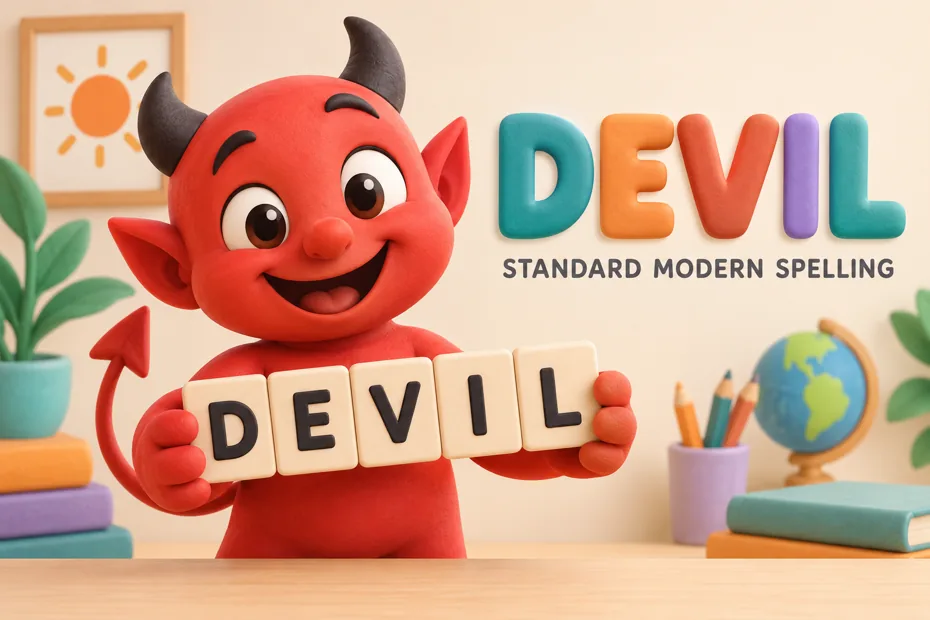
Devil is the standard modern English spelling for an evil spirit and related figurative meanings. Devel occurs in historical language, so it is too broad to say it has never been a word. Devle is not the standard spelling to use when you intend modern English devil.
Devel vs. devil vs. devle: key facts
- Use devil in ordinary contemporary prose.
- Devel appears in the historical development of devil.
- A historical spelling is not automatically suitable for a modern essay.
- Devil can name a supernatural being or describe a mischievous person.
- Deviled and devilled are recognized forms; follow your regional style.
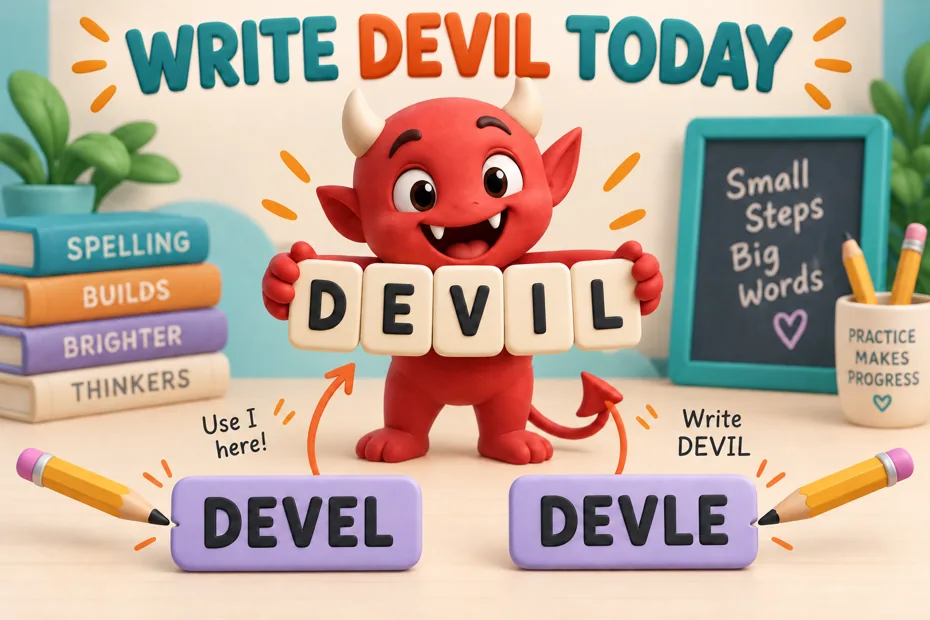
Which spelling belongs in modern writing?
Choose devil for ordinary modern English. The letters are d-e-v-i-l, with i before the final l. In an essay, email, caption, or story written in contemporary language, neither devel nor devle should replace devil merely because the pronunciation seems to suggest a different vowel.
| Form | Modern editing decision | Context to check |
|---|---|---|
| Devil | Use for the intended ordinary word. | Evil spirit, figurative person, idiom, or related verb. |
| Devel | Usually change to devil if that is the intended modern word. | Check historical quotations, names, and technical labels first. |
| Devle | Change to devil when the intended word is devil. | Check that it is not a proper name or quoted source. |
The distinction is between standard modern usage and context-specific text. An editor can correct a misspelling in a student’s original paragraph while preserving the same sequence of letters inside an accurately quoted historical document. That is why a global search-and-replace needs a context check before it changes every occurrence.

Is devel always a meaningless typo?
No. Merriam-Webster’s devil entry includes devel among the Middle English forms in the word’s history. That establishes a historical context for the spelling. It does not establish devel as the recommended everyday spelling in present-day English.
Clarification of the older guide below: statements that devel is unrecognized in every context should be read more narrowly. For a contemporary sentence about the familiar word, devil is the spelling to choose. Historical writing, copied quotations, names, or specialized labels require separate verification rather than an assumption that every unfamiliar form is an error.
For example, a historian explaining spelling change might discuss the form devel. A student writing “The devel appears in the story” without intending historical language should write devil instead. The evidence for historical existence and the advice for modern usage answer different questions; keeping those questions separate prevents an overcorrection.
What do modern uses of devil look like?
Collins Dictionary also records literal, figurative, and idiomatic uses of devil. A supernatural reference might be “The painting depicts a devil beside the gate.” A figurative description might be “That little devil hid my pencils.” Such language can be affectionate or critical depending on context, so choose it carefully when describing a real person.
Consider these original sentences: “The novelist created a devil who bargains with travelers”; “We had a devil of a time opening the jammed drawer”; “The details are where the real difficulty lies.” The last sentence offers a plain-language alternative when a familiar devil idiom would distract from a formal explanation.
The word also appears in cooking as deviled or devilled, with related -ing forms. These are not competing spellings of the basic noun: they are inflected forms of the verb. A recipe’s “deviled eggs” therefore does not justify spelling the noun devel. Follow a consistent regional convention across the document rather than mixing forms arbitrarily.
How should capitalization and apostrophes work?
Devil can be capitalized when used as a name or title for the particular religious figure, while a devil ordinarily refers to one evil spirit or a figurative person. Follow the context and the publication’s style. Capitalization does not change the internal spelling: the modern word remains devil.
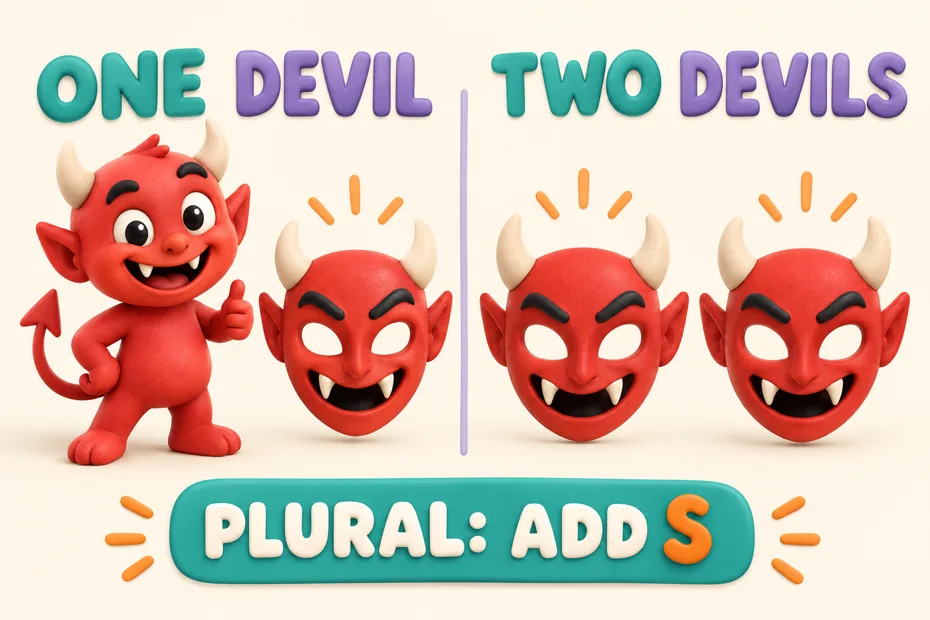
Possession adds an apostrophe: “the devil’s bargain” refers to a bargain associated with one devil. The ordinary plural is devils, as in “two devils in the illustration.” For possession involving several, write devils’, as in “the devils’ costumes.” Do not insert an apostrophe merely because the word is plural.
A short spelling check
- Confirm that the intended word is devil.
- Check the five letters d-e-v-i-l.
- Preserve names and quotations until their source is verified.
- Check capitalization, number, and possession separately.
Try completing “The costume shows a ___,” “Two ___ appear on stage,” and “The ___ mask fell.” The answers are devil, devils, and devil’s. The spelling stays stable while the ending changes with the grammar. For devel vs. devil vs. devle, standard modern usage is the first decision; context determines whether an unusual form should be preserved.
Frequently asked questions
Should I correct devel inside a quotation?
Do not silently alter a quotation just because it differs from current spelling. Check the original source and the reason for quoting it. Historical spelling may be relevant to the discussion. If you are paraphrasing rather than quoting, use modern devil when that is the intended word.
Is devle an alternative spelling of devil?
Devle is not the standard modern spelling for the ordinary English word devil. When that meaning is intended in contemporary prose, use d-e-v-i-l. If the letters occur as a name, label, or source quotation, verify that specific context before deciding whether the text contains a spelling mistake.
Does devil always refer to a religious figure?
No. Context can make devil a figurative description of a person or part of an everyday expression. A phrase such as “little devil” may describe mischief rather than a supernatural being. In formal or sensitive writing, choose a more precise description when the figurative label could sound insulting.
Are deviled and devilled both acceptable?
Merriam-Webster records both deviled and devilled, along with corresponding -ing forms. These are verb forms often encountered in food descriptions. Use the convention appropriate to your audience or style guide and keep it consistent. Both forms retain the basic word devil rather than creating a modern noun spelled devel.
Have you ever found yourself confused between “devel,” “devil,” and “devle”? It’s a common dilemma, but fear not, as I’m here to shed some light on the matter. In this text, I’ll guide you through the correct usage of these words, ensuring that you never mix them up again. Understanding the subtle differences between “devel,” “devil,” and “devle” is crucial for effective communication. So, whether you’re a writer, a student, or simply someone looking to enhance their language skills, this article will provide you with the clarity you need. Let’s immerse and unravel the mysteries of “devel,” “devil,” and “devle” together.
Key Takeaways
- “Devel” is not a recognized English word and is likely a misspelling of “devil”
- “Devil” refers to a mythical creature associated with evil, temptation, and mischief
- “Devle” is not a correct spelling and does not exist as a word in the English language
- It is important to double-check spelling to ensure accurate communication
- Understanding the definitions and appropriate contexts of these words is crucial for effective usage
- Consult reliable resources and seek feedback to enhance language skills and usage accuracy
What is “devel”?
Definition of “devel”:
“Devel” is not a recognized English word. It is likely a typographical error or a misspelling of other words such as “devil” or “devle.” It is important to be mindful of such errors to ensure effective communication.
Difference between “devel” and “devil”:
While “devel” does not have a specific meaning, “devil” refers to a fantasy creature often associated with evil or temptation. It is commonly used in religious or mythical contexts.
Here are some key differences between “devel” and “devil”:
- Definition: “Devel” is not a valid word, while “devil” has a distinct meaning.
- Usage: “Devel” is a likely typo, whereas “devil” is correctly used to describe the mythical creature.
- Context: “Devel” is not recognized in any specific context, but “devil” is often used in religious, literary, or folkloric contexts.
- Spelling: The incorrect use of “devel” results from misspelling “devil.”
It is important to note that “devel” is not a valid word in the English language. Hence, writers and speakers should carefully check their spelling and avoid using this erroneous term.
By understanding the difference between “devel” and “devil,” we can effectively communicate our thoughts and ideas without confusion. This knowledge will help avoid misunderstandings and ensure clear and accurate communication.
Remember: Accuracy in language is crucial for effective communication.
What is “devil”?
As we continue exploring the commonly confused words, let’s focus on understanding the term “devil.” It’s important to clarify the meaning of this word to ensure accurate usage in our communication.
The term “devil” typically refers to a fantasy creature associated with evil, temptation, and mischief. In various religious and mythical contexts, the devil is often described as an embodiment of wickedness, perpetually opposing goodness and tempting individuals towards immoral actions.
Definition of “devil”: A supernatural being associated with evil, temptation, and mischief, commonly depicted in religious and mythical literature.
It’s worth highlighting that “devil” is a widely recognized and accepted term in the English language. Its usage is prevalent in various texts, including religious scriptures, literature, and popular culture. Whether discussing mythology, beliefs, or even expressing one’s frustration using idiomatic expressions like “playing devil’s advocate,” this term has become ingrained in our everyday language.
Understanding the difference between “devil” and “devel” is crucial. While “devil” has a well-defined meaning, “devel” is not a recognized English word. It is likely a typographical error or misspelling of other words.
To avoid confusion and ensure effective communication, it’s essential to always double-check our spelling and use the correct term – “devil” – when referring to the supernatural creature associated with evil and temptation.
Let’s move forward and explore the next word in our series to further enhance our vocabulary and mastery of the English language.
What is “devle”?
In our exploration of commonly confused words, we now turn our attention to a term that may have caused some head-scratching: “devle.” While “devil” and “devel” are recognized terms in the English language, “devle” does not exist as a correct spelling.
The confusion between “devle” and “devil” likely stems from typographical errors or misspellings. It’s essential to double-check our spelling to ensure accurate communication.
To clarify, let’s define what “devil” means. The term “devil” refers to a legendary creature commonly associated with evil, temptation, and mischief. It has a prominent presence in various religious, mythical, and everyday contexts. Whether portrayed as a horned entity tempting humans or a symbol of rebellion and chaos, the “devil” has captured the imagination and sparked countless tales and interpretations throughout history.
Understanding the difference between “devil” and “devle” is crucial for effective communication. While “devil” is a recognized term embodying a specific concept, “devle” simply does not exist in the English lexicon.
By using the correct spelling and word choice, we can ensure a clear and accurate expression of our thoughts. Let’s stay mindful of the difference between “devil” and “devle” and strive for precision in our language use.
Next, we will continue our exploration of commonly confused words and investigate into the intriguing area of yet another word pair. Stay tuned for more insights to enhance your vocabulary and mastery of the English language.
Confused Words at a Glance:
| Term | Definition |
|---|---|
| Devil | A mythical creature associated with evil, temptation, and mischief. |
| Devel | Not a recognized English word. Likely a typographical error or misspelling. |
| Devle | Does not exist as a correct spelling. Likely a typographical error or misspelling. |
Differences between “devel,” “devil,” and “devle”
As an expert blogger, I am committed to providing clear and accurate information to enhance your understanding and usage of commonly confused and misused words in English. In this section, we will investigate into the differences between the words “devel,” “devil,” and “devle.”
Let’s start with the word “devle.” It’s important to note that “devle” is not a recognized English word. It is likely a typographical error or misspelling. When it comes to effective communication, checking our spelling is crucial to ensure accuracy.
Moving on to the term “devil,” it refers to a legendary creature associated with evil, temptation, and mischief. While “devil” is a widely recognized word, confusion may arise due to its similarity in spelling to “devel.”
Let’s address the word “devel.” Unlike “devil,” “devel” is not a commonly used English word. It is likely a misspelling or typo for the word “devil.”
To summarize the differences:
- “Devle” is not a recognized word in English.
- “Devil” refers to a legendary creature associated with evil, temptation, and mischief.
- “Devel” is not a commonly used English word and is likely a misspelling of “devil.”
By understanding these differences, you can enhance your vocabulary and language mastery. In the next section, we will explore another set of commonly confused words to further expand your knowledge.
Stay tuned for the next part of this educational series as we continue our exploration of commonly confused and misused words in English.
Tips for using “devel,” “devil,” and “devle” appropriately
As I continue to explore the confusion between “devel,” “devil,” and “devle,” it’s important to provide some tips on using these words appropriately. Understanding the differences and using them correctly can greatly enhance your vocabulary and language mastery.
1. Know the Definition: To start, it’s crucial to have a clear understanding of the definitions of these words. Let’s break them down:
- “Devle”: It’s important to note that “devle” is not a recognized English word. It is likely a misspelling or typo. Be careful not to use it in your writing or communication.
- “Devil”: This is a legendary creature associated with evil, temptation, and mischief. It’s important to use “devil” when referring to this specific entity.
- “Devel”: Although “devel” is occasionally used, it is not commonly found in English language and is likely a misspelling of “devil.” It’s best to avoid using it to ensure precise and accurate communication.
2. Be Mindful of Context: Understanding the context in which these words are used is crucial for their appropriate usage. Pay attention to the specific meaning and connotation each word carries in different situations.
3. Use Resources: If in doubt, consult reputable dictionaries or style guides to clarify any uncertainties about the appropriate usage of “devel,” “devil,” or “devle.” These resources can provide precise definitions, examples, and rules to aid in your understanding.
4. Practice, Practice, Practice: The more you practice using these words correctly, the more confident and proficient you’ll become. Incorporate them into your writing and speaking exercises to reinforce your understanding.
5. Seek Feedback: Don’t hesitate to ask for feedback from teachers, peers, or professionals. They can provide valuable insight and help you identify any areas for improvement in your usage of these words.
Remember, mastering the appropriate usage of words like “devel,” “devil,” and “devle” is a process that takes time and practice. By following these tips and consistently using them correctly, you’ll enhance your language skills and communicate more effectively.
Conclusion
Understanding the appropriate usage of words like “devel,” “devil,” and “devle” is crucial for enhancing vocabulary and language mastery. By familiarizing ourselves with their definitions, we can effectively communicate and avoid common mistakes.
While “devel” is not commonly used in English, it is often a misspelling or typo of “devil.” The term “devil” refers to a legendary creature associated with evil, temptation, and mischief. It is essential to use this word accurately to convey the intended meaning.
On the other hand, “devle” is not a recognized English word and should be avoided in writing or speech. Recognizing this can prevent confusion and maintain clarity in our communication.
To ensure appropriate usage, consider the context in which these words are used and consult reliable resources. Practice incorporating them into your writing and seek feedback to improve your skills.
By implementing these tips, you can enhance your language proficiency, expand your vocabulary, and communicate more effectively. So, let’s strive for accuracy and precision in our language usage, empowering ourselves with the right words for every situation.
Frequently Asked Questions
1. Why is it important to understand the meanings of “devel,” “devil,” and “devle”?
Understanding the meanings of these words is crucial for enhancing vocabulary and language skills. It helps avoid confusion and ensures accurate usage in written and spoken communication.
2. Is “devle” a recognized English word?
No, “devle” is not recognized as a valid English word. It is most likely a misspelling or typo. Using it may lead to misunderstandings or confusion.
3. What does “devil” refer to?
“Devil” refers to a legendary creature associated with evil, temptation, and mischief.
4. Is “devel” a commonly used word in English?
No, “devel” is not commonly used in English. It is often a misspelling of the word “devil.”
5. How can I improve my usage of these words?
To improve your usage, be mindful of the context, consult reliable resources like dictionaries, practice using the words in different contexts, and seek feedback from native speakers or language experts.


