
Gvsilla vs guerilla: verify the string before correcting it
Gvsilla has no verified general-English meaning in the sources checked for this update. Guerrilla is a dictionary headword for an irregular fighter, and guerilla is an accepted spelling variant. Do not automatically replace gvsilla: inspect the source and intended meaning. Gorilla is a separate word naming an ape.
Editorial clarification: The older article below treats gvsilla as a familiar error and assumes that guerilla is always the intended replacement. That assumption is not established. The article also says “guerilla, spelled with two Rs,” but guerilla has one r; guerrilla has two. Both are recorded spellings. No invented definition or pronunciation should be assigned to gvsilla.
What can you conclude about gvsilla?
The exact-string search performed for this update did not establish a reliable independent meaning for gvsilla. That finding supports caution, not an absolute claim that the letters can never be a name, identifier, or private code. A page asserting that a string is wrong does not show what its writer originally intended or how frequently anyone makes that error.
Keep the original spelling in your notes and check the surrounding words. A scanned document may contain recognition errors. A username may deliberately use unusual letters. A draft about wildlife may suggest an animal name, while a history draft may suggest a military term. The context can guide a question to the author; it does not justify silently deciding the answer.
| Form | Verified status in this guide | Action for a writer |
|---|---|---|
| gvsilla | No general-English meaning verified | Check the original and ask what was intended. |
| guerrilla | Dictionary headword for an irregular fighter | Use when that meaning fits; follow your style guide. |
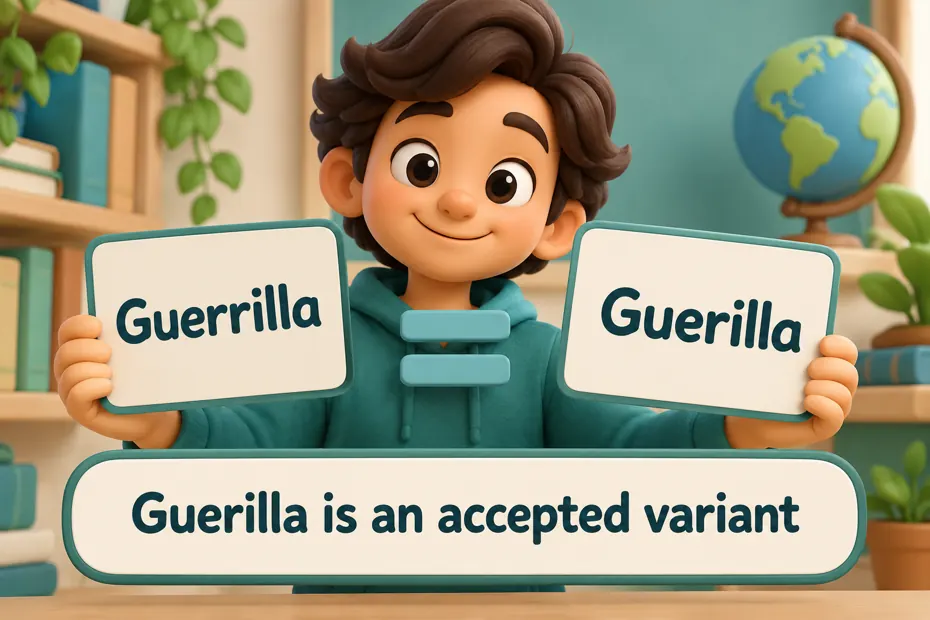
| guerilla | Accepted variant of guerrilla | Preserve official names; keep your chosen spelling consistent. |
| gorilla | A large African ape | Use only when the animal is intended. |
Which spelling is guerrilla and which is guerilla?
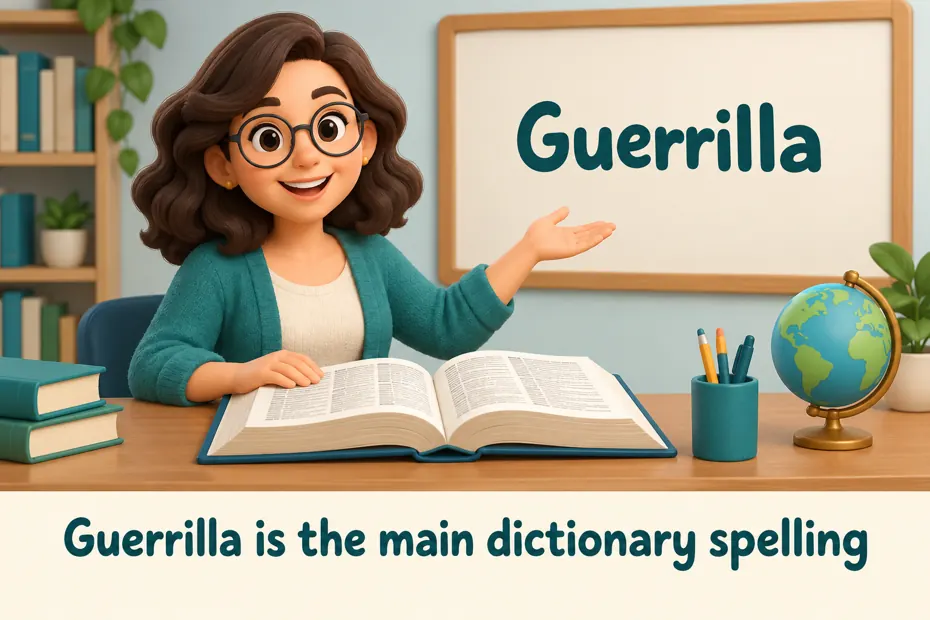
Merriam-Webster lists guerrilla with guerilla as a variant. The American Heritage Dictionary also records both forms. Spell the main headword g-u-e-r-r-i-l-l-a and the variant g-u-e-r-i-l-l-a. Both end in double l; the difference is the number of r’s after gue.
Choose guerrilla as a straightforward default if your publication has no stated preference. That is an editorial choice, not a declaration that guerilla is invalid. In a quotation, business name, book title, or other proper name, preserve the source’s spelling. In your own prose, consistent spelling helps readers distinguish a variant from an accidental typing change.
How is the word used in a sentence?
As a count noun, guerrilla can identify a member of an irregular fighting force: “The historical account described a guerrilla.” The plural is guerrillas: “The chapter discusses guerrillas in the region.” In a historical summary, name the particular group or period when the source supports it. Avoid using the label as a substitute for establishing who the people were.
Oxford’s noun entry records the fighter sense. In combinations such as guerrilla warfare or guerrilla fighters, the word describes the type of activity or participants. This vocabulary guide explains usage; it does not give instructions for military tactics. The older article’s broad examples do not identify an actual event.
The word also appears in figurative compounds such as guerrilla marketing, where the context concerns unconventional promotion rather than literal fighting. Oxford’s adjective entry helps distinguish these descriptive uses. Define a specialized phrase for your audience and name the actual activity rather than assuming that every reader shares the same interpretation.
Why should you check gorilla separately?
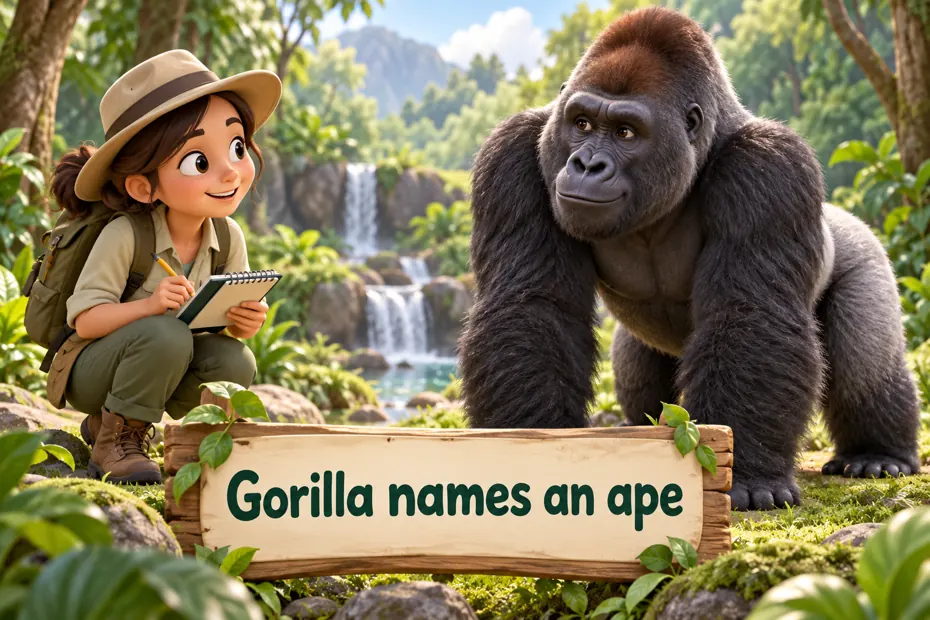
Merriam-Webster’s gorilla entry names the ape. Gorilla and guerrilla can sound alike in English, which makes them a useful spelling comparison. Their meanings remain separate: “The zoo’s gorilla rested in the shade” names an animal. “The book discusses guerrilla warfare” names a kind of conflict. Do not infer an animal meaning merely from resemblance.
If a writer types “a gvsilla in the rainforest,” ask whether gorilla was intended. If a writer types “gvsilla marketing,” ask whether guerrilla marketing was intended. These are queries, not automatic corrections. Once the author confirms the meaning, revise the spelling and read the whole sentence again for sense.
Practice checking meaning before spelling
- “The wildlife documentary followed a ___.” If the animal is intended, choose gorilla.
- “The chapter analyzed ___ warfare.” Choose guerrilla or the accepted variant guerilla.
- “The original label reads gvsilla.” Verify the label; no replacement is justified from that sentence alone.
- “The draft uses both guerrilla and guerilla.” Follow one editorial spelling except in accurately quoted names or text.
Frequently asked questions
Is guerilla necessarily a spelling mistake?
No. The dictionaries cited here recognize guerilla as a variant of guerrilla. A publication may prefer the two-r form, but a preference is not proof that the one-r form is nonexistent. Use the requested house spelling in your prose and preserve official names and quotations when accuracy requires their original form.
What does gvsilla mean?
No reliable general-English meaning was verified in this update. The string may be a typo, a transcription issue, or a context-specific identifier. The responsible next step is to inspect the original source and ask its writer. Do not assign a definition, pronunciation, or replacement solely from the older article’s assumption.
Is gorilla another spelling of guerrilla?
No. Gorilla names the ape, while guerrilla and guerilla name the fighter or appear in related descriptive compounds. Similar pronunciation does not make their written meanings interchangeable. In a sentence about an animal, use gorilla; in a sentence about the documented military sense, use the appropriate guerrilla spelling.
How do I remember the double letters?
The main headword guerrilla has double r and double l. The accepted variant guerilla has one r and double l. Gorilla also has double l, but its opening letters and meaning differ. Write the word in full beside a sentence showing the intended meaning rather than memorizing the ending without context.
Original article, retained with the clarification above
When it comes to the English language, there are countless words that can trip us up and cause confusion. One such pair is “gvsilla” and “guerilla.” These two words may sound similar, but their meanings and usage couldn’t be more different. In this text, I’ll guide you through the correct usage of these words, helping you avoid embarrassing mistakes and communicate with confidence. We’ll explore the definitions of “gvsilla” and “guerilla,” provide examples of their proper usage, and offer some tips to help you remember the difference. So, whether you’re a language enthusiast or simply want to improve your writing skills, let’s jump into the world of “gvsilla” and “guerilla” and learn how to use them appropriately.
Key Takeaways
- “Gvsilla” is not a recognized word in the English language and should be removed from your vocabulary.
- “Guerilla” refers to a member of an irregular military force that engages in unconventional warfare, using tactics such as ambushes and hit-and-run attacks.
- Using accurate and recognized words is essential for effective communication and maintaining credibility as a writer or speaker.
- “Gvsilla” has no specific meaning or usage, while “guerilla” is widely recognized and commonly used.
- Properly distinguishing between similar words like “gvsilla” and “guerilla” helps to avoid confusion and misinterpretation.
- By understanding the definition and context of “guerilla,” you can use the word accurately and confidently in your communication.
What is “gvsilla”
When it comes to commonly confused words, “gvsilla” is definitely one that often raises eyebrows. Many people mistakenly use this word, thinking it’s the same as “guerilla.” But, there is a significant difference between the two.
Let me start by clarifying that “gvsilla” is not a recognized word in the English language. It does not appear in any dictionaries or language references. So, if you have been using it, it’s time to remove it from your vocabulary.
Unfortunately, I cannot provide a specific definition for “gvsilla” since it does not exist. It might be a misspelling or a made-up word. That being said, it’s important to note that using incorrect or non-existent words can undermine your credibility as a writer or speaker.
To communicate accurately and effectively, it’s crucial to rely on proper vocabulary and grammar. Instead of using uncertain or fabricated terms like “gvsilla,” it’s best to stick to words that have a clear and recognized meaning.
The Difference between “gvsilla” and “guerilla”
Let’s address the confusion between “gvsilla” and “guerilla.” While “gvsilla” has no significance, “guerilla” refers to a specific concept.
“Guerilla” is a noun that describes a member of an irregular military force that engages in unconventional warfare. Guerilla fighters typically operate in small groups, using tactics such as ambushes, sabotage, and hit-and-run attacks. They often fight against a larger, more organized military force.
Here are a couple of examples to illustrate the correct usage of “guerilla”:
- The guerilla fighters launched a surprise attack on the enemy camp.
- The civilians sought protection from the guerilla forces in the remote jungle.
As you can see, “guerilla” is a well-established word with a precise meaning. So, remember, there’s no “gvsilla,” but “guerilla” refers to the tactics employed by unconventional fighters.
It’s always important to pay attention to the nuances and differences between words to communicate accurately and avoid confusion. Now that we have clarified the concept of “gvsilla” (or lack thereof) and discussed the accurate usage of “guerilla,” let’s move on to the next section to investigate deeper into this topic.
What is “guerilla”
As we investigate into the differences between “gvsilla” and “guerilla,” it’s vital to establish a clear definition of the latter.
Guerilla, spelled with two Rs, refers to a member of an irregular military force that engages in unconventional warfare. These forces typically operate in small units, making quick and precise strikes against larger, more traditional armies. Guerilla fighters employ tactics such as ambushes, sabotage, and hit-and-run tactics to disrupt and weaken their adversaries.
To put it simply, guerilla warfare is a form of asymmetrical warfare, challenging the conventional battlefield strategies and hierarchy. It is fundamentally different from traditional warfare, where large armies face off against one another in a battle for dominance.
In essence, guerilla fighters rely heavily on their knowledge of the terrain and their ability to blend into the civilian population, using surprise and guerrilla tactics to give themselves an advantage against better-equipped opponents.
Understanding the definition of guerilla is crucial to differentiate it from other similar terms and to use it appropriately in written and spoken communication. By using the correct word, you convey your message accurately and avoid any potential confusion or misinterpretation.
Remember, accuracy and precision in language are vital for effective communication. Now that we have a clear understanding of the term “guerilla,” let’s explore some examples of its correct usage in the next section.
Differences between “gvsilla” and “guerilla”
When it comes to the English language, it’s important to use the right words to effectively communicate our thoughts. There are cases where confusion might arise, especially when it comes to words that sound similar but have completely different meanings. In this section, I’ll be discussing the differences between the words “gvsilla” and “guerilla” to help enhance your vocabulary and avoid any confusion.
First things first, let’s address “gvsilla.” The truth is, “gvsilla” is not a recognized word in the English language. So, if you’ve been using this term, it’s time to remove it from your vocabulary.
On the other hand, “guerilla” is a term that holds significance. It refers to a member of an irregular military force that engages in unconventional warfare. These guerilla fighters are known for their ability to adapt to their surroundings and use unique tactics to disrupt and weaken larger, more traditional armies.
To better understand the concept, let’s investigate a little deeper into the definition of “guerilla” and how it differs from “gvsilla.”
Here are some key differences between “gvsilla” and “guerilla”:
- Recognition: “Gvsilla” is not a recognized word in the English language, while “guerilla” is widely recognized and used.
- Meaning: As we mentioned earlier, the meaning of “guerilla” refers to a member of an irregular military force. “Gvsilla” has no specific meaning as it does not exist.
- Usage: “Gvsilla” is not used in any context, while “guerilla” is commonly used to describe individuals engaging in unconventional warfare.
Now that we’ve established the differences between these two words, it’s important to remember to use “guerilla” correctly in your communication. This will help ensure that you convey your message accurately and effectively.
In the next section, I’ll provide some examples to illustrate the correct usage of “guerilla,” further enhancing your understanding and usage of this term.
Examples of correct usage
As mentioned earlier, it is important to use words accurately and effectively to ensure clear communication. In this section, I will provide some examples of correct usage of the words “gvsilla” and “guerilla.”
- Incorrect: Yesterday, I saw a group of gvsilla fighters in the forest.
Correct: Yesterday, I saw a group of guerilla fighters in the forest.
Here, the correct usage is “guerilla” to describe fighters engaged in irregular warfare. Using “gvsilla” would be incorrect as it is not a recognized word in the English language.
- Incorrect: The soldiers used gvsilla tactics to disrupt the enemy’s supply lines.
Correct: The soldiers used guerilla tactics to disrupt the enemy’s supply lines.
Again, “guerilla” is the correct term to describe the unconventional tactics employed by the soldiers. “Gvsilla” does not have any specific meaning and should be avoided in this context.
- Incorrect: The rebels employed gvsilla warfare to gain an advantage against the larger army.
Correct: The rebels employed guerilla warfare to gain an advantage against the larger army.
Here, using “guerilla warfare” accurately describes the rebels’ use of asymmetrical tactics to combat a more conventional force. “Gvsilla warfare” would be incorrect as it is not a recognized concept.
It is crucial to note that consistently using “guerilla” in these examples ensures proper and accurate communication. By avoiding the use of the non-existent word “gvsilla” and substituting it with the correct term, we convey our message with clarity and maintain linguistic standards.
So, remember to always choose the appropriate word and use it correctly to avoid confusion and miscommunication.
Now that we have seen some examples of correct usage, let’s investigate deeper into the definition and nuances of “guerilla” warfare in the next section.
Tips to remember the difference
Now that we have clarified the correct usage and definition of “guerilla,” let’s discuss some tips to remember the difference between “gvsilla” and “guerilla.” It’s important to understand the distinction between these two words to ensure clear and accurate communication. Here are a few pointers to help you remember:
- Know the Correct Spelling: The first step in using these words appropriately is to know the correct spelling of each term. Remember, there is no such word as “gvsilla.” It’s crucial to eliminate “gvsilla” from your vocabulary and use “guerilla” instead.
- Understand the Definition: Familiarize yourself with the definition of “guerilla” as a member of an irregular military force that engages in unconventional warfare. By understanding the meaning of the word, you can use it correctly and avoid any confusion.
- Context is Key: Consider the context in which you are using the word. Are you referring to a military tactic or a style of warfare? If so, “guerilla” is the word you should be using. But, if you are talking about something unrelated to warfare, then “gvsilla” is not the appropriate term to use, as it does not exist.
- Practice and Review: As with any language skill, practice makes perfect. Take the time to review the correct usage of “guerilla” and reinforce your understanding through practice exercises. The more you use the word correctly, the more it will become ingrained in your vocabulary.
Remember, accurate communication is crucial in any setting, whether it’s academic, professional, or personal. Properly distinguishing between similar words like “gvsilla” and “guerilla” demonstrates your command of the English language and helps to avoid misunderstandings.
By following these tips, you can confidently and consistently use the word “guerilla” to convey your message accurately. Let’s continue exploring examples of correct usage to further solidify our understanding.
Conclusion
To conclude, it is important to use the correct vocabulary and grammar to effectively communicate in the English language. This article has highlighted the difference between the words “gvsilla” and “guerilla,” clarifying that “gvsilla” is not a recognized word and should be removed from our vocabulary. On the other hand, “guerilla” refers to a member of an irregular military force that engages in unconventional warfare.
Understanding the definition of “guerilla” is crucial for using it appropriately in communication. By using the correct term, we demonstrate our command of the English language and ensure clear and accurate messages. Remembering the correct spelling, understanding the definition, considering the context, and practicing and reviewing are all helpful tips to differentiate between “gvsilla” and “guerilla.”
By consistently using the correct term, we avoid misunderstandings and convey our messages accurately. So, let’s strive for accurate communication by using “guerilla” correctly and removing “gvsilla” from our vocabulary.
Frequently Asked Questions
Q: What is the article about?
A: The article discusses the difference between the words “gvsilla” and “guerilla” in the English language, advising readers to remove “gvsilla” from their vocabulary.
Q: What is the definition of “guerilla”?
A: “Guerilla” refers to a member of an irregular military force that engages in unconventional warfare tactics, such as ambushes, sabotage, and hit-and-run.
Q: Why is it important to use the correct term?
A: Using the correct term, “guerilla,” ensures clear and accurate communication, demonstrating proficiency in English and avoiding misunderstandings.
Q: How can I remember the difference between “gvsilla” and “guerilla”?
A: Remember the correct spelling, understand the definition, consider the context, and practice and review to accurately use “guerilla” in communication.


