Much vs mutch: quantity word or traditional cap?
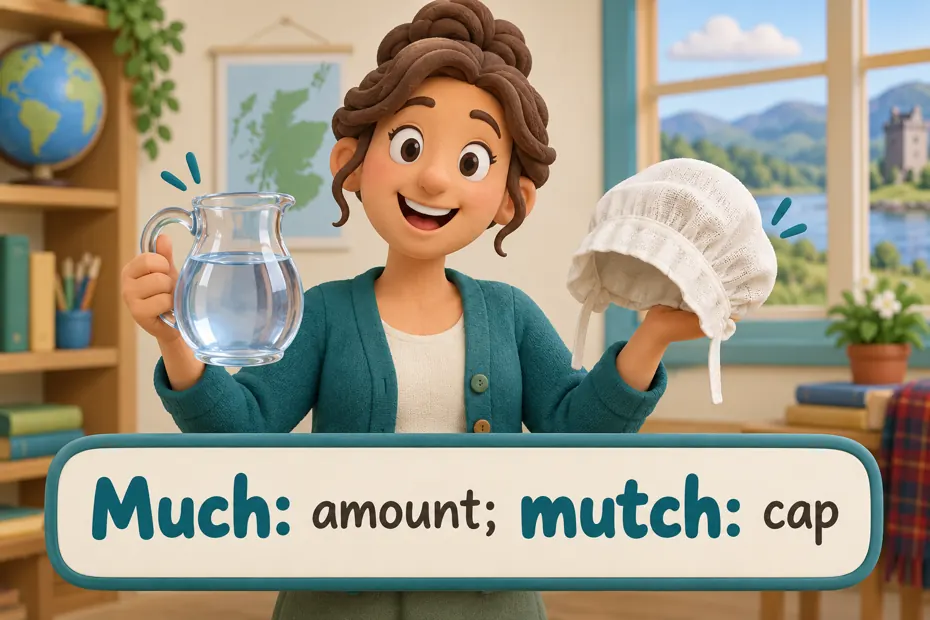
Much expresses an amount or degree, as in “not much water” and “much better.” Mutch is a real, uncommon noun for a traditional cap, especially in Scottish usage. Write much when discussing quantity. Mutch is a spelling error in that meaning, but it is not a nonexistent word.
Editorial correction: The older article below incorrectly says that mutch does not exist, labels much only as an adverb, and gives “I have much assignments” as a correct example. Dictionaries record mutch as a cap. Write “many assignments” or “a lot of assignments.” Also, much can occur in direct questions: “Do you have much time?” is grammatical.
Which word fits the intended meaning?
| Expression | Meaning or use | Example |
|---|---|---|
| much water | Quantity of an uncountable substance | We do not need much water. |
| much better | Degree of a comparative difference | The revised instructions are much better. |
| many books | Number of plural countable items | How many books did you borrow? |
| a lot of work | Large amount, common in conversation | I have a lot of work today. |
| a mutch | Traditional cap | The portrait shows a woman wearing a white mutch. |
Merriam-Webster’s mutch entry records the cap meaning. Collins also identifies the Scottish cap term. The distinction matters when editing a historical costume description: replacing every instance of mutch with much would damage a correctly written sentence about clothing.
When should you use much rather than many?
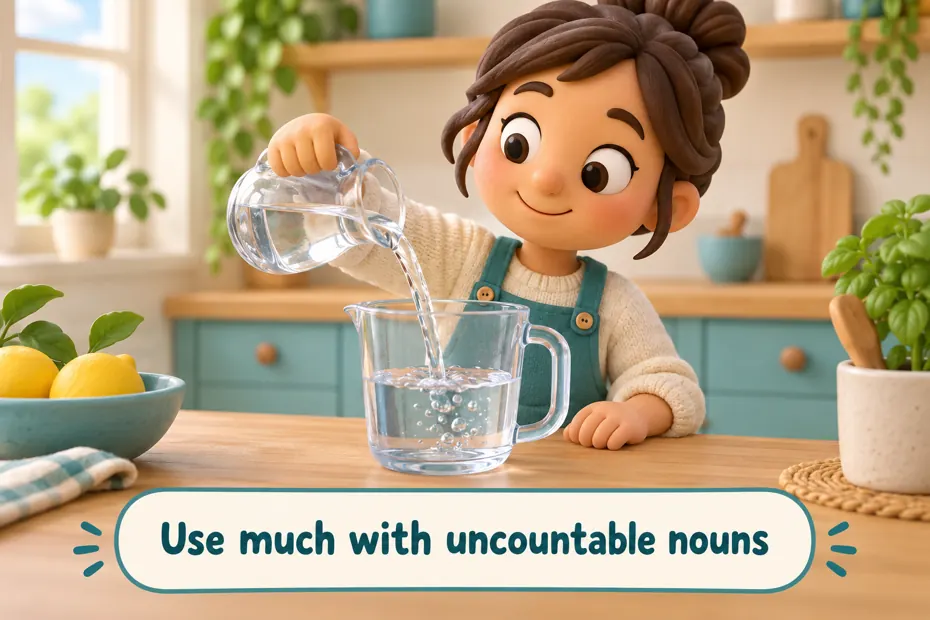
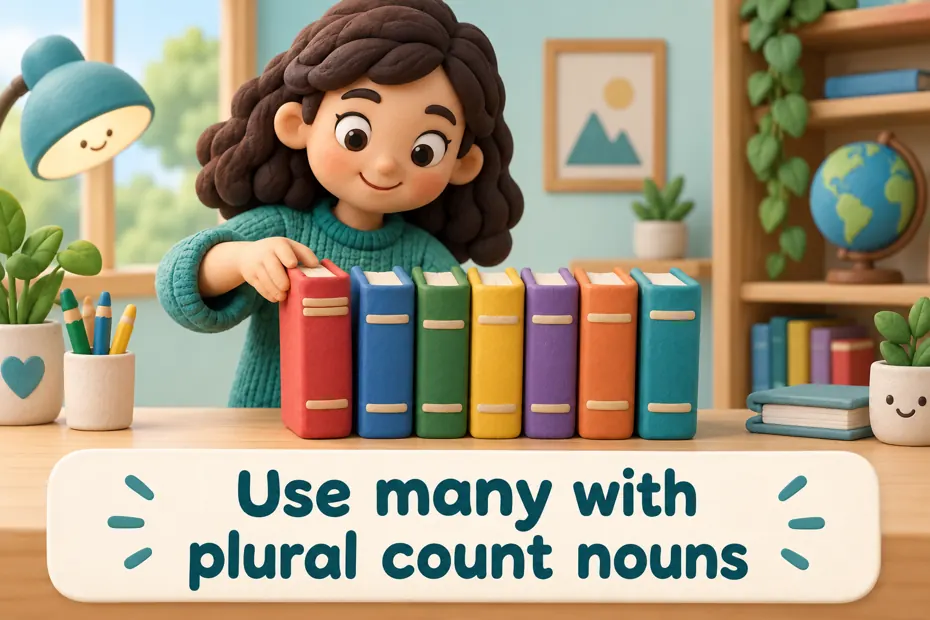
Use much when the noun has an uncountable meaning: “How much rice is left?” Use many with a plural count noun: “How many bowls are left?” Rice is treated as a substance; bowls are counted as separate items. To count rice, specify a unit or item: “How many bags of rice?” The noun following the quantity word determines the pattern.
Oxford’s quantifier guidance explains the much/many distinction. Practical pairs include much homework but many assignments, much information but many facts, and much money but many coins. The things may concern the same topic while their grammatical categories differ.
A noun can change meaning with its use. “We do not have much room” uses room to mean space. “The hotel does not have many rooms” counts separate accommodation units. Do not memorize that room always takes much or always takes many. Ask whether the particular sentence treats it as an amount or as separate countable items.
Why do questions and negatives often use much?
“Do you have much experience?” and “We do not have much experience” are ordinary patterns. The first is a direct yes-or-no question, so the older claim that much cannot occur in direct questions is incorrect. “How much experience do you have?” is also grammatical, but it asks about the amount rather than simply whether there is a substantial amount.
Cambridge’s quantifier guide notes that conversational affirmative clauses often prefer a lot of or lots of. “I have a lot of homework” usually sounds more natural in everyday conversation than “I have much homework.” That preference does not ban much from every positive statement: “There is too much homework” is ordinary.
Use too much for an excessive amount and so much for a strong degree or large amount: “There is too much noise” and “Thank you so much.” Use as much as in a comparison of amounts: “I drank as much water as you did.” None of those expressions takes the extra t in mutch.

How does much modify a comparison?
Much can be an adverb modifying a comparative: “This route is much shorter.” The word strengthens the difference between routes. It does not count routes or require an uncountable noun in that construction. Merriam-Webster records several grammatical uses of much, so treating every occurrence as the same quantifier pattern is too restrictive.
Compare “The route is much shorter” with “There are many shorter routes.” The first sentence describes the degree of one comparison. The second counts several alternatives. “Very shorter” is not the usual comparative modifier; write much shorter, far shorter, or considerably shorter when the intended difference is substantial.
What does mutch mean in a historical description?
A mutch is a cap, often a traditional close-fitting white linen cap in Scottish descriptions. The noun can take an article and a plural: “a mutch” and “two mutches.” In a museum caption or costume study, identify the object instead of changing its spelling merely because the word is unfamiliar. A short explanation helps readers who do not know the regional term.
Names and quotations deserve the same contextual care. If Mutch appears as a person’s surname, preserve the name. If a message says “Thanks so mutch,” the intended quantity expression is “Thanks so much.” A real noun can still be the wrong word in a sentence. Check the role before making the correction.
Frequently asked questions
Is mutch ever correct?
Yes. Mutch is correct when naming the traditional cap, and Mutch can occur as a name. It is not the standard quantity word in “so much” or “how much.” The original article’s blanket claim that the spelling has no meaning is incorrect. The surrounding sentence determines whether a correction is needed.
Should I write much assignments?
No. Assignments is a plural count noun, so write many assignments or a lot of assignments. Homework is ordinarily uncountable: “not much homework” is grammatical. In a conversational positive statement, “I have a lot of homework” usually sounds more natural. Changing the noun can change the appropriate quantity expression.
Can a direct question contain much?
Yes. “Is there much traffic?” and “Do you have much time?” are direct questions that correctly use much. “How much traffic is there?” asks explicitly about the amount. Avoid “Much traffic is there?” as the normal word order for that question. The issue is question construction, not a ban on much.
Does much always function as an adverb?
No. Much modifies degree in “much better,” but it also expresses quantity before an uncountable noun and can stand without an expressed noun when the meaning is clear. “Much remains to be done” illustrates the latter pattern. Read the whole construction before assigning a grammatical label or correcting the spelling.
Original article, retained with the corrections above
Hey there! Have you ever found yourself confused about when to use “much” and “mutch”? Well, you’re not alone! In this text, I’ll be diving deep into the correct usage of these two words and providing you with some helpful tips along the way.
We all know that the English language can be a bit tricky at times, especially when it comes to similar-sounding words. But fear not, because by the end of this article, you’ll have a clear understanding of when to use “much” and when to use “mutch” in your everyday conversations and writing.
Key Takeaways
- “Much” is a valid word in the English language, while “mutch” is a misspelling and does not exist.
- “Much” is an adverb used to emphasize the degree or extent of something, often indicating a large amount.
- “Much” is used with uncountable nouns to indicate a large quantity or degree.
- “Much” is used in comparisons to express a significant difference.
- “Much” is commonly used in negative sentences to emphasize the absence or lack of something.
- “Much” is frequently used in questions to inquire about the quantity or frequency of something.
What is the difference between “much” and “mutch”?
When it comes to the English language, there are countless words that can cause confusion. One such pair is “much” and “mutch.” So what exactly is the difference between these two words?
Let’s start with the definition of each word. “Much” is an adverb used to emphasize the degree or extent of something, often indicating a large amount. On the other hand, “mutch” is a misspelling of the word “much” and does not have a separate definition or usage.
The main difference between “much” and “mutch” is that one is a correct word with a specific meaning, while the other is simply an incorrect spelling. It is important to note that “mutch” should not be used in place of “much” in any context.
To better understand the correct usage of “much,” here are a few examples:
- I have much assignments to do tonight.
- She doesn’t eat much meat.
- We don’t have much time left before the deadline.
As you can see, “much” is used to indicate a large or significant amount of something. It is a versatile word that can be used in various contexts, such as talking about quantities, degrees, or even emotions.
On the other hand, “mutch” is simply a misspelling of “much.” It has no distinct definition or usage in the English language.
To conclude, it’s important to use the correct word when expressing yourself in English. The word “much” is the correct term to use when talking about a large quantity or extent of something. Remember, “mutch” is not a valid word and should be avoided.
Now that we’ve clarified the difference between “much” and “mutch,” let’s move on to some other commonly confused words in the English language.
When to use “much”
As I mentioned earlier, understanding the correct usage of “much” is essential in English. Let me jump into when and how this word should be used.
The first thing to note is that “much” is an adverb often employed to emphasize the degree or extent of something. It indicates a large amount and is commonly used in questions, negatives, and certain structures.
Here are some scenarios where “much” is appropriately used:
- Quantifiers: “Much” is used with uncountable nouns to indicate a large quantity or degree. For example:
- How much sugar do you need for the recipe?
- I don’t have much time to finish this assignment.
- Comparisons: When comparing two or more things, “much” can be used to express a significant difference. For example:
- This car is much faster than the previous model.
- I enjoyed the second book much more than the first one.
- Negatives: “Much” can be used in negative sentences to emphasize the absence or lack of something. For example:
- I don’t have much interest in politics.
- She didn’t give much thought to her decision.
- Questions: “Much” is commonly used in questions to inquire about the quantity or frequency of something. For example:
- How much money did you spend on your vacation?
- How much sleep did you get last night?
It’s important to note that “much” is not to be confused with “many,” which is used with countable nouns. Understanding the difference between these two words will ensure proper usage and clarity in your writing.
Now that we have a clearer understanding of when to use “much,” let’s explore the common misusage of “mutch” and why it’s incorrect.
Examples of correct usage of “much”
As we investigate further into the correct usage of “much,” let’s explore some examples to enhance your understanding and application of this adverb. These examples will highlight the different contexts in which “much” is used and provide clarity on its appropriate usage.
1. Quantity/Amount:
- I don’t have much time left before the deadline.
- Can you please give me some water? I haven’t had much to drink today.
2. Comparison:
- John earned much more money than his colleagues.
- This painting is worth so much more than what we paid for it.
3. Negation:
- There isn’t much left of the cake. It was delicious!
- We didn’t receive much feedback on the survey.
- How much does this shirt cost?
- Much is expected of you in this role. Are you ready?
It’s important to note that “much” is used to emphasize the degree or extent of something, typically indicating a large amount. Its usage is common in quantifying non-countable nouns and expressing comparisons or negations.
Remember, much is used with non-countable nouns, while “many” is used with countable nouns. This is a crucial distinction to avoid confusion in your writing and speech.
Now that we have explored examples of the correct usage of “much,” we will move on to discussing the common misusage of the word “mutch” and why it is incorrect. Stay tuned for valuable insights on avoiding this common mistake!
Misusage of “Mutch” and Its Incorrectness
Continuing our exploration of commonly confused words, we now turn our attention to the word “mutch,” which is often mistakenly used instead of “much.” But, hold on – “mutch” is not a word in the English language!
The correct spelling and usage is indeed “much,” which we have already discussed extensively. “Mutch” is simply an incorrect spelling that may occasionally be encountered due to typographical errors or confusion.
Understanding the difference between “much” and “mutch” is essential for effective communication. While “much” is an adverb that emphasizes quantity or extent, “mutch” does not exist in the English language and should be disregarded in your writing and speech.
Common mistakes to avoid when using “much”
When it comes to using the word “much,” there are a few common mistakes that people often make. Understanding these mistakes will help you use the word correctly and effectively. So, let’s immerse and explore the most frequent errors to avoid when using “much.”
1. Confusing “much” with “many”
One of the most common mistakes is confusing “much” with “many.” While both words deal with quantity, they are used in different contexts. Remember the following distinctions:
- “Much” is used with non-countable nouns to denote a large amount or degree. For example: “There’s not much water left.”
- “Many” is used with countable nouns to indicate a large number. For example: “There are many books on the shelf.”
2. Incorrect usage in questions
Another mistake to watch out for is using “much” incorrectly in questions. The word “much” is not used in direct questions. Instead, we use “how much” to ask about quantity or “how many” to inquire about number:
- Correct: “How much sugar do we need?”
- Incorrect: “Much sugar do we need?”
3. Overusing “much” in negative statements
Using “much” excessively in negative statements is another common error. While it’s correct to use “much” in negative constructions, be mindful of not overusing it. Instead, consider using alternative words or expressions such as “any” or “enough” to add variety to your sentence structure.
- Incorrect: “I don’t have much time and much money.”
- Correct: “I don’t have much time and enough money.”
4. Misusing “too much” and “so much”
Sometimes, confusion arises between the usage of “too much” and “so much.” Both phrases indicate an excessive amount, but “too much” implies a negative consequence or outcome, while “so much” is used to emphasize the degree or extent.
- Incorrect: “She ate so much that she got sick.”
- Correct: “She ate too much and got sick.”
By avoiding these common mistakes when using “much,” you can improve your English language skills and communicate more effectively. Remember to pay attention to the context and usage of “much” to convey your thoughts accurately.
When to use “mutch”
Let’s explore the topic of “mutch” and when it should be used. First things first, it’s important to note that “mutch” is NOT a word in the English language. So, there is no usage or appropriate context for it. It’s a common mistake that people make, but it’s crucial to disregard this incorrect spelling.
To clarify, the correct word that we should be focusing on is “much.” Now that we have cleared the confusion, let’s jump into when to use “much” correctly.
Definition of “Much”
“Much” is an adverb used to emphasize the degree or extent of something. It is often used to indicate a large amount. Here are some common scenarios where “much” should be used:
1. Quantifiers:
- I have much respect for her talent.
- There isn’t much time left before the deadline.
2. Comparisons:
- She has achieved much more than I have.
- This project is much bigger than the previous one.
3. Negatives:
- He doesn’t have much experience in this field.
- I don’t see much point in continuing with this discussion.
4. Questions:
- How much sugar do you need for this recipe?
- To what extent did you enjoy the concert?
In all these instances, “much” is used to quantify non-countable nouns, express comparisons, negations, and when asking about the degree or extent of something.
Remember, it’s important not to confuse “much” with “many,” which is used with countable nouns. “Much” refers to something that cannot be counted, while “many” refers to things that can be counted.
Conclusion
By using “much” appropriately, you can enhance your language skills and communicate more effectively. So, let’s avoid the incorrect usage of “mutch” and focus on mastering the correct usage of “much.”
Examples of correct usage of “mutch”
As we continue our exploration of the correct usage of “mutch,” it’s important to note that “mutch” is not a word in the English language. It may be a common misspelling or a result of confusion with the word “much.” Hence, there are no examples of correct usage for “mutch” because it simply does not exist.
Difference Between “Much” and “Mutch”
To clarify the difference between “much” and “mutch,” let’s take a closer look at their definitions:
- Much is an adverb used to emphasize the degree or extent of something, often indicating a large amount.
- Mutch is not a word in the English language and should be disregarded entirely.
So, as we can see, there is no correct usage of “mutch” since it has no meaning or presence in English vocabulary.
What Is “Much”?
Let’s investigate deeper into the correct usage of “much.” When used appropriately, “much” can enhance your communication skills and make your language more expressive. Here are some examples:
- With quantifiers: “I have much respect for her talent” or “There isn’t much time left before the deadline.”
- In comparisons: “She is much taller than her sister” or “This car is much faster than the old one.”
- In negatives: “I don’t have much patience for rude behavior” or “We didn’t eat much at the restaurant.”
- In questions: “How much money did you spend on that dress?” or “Do you have much experience in this field?”
By using “much” correctly in these contexts, you can convey the appropriate amount or extent of something.
Remember, it’s crucial not to confuse “much” with “many,” which is used with countable nouns. “Much” refers to non-countable nouns, while “many” is used with countable nouns.
Common mistakes to avoid when using “mutch”
One common mistake that people make when using the word “mutch” is that they confuse it with the word “much.” But, it is important to note that “mutch” is not a word in the English language. This means that using “mutch” in any context would be incorrect, as it does not have a definition or a proper usage.
To avoid this mistake, it is essential to understand the difference between “much” and “mutch.” Here are a few common mistakes to avoid when using “mutch” and how to correct them:
- Using “mutch” instead of “much”: As mentioned earlier, “mutch” is not a valid English word. Hence, it is crucial to always use “much” when expressing a large amount or degree of something. For example, instead of saying “I have mutch work to do,” it should be “I have much work to do.”
- Confusing the definition of “mutch” with “much”: Since “mutch” has no definition, one should avoid confusing it with “much.” Remember, “much” is an adverb used to emphasize the degree or extent of something, often indicating a large amount. It is used with non-countable nouns. Examples include “much water,” “much money,” and “much time.”
- Using “mutch” when asking questions: Another common mistake is using “mutch” instead of “much” when asking questions. When seeking information about the quantity or extent of something, it is always correct to use “how much.” For instance, “How much does this item cost?” or “How much time do we have?”
By avoiding these common mistakes and mastering the correct usage of “much,” you can improve your English language skills and communicate more effectively.
Stay tuned as I will now move on to discussing more misconceptions and common errors related to the usage of “much” in various contexts. Remember, clarity and accuracy are key when it comes to effective communication in English.
Tips for using “much” and “mutch” correctly
When it comes to using words correctly, it’s important to pay attention to their meaning and context. In this section, I’ll provide you with some valuable tips on how to use “much” and “mutch” appropriately. Let’s immerse!
Understand the Difference Between “Much” and “Mutch”
Before we investigate into the usage tips, let’s clarify the distinction between “much” and “mutch.” While “much” is a valid word in English with its own definition, “mutch” does not exist in the English language. So, it’s crucial to stick with “much” when expressing the concept of quantity or extent.
Familiarize Yourself with the Definition of “Much”
To use “much” correctly, it’s essential to understand its definition. Simply put, “much” functions as an adverb that emphasizes the degree or extent of something, often indicating a large amount. It is primarily used with non-countable nouns.
Use “Much” in Appropriate Contexts
Here are some useful tips for using “much” correctly:
- Quantifiers: “Much” is commonly used with quantifiers such as “too much,” “so much,” and “as much as.” For example, “There’s too much noise in this room.”
- Negatives: In negative statements, “much” is often used to convey the absence or lack of a large amount. For instance, “I don’t have much free time during the week.”
- Comparisons: When comparing two things, “much” is used to highlight a significant difference in extent or degree. For example, “He is much taller than his brother.”
- Questions: “Much” is used in questions to inquire about the extent or degree of something. For instance, “How much does this book cost?”
Remember: “Mutch” Is Not a Word!
To avoid confusion, it’s important to reiterate that “mutch” is not a valid word in English. So, remember to use “much” instead. By mastering the correct usage of “much” in various contexts, you can enhance your language skills and communicate more effectively.
Conclusion
Understanding the correct usage of “much” is crucial for effective communication in English. Through this article, I have highlighted the key differences between “much” and the non-existent word “mutch.” By mastering the usage of “much,” you can enhance your language skills and avoid common mistakes.
Remember, “much” is a valid word in English, while “mutch” does not exist. Use “much” appropriately with quantifiers, negatives, comparisons, and questions to convey your message accurately.
By focusing on the correct usage of “much,” you can express yourself more clearly and confidently. Avoiding the use of “mutch” will ensure that your language remains accurate and professional.
I hope this article has provided you with valuable insights into using “much” correctly. Incorporate these tips into your writing and speaking, and you’ll see a significant improvement in your language skills. Keep practicing, and soon using “much” will become second nature to you.
Frequently Asked Questions
Q: What is the article about?
The article provides tips for using the words “much” and “mutch” correctly.
Q: What is the difference between “much” and “mutch”?
The word “much” is a valid word in English, while “mutch” does not exist in the English language.
Q: How can “much” be used correctly?
“Much” can be used correctly with quantifiers, negatives, comparisons, and questions.
Q: Is “mutch” a word in English?
No, “mutch” is not a word in English.
Q: What should I focus on?
Focus on mastering the correct usage of “much” to enhance your language skills and communicate more effectively.


