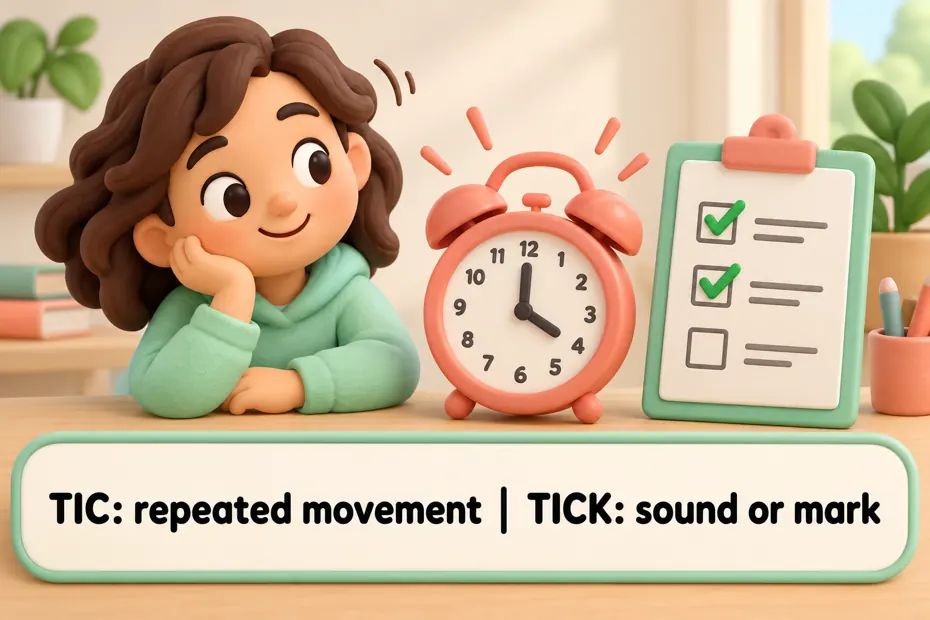
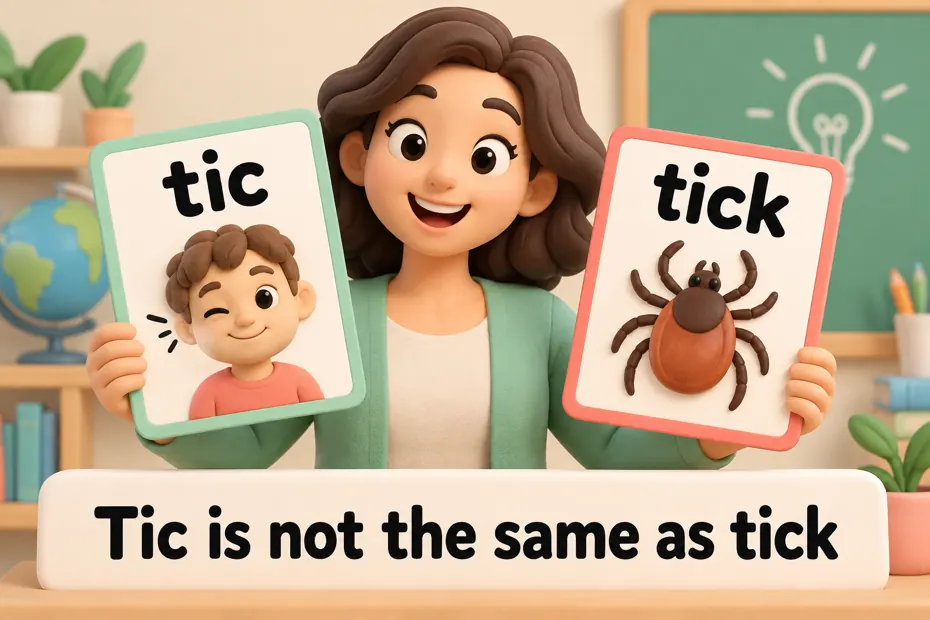
Tic refers to a repeated movement or sound that can be difficult to control, or figuratively to a repeated quirk of speech or behavior. Tick can mean a small blood-feeding arachnid, a short repeated sound, or a check mark. Choose the spelling by meaning, not pronunciation: a clock ticks; a person may have a tic.
Tic vs tick: key facts
- Tic and tick usually sound alike but have different meanings.
- A tic can involve movement or sound.
- A verbal tic can also mean a recurring expression in someone’s speech.
- A tick can be an arachnid, a sound, or a check mark.
- Tick is also a verb, as in a clock ticks or tick the box.
Which spelling belongs in your sentence?
Identify the thing or action being described. Repeated movements or vocalizations use tic. A small arachnid, the sound of a clock, or a mark on a form uses tick. A vocabulary comparison helps with spelling, but it cannot diagnose why someone repeats a movement or makes a sound.
| Context | Word | Original example |
|---|---|---|
| Repeated movement or sound | tic | The description mentioned a motor tic. |
| Repeated speech quirk | tic | “Actually” became a verbal tic in his speeches. |
| Clock sound | tick | We heard the tick of the clock. |
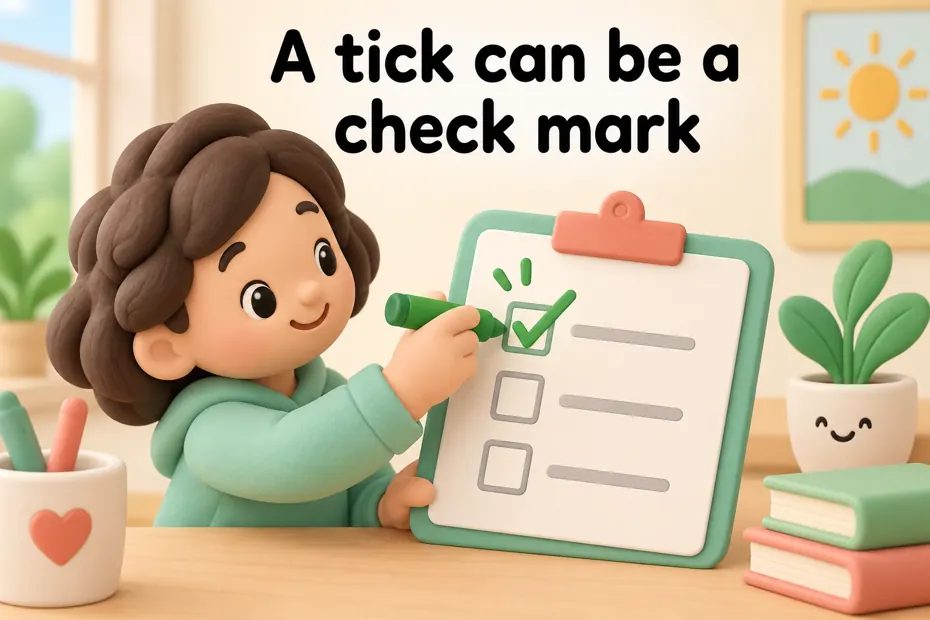
| Check mark | tick | Put a tick beside the correct answer. |
| Mark a choice | tick | Tick the box beside your name. |
| Arachnid | tick | The guide showed a picture of a tick. |
Merriam-Webster’s tic entry distinguishes movement and figurative speech-quirk senses. Its tick entry covers the separate word tick. For the health meaning, the NHS overview of tics explains that tics may involve movements or sounds and can be difficult to control.
How do you use tick as a noun and a verb?
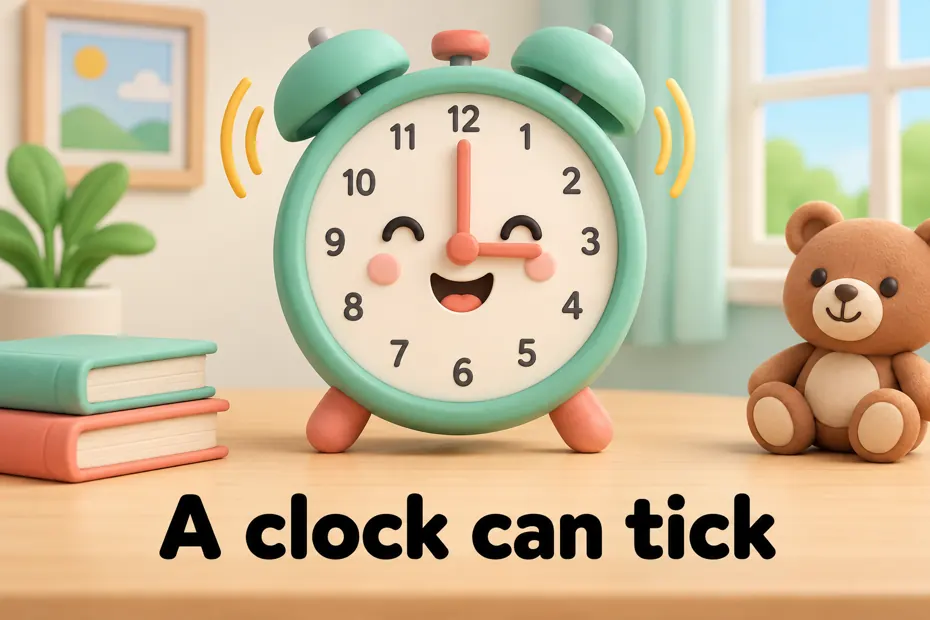
In “The tick was faint,” tick names a sound. In “The clock ticks quietly,” ticks describes the clock’s action. For a completed action, write ticked: “The clock ticked throughout the lesson.” The form ticking works in “The clock is ticking.” None of these clock examples needs the spelling tic.
A check mark is also called a tick, especially in British English. “Tick the box” tells the reader to mark a selection. If your audience is more familiar with check, write “Check the box” or “Place a check mark beside the answer.” Both versions express the same task without introducing the medical or figurative meanings of tic.
What does verbal tic mean?
In everyday commentary, verbal tic can describe a recurring expression such as actually or you know. That figurative label should not be confused automatically with a diagnosed condition. If you are simply editing a speech, “a repeated phrase” or “an overused expression” may describe your observation more precisely.
For example, “The draft repeats ‘in fact’ in every paragraph” identifies a specific editing issue. “The writer has a verbal tic” adds a characterization of the writer that may be unnecessary. Describing the text directly is often clearer and keeps feedback focused on something the writer can revise.
Keep health descriptions accurate and respectful
The older article below discusses health-related tics. Read it as general vocabulary context, not as a way to identify a condition in yourself or someone else. The NHS distinguishes motor tics from vocal or phonic tics and notes that they can affect daily life. A repeated sound alone does not establish a diagnosis.
The NHS advises seeking a GP’s advice when tics cause concern, pain, emotional or social problems, or interference with ordinary activities. That is different from asking a spelling guide to recommend treatment. If you are writing about an identified person, use their own description where appropriate and avoid jokes that turn a difficult-to-control movement into a character flaw.
Practice with original examples
Fill these gaps: “The clock began to ___.” “Place a ___ beside the answer.” “The article explains the term motor ___.” “The editor noticed a repeated verbal ___.” The answers are tick, tick, tic, tic. The first is a verb; the remaining examples use nouns with different meanings.
For a sentence containing both spellings, read “The lesson explains tic disorders while the classroom clock ticks.” Tic modifies disorders, while ticks states what the clock does. Label the meaning of each occurrence before checking the spelling. Both words may pass a spell-checker even when one has been used in the wrong context.
Frequently asked questions
Is a clock sound a tic?
Use tick for the short repeated sound of a clock. Tic has different movement or behavior meanings. You can write “the clock’s tick,” “the clock ticks,” or “the clock is ticking,” depending on the sentence. Choose the grammatical form as well as the correct base spelling.
Is every repeated phrase a medical tic?
No. Verbal tic can be a figurative description of a recurring expression in speech or writing. That wording does not itself establish a medical condition. For editing feedback, name the repeated phrase directly. For health concerns, seek appropriate clinical advice rather than drawing conclusions from a vocabulary label.
Is it tick the box or tic the box?
Write tick the box when instructing someone to mark a selection. Check the box is another clear option, especially for audiences familiar with that wording. Tic is not the spelling for a check mark or the act of adding one, despite the words’ similar pronunciation.
Original article and examples
Key Takeaways
- The key difference between “tic” and “tick” lies in their meanings and contexts of usage. A tic refers to an involuntary movement or vocalization associated with certain medical conditions, while a tick is a blood-sucking arachnid.
- “Tic” is commonly used in medical or psychological contexts when discussing involuntary movements or sounds associated with tic disorders, while “tick” can have various everyday uses such as describing clock sounds or checking off tasks.
- Tics can be motor or vocal, and they often have triggers that can worsen or exacerbate them. It’s important to be empathetic towards individuals with tic disorders.
- Ticks are small arachnids that feed on the blood of animals and humans, often transmitting diseases. It is important to check for ticks after spending time in nature.
- Understanding the correct usage of “tic” and “tick” is crucial for clear and accurate communication, as misusing these words can lead to confusion or misunderstandings.
- By using the appropriate word in each context, we convey our thoughts precisely, leaving no room for ambiguity. Choosing the right word enhances our communication and avoids misunderstandings.
Understanding the difference between “tic” and “tick”
When it comes to language, precision is key. Understanding the difference between similar-sounding words can significantly improve our communication skills. Today, I’ll shed light on the difference between “tic” and “tick” to help you use these words appropriately.
What is a tic? A tic refers to a sudden, repetitive, non-rhythmic movement or sound that is involuntary. It is often associated with various medical conditions, such as Tourette’s syndrome. Tics can manifest as body movements, such as blinking, shoulder shrugging, or vocalizations, like throat clearing or repetitive sounds. It’s important to note that tics are usually beyond a person’s control.
On the other hand, a tick is an arachnid that belongs to the family Ixodidae. These small, blood-sucking creatures are known for attaching themselves to animals and humans. Ticks have a specialized mouthpart that allows them to feed on the blood of their hosts. Also, ticks are known to carry and transmit diseases, making them a concern for both humans and animals.
To summarize, the main difference between “tic” and “tick” lies in their meanings and contexts of usage. A tic refers to an involuntary movement or vocalization associated with certain medical conditions, while a tick is a blood-sucking arachnid.
Understanding the distinction between these two words is crucial for clear and accurate communication. Misusing “tic” and “tick” can lead to confusion or misunderstandings. Let’s take a look at some examples to solidify our understanding:
- She has a nervous tic that causes her to constantly blink her eyes.
- After spending a day outdoors, I discovered a tick attached to my leg.
By using the appropriate word in each context, we convey our thoughts precisely, leaving no room for ambiguity.
Remember, language is a powerful tool, and accuracy in word choice enhances our communication. By understanding the difference between “tic” and “tick,” you are well-equipped to use these words appropriately.
Common uses of the word “tic”
As a writer, it’s crucial to understand the nuances and differences between similar-sounding words. In this section, we’ll jump into the common uses of the word “tic” to clarify any confusion and help you improve your communication skills.
Definition of “Tic”
A “tic” refers to a sudden, repetitive, non-rhythmic movement or sound that is involuntary. Tics can manifest in various forms, such as eye blinking, facial grimacing, shoulder shrugging, or throat clearing. These involuntary actions are typically associated with medical conditions like Tourette’s syndrome.
Difference Between “Tic” and “Tick”
Before we proceed, it’s important to note that “tic” and “tick” have different meanings. While “tic” represents an involuntary movement or sound, “tick” describes an arachnid that feeds on the blood of animals and humans, often transmitting diseases like Lyme disease.
Common Uses of “Tic”
Now that we have clarified the meaning of “tic,” let’s explore some common uses of this word:
- Tic Disorders: A “tic disorder” refers to a medical condition characterized by involuntary movements or sounds. These disorders include Tourette’s syndrome, chronic motor tic disorder, and chronic vocal tic disorder.
- Tic Repetition: Tics are often repetitive in nature. People with tics may experience the urge to repeat certain movements or sounds, even though they have little control over them. It’s essential to understand and be empathetic towards individuals who have tics, as their condition is involuntary.
- Tic Triggers: Certain stimuli, such as stress, excitement, or fatigue, can trigger tics in individuals with tic disorders. Recognizing and managing these triggers can be helpful in reducing the frequency and intensity of tics.
- Motor Tics: Motor tics involve involuntary movements, such as eye twitching, head jerking, or mouth movements. These movements can range from mild to severe and can significantly affect an individual’s daily life.
- Vocal Tics: Vocal tics involve involuntary sounds, such as throat clearing, sniffing, or barking. These sounds can be disruptive and may cause social discomfort for individuals with vocal tics.
Examples of sentences using “tic” correctly
Understanding the correct usage of the word “tic” can lead to more effective communication and empathy towards individuals with tic disorders. Here are some examples of sentences that use “tic” appropriately:
- “She has a tic disorder that causes involuntary movements of her face.”
- “I noticed a tic in his eye when he was feeling anxious.”
- “My brother has a vocal tic where he clears his throat repeatedly.”
- “Anxiety can sometimes trigger tics in individuals with tic disorders.”
- “Motor tics can range from simple gestures like eye blinking to complex movements like head jerking.”
- “The child’s tic repetition became more pronounced during times of stress.”
These examples demonstrate the various contexts in which the word “tic” is used correctly. It refers to involuntary movements or sounds associated with tic disorders. Tics can be motor or vocal, and they often have triggers that can worsen or exacerbate them. Understanding these nuances can help create a more understanding and supportive environment for individuals with tic disorders.
By using “tic” appropriately in our conversations, we contribute to breaking down stigmas and creating a more inclusive society. It’s important to approach the topic with sensitivity and educate ourselves about tic disorders to foster empathy and understanding.
Understanding the difference between “tic” and “tick” is vital because these words have distinct meanings and uses. While “tic” relates to involuntary movements or sounds associated with tic disorders, “tick” refers to an arachnid that can transmit diseases.
This distinction allows for more accurate and effective communication. By using these words correctly, we can avoid confusion and ensure clear and concise expression of our thoughts and ideas.
The various meanings and contexts of the word “tick”
As an expert blogger, I have come across many confusing pairs of words in English. One such pair is “tic” and “tick.” These words may sound similar, but their meanings and contexts are quite different. In this section, I will investigate into the various meanings and contexts of the word “tick” to help you understand it better.
Definition of “tick”:
The word “tick” can be used as a noun and a verb, with each usage having a distinct meaning. Let’s explore them further:
- Tick as a noun: When used as a noun, “tick” refers to a tiny, blood-sucking arachnid that can transmit diseases such as Lyme disease. You might have heard of “tick bites” and how important it is to check for ticks after spending time in nature.
- Tick as a verb: As a verb, “tick” can mean a few different things. Firstly, it can describe the light, repetitive sound made by a clock or similar timekeeping device. You know, the “tick-tock” sound that indicates the passage of time. Also, “tick” can be used to describe the action of checking items off a list or marking something as completed.
Differences between “tic” and “tick”:
While “tic” and “tick” may sound the same, they have distinct meanings and uses. Here are the key differences:
- Meaning: “Tic” refers to an involuntary, sudden, and repetitive movement or sound often associated with tic disorders. It can be a facial twitch, a throat-clearing sound, or any repetitive bodily movement beyond one’s control. On the other hand, “tick” refers to a variety of meanings discussed earlier.
- Context: “Tic” is typically used in a medical or psychological context when discussing compulsive behaviors or tic disorders. But, “tick” can be used in various everyday situations, such as talking about clock sounds, checking off tasks, or dealing with ticks in nature.
- “I heard the tick-tock of the clock in the background.”
- “I need to tick off all the items on my to-do list.”
- “Be cautious of ticks when
How to properly use “tick” in different situations
When it comes to the word “tick,” it has a range of meanings and contexts that can sometimes be confusing. Understanding how to use “tick” appropriately in different situations is essential for effective communication. Let’s explore the various ways this versatile word can be used.
1. As a Noun
In its noun form, “tick” refers to a blood-sucking arachnid commonly found in wooded areas. This small parasite can attach itself to humans or animals, causing discomfort or even transmitting diseases. Here’s an example sentence using “tick” as a noun:
- I found a tick on my dog’s fur after our hike in the woods.
2. As a Verb
As a verb, “tick” can have two distinct meanings. Firstly, it can describe the sound made by a clock or a similar device, indicating the passage of time. Here’s an example sentence using “tick” as a verb:
- I love falling asleep to the gentle tick of my grandfather’s antique clock.
Secondly, “tick” can also mean the action of checking off items from a list or fulfilling tasks one by one. This usage is often associated with to-do lists or agendas. Here’s an example sentence using “tick” as a verb:
- I like to tick off completed tasks to stay organized and motivated.
3. Common Mistakes
It’s important to note that “tick” is often mistakenly used instead of “tic,” especially when referring to involuntary movements or sounds associated with tic disorders. Remember, “tic” with a “c” refers specifically to such involuntary actions, while “tick” with a “k” has other everyday uses.
Understanding the differences between “tic” and “tick” is crucial to avoid confusion and ensure accurate expression of thoughts and ideas. By using these words correctly, you can contribute to a more understanding and inclusive environment for individuals with tic disorders.
To conclude, mastering the different usages of “tick” enables us to communicate effectively in various contexts. By understanding the differences between “tic” and “tick” and using them correctly, we can enhance our communication skills and avoid misunderstandings. So, next time you use the word “tick,” remember its multifaceted nature and choose the appropriate context for your intended meaning.
Conclusion
Understanding the difference between “tic” and “tick” is crucial for effective communication. By using these words correctly, we can avoid confusion and create a more understanding and supportive environment for individuals with tic disorders.
Throughout this article, we explored the various contexts in which “tic” is used, specifically in relation to involuntary movements or sounds associated with tic disorders. We also delved into the different meanings and uses of “tick,” including its usage as a noun and a verb.
By mastering the appropriate usage of “tick” in different situations, we can enhance our communication skills. Whether it’s referring to a blood-sucking arachnid, the sound made by a clock, or the action of checking off items from a list, using “tick” correctly ensures clear and concise expression of our thoughts and ideas.
Remember, it’s important to avoid the common mistake of using “tick” instead of “tic” when referring to involuntary movements or sounds associated with tic disorders. By understanding and utilizing these words appropriately, we contribute to a more inclusive and understanding environment for individuals with tic disorders.
So, let’s continue to improve our communication skills by using “tic” and “tick” appropriately in our everyday conversations.
Frequently Asked Questions
Q: What is the main focus of the article?
A: The article focuses on the difference between “tic” and “tick” and how understanding this difference can improve communication skills.
Q: What examples are provided for using “tic” correctly?
A: The article provides examples of sentences that use “tic” correctly, demonstrating its various contexts in relation to involuntary movements or sounds associated with tic disorders.
Q: Why is it important to use “tic” correctly?
A: Using “tic” correctly avoids confusion and creates a more understanding and supportive environment for individuals with tic disorders.
Q: What does “tick” refer to?
A: “Tick” can refer to a blood-sucking arachnid, the sound made by a clock, or the action of checking items off a list.
Q: What is the difference between “tic” and “tick”?
A: “Tic” refers to involuntary movements or sounds associated with tic disorders, while “tick” has various everyday uses.
Q: How can understanding the usage of “tick” be beneficial?
A: Understanding how to use “tick” appropriately in different situations is essential for effective communication.
Q: What are the examples of “tick” as a noun and a verb?
A: “Tick” can be used as a noun to refer to a blood-sucking arachnid, and as a verb to describe the sound made by a clock or the action of checking off items from a list.
Q: What common mistake should be avoided?
A: The common mistake of using “tick” instead of “tic” when referring to involuntary movements or sounds associated with tic disorders should be avoided.
Q: How does mastering the usage of “tick” contribute to effective communication?
A: Mastering the different usages of “tick” enables effective communication in various contexts and contributes to a more understanding and inclusive environment for individuals with tic disorders.


