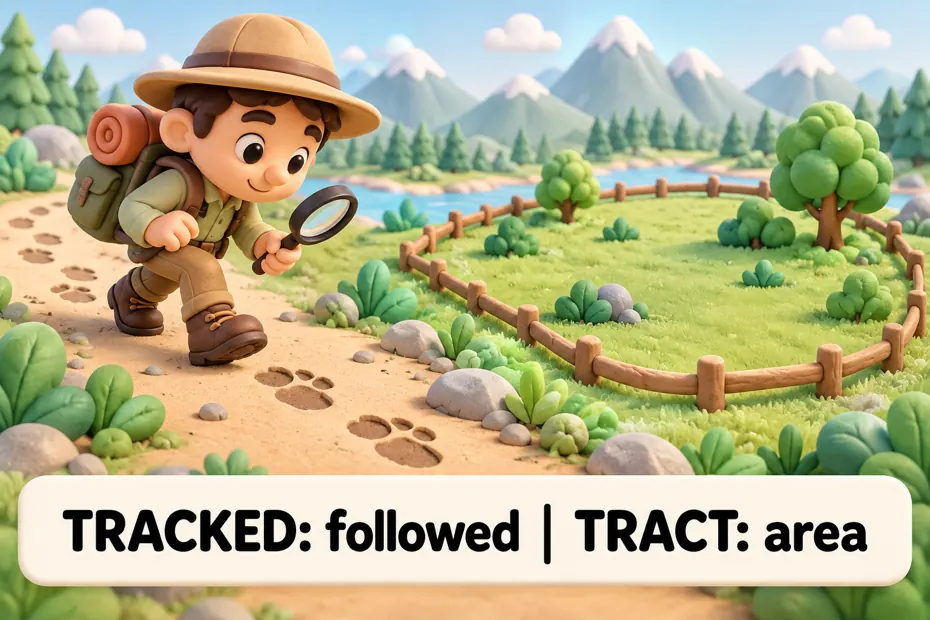
Tracked is the past tense and past participle of track, meaning followed, traced, or monitored. Tract is a noun for an area of land, a body system or pathway, or a short piece of writing. Use tracked for an action: “We tracked the parcel.” Use tract to name something: “a tract of land.”
Tracked vs tract: key facts
- Tracked belongs to the verb track.
- Tract names a thing or area rather than a completed tracking action.
- A tract of land can be defined or described generally.
- Digestive tract uses tract, not tracked.
- A written tract is more specific than just any document.
Which word fits the grammar?
Find the sentence’s subject and action first. In “The team tracked the shipment,” the team performs an action, and tracked supplies the past-tense verb. In “The team mapped the tract,” mapped supplies the action, while tract names the area being mapped. A noun and a past-tense verb cannot simply swap places because they sound similar.
| Meaning | Word | Original example |
|---|---|---|
| Followed a trail | tracked | We tracked the deer through the woods. |
| Monitored progress | tracked | The teacher tracked reading progress. |
| Located a shipment | tracked | She tracked the parcel online. |
| Area of land | tract | A wooded tract bordered the farm. |
| Body system | tract | The diagram labels the digestive tract. |
| Short persuasive writing | tract | The archive held a political tract. |
Merriam-Webster’s track entry supports the verb behind tracked. Its tract entry distinguishes the land, body-system, and pamphlet meanings. These examples illustrate word use; they do not give medical advice or property-boundary information.
How do you use tracked with helping verbs?
Tracked can stand as a simple past-tense verb: “They tracked the route.” It can also follow have, has, or had: “They have tracked the route” and “She had tracked the shipment before calling.” In a passive construction, the tracked item becomes the subject: “The shipment was tracked through each depot.”
After did, use the base form track rather than tracked: “Did you track the parcel?” and “I did not track it.” Compare that with “I tracked it yesterday,” where no helping verb did is present. The spelling choice and the verb-form choice are separate checks, so confirm both before finishing a sentence.
What kind of noun is tract?
In the land sense, a tract is an area: “They surveyed a tract beside the river.” The word alone does not state its size, ownership, or legal boundary. Add the detail the reader needs rather than treating tract as a measurement. For example, “the northern tract shown on the map” is more informative than an unexplained “the tract.”
In writing, tract often refers to a short pamphlet presenting a political or religious argument. The older guide’s broad phrase “a written document” should therefore not make readers assume every letter, shopping list, or report is naturally called a tract. Choose document when you mean the general category, and tract when its particular purpose fits.

Common spelling checks
Write digestive tract or respiratory tract when naming the relevant body system. The word is a noun modifying the topic, not evidence that something was tracked. Conversely, “The researchers tracked the participants’ responses” describes an action and needs the verb form.
The phrase “tracked changes” describes changes that were recorded or marked. “A tract of land” describes an area. Compare the endings visually: tracked contains the base track plus the past-tense ending ed; tract ends in ct and has no past-tense ending. This spelling check works best after you have already identified the intended meaning.
Practice with original examples
Complete the gaps: “We ___ the delivery yesterday.” “The ___ contains woodland.” “The lesson names the digestive ___.” “Did you ___ the order?” The answers are tracked, tract, tract, track. The final example tests the base form after did as well as the distinction between the two main spellings.
For a mixed sentence, read “The surveyor tracked the route across the tract.” Tracked states what the surveyor did; tract names the land crossed. Labeling each word’s job helps you edit similar-sounding pairs without depending on a spell-checker, which may accept either word even when its meaning is wrong.
Frequently asked questions
Is tracked a noun?
In the ordinary uses discussed here, tracked is a verb form or a modifier based on that form, as in a tracked parcel. Tract is the noun used for land, a body system, or a pamphlet. Identify whether the sentence describes an action or names a thing before choosing.
Is it digestive tracked or digestive tract?
Write digestive tract. Tract names the body system in this phrase, whereas tracked would describe a completed following or monitoring action. A sentence can include both ideas, but it needs different wording: “The illustration labels the digestive tract, and the student tracked each label in a checklist.”
Can tract mean any piece of writing?
Use tract when the short, often persuasive pamphlet meaning fits. For a general letter, article, or file, a more specific everyday label is usually clearer. Calling every written item a tract loses the distinction that makes the word useful and can imply an argumentative purpose the document does not have.
Original article and examples
Are you confused about when to use “tracked” and “tract” in your writing? Well, fear not, because in this text, I’ll provide you with a clear understanding of when and how to use these words appropriately. As an experienced writer, I’ve encountered this common dilemma myself, and I know how frustrating it can be to choose the right word. But don’t worry, I’m here to shed some light on the subject and help you navigate through the confusion. So, if you’re ready to master the art of using “tracked” and “tract” correctly, let’s immerse and unravel the mystery together.
Key Takeaways
- “Tracked” is the past tense and past participle form of the verb “to track,” meaning to follow the trail or path of someone or something, often using footprints or other indicators.
- “Tract” is a noun referring to an area of land, a written document, or a group of related organs or tissues in the body.
- Understanding the distinction between “tracked” and “tract” is crucial for effective communication and choosing the appropriate word in any given context.
- When using “tracked” correctly, consider its meaning and usage in sentences related to following movement, monitoring progress or data, and describing completed actions in the past.
- To use “tract” appropriately, understand its definition and employ it in sentences referring to specific areas of land, written or printed documents, or related organs or tissues.
- Avoid confusing “tracked” and “tract” by remembering that “tracked” is a verb used to describe actions, while “tract” is a noun used to refer to specific things or areas.
Tracked vs Tract: Understanding the Difference
When it comes to language, some words can be confusing, and even more so when they sound similar or have similar spellings. This is the case with the words “tracked” and “tract”. Even though their similarities, they have distinct meanings and usages. In this section, let’s jump into the difference between these two words and gain a clear understanding of when and how to use them appropriately.
Definition of Tracked:
The word “tracked” is the past tense and past participle form of the verb “to track”. It means to follow the trail or path of someone or something, often using footprints, marks, or other indicators. It implies monitoring or keeping a close watch on someone or something’s movements.
Definition of Tract:
On the other hand, “tract” is a noun that refers to an area of land, usually a large expanse. It can also mean a pamphlet or piece of writing covering a specific subject or topic, often intended for educational or promotional purposes.
Now that we have a clear understanding of the definitions of “tracked” and “tract”, let’s take a closer look at some examples to further solidify our understanding of the difference between these two words.
Examples of Tracked:
- The detective carefully tracked the suspect’s movements throughout the city.
- The hikers decided to track the footprints to find their way back to the trailhead.
- The company uses a software program to track inventory levels and sales.
- The rancher owns a vast tract of land, stretching as far as the eye can see.
- The student handed out tracts about the importance of environmental conservation.
- The doctor specialized in the digestive tract, studying the various organs and their functions.
By examining these examples, we can clearly see the distinction between “tracked” and “tract”. While “tracked” focuses on following someone or something’s trail or monitoring their movements, “tract” refers to a large area of land or a written piece covering a particular subject.
Understanding the subtle differences between these commonly confused words is crucial for effective communication. It allows us to convey our intended meaning accurately and avoid misunderstandings. With this newfound knowledge, we can confidently choose the appropriate word in any given context.
How to Use “Tracked” correctly
When it comes to using the word “tracked,” it’s important to have a clear understanding of its meaning and proper usage. Let me break it down for you:
- Definition of “Tracked”: “Tracked” is the past tense form of the verb “track,” which means to follow the trail or path of something or someone. It can also mean to monitor or keep a record of progress or movement.
Now that we know the definition, let’s jump into how to use “tracked” correctly in sentences:
- Tracking Movement: We can use “tracked” to describe following the path or movement of something or someone. For example:
- I tracked the footprints in the snow to find my lost keys.
- The wildlife conservationists tracked the migration patterns of the birds.
- Tracking Progress or Data: “Tracked” can also be used to indicate monitoring or keeping a record of progress or data. Here are a couple of examples:
- We tracked our expenses throughout the month to create a budget.
- The GPS system tracked the distance we traveled during our road trip.
- Past Actions: Finally, “tracked” can be used to describe completed actions in the past. Consider the following examples:
- I tracked my package online and it arrived today.
- The detective tracked down the suspect and made an arrest.
By using “tracked” correctly in your writing, you can communicate your ideas clearly and accurately. Remember to choose this word when you want to convey the act of following, monitoring, or keeping a record of something or someone.
When to Use “Tract” in your Writing
In this section, we’ll explore the proper usage of the word “tract” to help you steer clear of any confusion. By understanding the definition and examples of “tract,” you’ll be able to employ it correctly in your writing.
Definition of “Tract”
The term “tract” refers to a specific area of land, a written or printed document, or a group of related organs or tissues in the body. It is important to note that “tract” is a noun and should be used as such in sentences.
Using “Tract” in Context
Here are a few examples that demonstrate the correct usage of “tract” in different contexts:
- Real Estate: The developer purchased a large tract of land to build a new housing community.
- Literature: She handed me a tract about healthy eating habits.
- Anatomy: The respiratory tract consists of the nose, throat, and lungs.
The Difference Between “Tracked” and “Tract”
While “tracked” and “tract” may sound similar, they have different meanings and functions. Understanding their distinctions will help you avoid common errors.
- “Tracked” is the past tense form of the verb “track,” which means to follow the trail of something or someone, or to monitor progress or movement.
- On the other hand, “tract” is a noun that refers to land, written or printed documents, or a group of related organs or tissues in the body.
As you can see, “tracked” is a verb used to describe actions, while “tract” is a noun used to refer to specific things or areas.
Remember, using the correct word in your writing is crucial for effective communication. Now that you have a clear understanding of when to use “tract,” you can confidently employ it to convey your ideas accurately.
Common Mistakes and Confusions
One of the most common mistakes that people make is confusing the words “tracked” and “tract.” Although they may sound alike, they have completely different meanings and uses. Let’s jump into the differences and how to use each word appropriately.
The Difference Between “Tracked” and “Tract”
The confusion between “tracked” and “tract” often stems from their similar pronunciations. But, their meanings and usage are distinct.
Definition of “tracked”: “Tracked” is the past tense form of the verb “track.” It means to follow the trail or path of something or someone, or to monitor or keep a record of progress or movement.
Definition of “tract”: On the other hand, “tract” is a noun that refers to a specific area of land, a written or printed document, or a group of related organs or tissues in the body.
Examples and Usage
To better understand when to use “tracked” and “tract”, let’s look at some examples:
- If you want to monitor the progress of a project, you would say, “I tracked the project’s development.”
- When talking about a large area of land, you would use “tract,” such as, “They own a vast tract of farmland.”
- If you’re referring to a written document, you would say, “I read an interesting tract on healthy eating habits.”
- When discussing the respiratory system, you would use “tract” like this: “The air passes through the respiratory tract.”
Avoiding the Confusion
To avoid mixing up these two words, it’s crucial to keep their definitions in mind. Remember, “tracked” is a verb used to describe actions, while “tract” is a noun used to refer to specific things or areas. By using each word correctly, you can improve your writing and effectively communicate your ideas.
Understanding the difference between “tracked” and “tract” will help you avoid common mistakes and ensure clarity in your writing. By using these words appropriately, you can more accurately convey your intended meaning. So, be mindful of their distinctions and choose the right word in your sentences.
Next, we’ll investigate deeper into examples that further illustrate the proper usage of “tracked” and “tract.” So, let’s continue exploring these words and their contexts without delay.
Tips for Using “Tracked” and “Tract”
When it comes to the words “tracked” and “tract,” understanding their correct usage is key to effective communication. Here are some helpful tips to keep in mind when using these words:
- Difference between “tracked” and “tract”: It’s important to start by clarifying the fundamental difference between these two words. “Tracked” is the past tense form of the verb “track,” while “tract” is a noun with multiple meanings.
- Definition of “tracked”: “Tracked” is used to describe the action of following the trail or path of something/someone, or monitoring and keeping a record of progress or movement. It can also refer to the act of marking or leaving footprints.
- Definition of “tract”: On the other hand, “tract” primarily refers to a specific area of land, such as a plot or piece of property. But, it can also refer to a written or printed document, like a pamphlet or booklet. Plus, “tract” can describe a group of related organs or tissues within the body.
- Proper use of “tracked”: Use “tracked” when you want to indicate the act of following a trail, monitoring progress, or keeping a record. For example:
- “I tracked my package online to see when it would arrive.”
- “The detective tracked the suspect’s movements to solve the case.”
- Proper use of “tract”: Use “tract” when referring to a specific area of land, a written document, or a group of related organs or tissues. For example:
- “He owns a large tract of land in the countryside.”
- “I found an interesting informational tract at the library.”
- Avoiding confusion: To avoid mixing up these words, always consider the context and intended meaning of your sentence. Also, pay attention to the part of speech required in the sentence (verb or noun).
Remember, using the correct word not only helps you communicate ideas clearly, but also demonstrates your language proficiency and attention to detail. In the next section, I’ll provide further examples to illustrate the proper usage of “tracked” and “tract.” So, let’s dive deeper into these words and how to use them correctly.
Conclusion
Using the words “tracked” and “tract” appropriately is essential for effective communication. Throughout this article, I have provided valuable tips and examples to help you understand the correct usage of these words.
Remember, “tracked” is the past tense form of the verb “track,” and it is used to indicate following a trail, monitoring progress, or keeping a record. On the other hand, “tract” is a noun that can refer to a specific area of land, a written document, or a group of related organs or tissues.
By using the correct word in your sentences, you can avoid confusion and ensure that your ideas are communicated clearly. It is important to consider the context and intended meaning of the sentence to determine whether “tracked” or “tract” is the appropriate choice.
In the next section, you will find further examples that illustrate the proper usage of “tracked” and “tract.” By applying these guidelines, you can enhance your writing and convey your message with precision.
Frequently Asked Questions
1. What is the difference between “tracked” and “tract”?
“Tracked” is the past tense form of the verb “track” and means to follow a trail, monitor progress, or keep a record. On the other hand, “tract” is a noun that can refer to a specific area of land, a written document, or a group of related organs or tissues.
2. How can I use “tracked” correctly in a sentence?
To use “tracked” correctly, you can say, “He tracked the deer through the forest,” or “The shipment can be tracked online using the tracking number provided.”
3. Can you give an example of how to use “tract” properly?
Certainly! Here’s an example: “The real estate agent showed us a beautiful tract of land near the lake.”
4. What should I consider when choosing between “tracked” and “tract”?
When deciding between “tracked” and “tract,” consider the context and intended meaning of your sentence. If you want to express following a trail or a record, use “tracked.” If you want to refer to an area of land, a written document, or a group of related organs or tissues, use “tract.”
5. Where can I find further examples on using “tracked” and “tract” correctly?
The next section of the article will provide examples to further illustrate the proper usage of “tracked” and “tract.”


