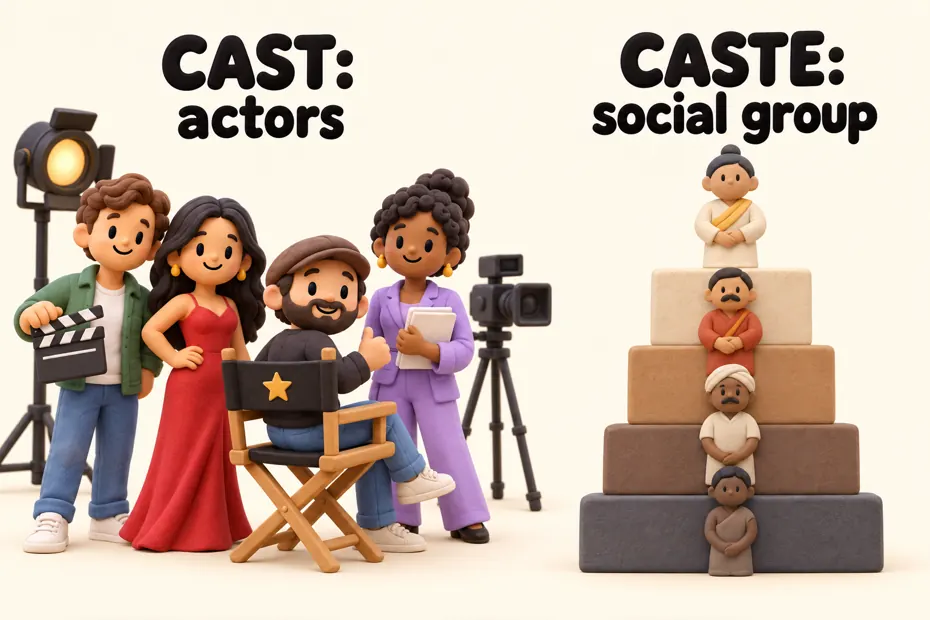
Cast can mean a group of actors, a protective casing for a broken limb, or the action of throwing, selecting actors, or forming something in a mold. Caste means a hereditary social group or division. Choose the spelling by meaning: a film has a cast; a social hierarchy involves caste.
Cast vs caste: key facts
- Cast works as a noun and a verb.
- Caste is a noun referring to a social division.
- The past tense and past participle of cast are normally cast.
- Cast a vote means submit a ballot, not calculate or estimate.
- A cast of actors is different from casting, the process of selecting them.

Which spelling fits your sentence?
Start with the idea you want to express. If the sentence concerns performers, a fishing line, a molded object, a shadow, or a medical support, use cast. If it concerns inherited social divisions, use caste. The silent final e does not turn cast into an alternative spelling for the same thing. These are separate words, not interchangeable variants.
| Situation | Word | Original example |
|---|---|---|
| Actors in a production | cast | The cast rehearsed the final scene. |
| Assigning an acting role | cast | They cast Mina as the detective. |
| Throwing a fishing line | cast | Leo cast his line beyond the reeds. |
| A protective limb casing | cast | Her arm was in a cast. |
| Hereditary social division | caste | The historian studied caste distinctions. |
The noun and verb senses above are supported by Merriam-Webster’s cast entry. Its caste entry identifies the social-group meaning. Dictionary meanings establish the spelling distinction; a full account of a particular society requires historical and sociological sources.
Use cast correctly in the past tense
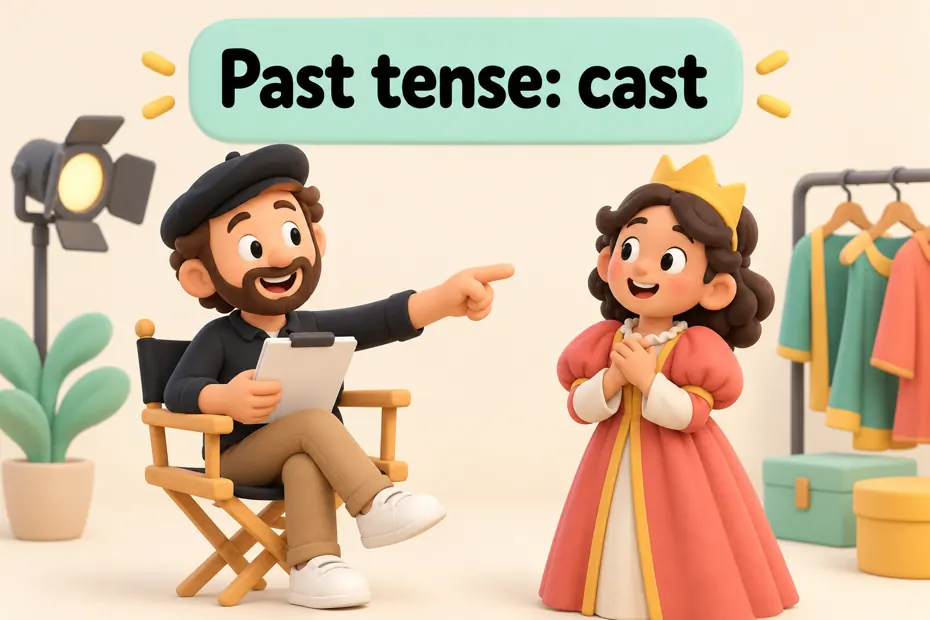
For ordinary writing, keep cast unchanged: “Today she casts the part; yesterday she cast it; she has cast it before.” The ending changes in casting, and the present-tense form for he, she, or it is casts. Do not write “the director casted the actor” when you mean the normal past tense.
Compare these original examples: “The tree casts a shadow each afternoon.” “Yesterday the tree cast a shadow over the bench.” “The tree has cast that shadow for years.” The time changes, but the past and participle forms remain cast. In “The cast arrived early,” cast is a noun, so the verb arrived carries the tense.
Clarifications for the original guide below
The older examples remain below, but two details need precision. First, casting a vote means formally submitting a ballot; it does not illustrate the calculating sense of cast. Second, the noun cast usually names the performers, whereas casting names the selection process. Write “The casting took two weeks” for the process and “The cast included twelve performers” for the group.
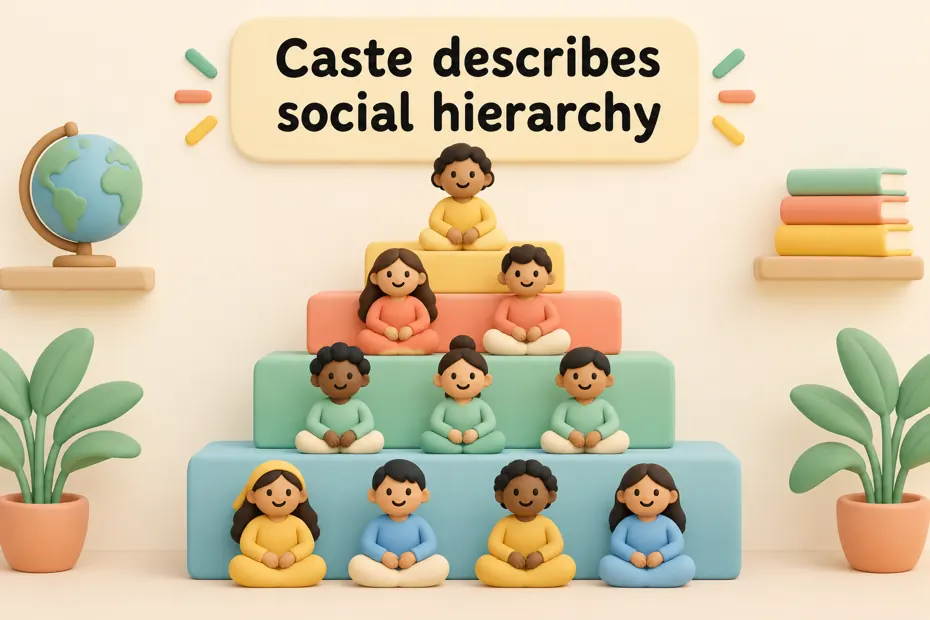
The social discussion also needs careful reading. A brief word-usage comparison cannot describe all caste identities, practices, or modern experiences. Treat the older four-category summary as a simplified historical outline, not a complete description of living communities. Avoid presenting a person’s social identity as a prediction of their occupation or character. The term “untouchable” in older discussions describes discriminatory classification and should not be used casually as a label for people.
Practice choosing cast or caste
Try these sentences before checking the answers: “The director announced the new ___.” “The essay examines ___ discrimination.” “We ___ the plaster into a mold.” The answers are cast, caste, cast. Each choice follows the intended meaning rather than the sound alone.
A useful editing check is to underline the word’s job. In the first sentence, it names performers. In the second, it identifies a social system connected with discrimination. In the third, it describes making an object. If the surrounding sentence still leaves the meaning unclear, add a concrete noun such as actors, mold, ballot, or social group.
Frequently asked questions
Is it a movie cast or movie caste?
Write movie cast when referring to the performers. For example, “The movie cast attended the premiere.” Caste would introduce an unrelated social-group meaning. If you mean the process of choosing those performers, use casting instead: “The movie’s casting began in spring.”
Can caste be used as a verb?
For the ordinary meaning discussed here, caste is a noun. Use it in phrases such as caste distinctions or a caste system. Cast is the verb used for throwing, molding, selecting performers, or submitting a ballot. Adding the final e would change the word and the intended meaning.
How can I remember the difference?
Associate cast with a cast of actors and caste with a social category. Then check the full sentence rather than relying only on the memory aid. The acting association is a useful starting point, but cast also covers several other meanings, including shadows, molded objects, fishing, and protective limb casings.
Original article and examples
When it comes to the English language, there are often words that sound similar but have completely different meanings. One such pair that often causes confusion is “cast” and “caste.” As an expert blogger, I’ve encountered this confusion countless times, and today I’m here to shed some light on the topic. In this text, I’ll explain the differences between “cast” and “caste” and provide you with some tips on how to use them appropriately in your writing. So, if you’ve ever found yourself unsure about which word to use, you’re in the right place. Let’s immerse and clear up the confusion once and for all.
Key Takeaways
- “Cast” and “caste” are two words that sound similar but have completely different meanings.
- “Cast” can be both a noun and a verb, with various definitions depending on the context. It can refer to the selection of actors for a production, the act of throwing or shaping something, or the act of calculating or estimating.
- “Caste” refers to a social stratification system based on hereditary occupations and birth, primarily associated with traditional hierarchical societies like the caste system in India.
- It is important to understand the distinction between “cast” and “caste” to ensure clear communication.
- “Cast” is more commonly used in the context of entertainment, while “caste” is specific to discussions about social hierarchy and its associated systems.
- Examples of proper usage can help solidify the understanding of how to use these words appropriately.
What is “cast”?
To understand the difference between “cast” and “caste,” let’s start by exploring the meaning of the word “cast.”
The word “cast” can be used as both a noun and a verb, and it has various definitions depending on its context. Here’s a brief overview:
- As a noun, “cast” refers to the act of selecting actors for a play, movie, or show. It can also refer to the group of actors chosen for a particular production. For example, “The cast of the new Broadway show includes some of the finest performers in the industry.”
- As a verb, “cast” can have multiple meanings. It can mean to throw or fling something, as in “I cast the fishing line into the lake.” It can also mean to shape or mold something by pouring a liquid material into a mold, such as “The sculptor cast the bronze statue.” Also, “cast” can mean to calculate or estimate, as in “I cast my vote in favor of the proposal.”
Overall, the word “cast” is quite versatile, with different meanings depending on the context. It is essential to consider the context carefully to understand how to use the word accurately in your writing.
Now that we have a better understanding of what “cast” means, let’s explore the difference between “cast” and “caste” in the following section.
What is “caste”?
Caste is a term that refers to a social stratification system or hierarchy based on hereditary occupations, social status, and birth. It is primarily associated with traditional hierarchical societies, such as the caste system in India.
The caste system categorizes individuals into different social groups or castes, which are determined by their birth. These castes are generally ranked in a hierarchical order, with each caste having its own rights, privileges, and restrictions. The caste system dictates the occupation, marriage partners, and social interactions of individuals.
In the Indian caste system, the castes are traditionally divided into four main categories:
- Brahmins (priests and scholars)
- Kshatriyas (warriors and rulers)
- Vaishyas (traders and farmers)
- Shudras (laborers and servants)
Also, there is a fifth category known as the “untouchables” or Dalits, who are considered to be outside of the caste system and often face social discrimination.
It is important to note that the concept of caste is unique to specific cultures and societies and may not be applicable in the same way in other parts of the world.
Understanding the distinction between “cast” and “caste” is crucial for clear communication, as these words have distinct meanings. While “cast” refers to the act of selecting actors for a production or the act of throwing or shaping something, “caste” relates specifically to the social stratification system.
By recognizing the difference between these words, we can ensure that our writing accurately reflects the intended meaning and reduces the likelihood of confusion.
I’ll now investigate deeper into how “cast” and “caste” can be used in different contexts and provide examples to illustrate their proper usage. So let’s continue our exploration in the following sections.
Understanding the differences between “cast” and “caste”
To communicate effectively in English, it’s essential to understand the distinction between words that may sound similar but have entirely different meanings. One such pair of words that often confuses people is “cast” and “caste.” So, let’s jump into the definitions and differences between these two words.
1. Definition of “Cast”:
The word “cast” can be used as both a noun and a verb. As a noun, it refers to the actors chosen for a play, movie, or performance. It can also denote a particular group of actors or the action of throwing something. As a verb, “cast” means to throw or to form an object by pouring a liquid into a mold.
2. Definition of “Caste”:
“Caste,” on the other hand, refers to a social stratification system based on hereditary occupations and birth. This system is primarily associated with traditional hierarchical societies, such as the caste system in India. In a caste system, individuals are categorized into different social groups or castes, each having its own rights, privileges, and restrictions.
3. Difference between “Cast” and “Caste”:
It’s important to note that “cast” and “caste” have entirely different meanings and applications:
- While “cast” refers to actors or the act of throwing, “caste” pertains to a social stratification system.
- “Cast” can be a verb or a noun, whereas “caste” is solely used as a noun.
- The term “cast” is more commonly used in the context of entertainment, whereas “caste” is specific to discussions about social hierarchy and its associated systems.
4. Examples of Proper Usage:
To further clarify the proper usage of these words, let’s look at some examples:
- “I was cast as the lead in the school play.”
- “She cast a spell to protect her family.”
- “The movie boasts a star-studded cast.”
- “The caste system in India has deep historical roots.”
- “Caste discrimination is a grave social issue that needs to be addressed.”
By understanding the differences between “cast” and “caste,” you’ll be able to use these words appropriately and avoid any confusion in your communication. Remember, clear and precise language is key to effective communication.
Examples of proper usage
When it comes to the words “cast” and “caste,” it’s important to use them appropriately to ensure clear communication. Here, I’ll provide you with examples of how these words are used in context, so you can better understand their proper usage.
- Correct usage of “cast”:
- In the sentence, “I was thrilled to be part of the cast in the school play,” the word “cast” is used as a noun and refers to the group of actors chosen for a performance.
- Another example would be, “The director decided to cast Tom Hanks for the lead role in the movie.” In this case, “cast” is used as a verb, representing the action of selecting an actor for a particular role.
- Correct usage of “caste”:
- The caste system in India is an example of a social stratification system based on hereditary occupations and birth.
- “Her family belonged to a higher caste, which afforded them certain privileges in society.” Here, “caste” is used to describe the social class or rank individuals are born into.
Understanding the difference between “cast” and “caste” is crucial for effective communication. The examples provided above highlight the distinct contexts in which these words are used. So, whether you’re referring to an actor’s role in a play or discussing social hierarchies, using the correct word ensures clarity and avoids confusion.
In the next section, I will investigate deeper into the origins and definitions of “cast” and “caste,” shedding more light on their unique meanings. But before we do that, let’s first explore some other examples that will help solidify your understanding of these terms.
Extra Examples for Clarification
To further enhance your understanding of the usage of “cast” and “caste,” here are a few extra examples:
- “She cast her fishing line into the crystal-clear lake and waited for a bite.” Here, “cast” is used to describe the action of throwing or launching something, in this case, a fishing line.
- “The discovery of the ancient burial site provided valuable insights into the social structure and caste system of that civilization.” In this sentence, “caste” is used to specifically refer to the social structure and hierarchy based on birth and occupation.
Common mistakes and misconceptions
One common mistake that people make when using the words “cast” and “caste” is confusing their meanings and usage. Let’s clear up some of these misconceptions to ensure proper understanding and communication.
First, let’s define the term “cast”. In its noun form, “cast” refers to a group of actors chosen for a performance. For example, “The cast of the play did an outstanding job.” As a verb, “cast” means to throw or project something with force. For instance, “I cast my fishing line into the water.” It’s important to remember, “cast” can have different connotations depending on the context.
On the other hand, “caste” has a completely distinct meaning. It refers to a social stratification system based on hereditary occupations and birth. This system is primarily associated with traditional hierarchical societies like the caste system in India. It’s crucial to understand that “caste” has no connection to actors or throwing objects.
Now that we have clarified the definitions, let’s explore some of the common mistakes that can occur:
- Confusing “cast” with “caste”: Many mistakenly use “cast” when they mean “caste” or vice versa. To avoid this confusion, it’s important to be aware of the proper usage and meaning of each word.
- Misusing “caste” as a synonym for social class: While both “caste” and “social class” refer to systems of social stratification, they are not interchangeable. “Caste” specifically relates to the hereditary occupational system, whereas “social class” encompasses a broader range of factors like wealth, education, and occupation.
- Overgeneralizing the term “caste”: It’s essential to recognize that the concept of caste is not universal and is primarily associated with specific cultures or societies. Misusing the term in contexts where it doesn’t apply can lead to misunderstandings.
By understanding the differences and avoiding these common mistakes, we can communicate with precision and clarity. Clarity in language is crucial for effective communication, whether it’s in written or spoken form.
Now that we have covered the common misconceptions and mistakes, let’s dive deeper into the origins and definitions of “cast” and “caste” to further enhance our understanding of these words.
Tips for using “cast” and “caste” appropriately
When it comes to using words like “cast” and “caste,” it’s important to understand the subtle differences in their meanings. Let me share a few tips to help you use these words appropriately:
1. Understand the Definitions:
Before using any word, it’s crucial to have a clear understanding of its definition. Let’s break it down:
- “Cast”: As a noun, “cast” refers to a group of actors chosen to perform in a play, movie, or TV show. As a verb, it means to throw or project something.
- “Caste”: This word refers to a social stratification system based on hereditary occupations and birth, often associated with traditional hierarchical societies.
2. Context Matters:
To avoid confusion, pay attention to the context in which you’re using these words. Are you referring to a group of performers or discussing social stratification? Be careful not to interchange these terms, as they have distinct meanings.
3. Use Examples to Guide You:
Examples can be helpful in solidifying your understanding of these words. Let’s consider a couple:
- “The director selected a talented cast for the new movie.” (referring to actors)
- “In India, the caste system plays a significant role in society.” (referring to social stratification)
4. Be Mindful of Pronunciation:
Though “cast” and “caste” may sound similar, their meanings are quite different. Double-check your pronunciation to ensure you are using the correct word in conversation or writing.
By following these tips, you’ll be able to use “cast” and “caste” appropriately, avoiding any confusion or miscommunication. Keep in mind the definitions, consider the context, use examples, and pronounce them correctly. Remember, clear and precise language is key to effective communication.
Now that we’ve covered some useful tips, let’s investigate deeper into the origins and definitions of these words. Understanding their unique meanings will provide further insight and help solidify your grasp of their correct usage.
Conclusion
Understanding the difference between “cast” and “caste” is essential for using these words appropriately. By familiarizing ourselves with their definitions and paying attention to the context in which they are used, we can ensure clear and effective communication. Examples serve as valuable tools in guiding our understanding and helping us grasp the nuances of these words.
Pronunciation also plays a crucial role in using “cast” and “caste” correctly. Being mindful of how we pronounce these words can prevent confusion and misinterpretation. Also, delving into the origins and definitions of “cast” and “caste” provides further insight into their proper usage.
By following these tips, we can confidently navigate the distinction between “cast” and “caste” in our writing and conversations. This knowledge enriches our language skills and allows us to communicate more effectively. So, let’s embrace these guidelines and use “cast” and “caste” with precision and clarity.
Frequently Asked Questions
Q: What is the article about?
The article provides tips for using the words “cast” and “caste” correctly, focusing on definitions, context, examples, and pronunciation. It emphasizes the importance of avoiding confusion and miscommunication by understanding the origins and definitions of these words.
Q: Why is it important to understand the definitions of “cast” and “caste”?
Understanding the definitions of “cast” and “caste” is crucial to ensure their proper usage and to avoid confusion in communication. These words have different meanings and connotations, and using them incorrectly can lead to misunderstandings or potential offense.
Q: How can I use examples to better understand the words “cast” and “caste”?
Examples can be helpful in illustrating how to use “cast” and “caste” in different contexts. By providing concrete instances of their usage, examples can clarify the intended meaning, usage, and nuances of these words.
Q: What should I consider when pronouncing “cast” and “caste”?
Pronunciation plays a critical role in effectively communicating words such as “cast” and “caste.” Paying attention to the correct pronunciation helps convey the intended meaning and ensures understanding among listeners or readers.
Q: How can understanding the origins and definitions of “cast” and “caste” help me?
Understanding the origins and definitions of “cast” and “caste” provides valuable insights into their correct usage. This knowledge enables individuals to use these words appropriately, avoiding miscommunication and promoting effective communication. Understanding the historical and cultural contexts surrounding these words also helps in using them more accurately.


