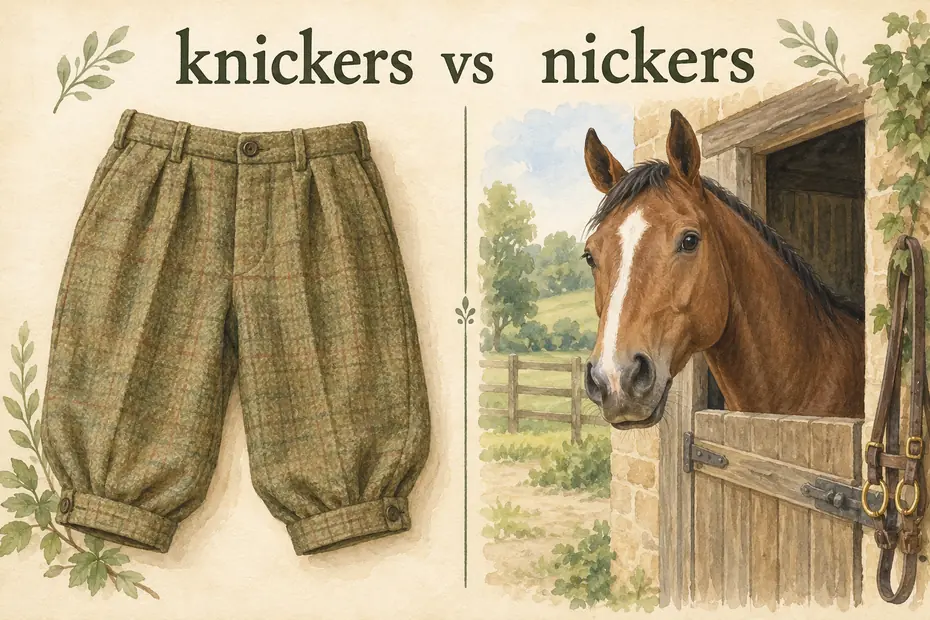
Knickers vs nickers: clothing versus horse sounds
Knickers is a clothing word; nickers is a valid form of nicker, a word for a horse’s sound or the action of making that sound. Write “The golfer wore knickers” for knee-length trousers and “The horse nickers at the gate” for a vocalization. The initial k in knickers is silent.
Correction to the older discussion below: nickers is not always a misspelling and is not a word that must be avoided in every context. Dictionaries record both the verb nicker and its noun. They also record a separate British slang money sense. The clothing spelling still requires k, but other meanings legitimately use nickers without it.
Key facts and comparison
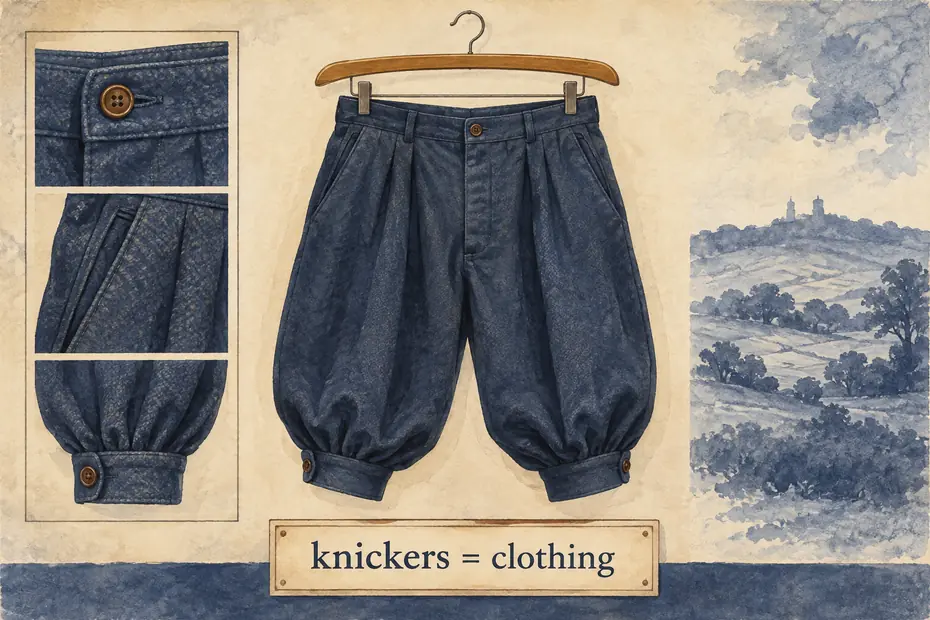
- Knickers can mean loose short trousers gathered at the knee.
- In chiefly British usage, knickers can mean underpants.
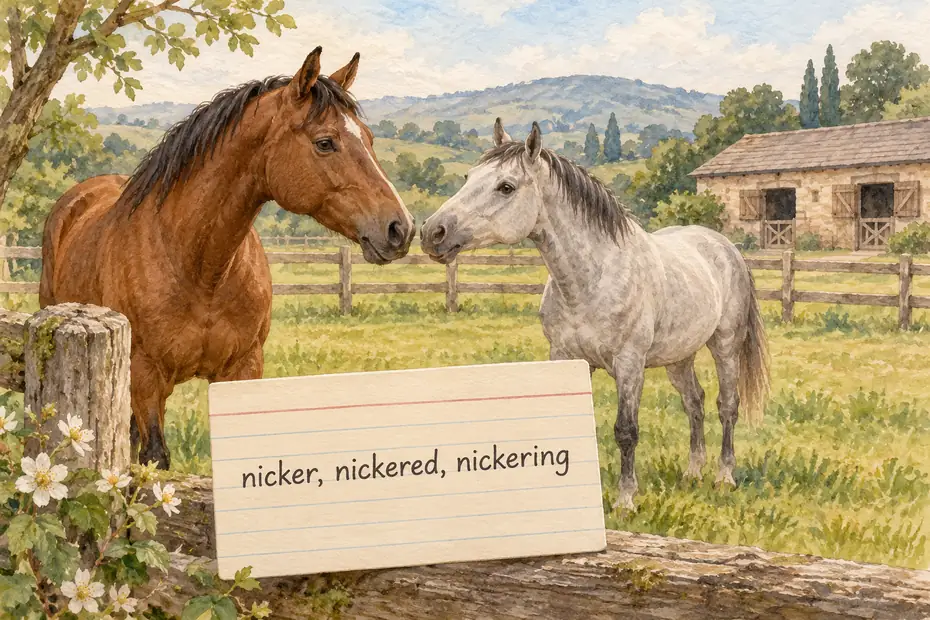
- Nicker can be a verb meaning to neigh or whinny.
- Nickers can be the present-tense verb after a singular subject.
- Nickers can also be the plural noun naming horse sounds.
| Spelling | Function | Original example | Context clue |
|---|---|---|---|
| knickers | Plural clothing noun | The costume included wool knickers. | Wearing or garments |
| nickers | Verb | The mare nickers softly. | A horse performs an action |
| nickers | Plural sound noun | We heard nickers from the stable. | Several vocal sounds |
| nicker | Singular sound noun | A nicker came from the stall. | One vocal sound |
What does knickers mean in different regions?
Merriam-Webster’s knickers entry identifies loose short trousers gathered at the knee and a chiefly British underpants meaning. Collins’s knickers entry also distinguishes the clothing senses. The regional context helps readers decide which garment a sentence describes.
In a historical sporting description, “He wore knickers and long socks” points toward the short-trouser sense. In a British laundry conversation, “The knickers are in the drawer” may refer to underwear. These original examples show why a single garment description cannot cover every occurrence of the word.
For an international audience, consider a more explicit phrase if the exact garment matters. “Knee-length trousers gathered below the knee” or “underpants” avoids regional uncertainty. Keep knickers when it suits the speaker, setting, or established terminology; clarify it when a reader could reasonably imagine a different garment.

How does nickers work as a verb or noun?
Merriam-Webster’s nicker entry records a verb for neighing or whinnying and a noun for a horse’s cry. Its verb forms include nickered, nickering, and nickers. This directly contradicts the older claim that nickers has no recognized use.
“The horse nickers when the groom approaches” uses nickers as a verb. “The horses nicker when the groom approaches” uses the base form with a plural subject. “The groom heard several nickers” uses a plural noun. The same final s can therefore serve different grammatical purposes.
Collins’s nicker entry also records horse-related uses. A sentence about a horse does not automatically need nickers, however: “The rider packed knickers” concerns clothing. Identify the actual object or action rather than choosing a spelling from the broad topic of riding.
What about the money meaning of nicker?
Nicker also has a separate British slang meaning connected with a pound sterling. Merriam-Webster labels this money sense British slang. Recognizing the entry prevents another mistaken blanket rule, but the horse-versus-clothing distinction remains the main practical comparison for most readers of this article.
Slang varies with region and conversational setting. When explaining an amount to a broad audience, “pounds” is clearer than relying on an unfamiliar colloquialism. Don’t insert the money sense into a horse sentence simply because the spelling matches; meanings need contextual evidence.
How can you proofread the silent k?
For clothing, preserve the k in knickers. For a horse’s sound or the verb nicker, use the spelling without k. Pronunciation alone cannot reliably settle the difference because the initial k of knickers is not pronounced.
- Ask whether the sentence names clothing, a horse sound, or an action.
- If it names a garment, check which regional sense of knickers is intended.
- If a horse makes the sound, choose nicker, nickers, nickered, or nickering according to the grammar.
- If several sounds are being counted, use the plural noun nickers.
- Read the whole phrase before applying any automatic correction.
Practice with these original sentences: “The tailor altered the ___”; “The pony ___ from its stall”; “Two soft ___ broke the silence.” The answers are knickers, nickers, and nickers. A spellchecker that recognizes both words cannot make this meaning decision for you.
The correct conclusion for knickers vs nickers is that both spellings can be legitimate. Clothing takes the silent k; horse vocalizations and the nicker verb family do not.
FAQ: knickers and nickers
Is one garment called a knicker?
Knickers normally functions as a plural clothing noun, much like trousers. “A pair of knickers” is a useful way to refer to one garment. Keep the plural form when using the ordinary clothing term, rather than treating the horse noun nicker as its singular counterpart.
Can a horse nickered be corrected to knickered?
No, not when the sentence describes a horse’s vocalization. Nickered is the past-tense form of nicker. “The horse nickered” reports an action and needs no initial k. Knickers belongs to the clothing vocabulary and does not supply the past tense of that animal-sound verb.
Does every sound from a horse count as a nicker?
Nicker is a recognized horse-sound word, but a precise description should still match what the writer means. Don’t use a spelling lesson to make a claim about an animal’s emotion or condition. In ordinary vocabulary work, the key point is that nicker names a legitimate sound and verb.
Why does context matter more than a spellchecker?
Both knickers and nickers can be valid strings of letters, so a spelling checker may accept either. Context identifies whether the sentence concerns a garment or a vocalization. Read the noun, subject, and verb together, then choose the word family that expresses the intended meaning.
Key Takeaways
- “Knickers” and “nickers” are commonly confused words in English, but they have completely different meanings.
- “Knickers” refers to a type of undergarment or underwear worn by women or children, while “nickers” is a misspelling or variation of the term “knickers” and should be avoided.
- The term “knickers” originated in the early 19th century in Britain and has a rich history intertwined with fashion and societal norms.
- Knickers are typically made of comfortable and breathable materials, such as cotton or silk, and come in various styles and cuts, including briefs, French cut, boxer briefs, and boyshorts.
- Knickers can be worn as everyday underwear, part of a lingerie set, or even as outerwear for a fashionable look.
- By using the correct term “knickers” and understanding its proper usage and context, you can enhance your language skills and effectively communicate.
Understanding the Difference: Knickers vs Nickers
As a writer and language enthusiast, I understand the importance of using words accurately and effectively. Two words that are commonly confused in English are “knickers” and “nickers.” While they may sound similar, they have entirely different meanings.
Definition of “knickers”
Knickers refer to a type of undergarment or underwear that is typically worn by women or children. They are similar to shorts and cover the lower body, extending to the thighs or knees. Knickers are often made of comfortable and breathable materials, such as cotton or silk.
Definition of “nickers”
On the other hand, “nickers” is not a commonly used word in English. It is actually a misspelling or a variation of the term “knickers.” This misspelling is often attributed to the confusion between the letters “k” and “n.” But, it is important to note that “nickers” is not a correct or recognized word, and its usage should be avoided.
Difference between “knickers” and “nickers”
The main difference between “knickers” and “nickers” lies in their usage and meaning. While “knickers” refers to a type of undergarment, “nickers” is not a valid term and should not be used.
Conclusion
Please note that “nickers” is not a correct word and should not be used in any context. Stick to the proper term “knickers” when referring to the undergarment. By understanding the difference and using the correct term, you can effectively communicate and avoid any confusion or misunderstandings.
The Origin and Meaning of Knickers
When it comes to the difference between “knickers” and “nickers,” understanding their origins and meanings is key. Let’s jump into the world of undergarments and uncover the true significance of the word “knickers.”
What is the definition of Knickers?
Knickers, also known as breeches or pantaloons, are a type of undergarment or underwear traditionally worn by women and children. The term “knickers” originated in the early 19th century in Britain and has been widely used ever since. These garments typically reach below the knee or ankle, covering the thighs and lower legs.
The History of Knickers
The history of knickers traces back to the Victorian era when modesty and proper dressing were highly valued. During this time, women wore long, flowing skirts that required additional layers underneath for modesty and comfort. Knickers served as an essential part of the undergarment ensemble, providing coverage and ease of movement.
As fashion evolved, so did knickers. They transformed from practical undergarments to fashionable items incorporated into women’s attire. The design, fabric, and embellishments of knickers varied over time, reflecting the changing trends and preferences of each era.
The Difference Between Knickers and Nickers
Now that we understand the origin and meaning of “knickers,” it’s important to address the misspelled variation, “nickers.” While “knickers” refers to the specific type of undergarment, “nickers” is a misspelling or variation of the word. It is not a recognized or proper term in English.
Using the correct term, “knickers,” is essential to avoid confusion and misunderstandings. By respecting the proper vocabulary, we can ensure effective communication and enhance our understanding of the English language.
Summarizing, “knickers” is a well-established term for a specific type of undergarment worn by women and children. It originated in the 19th century and has a rich history intertwined with fashion and societal norms. So embrace the correct word, and let’s keep the legacy of “knickers” alive!
Now that we’ve explored the origin and meaning of “knickers,” let’s move on to investigate into other commonly confused and misused words in the English language.
The Commonly Misused Term: Nickers
When it comes to the words “knickers” and “nickers,” the difference may seem subtle, but it’s important to understand the correct usage. While “knickers” refers to a type of undergarment or underwear worn by women or children, “nickers” is actually a misspelling or variation of the term “knickers.” It is not a correct or recognized word and should be avoided.
To clarify, let’s take a closer look at the definition of “knickers.” Knickers, also known as breeches or pantaloons, originated in the early 19th century in Britain. Back in the Victorian era, they were worn as part of the undergarment ensemble for modesty and comfort.
The design and style of knickers have evolved over time to reflect changing fashion trends. In the past, they were often long and loose-fitting, reaching just below the knee. Nowadays, they come in various styles such as briefs, boy shorts, and bikini cuts, catering to different preferences and needs.
It’s crucial to use the correct term “knickers” to avoid confusion and misunderstandings. While “nickers” may sound similar, it is not a recognized term in reference to undergarments. By using the proper term, we ensure effective communication and maintain clarity in our language.
By understanding the difference between these terms and using them appropriately, we can enhance our language skills and effectively communicate with others. So remember, next time you’re discussing undergarments, it’s “knickers,” not “nickers.”
Let’s continue our exploration of commonly confused words and their proper usage to expand our knowledge and master the English language.
The Fashion and Style of Knickers
When exploring the world of fashion and style, it’s important to understand the significance of knickers. Knickers, also known as breeches or pantaloons, have a rich history that dates back to the early 19th century in Britain. They were originally worn as part of the undergarment ensemble, providing both modesty and comfort.
During the Victorian era, knickers became an essential piece of clothing for women and children. The design and style of knickers have evolved over time to reflect the changing fashion trends. Today, knickers are often associated with vintage or retro fashion, adding a touch of timeless elegance to any outfit.
One of the defining features of knickers is their length. Unlike traditional underwear, knickers typically extend to just above or below the knee. This longer length provides coverage and a more modest look. It also allows for greater freedom of movement, making knickers a practical choice for various activities.
In terms of materials, knickers are commonly made from cotton, silk, or satin. These fabrics provide a soft and comfortable feel against the skin while maintaining durability. Lace and embroidery are often used as decorative elements, adding a touch of femininity and sophistication.
Knickers come in a variety of styles and cuts, catering to different preferences and body types. Some popular styles include:
- Briefs: These knickers offer full coverage and a snug fit, perfect for everyday wear.
- French cut: With higher leg openings, these knickers create the illusion of longer legs.
- Boxer briefs: This style combines the coverage of briefs with the fit of boxer shorts, providing comfort and support.
- Boyshorts: These knickers have a low-rise waist and provide more coverage around the hips, resembling shorts.
When incorporating knickers into your outfit, consider the occasion and your personal style. They can be paired with matching bras or camisoles for a coordinated lingerie set or worn as a stylish undergarment beneath dresses and skirts. For a bold fashion statement, knickers can even be worn as outerwear, layered with stockings or paired with a statement blouse or jacket.
Proper Usage and Context of Knickers vs Nickers
As an expert blogger, I am here to shed light on the proper usage and context of the words “knickers” and “nickers.” Understanding the difference between these two terms is crucial to effective communication. Let’s jump into the details.
First and foremost, let me clarify the definition of each word. “Knickers” refers to a type of undergarment or underwear worn by women or children. It is also known as breeches or pantaloons. On the other hand, “nickers” is not a correct or recognized word. It is simply a misspelling or variation of “knickers” that should be avoided.
Now that we have established the definitions, let’s explore the proper usage of “knickers” in different contexts:
- Clothing: Knickers are often associated with vintage or retro fashion. They are known for their longer length, providing coverage and a more modest look. Made from cotton, silk, or satin, they can be decorated with lace and embroidery, adding a touch of elegance. Knickers come in various styles and cuts, including briefs, French cut, boxer briefs, and boyshorts. They can be worn as everyday underwear or as part of a lingerie set.
- Fashion and Style: Knickers can also be used as outerwear, especially in certain fashion trends. Pairing knickers with a blouse or jacket can create a unique and fashionable look. It’s important to remember the versatility of knickers and how they can be styled for different occasions.
- Historical Context: Knickers have a rich history dating back to the Victorian era. During this time, they were worn as part of the undergarment ensemble for modesty and comfort. The design and style of knickers have evolved over time to reflect changing fashion trends. Understanding this historical context can enhance your appreciation for this garment.
By using the correct term “knickers” instead of the incorrect variation “nickers,” you demonstrate a strong command of the English language. Remember, effective communication involves choosing the right words to convey your message accurately.
Conclusion
Understanding the difference between “knickers” and “nickers” is essential to effective communication. Throughout this article, we have explored the origin, meaning, and evolution of knickers, highlighting their association with vintage fashion and their various styles and materials. By using the correct term “knickers,” we can avoid confusion and ensure clear communication.
Language skills play a crucial role in conveying our thoughts and ideas accurately. By familiarizing ourselves with commonly confused words like “knickers” and “nickers,” we can enhance our language proficiency and avoid misunderstandings.
In a world where effective communication is key, taking the time to understand and use the appropriate terminology is vital. So, whether you’re discussing fashion trends, historical clothing, or simply engaging in everyday conversation, remember to choose your words wisely and use “knickers” when referring to this particular garment. By doing so, you’ll demonstrate your linguistic prowess and ensure that your message is received loud and clear.
Frequently Asked Questions
Q: What is the difference between “knickers” and “nickers”?
A: “Knickers” refers to a type of undergarment or outerwear worn primarily by women. They are also known as breeches or pantaloons. On the other hand, “nickers” is a misspelling or abbreviation of “knickers” that does not have a specific meaning. It is essential to use the correct term “knickers” to avoid confusion and convey the intended message accurately.
Q: Where did “knickers” originate?
A: The term “knickers” originated in the early 19th century in Britain. They were initially worn for modesty and comfort. The history of knickers can be traced back to the Victorian era, where they gained popularity as an undergarment for women.
Q: What materials are knickers made from?
A: Knickers can be made from various materials, including cotton, silk, and satin. They can also be decorated with lace and embroidery, adding a touch of femininity to the garment.
Q: Can knickers be worn as outerwear?
A: Yes, knickers can be worn as outerwear, especially in vintage or retro fashion. They can be paired with a blouse or a cropped top for a stylish and unique look.
Q: Are knickers only worn by women?
A: While knickers are traditionally associated with women’s underwear, they can also be worn by men, although less commonly. In recent years, there has been a growing trend of men embracing more diverse underwear styles, including knickers.
Q: How should I effectively communicate using the correct term?
A: To avoid confusion and effectively communicate, it is essential to enhance language skills and be aware of the proper use of commonly confused words like “knickers” and “nickers.” Taking the time to understand the meaning and history behind these words will help ensure clear and accurate communication.


