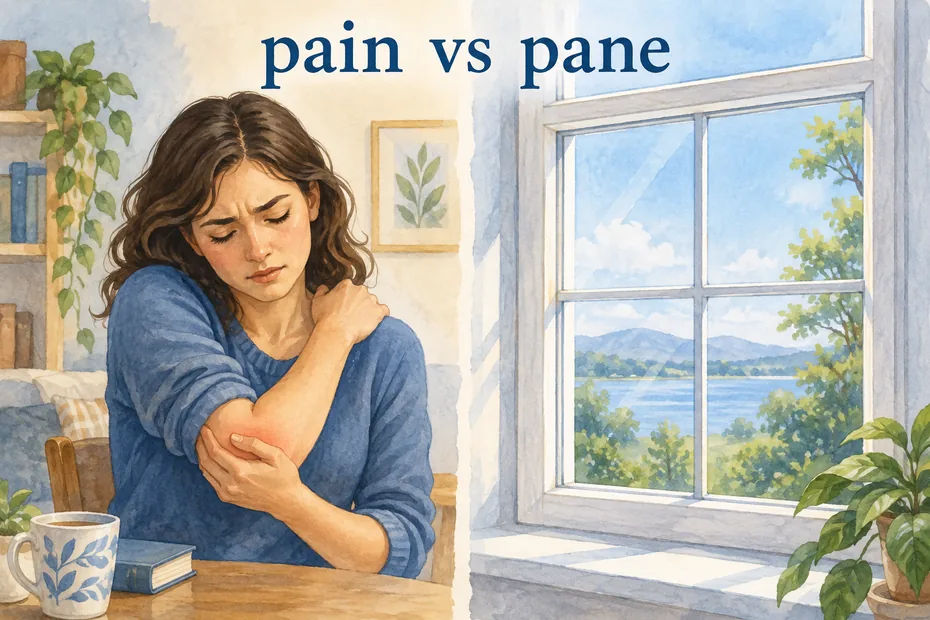
Pain vs pane: feelings versus sections of glass
Pain refers to physical discomfort, emotional suffering, or something troublesome; pane usually refers to a sheet or section of glass in a window or door. Write “The sharp pain interrupted her work” for discomfort and “The cracked pane needed replacing” for glass. The two words sound alike, so their meaning and surrounding vocabulary determine the spelling.
The simple glass-versus-suffering comparison is useful, but it leaves out two common reading situations: figurative pain and software panes. A complaint such as “Parking is a pain” need not describe bodily discomfort. A navigation pane on a computer screen need not contain any glass. Recognizing these extensions makes the distinction more reliable.

Key facts and comparison
- Pain and pane are homophones in standard English pronunciation.
- Pain can describe bodily discomfort or emotional suffering.
- Pain can also describe an annoyance in informal language.
- A pane is commonly an individual sheet of window glass.
- Panes can also be distinct areas within a software window.
| Word | Context | Original example | Useful substitute |
|---|---|---|---|
| pain | Physical discomfort | He described a pain in his shoulder. | Discomfort |
| pain | Emotional suffering | The letter expressed her pain. | Distress |
| pain | Informal annoyance | Finding a space was a pain. | Nuisance |
| pane | Glass | Rain struck the window pane. | Glass section |
| pane | Software display | Open the preview pane. | Display section |
What meanings does pain cover?
Merriam-Webster’s pain entry includes physical discomfort, emotional distress, an informal troublesome person or thing, and the plural pains for care or effort. Pain therefore does not always identify an injury. In a vocabulary exercise, identify the intended sense before selecting a replacement word.
“The noise was a pain” expresses annoyance. “The separation caused pain” expresses emotional suffering. “She felt pain when moving her wrist” describes a bodily sensation. All three original sentences use pain, but replacing each instance with “injury” would distort the meaning. Word choice depends on the full sentence rather than a single memorized definition.
Collins’s pain entry also distinguishes suffering, annoyance, and effort-related uses. In “The editor took pains to verify the quotation,” pains refers to careful effort. The writer is not claiming that checking the quotation physically hurt. Keep the phrase together when deciding its meaning.

What counts as a pane?
A pane commonly means an individual piece of glass fitted into a window or door. Merriam-Webster’s pane entry records the glass sense and a separate area within a computer window. Collins’s pane entry provides the familiar window-glass meaning as well.
Don’t equate pane with the whole window. A window can include a frame, fittings, and one or more panes. “The frame is damaged” and “The pane is cracked” point to different components. This distinction is especially helpful in descriptions of buildings, repairs, or illustrations where naming the damaged part precisely matters.
In software instructions, a pane is a region of the interface: a preview pane, navigation pane, or reading pane. Write “Select the folder in the left pane” when referring to that region. “Select the folder in the left pain” would be a spelling error, even though a dictionary recognizes pain as a valid word.
How do word families help with spelling?
Meaningful word families reinforce the difference. Pain connects with painful, painless, and pained; pane connects with windowpane and descriptions such as single-pane. Use those connections as a memory aid, while checking the meaning of each complete phrase.
“A pained expression” describes a look associated with distress or displeasure. “A paned window” describes a window divided into panes. Similar-looking endings do not make the forms interchangeable. If you’re uncertain, rewrite with an explicit noun: “an expression of distress” or “a window containing several glass sections.”
- Ask whether the sentence concerns suffering, annoyance, effort, or a section.
- Try discomfort, nuisance, or effort for a pain-related meaning.
- Try glass section or screen section for a pane-related meaning.
- Check the compound word or familiar phrase around it.
- Read the corrected sentence once more for its intended meaning.

Practice beyond the basic definition
Choose the missing words in these original examples: “The broken ___ let in rain”; “The missing attachment was a ___”; “Check the document in the preview ___”; “She took ___ over the lettering.” The answers are pane, pain, pane, and pains. Each answer follows the subject and the phrase around the blank.
A useful paired example is “Replacing the cracked pane was a pain.” Pane names the glass; pain calls the task troublesome. The sentence deliberately places both words in the same situation, showing why a topic such as window repair cannot determine the spelling by itself.
The practical conclusion for pain vs pane is to follow the meaning: suffering or trouble uses pain, while a glass or interface section uses pane. These substitution tests guide spelling; they are not tools for diagnosing physical symptoms or assessing a building’s safety.
FAQ: pain and pane
Is pane always made of glass?
Not in every use. Window-related pane usually refers to glass, but a software pane is a distinct screen area. The computer use helps explain phrases such as reading pane and navigation pane. Look at the object being described before applying the familiar physical-glass definition.
Can pain be a verb?
Yes. Pain can mean to cause distress, as in the original example “The unfair accusation pained her.” The resulting form pained belongs to the pain family. Pane does not replace it when the sentence concerns emotional hurt, even though the two base words sound alike.
Why is it take pains rather than take panes?
Take pains is an established expression about making a careful effort. The plural refers to trouble or care taken over a task. “Take panes” would instead suggest handling glass sections and would not express the same idea. Read the whole expression rather than correcting the sound alone.
Is windowpane one word?
Windowpane is a recognized compound identifying a pane of window glass. You may also encounter a phrase such as “a pane of glass,” where pane remains a separate noun. Both point to the glass meaning. Windowpain would wrongly introduce the suffering-related spelling into the compound.
As an expert writer, I’ve come across countless instances where confusion arises between two similar-sounding words. One such pair is “pain” and “pane.” While they may sound alike, their meanings couldn’t be more different. In this text, I’ll jump into the nuances of these words and provide you with a comprehensive guide on using them appropriately. From understanding their definitions to exploring real-life examples, I’ll equip you with the knowledge to confidently differentiate between “pain” and “pane” in your writing. So, let’s begin on this linguistic journey and put an end to any confusion once and for all.
Key Takeaways
- “Pain” refers to a distressing physical or emotional sensation, while “pane” refers to a piece of glass within a window or door.
- Understanding the definitions of “pain” and “pane” is crucial for accurate and effective communication in writing.
- Using “pain” appropriately helps convey the intensity and nature of physical or emotional sensations.
- Using “pane” correctly is important when discussing architecture, design, or home improvement.
- Misusing “pain” and “pane” can lead to confusion and misinterpretation in written materials.
- Examples of proper usage help clarify the distinction between “pain” and “pane” and add clarity to your writing.
Definition of “pain”
Pain is a fundamental sensation that we’ve all experienced at some point in our lives. It can be described as an uncomfortable or distressing feeling that tells us something is wrong with our bodies. Understanding the definition of pain is essential to use the word accurately and effectively in writing.
Pain can manifest in various forms, from a dull ache to an intense sensation. It can be physical or emotional, and it can range from mild to severe. Regardless of its nature, pain serves as a signal, drawing our attention to something that needs addressing.
To clarify the difference between pain and other similar words, such as “ache” or “discomfort,” it’s important to note that pain refers specifically to a distressing sensation, while discomfort generally refers to a lack of ease or physical unease. Ache, on the other hand, often describes a dull, continuous pain in a specific area of the body.
Understanding the definition of pain is crucial, especially in medical or healthcare-related writing, where precise and accurate language is essential. By using pain appropriately, we can effectively convey the intensity and nature of physical or emotional sensations that individuals may experience.
Definition of “pane”
As a continuation of our exploration of commonly confused and misused words, let’s take a closer look at the word “pane.” “Pane” is often confused with “pain” due to their similar pronunciations, but they have vastly different meanings and uses.
In the context we are discussing, “pane” refers to a rectangular or square piece of glass within a window or door. It is typically framed by wood or metal, serving as a means of allowing light into a space while also providing insulation.
The key difference between “pane” and “pain” lies in their definitions and usage. While “pain” refers to a distressing physical or emotional sensation, “pane” is strictly limited to its definition as a glass panel within a window or door. This distinction is crucial in ensuring accurate and effective communication, especially in written materials where precision is important.
Understanding the definition of “pane” allows us to use the word appropriately, particularly in the context of discussing architecture, home improvement, or design. By using “pane” correctly, we avoid confusing it with “pain” and convey our intended meaning clearly and confidently.
To further illustrate the distinction, here are a few examples of sentences using the word “pane” correctly:
- The sunlight streamed through the large, clear pane of glass, illuminating the room beautifully.
- He accidentally broke a pane of glass while trying to open the window.
- The stained-glass window featured intricate designs within each individual pane.
Key differences between “pain” and “pane”
As a writer, it is crucial to understand the distinction between similar-sounding words to communicate effectively. In this section, I’ll discuss the key differences between the words “pain” and “pane,” helping you to confidently use them in your writing with precision.
Definition of “Pain”
Let’s start by defining the word “pain.” Pain refers to a distressing physical or emotional sensation that can range from mild discomfort to intense agony. It is a universal experience that can be caused by injury, illness, or psychological factors. When using the word “pain” in your writing, it’s important to consider the context and accurately convey the level of discomfort or suffering involved.
Definition of “Pane”
Let’s shift our focus to the word “pane.” Pane refers to a rectangular or square piece of glass within a window or door. It is an essential element in architecture and design, allowing natural light to enter a space while providing insulation and security. Understanding the definition of “pane” is essential when describing the characteristics of windows, doors, or architectural features.
Difference Between “Pain” and “Pane”
The key difference between “pain” and “pane” lies in their definitions and usage. While they may sound alike, their meanings are distinct:
- Meaning: “Pain” refers to a distressing physical or emotional sensation, while “pane” refers to a piece of glass within a window or door.
- Context: “Pain” is used to describe discomfort or suffering, whereas “pane” is used in the context of architecture, design, or home improvement.
- Usage: To use these words appropriately, consider the intended meaning and select the correct word based on the context. Using “pain” instead of “pane” or vice versa could lead to confusion and misinterpretation, especially in written materials.
Understanding these differences is crucial for accurate and effective communication. By using “pain” and “pane” correctly, you can avoid confusion and convey your intended meaning clearly. Now, let’s move on to examples that illustrate the proper usage of these words.
Examples of using “pain” and “pane” correctly
Understanding the proper usage of words is crucial for effective communication. In this section, I’ll provide you with some examples of how to correctly use the words “pain” and “pane” in various contexts. Let’s immerse!
- Using “pain” correctly:
- “After my intense workout yesterday, I felt a sharp pain in my leg.”
- “The loss of a loved one can cause immense emotional pain.”
- “She winced in pain as the dentist touched her sensitive tooth.”
- Using “pane” correctly:
- “I need to replace the broken pane in my kitchen window.”
- “The antique mirror had beautiful etchings on its glass pane.”
- “The sun’s rays filtered through the stained glass pane, creating a colorful display.”
- Using “pain” and “pane” in a sentence:
- “She accidentally slammed the door, causing a pane of glass to shatter. The sharp shards caused her pain as she tried to clean up the mess.”
As you can see, using these words correctly adds clarity and precision to your writing. Misusing them can lead to confusion and misinterpretation. So, it’s essential to understand the difference between “pain” and “pane” and use them appropriately in various contexts.
Remember, “pain” refers to a distressing physical or emotional sensation, while “pane” refers to a piece of glass within a window or door. By using these examples as a guide, you can confidently navigate the proper usage of these words in your writing.
Summary
- “Pain” refers to physical or emotional distress.
- “Pane” is a piece of glass within a window or door.
- Examples help clarify the correct usage of these words.
- Understanding the difference ensures clear communication.
- Stay tuned for more tips on word confusions in subsequent sections.
Common mistakes to avoid when using “pain” and “pane”
When it comes to the words “pain” and “pane,” I understand how easy it can be to mix them up. But fear not, I’m here to shed some light on the key differences between these two words and help you avoid common mistakes when using them.
Definition of “pain” and “pane”
First, let’s clarify the definitions of these two words. “Pain” refers to a distressing physical or emotional sensation. It’s that uncomfortable feeling we experience when we stub our toe or go through a heartbreak. On the other hand, “pane” refers to a piece of glass within a window or door. It’s what allows us to see outside while keeping the elements at bay.
The difference between “pain” and “pane”
The confusion between “pain” and “pane” often arises because of their similar spellings but completely different meanings. So, here’s a quick breakdown to help you keep them straight:
- “Pain” is a noun, used to describe a sensation or feeling of discomfort.
- “Pane” is also a noun, but it specifically refers to a part of a window or door.
Now that we have a clear understanding of the definitions and differences between these two words, let’s move on to some of the common mistakes people make when using them.
- Using “pain” instead of “pane” when referring to a piece of glass within a window or door: This is a common error that can lead to confusion. Remember, when talking about the glass part of a window or door, use “pane.”
- Using “pane” instead of “pain” when describing a distressing sensation: It’s important to accurately convey your feelings. If you’re experiencing physical or emotional discomfort, use “pain” instead of “pane.”
By being aware of these common pitfalls, you can ensure that your writing is clear, precise, and conveys your intended meaning. In the next section, we’ll explore some examples of how to correctly use “pain” and “pane” in various contexts.
Remember, understanding the difference between “pain” and “pane” is crucial for effective communication. Now that we’ve cleared up the confusion, let’s jump into some examples that will solidify your understanding of how to use these words correctly.
Conclusion
Understanding the difference between “pain” and “pane” is crucial for effective communication. While these two words may sound similar, they have completely different meanings. “Pain” refers to a distressing physical or emotional sensation, while “pane” refers to a piece of glass within a window or door.
Throughout this article, we have discussed common mistakes to avoid when using these words. By providing clear definitions and examples, we have emphasized the importance of accurately conveying feelings and using the correct word to avoid confusion.
Remember, using “pain” instead of “pane” when referring to a piece of glass, or vice versa, can lead to misunderstandings. To ensure clear and precise communication, it is essential to use the appropriate word in the right context.
By understanding the distinctions between “pain” and “pane,” you can confidently express yourself and avoid any confusion that may arise from their similar spellings. So, the next time you encounter these words, remember their true meanings and use them correctly to enhance your communication skills.
Frequently Asked Questions
Q: What is the article about?
The article discusses the differences between the words “pain” and “pane” and highlights common mistakes related to their usage. It emphasizes the importance of accurately conveying feelings and using the correct word to avoid confusion.
Q: What is the definition of “pain”?
“Pain” refers to a distressing physical or emotional sensation.
Q: What is the definition of “pane”?
“Pane” refers to a piece of glass within a window or door.
Q: What are some common mistakes people make with these words?
Common mistakes include using “pain” instead of “pane” when referring to a piece of glass and vice versa.
Q: Why is it important to understand the difference between “pain” and “pane”?
Understanding the difference is crucial for effective communication and to avoid confusion.


