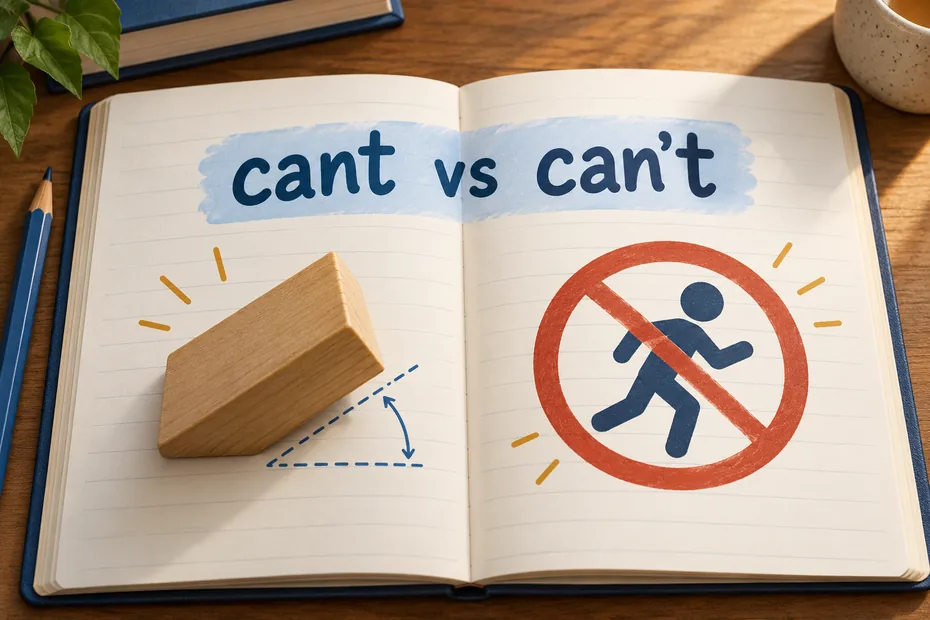
Cant vs can’t: meanings, apostrophes, and examples
Can’t is the contraction of cannot; cant is a separate word that can describe insincere speech, group jargon, or a slope or tilt. Write “I can’t open the window” when someone is unable to open it. Write “The window frame has a slight cant” when describing its angle. The apostrophe changes the word rather than merely decorating it.
The earlier discussion below emphasizes specialized vocabulary. That is one valid meaning of cant, but it is not the whole definition. Cant also has physical meanings and a critical meaning connected with empty or hypocritical language. This distinction matters when deciding whether a missing apostrophe is a typo or an intentional word.

Key facts at a glance
- Can’t can be expanded to cannot without changing its basic meaning.
- Cant does not expand to cannot when it means jargon, hypocrisy, or inclination.
- The verb cant has the forms cants, canted, and canting.
- Can’t normally comes before a base-form verb, such as attend, swim, or explain.
- A spellchecker can accept cant because cant is a real dictionary word.
| Spelling | Meaning in context | Original example | Quick test |
|---|---|---|---|
| can’t | Cannot | I can’t reach the shelf. | Replace with cannot. |
| cant | Insincere language | The apology sounded like cant. | Ask whether the speaker sounds sincere. |
| cant | Group vocabulary | The novel records the cant of thieves. | Look for a group and its language. |
| cant | Tilt or inclination | The surveyor measured the cant. | Look for physical orientation. |
What does cant mean beyond jargon?
Merriam-Webster’s cant entry distinguishes speech-related senses from angle-related senses. Cant can name conventional expressions used insincerely, private group language, and an inclination. Its verb forms can describe speaking in cant or setting something at an angle. These are distinct meanings that share a spelling.
Consider two original sentences: “The committee rejected the manager’s cant” and “The carpenter adjusted the cant of the frame.” The committee sentence concerns language and likely implies disapproval. The carpenter sentence concerns geometry. Neither sentence becomes sensible if cant is replaced with cannot, so neither needs an apostrophe.
Collins’s cant entry likewise records insincere talk, repeated stock phrases, specialized vocabulary, and slanting or tilted positions. Calling someone’s language cant can therefore sound dismissive. When you simply mean a profession’s useful terminology, “technical vocabulary” or “jargon” may communicate your intention more clearly.

How does can’t work in a sentence?
Can’t supplies the negative form of can. Merriam-Webster’s can’t entry identifies cannot as its expanded form. The word can express inability, a blocked possibility, or another negative use of can; it is not limited to a person’s physical skill.
Compare “I can’t lift the suitcase,” “We can’t arrive before noon,” and “That can’t be the correct address.” The first concerns ability, the second an obstacle to an event, and the third a judgment about possibility. In every case, cannot provides a practical spelling check. These examples are constructed to illustrate the pattern rather than quotations from the dictionaries.
After can’t, use the plain verb: “She can’t attend,” rather than “She can’t attends.” When the main verb is omitted, the earlier sentence can supply it: “Can you attend?” “I can’t.” The apostrophe remains necessary even when no following verb appears on the page.
Which proofreading test catches the missing apostrophe?
The quickest proofreading test is to expand the intended negative to cannot. If the expanded sentence communicates your meaning, restore can’t. If expansion destroys the sentence, check whether cant has a legitimate speech-related or physical meaning instead.
- Read the whole sentence, including any previous question.
- Try cannot in the position occupied by cant or can’t.
- If cannot fits, use can’t or write cannot in full.
- If it does not fit, identify the noun or verb meaning of cant.
- Check the surrounding phrase after making the correction.
For example, edit “The printer cant connect” to “The printer can’t connect.” Leave “The technician corrected the cant of the bracket” unchanged. A global replacement of every cant with can’t would damage the second sentence. Search-and-replace should therefore be followed by a sentence-level meaning check.

Practice with context
Choose the spelling for these original examples: “We ___ hear the announcement”; “The essay criticized fashionable ___”; “Please ___ the panel slightly”; “They ___ finish today.” The answers are can’t, cant, cant, and can’t. The panel example uses an imperative verb; the essay example uses a noun. The other two examples negate can.
The reliable conclusion for cant vs can’t is that meaning decides the spelling. Don’t rely only on pronunciation or on whether your keyboard flags the word. Expand the contraction first, then inspect any remaining cant as a genuine vocabulary item.
FAQ: cant and can’t
Is cant always a spelling mistake?
No. Cant is a real word with several established senses. It becomes a mistake when the intended meaning is cannot and the apostrophe has been omitted. A sentence about a slope, insincere rhetoric, or a group’s language may correctly use cant without any punctuation.
Can I write cannot instead?
Yes. Cannot avoids the apostrophe decision when you are negating can. Choose the full form if it suits the sentence’s tone or your document’s style requirements. Expanding can’t is particularly useful during proofreading because it makes the intended grammatical relationship easy to see.
Does canted come from can’t?
No. Canted belongs to the separate verb cant, including its angle-related meaning. “The frame was canted” describes its position. Can’t is a contraction and does not produce canted or canting. Matching the word to its verb family prevents this otherwise plausible-looking spelling confusion.
Why can a spelling checker miss cant?
A basic spelling checker recognizes valid words rather than reliably interpreting your intention. Because cant exists, it may accept “I cant come” even though the sentence needs can’t. Read the complete statement and apply the cannot substitution test instead of treating a lack of highlighting as proof.
Hey there! Have you ever been confused about when to use “cant” versus “can’t”? Well, you’re not alone! In this text, I’ll jump into the nuances of these two words and help you understand how to use them appropriately.
“Cant” and “can’t” may sound similar, but they have completely different meanings and uses. Understanding the distinction between them is essential for effective communication. Whether you’re writing an email, a blog post, or simply having a conversation, using the right word can make all the difference in getting your message across clearly and accurately.
So, if you’re ready to master the art of using “cant” and “can’t” correctly, let’s get started! By the end of this article, you’ll feel confident in your ability to choose the right word in any context. Let’s immerse and unravel the mystery behind these two commonly confused words.
Key Takeaways
- “Cant” refers to specialized vocabulary or jargon used by a specific group or profession.
- “Can’t” is a contraction of “cannot” and indicates the inability to do something.
- Understanding the difference between “cant” and “can’t” is crucial for effective communication.
- Use “cant” when referring to specialized language in specific contexts, such as professions, disciplines, or subcultures.
- Use “can’t” to express personal or universal inability and to negate abilities or possibilities.
- In formal writing or professional contexts, it’s preferable to use the full form “cannot” instead of “can’t.”
Understanding the Difference between “cant” and “can’t”
One common mistake that I often see in writing is the confusion between “cant” and “can’t.” These two words may seem similar, but they have distinct meanings and uses. In this section, I will explain the difference between “cant” and “can’t” to help you use them appropriately in your writing.
Let’s start with the definition of “cant.” “Cant” is a noun that refers to the jargon or specialized vocabulary used by a particular group or profession. It is often associated with insiders who share a common language or knowledge. For example, medical professionals may use medical cant that is not easily understood by the general public.
On the other hand, “can’t” is a contraction of “cannot” and is used to express the inability to do something. It indicates a lack of capability or possibility. For instance, if I say, “I can’t attend the meeting,” it means that I am unable to attend due to some reason or restriction.
The key difference between these two words is that “cant” describes a specialized language or jargon, while “can’t” expresses the inability to do something. It’s important to recognize this distinction to ensure effective communication and avoid confusion.
To further clarify, here are some examples:
- “I can’t speak Spanish fluently.” (expressing inability)
- “He can’t come to the party because he has other commitments.” (expressing an obstacle)
- “The article was full of technical cant that was hard to understand.” (referring to specialized vocabulary)
Understanding the nuance between “cant” and “can’t” will enhance your ability to use these words appropriately in different contexts. Paying attention to the meaning and context of each word will make your writing more precise and effective.
When to Use “cant”
As a language enthusiast, I understand the importance of using words correctly for effective communication. In this section, I’ll dive deeper into the usage of “cant” and provide you with the information you need to use it appropriately.
Definition of “Cant”: When we talk about “cant,” we aren’t referring to the contraction of “cannot” (“can’t”). Instead, “cant” has a different meaning. It refers to the jargon or specialized vocabulary used by a particular group or profession. In other words, it’s the language unique to a specific field or community.
Difference Between “Cant” and “Can’t”: It’s important to note that “cant” and “can’t” have distinct meanings. Whereas “cant” is a noun that refers to specialized vocabulary, “can’t” is a contraction of “cannot” and expresses the inability to do something. Understanding this difference will help you avoid confusion and use the correct word in the appropriate context.
- In specialized contexts: Use “cant” when you want to refer to the jargon or specialized vocabulary of a particular group or profession. For example, if you are writing an article about the legal profession, you might discuss the use of legal “cant” or terminology specific to lawyers and judges.
- Exploring specific disciplines: If you’re studying a specific field or writing about it, using “cant” can demonstrate your understanding of the subject matter. For instance, in a scientific article, discussing the “cant” of physics would involve diving into the specialized language used by physicists.
- Analyzing societal subcultures: In discussions about subcultures or groups with their own unique language, you can use “cant” to highlight their distinctive vocabulary and expressions. For example, you might explore the “cant” of musicians or computer programmers.
Using “cant” in these contexts will enhance your writing by demonstrating your familiarity with the specific language and terminology of a particular field or group. But, it’s essential to use it correctly and be mindful of its precise meaning.
Examples of “cant” in Context
To further illustrate the usage of “cant” in English, let’s explore some examples in various contexts:
Specialized Fields
In professions and specialized fields, “cant” plays a crucial role in conveying precise meaning among experts. For instance:
- Medical Cant: Doctors and nurses use medical terminology that may be unfamiliar to the general public. When they discuss cases, they may refer to conditions and procedures using specific medical “cant” such as “myocardial infarction” (heart attack).
- Legal Cant: Lawyers have their own set of terms and expressions known as “legal cant.” Using this specialized vocabulary, they can efficiently communicate complex legal concepts among their peers. Examples include phrases like “voir dire” (jury selection) or “habeas corpus” (a legal action requiring a person to be brought before a court).
Specific Disciplines
Different disciplines develop their own jargon to help communication within their communities. Here are a few examples:
- Science Cant: In the scientific community, “cant” is prevalent, allowing scientists to discuss intricate concepts. Biologists might use terms like “endothermic” (absorbing heat) or “polymerase chain reaction” (a technique used in molecular biology).
- Technology Cant: In the world of technology, professionals have their own unique vocabulary. For instance, software developers might discuss “APIs” (Application Programming Interfaces) or “backend” (the server-side of an application).
Societal Subcultures
Even outside of professional contexts, certain societal subcultures are known for using their own “cant.” These languages help build identity and establish a sense of belonging:
- Slang Cant: Populated by teenagers and young adults, slang often evolves rapidly and can be location-specific. For example, phrases like “lit” (exciting, amazing) or “on fleek” (perfectly done) are part of the slang “cant” used by youth.
- Internet Cant: The online world has its own language, and understanding internet “cant” is essential for effective communication online. When someone types “LOL” (laugh out loud) or “OMG” (oh my god), they are using common internet acronyms.
By recognizing and using “cant” appropriately in various contexts, we can demonstrate our familiarity and understanding of specific fields or subcultures while effectively communicating with others.
When to Use “can’t”
As a continuation of our exploration of commonly confused words, let’s now turn our attention to understanding when to use the contraction “can’t.”
Definition of “can’t”:
“Can’t” is a contraction of the word “cannot” and is used to express the inability to do something. It’s essential to note that “can’t” is not interchangeable with the word “cant,” which refers to specialized vocabulary used by specific groups or professions.
Difference between “can’t” and “cant”:
While both “can’t” and “cant” may seem similar, they have distinct meanings and usage. “Can’t” expresses the inability to do something, while “cant” refers to specialized terminology or jargon.
So, how do we know when to use “can’t” correctly? Here are a few key instances:
- Expressing Personal Inability:
I’ll use “can’t” when indicating my own inability to perform a certain action. For example:
- “I can’t swim.”
- “I can’t eat spicy food.”
By using “can’t,” I provide a clear statement about my personal limitations.
- Expressing General or Universal Inability:
“Can’t” can also be used to express a general or universal inability that applies to everyone. For instance:
- “We can’t ignore the importance of education.”
- “They can’t predict the future.”
In these cases, “can’t” helps to convey the idea that the stated actions or situations are universally impossible or unfeasible.
- Negating Abilities or Possibilities:
When we want to negate a possibility or ability, “can’t” is the appropriate choice. For example:
- “She can’t be the culprit; she was with me the entire time.”
- “It can’t be true; I saw him just yesterday.”
Here, “can’t” is used to challenge or deny a claim by highlighting the unlikelihood or impossibility of the stated situation.
Remember, “can’t” is a contraction often used in casual or informal situations. In more formal writing or professional contexts, it’s preferable to use the full form, “cannot.”
Examples of “can’t” in Context
As we discussed earlier, “can’t” is a contraction of “cannot” and is used to express personal inability, general or universal inability, and to negate abilities or possibilities. Now, let’s look at some examples of how “can’t” is used in different contexts.
Personal Inability
In everyday conversations, “can’t” is often used to express personal inability to do something. For example:
- I can’t go to the party tonight because I have a prior commitment.
- Sorry, I can’t help you move this weekend as I am out of town.
General or Universal Inability
“Can’t” can also be used to convey a general or universal inability. Here are some examples:
- The car won’t start, so we can’t go anywhere right now.
- I can’t go swimming today because the pool is closed.
Negating Abilities or Possibilities
“Can’t” is also commonly used to negate abilities or possibilities. Consider the following examples:
- I can’t believe how fast he ran the marathon!
- You can’t be serious! Are you really considering quitting your job?
It’s important to note that “can’t” is more commonly used in casual or informal situations. In formal writing or professional contexts, it is preferred to use “cannot.”
Understanding how to use “can’t” correctly allows you to express personal limitations, convey general or universal inabilities, and negate abilities or possibilities in a concise manner. By using the appropriate form of “can’t” in your communication, you can ensure clarity and accuracy in your language.
Now that we have explored examples of “can’t” in different contexts, let’s investigate into the usage of “cant” in the next section.
Conclusion
Understanding the difference between “cant” and “can’t” is crucial for effective communication. While “cant” refers to specialized vocabulary used within specific groups or professions, “can’t” is a contraction of “cannot” used to express personal or universal inability.
Using “cant” correctly demonstrates familiarity with specific language and terminology, allowing for clearer communication within specialized fields, disciplines, and societal subcultures. It helps build identity and facilitates effective communication within these communities.
On the other hand, using “can’t” appropriately ensures clarity and accuracy in communication. It is commonly used in casual or informal situations to express personal inability or to negate abilities or possibilities. “Cannot” is preferred in formal writing or professional contexts.
By mastering the appropriate usage of “cant” and “can’t,” we can enhance our communication skills and avoid misunderstandings. Whether we are exploring specialized fields, engaging in specific disciplines, or participating in societal subcultures, using these terms correctly is essential for effective and accurate communication.
Frequently Asked Questions
Q: What is the difference between “cant” and “can’t”?
A: “Cant” refers to jargon or specialized vocabulary used within a particular group or profession. On the other hand, “can’t” is a contraction of “cannot” and expresses the inability to do something.
Q: In what contexts can “cant” be used?
A: “Cant” can be used in specialized fields, specific disciplines, and societal subcultures. It helps communicate specific language, terminology, and builds identity within these communities.
Q: How is “can’t” used?
A: “Can’t” is used to express personal inability, general or universal inability, and to negate abilities or possibilities. It is more commonly used in casual or informal situations, while “cannot” is preferred in formal writing or professional contexts.
Q: What is the importance of using “cant” and “can’t” correctly?
A: Using “cant” correctly demonstrates familiarity with specific language and terminology, ensuring effective communication within specialized communities. Similarly, using “can’t” correctly in communication helps ensure clarity and accuracy.
Q: Can you provide examples of “cant” and “can’t” usage in different contexts?
A: Examples of “cant” usage include specialized fields like medicine and law, specific disciplines like science and technology, and societal subcultures like slang and internet language. Examples of “can’t” usage include expressing personal inability, general or universal inability, and negating abilities or possibilities.


