
Raising, rasing, or razing? Choose the action and the register
Raising means lifting, increasing, collecting, rearing, or bringing something up; razing commonly means demolishing a structure; rasing is a documented form of the archaic verb rase. Write “The students are raising funds” for collecting money and “The crew is razing the old shed” for demolition. In ordinary modern writing about demolition, razing is the clearer familiar spelling.
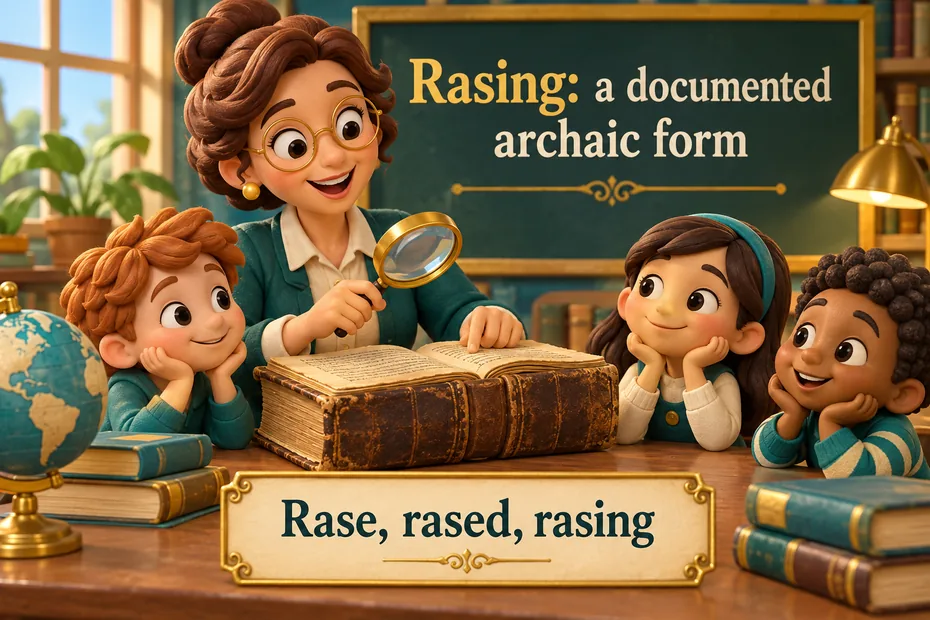
One correction is essential: rasing is not automatically an invented word or a typo. Merriam-Webster records rase with the forms rased and rasing, marking its erase and demolish meanings archaic. Context may reveal a genuine older usage, even though a modern writer usually wants razing or another clearer verb.

Key facts and comparison
| Form | Base verb | Main learner meaning | Example |
|---|---|---|---|
| raising | raise | Lifting, increasing, collecting, or rearing | They are raising a flag. |
| razing | raze | Demolishing or leveling | The crew is razing the shed. |
| rasing | rase | Archaic form associated with erasing or demolition | An older text may use rasing. |
Raising: many uses, one verb family
Merriam-Webster’s raise entry records raising and raised and a wide range of meanings. Collins’s raise entry also documents familiar uses beyond physical lifting. The object tells you which meaning is intended.
In “raising a hand,” something moves upward. In “raising prices,” an amount increases. In “raising funds,” people collect money for a purpose. In “raising children,” the action concerns caring for and bringing them up. In “raising a question,” someone brings an issue forward for consideration.
Original examples include “The teacher noticed a student raising her hand”; “The club is raising money for new books”; “The writer is raising an important question”; and “They are raising chickens on the farm.” The common verb does not mean every action is an improvement. Raising costs can be unwelcome, and raising a concern may identify a problem.

Razing: demolition, rather than construction
Merriam-Webster’s raze entry gives the common demolition meaning and records razed and razing. Collins’s raze entry likewise describes destruction of a building or place. For modern everyday prose, this is the spelling to choose when an existing structure is being torn down.
Compare “The workers are raising a new structure” with “The workers are razing the old structure.” The first concerns setting up or constructing; the second concerns demolition. Because the words sound alike, confusing their spelling can reverse the reader’s understanding of the project.
Razing implies more than a minor repair or partial alteration. “They are repainting the shed” or “They are removing one partition” does not automatically justify “razing the shed.” Choose the action that actually occurred. The demolition meaning also does not promise that no rubble remains; that absolute claim confuses demolishing a structure with clearing away every material.
Raze has additional dictionary senses associated with scraping, cutting, or shaving off, and an archaic erase sense. A historical or specialist passage may therefore need more attention than the simple modern building contrast.
Rasing: rare, documented, and context dependent
Merriam-Webster’s rase entry explicitly lists rasing and labels the verb’s relevant meanings archaic. Collins’s rase entry also documents the word. Calling every occurrence a misspelling would overlook that record.
If you find rasing in an old quotation, check the original edition and its context before silently changing it. When quoting, preserve the source accurately or explain an editorial modernization according to the publication’s conventions. When writing a new sentence for a general audience, prefer familiar razing for demolition or erasing for removal of writing.
If a student writes “They are rasing money,” raising is the intended correction because the context concerns collecting funds. If the sentence concerns demolishing a building, razing is normally the modern choice. The correct edit depends on intended meaning, not simply on the presence of an unfamiliar spelling.
Forms and pronunciation
| Base | Past tense | -ing form |
|---|---|---|
| raise | raised | raising |
| raze | razed | razing |
| rase | rased | rasing |
Each base verb loses its final e before ing. Raising retains the ai from raise, razing retains the z from raze, and rasing retains the s from rase. Their common pronunciations overlap, so listening alone does not settle the spelling.
Practice and frequently asked questions
- “We are ___ funds for the library.” Answer: raising.
- “The contractor is ___ the abandoned shed.” Answer: razing in ordinary modern writing.
- “The speaker is ___ a concern.” Answer: raising.
- “The dictionary lists rased and ___.” Answer: rasing.
Can raising and razing concern the same site? Yes. A crew might raze an old building before raising a new one. The actions remain different.
Is rasing standard everyday wording? It is documented, but its archaic register makes it unusual in modern general prose.
What is the easiest memory aid? Raise brings something up; raze brings a structure down. Treat rase as a historical dictionary word whose context needs checking.
Key Takeaways
- “Raising” refers to lifting, promoting, or improving something.
- “Razing” means completely destroying or demolishing a building or structure.
- “Rasing” is not a commonly used word in English and is a misspelling of “razing.”
- It is important to use the correct word (“raising” or “razing”) to convey the intended meaning accurately.
- Understanding the differences between these words is crucial for effective communication in both written and spoken English.
- Mnemonic devices, such as visualizing lifting for “raising” and bulldozer demolition for “razing,” can help remember the meanings.
Understanding the Difference between Raising, Rasing, and Razing
When it comes to the English language, there are many words that sound similar but have different meanings. This can be especially confusing for students who are trying to improve their language skills. One common confusion is between the words “raising,” “rasing,” and “razing.” In this section, I’ll explain the difference between these words and provide examples to help clarify their usage.
Definition of Raising, Rasing, and Razing
Let’s start by defining each of these words individually:
- Raising: The word “raising” is a verb that refers to the act of lifting something up or elevating it. It can also mean promoting or improving something, such as raising awareness or raising funds for a cause.
- Rasing: The word “rasing,” on the other hand, is not a commonly used word in English. It is a misspelling or typo of the word “razing,” which means to completely destroy or demolish something, typically a building or structure.
- Razing: “Razing” is a verb that describes the action of tearing down or destroying a building or structure completely. It implies the complete removal of the structure, leaving nothing behind.
The Difference between Raising, Rasing, and Razing
Now that we have defined each of these words, let’s understand the differences between them.
- “Raising” refers to the act of lifting or promoting something, while “razing” refers to the complete destruction of a building or structure.
- “Rasing” is a misspelling of “razing” and is not a commonly used word.
Examples of Raising, Rasing, and Razing
To further illustrate the differences, here are some examples of the correct usage of each word:
- Raising: I am raising my hand to answer a question in class.
- Rasing: This word is not commonly used in English. A correct usage example cannot be provided.
- Razing: The city decided to raze the old abandoned building and replace it with a park.
As you can see, understanding the difference between raising, rasing, and razing is crucial for using these words correctly and effectively in both written and spoken English.
Remember, raising means to lift or promote, razing means to completely destroy, and rasing is not a commonly used word.
Common Mistakes and Confusions
When it comes to the words “raising,” “rasing,” and “razing,” it’s not uncommon for people to get them confused. In this section, I’ll address some common mistakes and help clarify the differences between these similar-sounding words.
Difference between “raising” and “rasing”
One of the most common mistakes is using the word “rasing” instead of “razing.” It’s important to note that “rasing” is not a word in standard English and is actually a misspelling of “razing.” So, if you’ve come across this term before, know that it should be “razing” instead.
On the other hand, “raising” is a legitimate word that refers to the act of lifting or promoting something. It can also mean building or constructing something upward. For example, you can raise your hand, raise a flag, or raise a child. It’s important to use “raising” when you are talking about elevating or promoting something.
Definition of “razing”
Let’s talk about “razing.” Unlike “raising,” which involves building up or promoting, “razing” refers to the complete destruction or leveling of a building or structure. It means tearing down or demolishing something to the ground.
It’s essential to use “razing” when you are discussing the act of completely destroying something, such as “the entire village was razed to the ground” or “they razed the old building to make room for a new one.” Using “raze” instead of “raising” or “rasing” indicates that something is being completely destroyed and removed.
Remember, understanding the definitions of these words is crucial for effective communication. Using the correct term will ensure that you convey your message accurately and avoid confusion.
To summarize, “raising” involves lifting or promoting something, “rasing” is a misspelling of “razing” and should be avoided, and “razing” means completely destroying a structure or building.
| Word | Definition |
|---|---|
| Raising | Lifting or promoting something |
| Razing | Completely destroying a building or structure |
| Rasing | Not a word in standard English (misspelling) |
Proper Usage of Raising, Rasing, and Razing
To effectively communicate in English, it’s important to understand the differences between similar-sounding words. In this section, I’ll clarify the proper usage of “raising,” “rasing,” and “razing” to help you confidently differentiate between them.
The Difference Between Raising and Rasing
Let’s start by examining the difference between “raising” and “rasing.”
Raising: When we talk about “raising,” we’re referring to lifting or promoting something. It can involve elevating an object, increasing its value or importance, or nurturing its growth. For example, raising a child, raising funds for a charitable cause, or raising awareness about an important issue.
Rasing: Now, let’s address the misspelling that leads to confusion, “rasing.” It’s important to note that “rasing” is not a commonly used word in the English language. The correct term, in this context, should be “raising.” So, whenever you come across the term “rasing,” consider it a mistake and replace it with “raising.”
Understanding Razing
Moving on to the word “razing,” let’s investigate into its meaning and proper usage.
Razing: When we talk about “razing,” we’re talking about the complete destruction or leveling of a building or structure. It signifies tearing down something to the ground, leaving nothing behind. This term is often used in the context of war, demolition, or urban development. For example, razing an old building to make space for a new development or razing a village during a military conflict.
Understanding the proper usage of “razing” is crucial to avoid confusion. Remember, “razing” refers to the complete destruction of a structure, while “raising” involves lifting or promoting something, and “rasing” is simply a misspelling of “razing.”
No concluding paragraph.
Examples of Incorrect Usage
Many English learners often struggle with the correct usage of similar-sounding words. In this section, I will highlight some common examples of incorrect usage of “raising,” “rasing,” and “razing” to help you better understand the differences between these words.
- Incorrect: “I’m rasing my hand to ask a question.”
Explanation: The word “rasing” is a misspelling of “razing” and should be avoided. In this context, the correct word to use is “raising.” “Raising” refers to the action of lifting or elevating something, such as your hand to ask a question. - Incorrect: “The company is rasing its prices due to inflation.”
Explanation: Again, “rasing” is misspelled. The correct word to use here is “raising.” In this context, “raising” means increasing or elevating something, like the prices of products or services. - Incorrect: “The old building was rasing to the ground.”
Explanation: The correct word in this sentence is “razing.” “Razing” means completely destroying or leveling a building or structure. So, the correct sentence should be: “The old building was razed to the ground.” - Incorrect: “They were rasing awareness about climate change at the protest.”
Explanation: Once again, “rasing” is a misspelling. The correct word to use in this context is “raising.” Here, “raising” means promoting or bringing attention to a particular cause or issue, such as climate change awareness.
It’s important to use these words correctly to avoid confusion and effectively convey your message in English. By understanding the differences between “raising,” “rasing,” and “razing,” you can ensure that your communication is clear and accurate.
Let’s now move on to the next section, where we will explore more examples and further clarify the proper usage of these words.
Tips for Remembering the Differences
When it comes to confusing words like “raising,” “rasing,” and “razing,” it’s important to have strategies in place to help you remember their differences. Here are a few tips to keep in mind:
- Understand the Definitions: To effectively use these words, it’s crucial to grasp their meanings. Let’s break it down:
- Raising: This word refers to lifting or promoting something. It could involve elevating an object or promoting a cause or idea. For example, “I was raising my hand to ask a question in class” or “The company is raising awareness about climate change.”
- Razing: On the other hand, “razing” means completely destroying a building or structure. It implies tearing something down to the ground. For instance, “The old factory was razed to make way for a new development.”
- Clarify the Misspelling: The term “rasing” is actually a misspelling of “razing.” It’s important to note this to avoid confusion and ensure accurate usage. The correct word to use when describing the destruction of a structure is “razing,” not “rasing.”
- Make Mnemonic Devices: Mnemonic devices can be handy tools for remembering differences. Try creating associations or mental images to help you recall the correct meanings of these words. For instance:
- For “raising,” you can imagine yourself physically lifting something up, like raising your hand in class.
- For “razing,” picture a bulldozer tearing down a building, representing the complete destruction it implies.
- Contextualize with Examples: Context can play a crucial role in understanding and using these words accurately. By studying and practicing examples, you’ll become more comfortable distinguishing between “raising,” “rasing,” and “razing.” Here are a few examples to illustrate their usage:
- “I’m raising funds for the charity event.” (Lifting or promoting something)
- “She accidentally wrote ‘rasing’ instead of ‘razing’ in her essay.” (Misspelling of ‘razing’)
- “The city decided to raze the abandoned building.” (Completely destroying a structure)
Conclusion
Understanding the differences between “raising,” “rasing,” and “razing” is essential for effective communication in English. “Raising” refers to lifting or promoting something, while “razing” means to completely destroy a building or structure. It is important to note that “rasing” is a misspelling of “razing” and should be avoided.
By grasping the definitions of these words and using them correctly, you can enhance your communication skills. Remember, “raising” involves lifting or promoting something, while “razing” means completely destroying a structure or building.
To ensure accurate usage, create mnemonic devices or use contextual examples. These strategies can help you avoid confusion and convey your message clearly.
Summarizing, mastering the distinctions between “raising,” “rasing,” and “razing” will enable you to communicate effectively and confidently in English. By utilizing these words correctly, you can articulate your thoughts with precision, enhancing your overall communication skills.
Frequently Asked Questions
Q: What is the difference between “raising,” “rasing,” and “razing”?
A: The word “raising” refers to lifting or promoting something. “Raising” involves lifting or promoting something. On the other hand, “razing” means completely destroying a building or structure. “Rasing” is a misspelling of “razing” and should be avoided.
Q: How can I remember the differences between these words?
A: To remember the differences between these words, it is helpful to understand their definitions. Clarify that “rasing” is a misspelling of “razing” and should be avoided. Creating mnemonic devices or mental associations can also aid in remembering. Using examples in context can further assist in distinguishing the correct usage of each word. By applying these strategies, you can accurately use “raising,” “rasing,” and “razing” and avoid confusion in your communication.


