
Cession or session? Transfer versus a meeting period
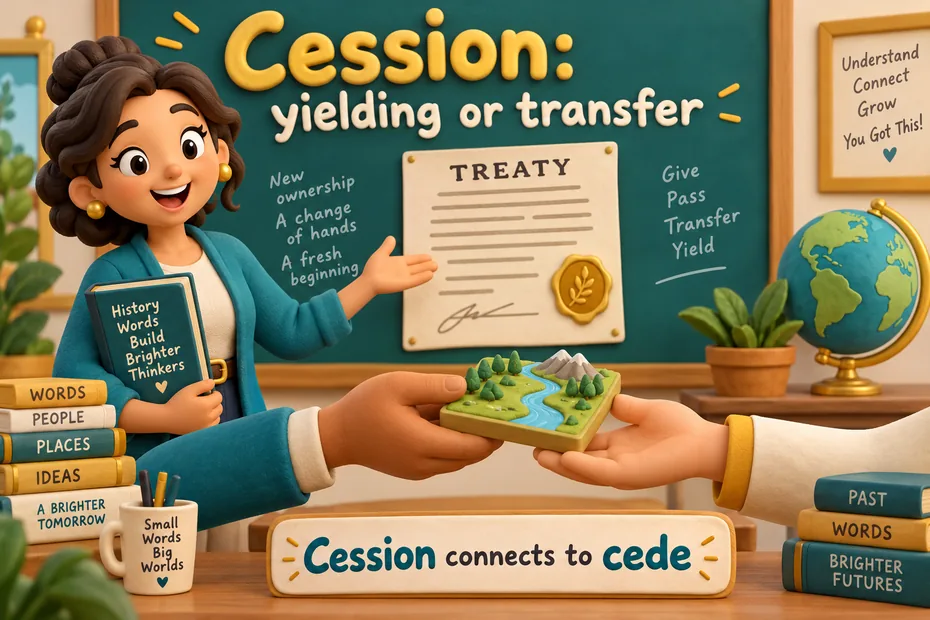
Cession means yielding or transferring something to another; session means a meeting or a period devoted to an activity. Write “The treaty described the cession of territory” for a transfer and “The afternoon session begins at two” for an event period. The two words normally sound alike, so meaning must guide the spelling.
A cession is not simply any pause, and a session does not itself mean giving up ownership. They can appear together: “The delegates discussed the proposed cession during the morning session.” The first names what was discussed; the second names when the discussion took place.
Key facts and comparison
| Word | Main meaning | Common contexts | Example |
|---|---|---|---|
| cession | Yielding or transfer to another | Territory, rights, formal agreements | The document recorded the cession. |
| session | Meeting or activity period | Classes, conferences, recording, training | We booked a practice session. |
| cede | Verb associated with cession | Give over or yield | They agreed to cede control. |
| in session | Meeting or actively conducting business | Courts and assemblies | The committee is in session. |
Cession: what is being yielded?
Merriam-Webster’s cession entry connects the noun with yielding to another. Collins’s cession entry likewise describes ceding, including territory or rights. A clear sentence usually specifies the thing transferred and, when relevant, the parties involved.
Compare “The agreement included a cession” with “The agreement included a cession of territory to the neighboring state.” The second gives a reader more useful information. “Cession of” commonly introduces what is yielded, while “to” can identify the recipient. These are writing patterns, not instructions for making a legally effective transfer.
The related verb is cede. Merriam-Webster’s cede entry records yielding or granting something to another. “They ceded control” states an action; “the cession of control” names that action as a noun. Choose the form that fits your sentence rather than replacing session with cession mechanically.
Do not assume that the word guarantees an uncomplicated, freely welcomed arrangement for everyone affected. Historical transfers can involve power imbalances and contested claims. Describe the specific agreement and its context instead of treating “voluntary” as part of every possible use of cession.

A documented historical example
The U.S. Department of State’s Office of the Historian account of the Alaska purchase describes the 1867 agreement through which the United States acquired Alaska from Russia. In vocabulary terms, a discussion of territory transferred under such an agreement belongs with cession, rather than session.
Keep that example’s function clear: it illustrates a territorial-transfer context. A meeting held to discuss a treaty would be a session. The territorial transfer and the meeting about it are different things, even when both occur in one historical account.
Session: what activity occupies the time?
Merriam-Webster’s session entry includes meetings of courts or legislatures and periods devoted to particular activities. Collins’s session entry provides similar everyday uses. This is the word for “training session,” “recording session,” “study session,” and “question-and-answer session.”
A session need not be a single brief meeting. Depending on context, the word can describe a series of meetings or a larger period during which a body conducts business. Let the surrounding information establish the duration: “a forty-minute coaching session” and “the legislative session” do not necessarily refer to the same kind of time span.
Original examples include “The tutor planned a revision session,” “The musicians completed the recording session,” and “The conference has three afternoon sessions.” Each sentence names an activity period rather than a transfer of possession or authority.

Grammar and useful phrases
Both nouns can take a plural s: cessions and sessions. The choice still follows meaning. “Several territorial cessions” refers to transfers; “several training sessions” refers to periods of training. For one activity period, write “a session,” not “an session.”
The phrase in session means that a body is meeting or conducting its business. “The court is in session” does not imply that the court is surrendering anything. Conversely, “the cession of land” concerns the transfer itself, even if its terms were debated over several sessions.
When editing, replace cession mentally with “transfer” and session with “meeting period.” If the sentence concerns an agenda, start time, attendance, or practice, session is usually the relevant word. If it concerns something ceded to another party, inspect cession and specify what changed hands.
Practice and frequently asked questions
- “The workshop’s final ___ starts after lunch.” Answer: session.
- “The treaty included the ___ of territory.” Answer: cession.
- “The committee discussed the ___ in a closed ___.” Answers: cession, session.
- “The orchestra booked another recording ___.” Answer: session.
Are the words homophones? They commonly share the same pronunciation. Their first letters signal different meanings rather than a dependable sound difference.
Is cession the same as cessation? No. Cessation concerns stopping or ending; cession concerns yielding to another. Check the whole word when reading quickly.
What is the best memory aid? Link cession to cede and session to scheduled activity. Then confirm the noun’s meaning in the actual sentence.
Key Takeaways
- Cession refers to the act of giving up or surrendering something, usually in a formal or legal context.
- Session refers to a specific period of time dedicated to a particular activity, such as a meeting or conference.
- The main difference between cession and session is that cession involves the transfer or surrender of something, while session is focused on allocating a specific time for activities or discussions.
- Examples of cession include territorial cession, rights cession, and sovereign cession.
- Examples of session include academic sessions, government sessions, and business sessions.
- Understanding the difference between cession and session is crucial for using these terms accurately in various contexts.
What is a Cession?
A cession refers to the act of giving up or surrendering something, usually in a formal or legal context. It can also refer to the transfer of rights, property, or territory from one party to another.
In general, a cession involves relinquishing or abandoning a claim, possession, or authority. It can apply to various aspects, such as land, assets, rights, or control.
The concept of cession is often encountered in discussions about territorial disputes, where one country or organization voluntarily gives up control over a certain area to another. This can occur through a treaty, agreement, or negotiation.
Cessions can also happen in personal or financial situations. For example, an individual may cede their ownership rights to a property or transfer their share of a company’s stocks to someone else.
The key difference between a cession and other similar terms, such as a session, lies in the context and nature of the action. While a cession involves relinquishment or surrender, a session typically refers to a meeting, period, or gathering.
To summarize, a cession is the act of giving up or surrendering something, whether it be rights, property, or territory. It is important to understand the definition of cession to accurately differentiate it from similar terms and use it appropriately in various contexts.
Now that we have explored the definition of cession, let’s move on to understand the concept of session in the next section.
What is a Session?
To understand the difference between “cession” and “session,” it’s important to first define what a session is. A session refers to a specific period of time, often used in the context of meetings, conferences, or events. It represents a designated timeframe during which activities or discussions take place.
Here’s a breakdown of the key characteristics and uses of a session:
- Definition of a Session: A session is a scheduled period of time devoted to a particular purpose, such as a meeting, seminar, or training session. It has a defined start and end time, and participants come together to focus on a specific objective or topic.
- Difference between Cession and Session: While “cession” involves the act of giving up or surrendering something, “session” refers to a period of time devoted to a specific activity or purpose. The main distinction lies in the nature of the action: cession involves transfer or relinquishment, whereas session pertains to a designated timeframe.
- Examples of Sessions: Sessions can take various forms and serve different purposes. Some examples include:
- Business Meetings: Companies hold regular sessions to discuss projects, updates, and strategies.
- Academic Classes: Educational institutions divide their day into sessions or periods where different subjects are taught.
- Conference Sessions: Conferences typically have multiple sessions with different speakers or topics.
- Therapy Sessions: Individual or group therapy sessions provide a designated time for counseling or treatment.
Understanding the concept of a session is crucial to differentiate it from the term “cession.” By knowing the definition and key characteristics of both terms, you’ll be able to use them appropriately and accurately in various contexts.
Next, let’s explore the concept of cession and clarify any misconceptions surrounding its usage.
Key Differences between Cession and Session
As we investigate deeper into the topic of cession versus session, it’s important to understand the key differences between these two terms. Let’s explore these differences in detail:
Definition of Cession: Cession refers to the act of giving up or surrendering something, particularly territory or rights, to another party. It involves the transfer of ownership or control from one entity to another. Cession is commonly used in the context of international diplomacy and agreements between countries.
Definition of Session: A session, on the other hand, is a specific period of time dedicated to a particular activity, such as a meeting, conference, or legislative assembly. It is a defined timeframe during which discussions, presentations, or deliberations take place. Sessions can be organized in various settings, ranging from academic institutions to professional conferences.
Difference in Meaning: The main difference between cession and session lies in their meanings. While cession involves the transfer or surrender of something, session refers to a dedicated time period for a specific purpose.
Ownership vs Timeframe: The key distinction between cession and session can be summarized as ownership versus timeframe. Cession revolves around the transfer of ownership or control, whereas session is focused on allocating a specific time for activities or discussions.
Examples: To better grasp these differences, let’s look at a couple of examples. When one country cedes territory to another, it is a cession of land. On the other hand, when a committee holds a session to discuss important matters, it is a session dedicated to that specific purpose.
Summarizing, understanding the difference between cession and session is crucial for using these terms accurately in various contexts. Cession refers to the surrender or transfer of territory or rights, whereas a session is a designated period of time for a particular activity. Remember, cession is about ownership, while session is about time.
When to Use Cession
Cession and session are two words that are often confused due to their similar spellings. But, their meanings are distinct and should be used appropriately in different contexts. In this section, I will focus on when to use the word ‘cession’ and provide examples to help clarify its usage.
Definition of Cession: Cession refers to the act of giving up or surrendering something, particularly territory or rights, to another party. It involves the transfer or surrender of something to someone else. It’s important to note that cession usually implies a permanent or long-term giving up of something, rather than a temporary allocation.
Here are some scenarios and examples that demonstrate the appropriate usage of cession:
- Territorial Cession: When one country relinquishes control over a specific area to another country, it is referred to as territorial cession. For example, the Louisiana Purchase in 1803 involved the cession of a large territory from France to the United States.
- Rights Cession: Cession can also be used when referring to the transfer of rights from one party to another. For instance, when an author grants the rights to their book to a publisher, it is a rights cession.
- Sovereign Cession: In the context of international relations, sovereign cession occurs when a state voluntarily surrenders some of its sovereign powers to an international organization. The transfer of power or authority is a form of cession.
It is important to understand the difference between cession and session to ensure accurate usage. Remember, cession involves the giving up or surrendering of something, while session refers to a specific period of time dedicated to a particular activity.
In the next section, I will discuss when to use ‘session’ and provide examples that highlight its appropriate usage.
When to Use Session
As a continuation of our discussion on the difference between cession and session, I’d like to shed some light on when to use the word “session.” Understanding the appropriate context for using this term is crucial for accurate communication. Let’s immerse!
Definition of Session
A session refers to a specific period of time dedicated to a particular activity. It is commonly used in various contexts, including education, government, and business. Sessions can be scheduled events, meetings, or gatherings that have a focused purpose or objective.
Key Differences
While cession involves the surrender or transfer of something, session revolves around the concept of time and activity. Here are a few examples to illustrate the difference:
- Education: In the educational context, a session refers to a specific period of time when students attend classes. Each session typically lasts for a fixed duration, such as an hour or two, and is scheduled throughout the school day.
- Government: In the area of government, a session refers to a period of time when a legislative body, such as a parliament or congress, convenes to conduct business. During these sessions, lawmakers discuss and debate proposed bills, pass legislation, and address important issues.
- Business: In the business world, a session can refer to meetings, workshops, or conferences where professionals gather to discuss a particular topic, share information, or collaborate on projects. These sessions often have a set agenda and are aimed at achieving specific objectives.
Appropriate Usage
Now that we understand the definition and examples of session, let’s explore some situations when the term can be used appropriately:
- Academic Settings: When referring to periods of classroom instruction or study sessions.
- Legal Proceedings: When discussing the scheduled periods of legislative or judicial activities.
- Business Meetings and Conferences: When describing specific gatherings for sharing information, brainstorming, or decision-making.
By using the word “session” in the appropriate context, we can ensure accurate and effective communication. Remember, the key difference here is that “session” is all about time and focused activity, while “cession” involves the surrender or transfer of something.
Examples:
| Academic | Legislative | Business |
|---|---|---|
| School session | Parliamentary session | Planning session |
| Study session | Court session | Training session |
| Tutorial session | Committee session | Conference session |
Conclusion
In this text, I have explored the concepts of cession and session and highlighted their key differences. Cession refers to the act of giving up or surrendering something, while a session is a specific period of time dedicated to a particular activity.
Throughout the article, I have provided examples to illustrate the appropriate usage of the word ‘session’. It is commonly used in education, government, and business contexts. For instance, in education, ‘session’ refers to periods of classroom instruction or study sessions. In government, it denotes the time when a legislative body convenes to conduct business. In the business world, ‘session’ is used to refer to meetings, workshops, or conferences.
By using the word ‘session’ in the appropriate context, we can ensure accurate and effective communication. It is important to understand the nuances of these terms to avoid confusion and convey our thoughts clearly.
I hope this article has provided you with a better understanding of when to use ‘cession’ and ‘session’. Remember to use the right word in the right context to enhance your communication skills.
Frequently Asked Questions
Q: What is the difference between cession and session?
A: The key difference between cession and session is that cession refers to the act of giving up or surrendering something, while a session is a specific period of time dedicated to a particular activity.
Q: When should I use the word “session”?
A: You should use the word “session” when referring to a specific period of time dedicated to a particular activity. It is commonly used in education, government, and business contexts.
Q: Can you provide examples of how the term “session” is used?
A: Certainly! In education, “session” can refer to periods of classroom instruction or study sessions. In government, it refers to periods when a legislative body convenes to conduct business. In business, “session” can refer to meetings, workshops, or conferences.
Q: Why is it important to use the word “session” in the appropriate context?
A: Using the word “session” in the appropriate context ensures accurate and effective communication. It helps avoid confusion and allows others to understand the specific period of time dedicated to a particular activity.


