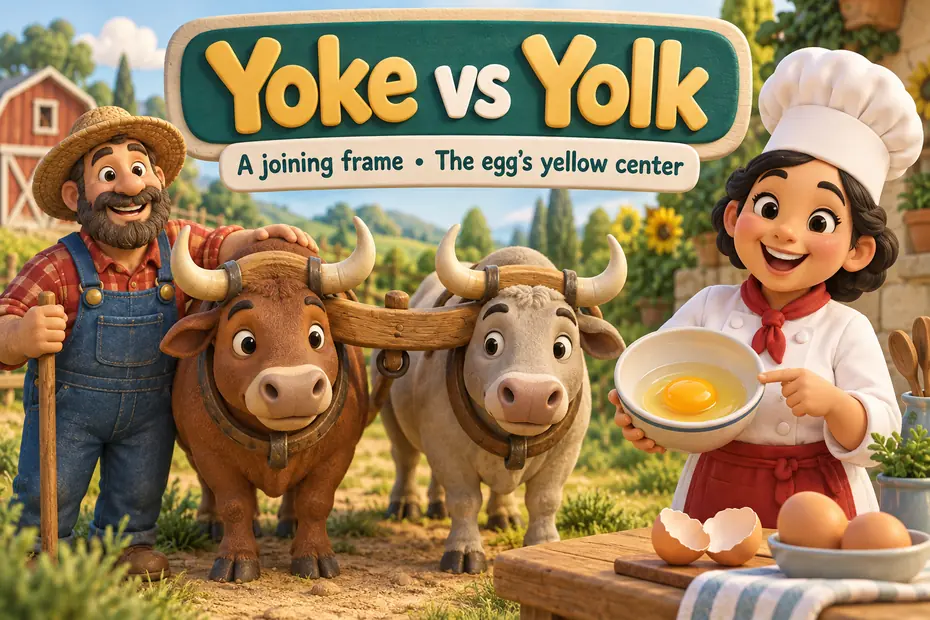
Yoke vs. yolk: the quick answer
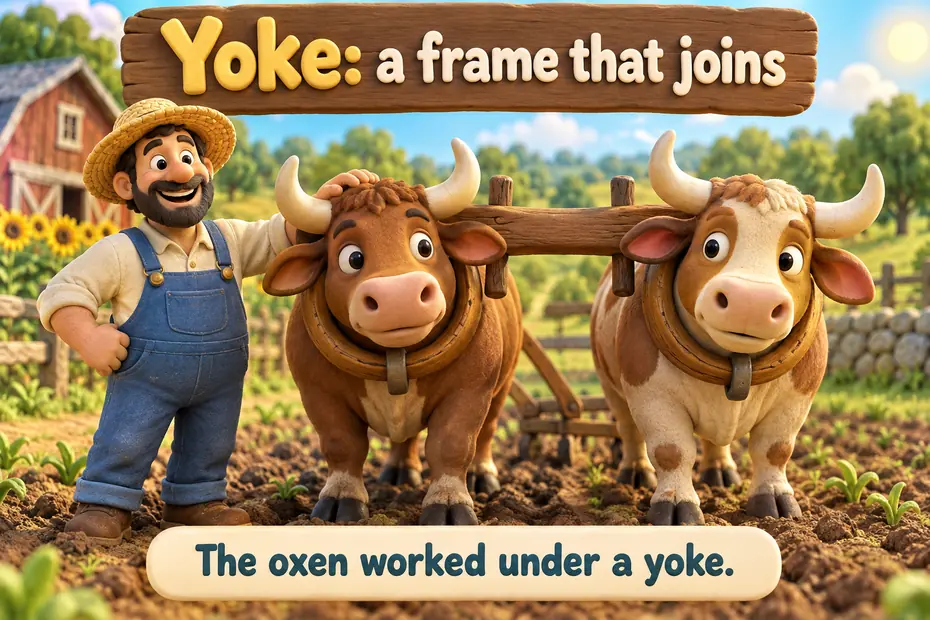
Use yoke for a joining frame, a related device, or a figurative burden. Use yolk as the usual spelling for the yellow inner part of an egg. “The oxen worked under a yoke” describes equipment. “The recipe calls for two yolks” describes egg ingredients. The words often sound alike, so choose the spelling by meaning.
Yoke also works as a verb meaning to join or link: “The farmer yoked the oxen together.” Its uses extend beyond farming to clothing and other equipment. A spelling guide should therefore do more than picture a wooden bar and an egg: it should help you recognize the word in different contexts.
Key facts and a comparison table
| Word | Meaning or use | Example |
|---|---|---|
| yoke | A frame joining draft animals | The farmer checked the yoke. |
| yoke | A figurative burden or constraint | They struggled under the yoke of oppression. |
| yoke | A verb meaning join or link | The task yoked the two teams together. |
| yolk | The inner food-storing part of an egg | The yolk remained in the bowl. |
| yolks | More than one yolk | The custard recipe listed three yolks. |
Merriam-Webster’s yoke entry includes noun and verb meanings. Its yolk entry identifies the egg sense. These entries support the usual writing distinction while also recording less common uses that may appear in older or specialized texts.
Yoke: joining equipment and figurative constraints
A familiar farm yoke joins animals so they can work together. In a historical description, “The oxen pulled the wagon under a yoke” gives readers an image of linked draft animals. A yoke can also name a carrying frame fitted across a person’s shoulders. Both uses involve equipment that supports or connects a load.
The figurative word can suggest an oppressive burden, restraint, or binding connection. “The yoke of oppression” emphasizes constraint rather than ordinary companionship. If you write “The two projects were yoked together,” the metaphor suggests a link that makes them function as a pair. Explain the relationship if the metaphor leaves readers uncertain.
Context matters for tone. Calling a responsibility a yoke may make it sound heavy or restrictive. If you only mean “shared responsibility,” those plain words may fit better. Choose the metaphor because it captures your meaning, rather than because it sounds more dramatic.
Yolk: the egg word in recipes and biology
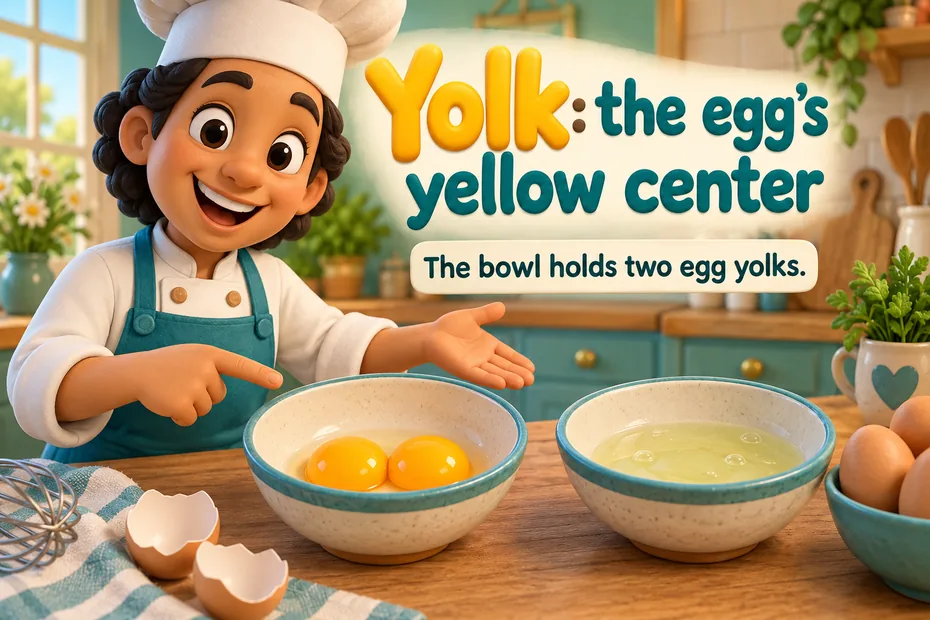
In a chicken egg, the yolk is the rounded yellow-to-orange inner portion surrounded by egg white. A recipe may ask you to separate the yolk from the white, keep the yolks, or use a whole egg. Those instructions describe different ingredients, so the word matters: two yolks is not the same quantity or ingredient as two whole eggs.
In biological descriptions, yolk provides stored food for a developing embryo. The word therefore belongs in more than kitchen writing. “The diagram labels the yolk” can be a straightforward sentence in a lesson about eggs. Collins’ yolk entry gives the familiar egg definition and further context.
Do not confuse the name of an egg part with a guarantee about nutrition. A yolk’s appearance does not by itself establish every nutrient amount. The FAO chapter on egg quality discusses yolk appearance as a quality characteristic; actual composition needs a separate data source and a specified food preparation.

Checking the earlier nutrition figures
The earlier general statement that a chicken yolk contains 33% water and 51% fat should not be used as a universal composition rule. Food-composition values depend on the item being measured and its preparation. For example, the FAO Pacific Islands food-composition table lists hard-boiled chicken yolk per 100 grams with 50 grams of water, 16.1 grams of protein, and 31.7 grams of total fat.
Those figures describe that table’s hard-boiled item; they are not a prescription for an individual diet or an assertion that every raw yolk has exactly the same composition. For this vocabulary choice, the useful rule remains simple: write yolk when naming the egg part. Use a properly identified nutrition reference when numerical composition matters.
Grammar, plurals, and other yoke meanings
The ordinary plural of the equipment noun is yokes; the egg plural is yolks. Write “two wooden yokes” and “two egg yolks.” A possessive needs an apostrophe: “the yolk’s color” refers to the color of one yolk, while “the yolks’ color” refers to several. Ordinary plurals need no apostrophe.
The verb forms are yoke, yokes, yoked, and yoking. Drop the final e before ing. “They yoked the animals together” describes an action; “The yokes lay in the shed” uses a plural noun. The same spelling can serve different grammatical roles.
Collins’ yoke entry also records other contexts. A clothing yoke is a fitted or shaped section of a garment, often near the shoulders. An aircraft yoke is a control device. Neither refers to egg yolk, even though the word may be unfamiliar outside farming.
Frequently asked questions and practice
Which spelling belongs in “Separate the ___ from the white”?
Use yolk for the normal recipe wording. The sentence names the egg’s inner portion.
Which spelling belongs in “The shirt has a patterned ___”?
Use yoke if you mean the shaped garment section. Check the clothing context rather than assuming every yoke joins animals.
Is yoke ever recorded as an egg spelling?
Yes. Merriam-Webster records a less common yoke spelling for yolk. That historical or uncommon overlap is a reason to avoid claiming the spelling never exists. For clear modern recipe writing, choose the usual yolk.
What is the easiest memory aid?
Connect yoke with joining and yolk with the egg. Then check the full context, especially for clothing, aircraft, or older wording. Meaning gives you a more reliable test than pronunciation alone.
Have you ever found yourself confused between the words “yoke” and “yolk”? Don’t worry, you’re not alone. These two words may sound similar, but they have completely different meanings. In this text, I’ll guide you through the proper usage of “yoke” and “yolk” so that you never mix them up again.
Firstly, let’s talk about “yoke.” It refers to a wooden beam used to join two animals, usually oxen, together for pulling a load. But, “yoke” can also be used metaphorically to describe something that binds or connects people or things. On the other hand, “yolk” is the yellow part of an egg. It contains the nutrients necessary for the development of the embryo.
By understanding the distinctions between “yoke” and “yolk,” you’ll be able to use these words confidently and accurately. So, let’s immerse and explore the nuances of these commonly confused terms.
Key Takeaways
- “Yoke” refers to a wooden beam used to join two animals together for pulling a load, while “yolk” refers to the yellow part of an egg.
- “Yoke” can also be used metaphorically to describe a burden or constraint.
- Understanding the distinction between “yoke” and “yolk” is essential for precise and accurate communication in English.
- The correct usage of “yoke” includes describing a physical object or metaphorical burdens, while “yolk” refers to the inner part of an egg used in cooking or baking.
- Using “yoke” correctly in context allows for clear and effective communication, whether referring to joining animals or metaphorical burdens.
- The yolk of an egg is a nutrient-rich part that plays a vital role in embryonic development and offers culinary possibilities. Correct usage enhances communication and vocabulary skills.
What is a yoke?
Let’s investigate into the world of “yoke” and unravel its meaning. To effectively distinguish between “yoke” and “yolk,” it’s crucial to have a clear understanding of what each word represents.
Definition of a Yoke
A yoke is not just a random word that pops up in everyday conversations. In fact, it has a specific meaning. A yoke refers to a wooden beam that is used to join animals together for pulling a load. This load can range from plows in agriculture to carts and wagons for transportation.
Understanding the difference between yoke and yolk is essential for precise and accurate communication in English. By familiarizing ourselves with the true meaning of each word, we can avoid any confusion or misinterpretation.
One key point to remember is that a yoke is not only utilized in farming or agricultural contexts. It can also be metaphorically used to describe a burden or a constraint. For instance, one might say, “I felt a heavy yoke of responsibility on my shoulders.”
Now that we have established a clear definition of yoke, we can confidently move forward and explore the distinct meaning of yolk in the next section.
No conclusion paragraph or sentence to follow.
Different meanings of yoke
One of the most frequent confusions that students encounter when it comes to English words is distinguishing between “yoke” and “yolk.” It’s important to understand the difference between these two words to avoid making common mistakes in communication.
Let’s start by defining the word “yoke.” In its most literal sense, a yoke is a wooden beam used to join animals together for pulling a load. This is a common image in farming, where a yoke was traditionally used to harness oxen or horses together, enabling them to work as a team. But, the usage of “yoke” extends beyond its literal meaning. It can also be used metaphorically to describe a burden or constraint that someone carries, whether it’s a duty, obligation, or restriction.
On the other hand, “yolk” refers specifically to the yellow, inner part of an egg. It is rich in nutrients and acts as nourishment for the developing embryo. The yolk is protected by the eggshell and serves as a vital component in cooking and baking.
To summarize, the difference between “yoke” and “yolk” lies in their meanings and usage:
- “Yoke” is a noun referring to a wooden beam used to join animals together for pulling a load, or metaphorically, a burden or constraint.
- “Yolk” is a noun referring to the yellow, inner part of an egg, which is rich in nutrients and used in cooking or baking.
Understanding the distinction between these two words will ensure that you can use them appropriately and confidently in your writing and conversations. It’s always important to be mindful of the context and meanings of words to convey your message accurately. So remember, it’s “yoke” when you’re talking about joining animals or metaphorical burdens, and “yolk” when you’re referring to the inner part of an egg.
Next, let’s move on to exploring some examples to solidify our understanding of these two words.
Examples of using yoke correctly
When it comes to using the word “yoke” correctly, context is key. Let me provide you with a couple of examples to help solidify your understanding:
- “The farmer attached a sturdy yoke to the oxen.” In this sentence, “yoke” is used in its literal sense, referring to the wooden beam that joins animals, such as oxen, together to pull a load. By using “yoke” in this context, you’re effectively conveying the image of a farmer harnessing the power of the oxen to work together and accomplish a task.
- “The weight of their expectations was a heavy yoke on my shoulders.” This sentence presents a metaphorical usage of the word “yoke.” Here, “yoke” is used to describe a burden or constraint, emphasizing the idea of being weighed down by the expectations of others. By using “yoke” in this way, you can convey the feeling of being overwhelmed by responsibilities or pressures.
Understanding the correct usage of “yoke” allows you to communicate more precisely and effectively. Whether using it literally to describe a physical object or metaphorically to convey a burden, bringing clarity to your writing or conversation.
What is a yolk?
Let’s jump into what exactly a yolk is when it comes to the world of eggs. The yolk, in simple terms, is the yellow, oval-shaped part of the egg. It is surrounded by the egg white, also known as the albumen.
Let’s dig a little deeper into the specifics of the yolk. The yolk is part of the reproductive system of the egg-laying species, including birds, reptiles, and fish. It serves as the nutrient-rich food source for the developing embryo. This means that the yolk contains essential proteins, fats, vitamins, and minerals necessary for the growth and nourishment of the developing organism.
The composition of the yolk can vary depending on the species. In chicken eggs, for example, the yolk contains about 33% water, 16% protein, and 51% fat. It is also a significant source of cholesterol and various vitamins, such as vitamins A, D, E, and B12.
The yolk’s color can vary as well, ranging from pale yellow to deep orange. The color is influenced by the diet of the laying hen, with a diet rich in certain pigments like xanthophylls resulting in a darker yolk color.
In cooking, the yolk is often separated from the egg white and used in various dishes. It is valued for its rich, creamy texture and adds richness and flavor to recipes like custards, sauces, and baked goods. Also, the yolk is used as a binding agent in recipes like meatballs and meatloaf.
Now that we have a better understanding of what a yolk is, let’s move on to exploring the difference between “yolk” and “yoke” in the next section.
Different meanings of yolk
When it comes to the words “yoke” and “yolk,” there is often confusion about their meanings and usage. So, let’s investigate into the different meanings of “yolk” to gain a better understanding.
The Definition of Yolk
In the context of eggs, the yolk refers to the yellow, oval-shaped part of the egg. It serves as a nutrient-rich food source for the developing embryo.
Composition and Color Variations
The composition and color of the yolk can vary depending on the species of the laying hen and its diet. Factors such as the hen’s nutrition and access to certain foods can influence the color and richness of the yolk. For example, a hen that consumes a diet rich in pigments like marigold petals or corn will produce a yolk with a vibrant and deep yellow color.
Culinary Use of Yolk
In cooking, the yolk is often separated from the egg white and used in various dishes due to its rich, creamy texture and flavor. It adds moisture, richness, and acts as an emulsifier in recipes like custards, mayonnaise, and pasta sauces.
Importance of Using “Yolk” Correctly
Understanding the correct usage of “yolk” is essential for clear and effective communication. Using the word appropriately allows you to convey information about the nutritional value, composition, and culinary applications of the yolk accurately.
To summarize, the yolk of an egg is the nutrient-rich, yellow part that plays a vital role in embryonic development and offers a myriad of culinary possibilities. By understanding its definition and significance, you can enhance your communication and vocabulary skills.
Remember, the key to mastering the English language lies in recognizing the subtle differences between words like “yolk” and “yoke.” Let’s explore the distinctions in the next section.
Examples of using yolk correctly
As promised, in this section, I’ll provide you with some examples of using the word “yolk” correctly in various contexts. Understanding how to use “yolk” accurately will not only improve your vocabulary but also help you communicate more effectively.
- In Culinary Applications:
- When making a classic Caesar salad dressing, I always add a raw egg yolk for that extra creaminess and richness.
- To prepare a fluffy and delicious omelet, separate the egg white from the yolk and beat them separately before combining them.
- In Nutritional Information:
- The yolk of an egg is an excellent source of essential nutrients such as vitamin B12, vitamin D, and omega-3 fatty acids.
- When choosing eggs at the grocery store, look for yolks that are bright yellow or orange, as they indicate a higher nutritional value.
- In Anatomy and Biology:
- The yolk of a bird’s egg serves as a vital source of nutrition for the developing embryo.
- The size and color of the yolk can vary among different bird species, depending on their diet and genetics.
Remember, using “yolk” correctly is crucial to convey accurate information about the culinary, nutritional, and biological aspects of eggs. By incorporating these examples into your vocabulary, you’ll be able to express yourself more precisely and confidently.
Next, I’ll investigate into some common mistakes people make when using the words “yolk” and “yoke,” and provide tips on how to avoid confusion. So, let’s keep going and solidify our understanding of these words.
Understanding the distinctions
When it comes to the words “yoke” and “yolk,” it’s important to understand the distinctions between them. The two words may sound similar, but they have completely different meanings and usage in the English language.
Let’s start by defining each word. The definition of “yoke” refers to a wooden or metal frame that is used to join together a pair of animals, usually oxen, for pulling loads. It can also be used metaphorically to describe any kind of burden or oppression.
On the other hand, the definition of “yolk” refers to the yellow, nutrient-rich part of an egg. It’s the part that contains essential vitamins, minerals, and fats. The yolk is usually separated from the egg white and used in various culinary applications.
Now that we’ve established the differences in definition, it’s important to understand how these words are used in different contexts. Let’s take a closer look at some examples to illustrate their proper usage:
- Culinary applications: When cooking, it’s crucial to use the word “yolk” correctly. For example, if a recipe calls for separating the yolk from the egg white, it means you need to separate the yellow part from the clear part of the egg. Using “yoke” instead would not only be grammatically incorrect, but it would also cause confusion in the kitchen.
- Nutritional information: When discussing the nutritional value of eggs, it’s essential to refer to the yolk accurately. The yolk is rich in essential nutrients like vitamins A, D, E, and K, as well as omega-3 fatty acids. Incorrectly using “yoke” in this context could lead to misinformation about the nutritional content of eggs.
It’s worth noting that confusion between “yoke” and “yolk” is a common mistake, even among native English speakers. Understanding the distinctions helps to avoid these errors and ensures accurate communication.
Conclusion
Understanding the difference between “yoke” and “yolk” is essential for accurate communication. The correct usage of “yolk” in culinary applications and discussions about nutritional value is crucial to convey accurate information. By using “yolk” appropriately, we can ensure that we are providing accurate details about eggs and their culinary and nutritional benefits.
It is important to note that confusion between “yoke” and “yolk” is a common mistake, even among native English speakers. But, by understanding the distinctions between these two words, we can avoid making these errors and communicate effectively.
So, next time you are discussing eggs or cooking, remember to use “yolk” when referring to the yellow part of the egg and “yoke” when talking about a wooden beam used to harness animals. This small distinction can make a big difference in conveying accurate information and enhancing your communication skills.
Keep practicing and pay attention to the correct usage of “yolk” to become a master at using these words appropriately. Happy writing!
Frequently Asked Questions
Q: What is the article about?
A: The article discusses the difference between the words “yoke” and “yolk” and provides examples of using “yolk” correctly in culinary applications.
Q: Why is it important to use “yolk” accurately?
A: Using “yolk” accurately helps to convey accurate information about eggs and their culinary and nutritional value.
Q: Is confusion between “yoke” and “yolk” common?
A: Yes, confusion between “yoke” and “yolk” is a common mistake, even among native English speakers.
Q: How does understanding the distinctions help?
A: Understanding the distinctions between “yoke” and “yolk” helps to avoid errors and ensures accurate communication.


