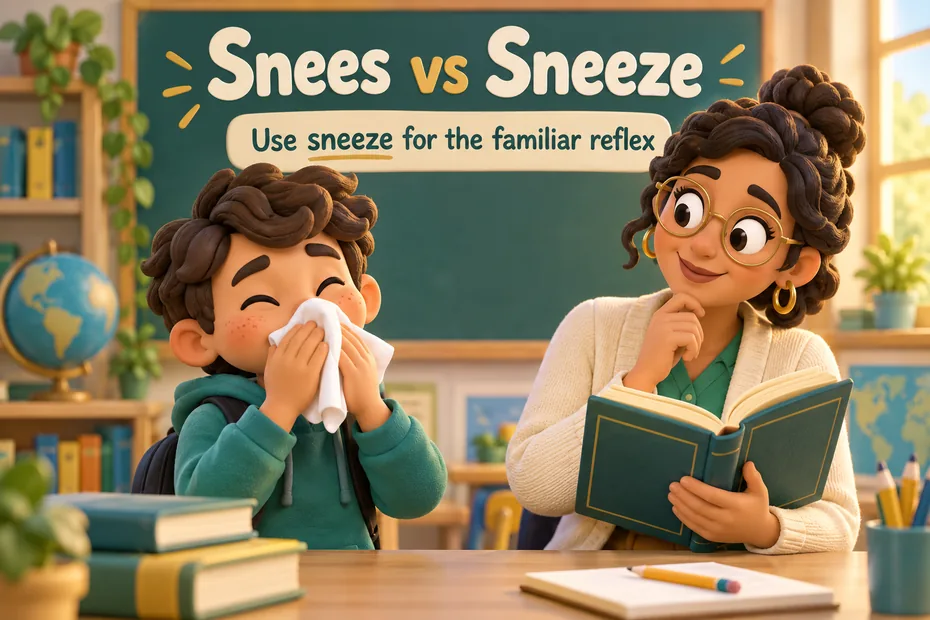
Snees vs. sneeze: the quick answer
Use sneeze for the familiar reflex involving a sudden expulsion of breath through the nose and mouth. The correct forms are sneeze, sneezes, sneezed, and sneezing. “I sneeze,” “She sneezes,” and “He sneezed yesterday” are ordinary modern English examples. If you mean this action, snees is the wrong spelling.
However, saying that snees can never be a word goes too far. Collins records the obsolete verb snee, meaning to cut or thrust with a knife, particularly in fighting. Its conjugation table lists snees for he, she, or it in the present tense. This historical form is separate from the everyday word sneeze. You do not need it to describe someone sneezing.

Key facts and a comparison table
| Form | Use | Example or guidance |
|---|---|---|
| sneeze | Base verb; also a singular noun | I sneeze. That was a sneeze. |
| sneezes | Third-person present verb; plural noun | She sneezes. Two sneezes interrupted us. |
| sneezed | Past tense and past participle | He sneezed. He has sneezed. |
| sneezing | Present participle or action noun | They are sneezing. |
| snees | A recorded form of obsolete snee | Check historical context; do not use for the reflex. |
Merriam-Webster’s sneeze entry identifies both the verb and the noun. Collins’ sneeze entry gives the modern forms together. These sources support a precise rule: snees is not the normal spelling of the breathing reflex, even though it has a separate historical explanation.
Sneeze as a verb and a noun
As a verb, sneeze tells you what someone does: “I sneeze when the dust rises.” As a noun, it names an instance of that action: “A sneeze interrupted the reading.” The word’s spelling stays the same in these two uses, while the sentence structure tells you its job.
Compare “The child began to sneeze” with “The child gave a loud sneeze.” After to in the first sentence, sneeze is the base verb. After a loud in the second sentence, it is a noun. Learning both uses helps you avoid the mistaken idea that the word only works as a verb.
The plural noun is sneezes: “Several sneezes broke the silence.” It is spelled exactly like the third-person present verb in “She sneezes.” These are different grammatical roles, not different meanings that require different spellings. Read the whole sentence to identify which role is present.
Choosing the correct verb form
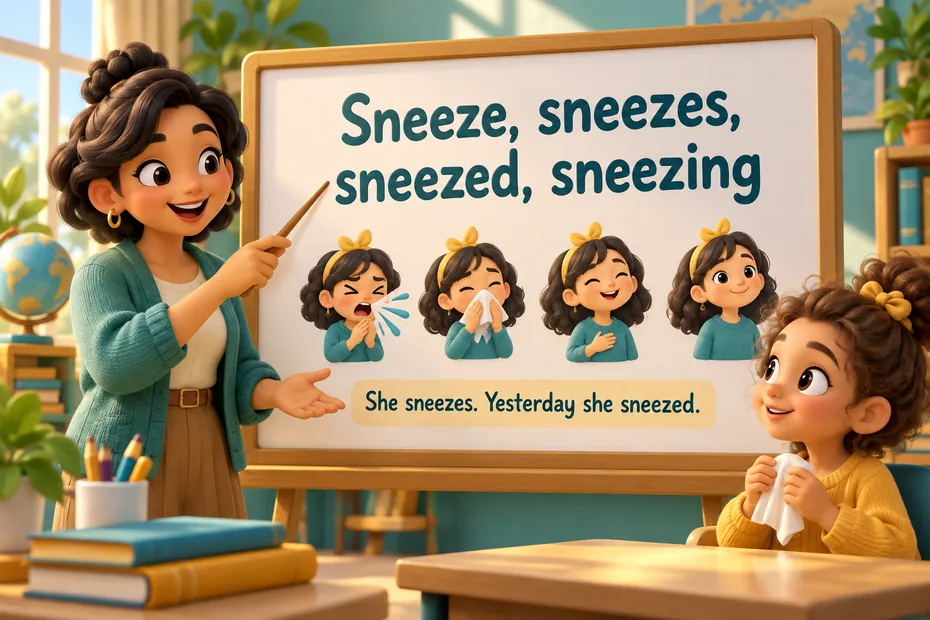
Use sneeze with I, you, we, and they in the simple present: “They sneeze.” With a singular he, she, or it, use sneezes: “He sneezes.” For a completed past action, use sneezed: “They sneezed during the story.” For an ongoing action, combine the appropriate form of be with sneezing: “She is sneezing.”
When adding ing, drop the final e: sneeze becomes sneezing. The past form adds d to the base spelling: sneezed. Keep the z. The correct spelling is not sneesing or sneesed when you mean the familiar reflex.
- Incorrect: “She snees every morning.” Correct: “She sneezes every morning.”
- Incorrect: “Yesterday I sneeze.” Correct: “Yesterday I sneezed.”
- Incorrect: “He did sneezed.” Correct: “He did sneeze.”
- Incorrect: “They are sneeze.” Correct: “They are sneezing.”
After did, use the base form, as in the third example. The auxiliary already marks the past. Similarly, “She can sneeze” uses the base form after can. Small grammar checks can resolve errors that spelling checks alone miss.

What to do when you find snees in a source
First identify the context. In a contemporary sentence about a person’s nose or a sudden noisy breath, the likely intended word is sneeze or sneezes. In a discussion of older language, an exact quotation, or an obsolete verb, investigate before changing it. Collins’ historical entry gives a reason to avoid declaring every occurrence meaningless.
Preserve exact wording when quoting a historical source, and explain an unfamiliar term if readers need help. In your own modern prose, prefer current vocabulary that communicates directly. You do not need to revive an obsolete verb just because a dictionary records it. A dictionary label such as obsolete matters as much as the definition.
The phrase nothing to sneeze at
“That achievement is nothing to sneeze at” means it deserves attention or should not be dismissed. It does not describe a literal sneeze. Merriam-Webster’s sneeze at entry explains this informal expression. For example, “Finishing the whole course is nothing to sneeze at” recognizes that finishing is significant.
Keep the standard spelling in the phrase, including sneezed in “not to be sneezed at.” If your audience may not know the idiom, write “That achievement deserves respect” instead. The best wording is the one that communicates your intended meaning clearly.
Frequently asked questions
Is snees the plural of sneeze?
No. The ordinary plural noun is sneezes. Write “three sneezes,” with z and the ending es.
Should I always replace snees with sneeze?
For modern writing about the reflex, correct the spelling and choose the proper grammatical form. For a historical quotation or specialized discussion, check the source first. The form might refer to obsolete snee, rather than a misspelled reflex.
What is the easiest memory check?
Keep the z in sneeze and its related modern forms. Then check the subject and tense: “I sneeze,” “she sneezes,” “we sneezed,” and “they are sneezing.”
Key Takeaways
- ‘Snees’ is not a valid word in the English language and should be avoided in formal and informal writing.
- ‘Sneeze’ is a well-known verb that describes the involuntary action of expelling air through the nose and mouth.
- The key difference between ‘snees’ and ‘sneeze’ lies in their legitimacy and usage.
- Understanding the correct usage of ‘sneeze’ is essential for effective communication.
- Always use ‘sneeze’ when referring to the act of involuntary air expulsion through the nose and mouth.
- Using the correct term, ‘sneeze’, ensures clear and accurate communication and avoids confusion or misunderstanding.
The Difference Between ‘snees’ and ‘sneeze’
When it comes to understanding and using commonly confused words in English, it’s important to grasp the difference between ‘snees’ and ‘sneeze’. These words might sound similar, but they have distinct meanings and usage. In this section, I’ll break down the definitions of both words and highlight their distinguishing features.
Definition of ‘snees’:
Let’s start with ‘snees’. The word ‘snees’ is not a commonly used term in the English language. In fact, it is not a recognized word at all. It might be a typographical error or a misspelling of ‘sneeze’. Hence, it’s crucial to remember, ‘snees’ is not a valid word and should be avoided in formal and informal writing.
Definition of ‘sneeze’:
On the other hand, ‘sneeze’ is a well-known verb that describes the involuntary action of expelling air through the nose and mouth due to an irritation or stimulation in the nasal passages. It is a natural reflex that helps clear the nasal passages and protect the respiratory system. Whether triggered by allergies, a cold, or dust particles, ‘sneezing’ is a common occurrence for everyone.
The Key Difference:
The key difference between ‘snees’ and ‘sneeze’ lies in their legitimacy and usage. While ‘sneeze’ is a legitimate verb with a clear definition and widely recognized usage, ‘snees’ does not exist as a valid word in English. Hence, it’s important to use ‘sneeze’ when referring to the act of involuntary air expulsion through the nose and mouth.
- When I have a cold, I tend to sneeze a lot.
- It’s polite to cover your mouth when you sneeze.
- I can’t help but sneeze whenever I’m around cats.
Remember, understanding the difference between ‘snees’ and ‘sneeze’ is essential for effective communication. By using the correct term, you can convey your ideas clearly and accurately while avoiding any confusion or misunderstanding.
Now that we’ve clarified the distinction between these two words, let’s move on to explore more commonly confused words in the following sections.
When to Use ‘snees’
There seems to be some confusion surrounding the word “snees”, so let’s dive right in and clarify its usage.
First things first, it’s important to note that “snees” is not a valid word in the English language. It doesn’t exist in any reputable dictionaries and is not recognized by linguistic experts. Hence, it should be avoided in formal writing or any context where accuracy is important.
The confusion might stem from the similarity between “snees” and the word “sneeze”. While they sound alike, they have completely different meanings and functions.
The word “sneeze” is a well-known verb that describes the involuntary action of expelling air through the nose and mouth. It typically occurs in response to irritation or stimulation of the nasal passages. It’s a natural bodily function that helps clear the airways.
On the other hand, “snees” has no recognized definition or purpose. It’s just a misspelling or an invented word that may appear in casual conversations or informal writing. But, using it in official or academic contexts would be incorrect and could lead to confusion or misunderstanding.
To sum it up, “snees” is not a valid word you should incorporate into your vocabulary. Stick to “sneeze” when referring to the involuntary action of expelling air through the nose and mouth.
Remember, using the correct term is crucial for clear and accurate communication. In the next sections, we’ll continue exploring more commonly confused and misused words to further enhance your understanding and usage of English.
So now that we’ve clarified the usage of “snees”, let’s move on and explore another set of commonly confused words.
When to Use ‘sneeze’
When it comes to understanding the proper usage of words, it’s important to distinguish between similar-sounding terms with different meanings. In this section, I’ll be focusing on the word ‘sneeze’ and its appropriate usage. Let’s immerse!
Definition of ‘Sneeze’
First and foremost, let’s clarify the definition of ‘sneeze.’ It is a well-known verb that describes the involuntary action of expelling air through the nose and mouth. This reflexive action is often triggered by irritation in the nasal passages, resulting in a sudden and forceful expulsion of air. We’ve all experienced this sensation at some point, whether due to allergies, colds, or other factors.
Differentiating ‘Sneeze’ from ‘Snees’
You might wonder how ‘sneeze’ differs from ‘snees.’ It’s important to note that ‘snees’ is not a valid word in the English language. While the two words may sound similar, ‘snees’ has no recognized definition or purpose. It’s crucial to use the correct term, ‘sneeze,’ for clear and accurate communication.
Usage of ‘Sneeze’
Now that we understand the definition of ‘sneeze’ and the non-existence of ‘snees,’ let’s discuss when to use this word in context. ‘Sneeze’ is primarily used to describe the physical act of expelling air through the nose and mouth. Here are a few examples to illustrate its usage:
- “I couldn’t control my sneeze during the movie, and everyone turned to look at me.”
- “Please cover your mouth and nose when you sneeze to prevent the spread of germs.”
As you can see, ‘sneeze’ is used to describe the specific action of expelling air during a reflexive response to irritation. It’s an essential term to accurately convey this bodily function.
Summarizing, ‘sneeze’ is the correct word to use when referring to the action of expelling air through the nose and mouth. Remember, ‘snees’ isn’t a valid word and should be avoided in formal writing or any context where accuracy is important.
Common Mistakes and Confusions
When it comes to language, it’s easy to get caught up in the nuances and make mistakes. Here are some common mistakes and confusions that arise when it comes to the words ‘snees’ and ‘sneeze’:
- Difference between ‘snees’ and ‘sneeze’: One of the most common mistakes is thinking that ‘snees’ is a valid word. But, this is not the case. ‘Snees’ does not exist in the English language and should be avoided in formal writing or any context where accuracy is important. On the other hand, ‘sneeze’ is a well-known and widely accepted verb that describes the involuntary action of expelling air through the nose and mouth.
- Definition of ‘sneeze’: To further clarify, ‘sneeze’ is a natural bodily reflex that occurs when irritants, such as dust or allergens, stimulate the nerves in our nasal passages. This reflex causes a sudden and forceful expulsion of air through the nose and mouth, often accompanied by a distinctive sound.
- Using the correct term: It is important to use the correct term, ‘sneeze’, for clear and accurate communication. Using ‘snees’ instead can lead to confusion and misunderstandings. Whether you are writing an academic paper, a professional email, or engaging in everyday conversation, using the correct term will ensure that your message is clear and understood by others.
By understanding the difference and using the correct term, ‘sneeze’, we can avoid common mistakes and confusions that may arise. Remember, accuracy and clarity are key in effective communication.
Don’t stop here! In the following sections, we will explore more commonly confused words, providing you with the knowledge and tools to use them appropriately. Stay tuned for more insights and tips to enhance your language skills.
Conclusion
Using the correct words is crucial for effective communication. In this text, we discussed the difference between ‘snees’ and ‘sneeze’ and highlighted the importance of using the appropriate term. It’s important to note that ‘snees’ is not a valid word in the English language and should be avoided in formal writing or any context where accuracy is key.
We delved into the definition of ‘sneeze’, a well-known verb that describes the involuntary action of expelling air through the nose and mouth. This natural bodily reflex occurs when irritants stimulate the nerves in our nasal passages. By understanding the true meaning of ‘sneeze’, we can ensure clarity and accuracy in our communication.
As we conclude this discussion, it’s worth mentioning that this article is just the beginning. In the following sections, we will explore more commonly confused words, providing you with the knowledge you need to communicate effectively and confidently. Stay tuned for more insights on language usage!
Frequently Asked Questions
Q: What is the difference between ‘snees’ and ‘sneeze’?
A: ‘Snees’ is not a valid word in English. It should be avoided in formal writing or contexts where accuracy is important. ‘Sneeze’, on the other hand, is a well-known verb that describes the involuntary action of expelling air through the nose and mouth.
Q: What triggers a sneeze?
A: A sneeze is a natural bodily reflex that occurs when irritants stimulate the nerves in our nasal passages. It is the body’s way of clearing the nasal airway.
Q: Can you provide a more detailed explanation of ‘sneeze’?
A: ‘Sneeze’ is a well-known verb that describes the involuntary action of expelling air through the nose and mouth due to irritation in the nasal passages. It is a common response to irritants like dust, pollen, or certain substances.
Q: Should I use the word ‘snees’ in my writing?
A: No, ‘snees’ is not a valid word in English. It should be avoided in formal writing or any context where accuracy is important. Stick with the correct term ‘sneeze’ for clear and accurate communication.
Q: Will the article address more commonly confused words?
A: Yes, the article will explore more commonly confused words in the following sections. Stay tuned for further clarification on other confusing terms.


