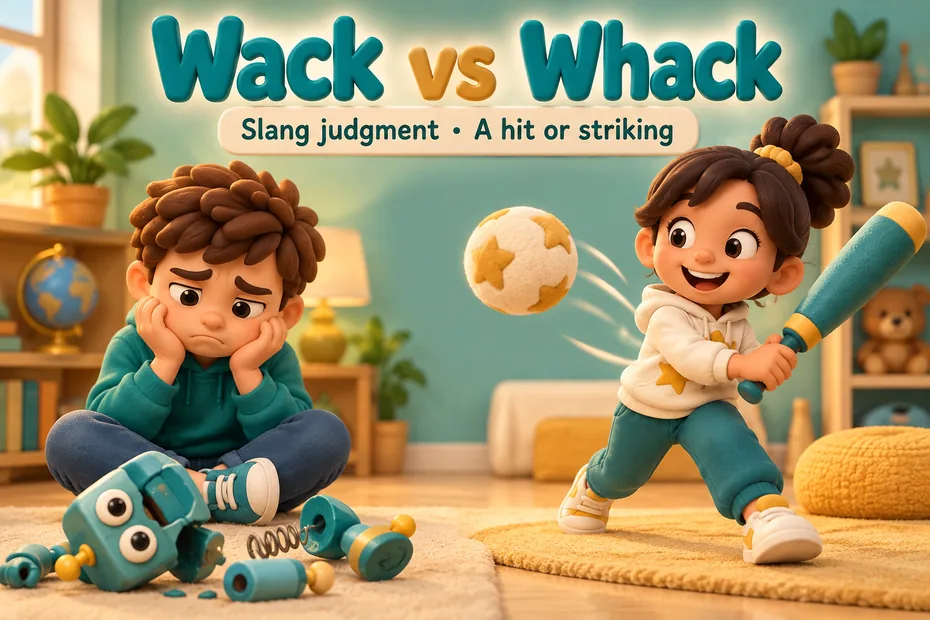
Wack vs. whack: the quick answer
Use wack as informal slang for something poor, disappointing, or unappealing. Use whack for a hit or the action of striking. “That game is wack” expresses a judgment; “She gave the ball a whack” describes an action. The spelling difference is the letter h: wack has no h, while whack has one. Context usually makes the intended meaning clearer than pronunciation alone.
For the most straightforward writing, keep those two core meanings separate. Informal language varies, and speakers sometimes use whack in slang judgments too. That does not make the two words interchangeable in every sentence. If you are describing a blow, spelling the word wack can distract readers; if you are writing a formal evaluation, a specific description is often more useful than either slang spelling.

Key facts and a comparison table
| Word or phrase | Useful meaning | Example |
|---|---|---|
| wack | Informal adjective: poor or unappealing | The ending was wack. |
| whack | Verb: strike | Whack the soft ball with the paddle. |
| a whack | Noun: a blow | The branch gave the fence a whack. |
| take a whack at | Informal: attempt something | I will take a whack at the puzzle. |
| out of whack | Not in proper order or working properly | The printer settings are out of whack. |
These meanings are supported by Merriam-Webster’s entry for wack, its entry for whack, and its entry for out of whack. A dictionary entry describes established usage; the best choice in your own sentence still depends on meaning, audience, and tone.
How to use wack
Wack commonly works as an adjective in casual comments. “The sound quality is wack” says the speaker dislikes it, but leaves the exact problem unstated. Perhaps the audio crackles, the volume jumps, or the voices are muffled. When precision matters, name that problem: “The recording has loud background hiss.” This helps the listener understand what to fix.
In conversation with people who know the slang, a short judgment may be enough. In an assignment, customer complaint, or workplace report, words such as unreliable, disappointing, or poorly designed often communicate more directly. Choose the replacement that matches the actual criticism, rather than treating all negative adjectives as identical.
- Casual: “The new menu is wack.”
- More specific: “The new menu makes the vegetarian choices difficult to find.”
- Casual: “That explanation was wack.”
- More specific: “That explanation skipped the step we needed.”
How to use whack
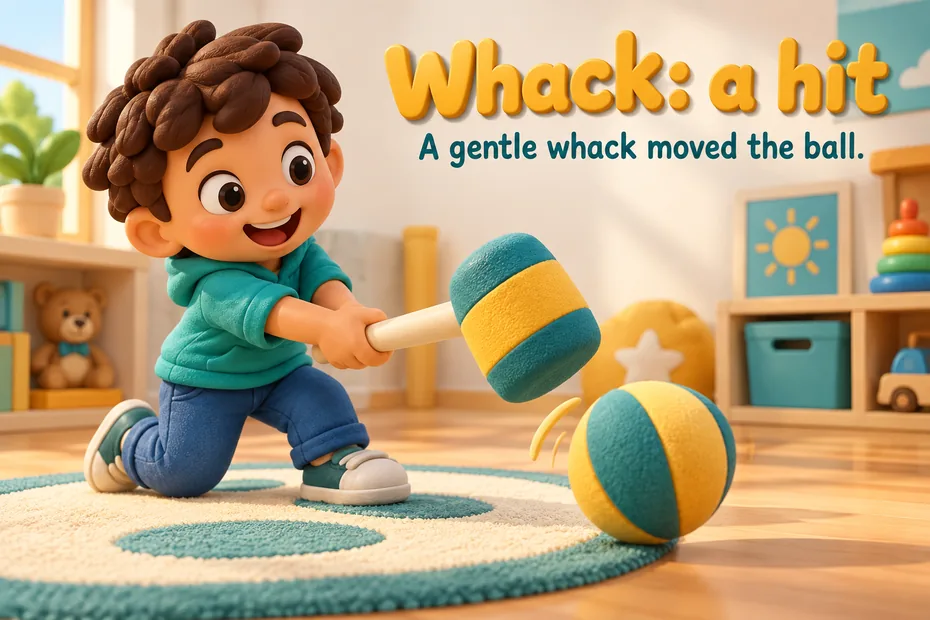
Whack can be a verb or a noun. As a verb, it describes striking: “The player whacked the ball.” As a noun, it describes the blow itself: “The ball hit the wall with a whack.” You can also describe the sound of a blow, depending on the sentence. The spelling remains whack in all these uses.
The ordinary verb forms are whacks, whacked, and whacking. “She whacks the ball” uses the present tense; “She whacked the ball” uses the past tense; “She is whacking the ball” describes an ongoing action. Notice the ck stays in place before the endings. You do not need to add another k.
Whack also has other informal senses. “Take a whack at this question” means make an attempt, not physically strike a question. Collins’ entry for whack includes additional meanings with regional or informal labels. Read the surrounding sentence before choosing a definition. A phrase used casually in one setting may sound unfamiliar or carry a different implication elsewhere.
Why out of whack keeps the h
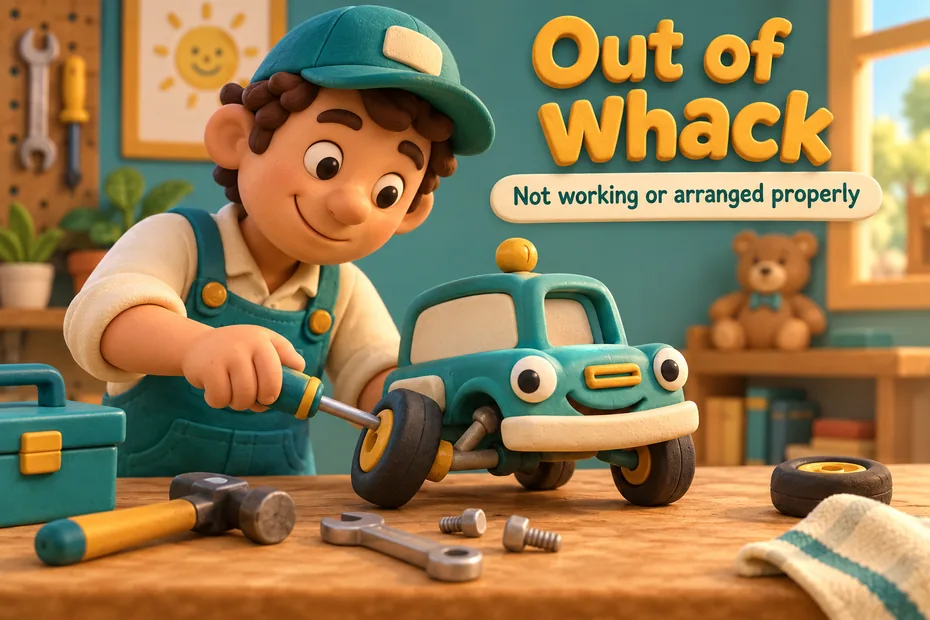
Out of whack is an established phrase for something that is out of proper order, shape, or alignment. A schedule can be out of whack after several delays; a wheel can be out of whack when it no longer turns smoothly. The phrase does not require an actual hit, and it does not simply mean that someone dislikes the object.
Compare “This chair is wack” with “This chair is out of whack.” The first is an informal negative judgment. The second suggests something is wrong with the chair’s condition or arrangement. For a useful maintenance report, go further: “The chair’s right front leg is loose.” Keep whack in the established expression even though the meaning has moved beyond a literal blow.
Common questions
Are wack and whack pronounced differently?
Many speakers pronounce them alike. Some varieties of English distinguish a breathier sound in words beginning with wh, but pronunciation is not a dependable universal spelling test. Use the meaning and the established phrase instead.
Does whack always mean doing something quickly?
No. A sentence or regional expression may suggest quick action, but the basic striking meaning does not guarantee speed, efficiency, or success. “I took a whack at the puzzle” says I attempted it; it does not tell you whether I solved it.
How can I check my sentence?
Ask whether you mean a casual judgment, a blow or striking action, an attempt, or a problem with order or functioning. Then check the grammar: wack can describe quality, while whack can name a blow or serve as a verb. If the slang sounds too vague for your audience, replace it with the exact criticism or action you intend.
Key Takeaways
- “Wack” is an adjective used to describe something as bad, of poor quality, or not up to standard.
- “Whack” can be used as both a noun and a verb, referring to a forceful blow or action.
- “Wack” is primarily used to describe something negative or undesirable, while “whack” is commonly associated with physical impact or action.
- “Wack” is spelled with a single “h” and pronounced as “wak,” while “whack” is spelled with a “wh” and pronounced as “hwak.”
- “Wack” signifies something of poor quality or unappealing, while “whack” denotes forceful and impactful actions or blows.
- The misuses of “wack” as a verb and misspelling “whack” as “wack” should be avoided. Additionally, “whack” should not be used as an adjective to describe something as bad or of poor quality.
Understanding the Difference between “Wack” and “Whack”
As an expert in the English language, it’s crucial to understand the distinction between similar words that often cause confusion. In this section, I’ll guide you through the difference between two commonly misused words: “wack” and “whack.”
Definition of “Wack”:
Firstly, let’s talk about “wack.” This word is an adjective derived from African-American slang. It is used to describe something as bad, of poor quality, or not up to standard. For example, you might say, “That movie was wack,” indicating that the movie was not enjoyable or well-made.
Definition of “Whack”:
On the other hand, “whack” is a versatile word that can be used as both a noun and a verb. As a noun, it refers to a hard or forceful blow. For example, you could say, “He gave the piñata a whack,” indicating a strong hit. As a verb, it means to strike or hit something forcefully. For instance, you could say, “I whacked the ball out of the park during the baseball game.”
Now that we’ve established the definitions, let’s explore the differences between “wack” and “whack.”
- Usage and Context:
- “Wack” is primarily used as an adjective to describe something negative or undesirable.
- “Whack” can be used as both a noun and a verb and is commonly associated with physical impact or action.
- Spelling and Pronunciation:
- The word “wack” is spelled with a single “h” and pronounced as “wak.”
- “Whack” is spelled with a “wh” and pronounced as “hwak.”
- Meaning:
- “Wack” signifies something of poor quality or unappealing.
- “Whack” denotes forceful and impactful actions or blows.
To help solidify your understanding, here are a few examples of the correct usage of these words:
- The movie I saw last night was wack. The plot was confusing, and the acting was terrible.
- She gave the punching bag a powerful whack with her fist, releasing all her frustration.
Common Misuses and Incorrect Usage
Let’s dive deeper into the common misuses and incorrect usage of “wack” and “whack.” Understanding their proper usage is crucial for effective communication.
Misuse of “Wack” as a Verb
One common mistake is using “wack” as a verb, which is incorrect. Remember, “wack” is an adjective used to describe something as bad or of poor quality. It should not be used as a verb. Here’s an example:
Wrong: “I wacked the ball out of the park.”
Correct: “I hit the ball out of the park.”
Incorrect Spelling: “Whack”
Another confusion arises when people misspell “whack” as “wack.” The correct spelling is “whack” with an “h.” This is a crucial distinction to remember to ensure accurate written communication.
Misusing “Whack” as an Adjective
While “whack” is primarily used as a noun or a verb, some may incorrectly use it as an adjective. But, “whack” should not be used to describe something as bad or of poor quality. Here’s an example of the correct usage:
Wrong: “The movie was really whack.”
Correct: “The movie was really bad.”
Ambiguity between “Whack” as a Noun and a Verb
The usage of “whack” as both a noun and a verb can sometimes lead to confusion. As a noun, “whack” refers to a forceful blow or action. As a verb, it means to strike or hit forcefully. Here are a couple of examples to illustrate the correct usage:
Noun: “He gave the punching bag a powerful whack.”
Verb: “She whacked the piñata with all her strength.”
Summarizing, avoiding the misuses and understanding the distinctions between “wack” and “whack” is essential for accurate and effective communication. Remember, “wack” is an adjective to describe something as bad, while “whack” is a noun or verb referring to a forceful blow or action.
Proper Definitions of “Wack” and “Whack”
Let’s jump into the proper definitions of “wack” and “whack” and explore how they should be used in context.
Definition of “Wack”
“Wack” is an adjective that is used to describe something as bad or of low quality. When something is referred to as “wack,” it means that it is not up to par or lacks the expected standards.
Definition of “Whack”
“Whack,” on the other hand, can be used as both a noun and a verb. As a noun, it refers to a forceful blow or action. For example, when you hit something really hard, you can describe it as a “whack.” As a verb, it means to strike or hit forcefully.
Now that we have a clear understanding of the definitions, let’s take a look at some examples to illustrate the proper usage of these words.
Examples:
- “That movie was wack. The plot was confusing, and the acting was subpar.”
- “I gave the piñata a hard whack, and the candies went flying everywhere.”
As you can see, “wack” is used to describe the quality of the movie, while “whack” is used to describe the forceful action of hitting the piñata.
Understanding the distinctions between “wack” and “whack” is crucial for effective communication. Using these words correctly will help you express your thoughts accurately and convey your message clearly.
Now that we have explored the proper definitions of “wack” and “whack,” let’s move on to common misuses and incorrect usage of these words.
Context and Examples of Using “Wack” Correctly
As I investigate deeper into the comparison between “wack” and “whack,” it’s important to understand the context and examples of using “wack” correctly. Let’s explore the nuances of this word and how to wield it appropriately in our language.
What is “Wack”?
“Wack” is an adjective that is used to describe something as bad, of poor quality, or unimpressive. When used correctly, it conveys a sense of disappointment or dissatisfaction. It’s crucial to recognize that “wack” is a slang term that has transcended into mainstream usage. Although it originated in hip-hop culture, it has now become prevalent in everyday conversation.
Definition of “Wack”
To paint a clearer picture, let’s examine the definition of “wack”:
- Adjective: of poor quality, bad, unimpressive
Examples of Using “Wack”
To help illustrate the proper usage of “wack,” here are a few examples:
- “I saw that movie last night, and it was wack. The plot was predictable, and the acting was subpar.”
- “The new restaurant in town had great reviews, but their food was surprisingly wack. The flavors were bland, and the portion sizes were small.”
- “I can’t believe they released this album. The songs are all wack, and none of them stand out.”
It’s crucial to note that “wack” should not be confused with the word “whack,” which has a different meaning entirely. Understanding the distinction between these two words is vital for accurate communication.
- difference between
- what is
- definition of
Context and Examples of Using “Whack” Correctly
When it comes to the words “wack” and “whack,” understanding their proper usage is essential for clear communication. In my previous section, I discussed the meaning and usage of “wack.” Now, let’s investigate into the context and examples of using “whack” correctly.
Definition of “Whack”
“Whack” is a versatile word, often used as a noun, verb, or adjective. Its primary meaning is associated with a forceful strike or a sudden blow. But, “whack” can also be used to describe something as strange, unusual, or lacking in quality.
Using “Whack” as a Noun
As a noun, “whack” refers to a forceful blow or hit. For example:
- “He gave the pinata a whack, and candy flew everywhere.”
Using “Whack” as a Verb
As a verb, “whack” means to strike forcefully or to accomplish something quickly and efficiently. Examples include:
- “She whacked the ball with all her strength, sending it over the fence.”
- “I need to whack through this stack of paperwork before the end of the day.”
Using “Whack” as an Adjective
When used as an adjective, “whack” can convey an element of strangeness or poor quality. For instance:
- “That movie was so whack, I can’t believe I wasted my time watching it.”
- “Her taste in fashion is always a bit whack; she loves wearing mismatched patterns.”
Understanding the distinction between “wack” and “whack” is crucial to avoid confusion and ensure accurate communication. While “wack” is used to describe something as bad or unimpressive, “whack” can refer to a forceful strike or something that is strange or lacking in quality.
By familiarizing yourself with the proper usage and examples of each word, you can enhance your language skills and communicate with confidence.
Keep reading to discover more about these commonly confused words, their nuances, and how they are used in different contexts.
Conclusion: Mastering the Usage of “Wack” and “Whack”
Understanding the difference between “wack” and “whack” is crucial for effective communication. Throughout this article, I have provided context and examples to help you grasp the appropriate usage of these words.
As we have discussed, “whack” is a versatile word that can function as a noun, verb, or adjective. It denotes a forceful blow or hit when used as a noun, and it signifies striking forcefully or accomplishing something quickly and efficiently when used as a verb. Also, “whack” can convey an element of strangeness or poor quality when used as an adjective.
By familiarizing yourself with the proper usage and examples of “whack,” you can enhance your communication skills and avoid any misunderstandings. Remember, accuracy in language is vital, and mastering the usage of “wack” and “whack” will help you convey your thoughts precisely.
So, go ahead and confidently incorporate these words into your vocabulary. With practice, you’ll become adept at using “wack” and “whack” appropriately, further enhancing your ability to express yourself clearly and effectively.
Frequently Asked Questions
Q: What is the article about?
A: The article discusses the difference between the words “wack” and “whack” and provides context and examples of correctly using “whack” in different forms.
Q: What does “whack” mean as a noun?
A: As a noun, “whack” refers to a forceful blow or hit.
Q: What does “whack” mean as a verb?
A: As a verb, “whack” means to strike forcefully or to accomplish something quickly and efficiently.
Q: How is “whack” used as an adjective?
A: As an adjective, “whack” can convey an element of strangeness or poor quality.
Q: Why is understanding the distinction important?
A: Understanding the difference between “wack” and “whack” is important for accurate communication and using the words appropriately.
Q: What should readers do?
A: Readers should familiarize themselves with the proper usage and examples of “whack” to ensure correct communication.


