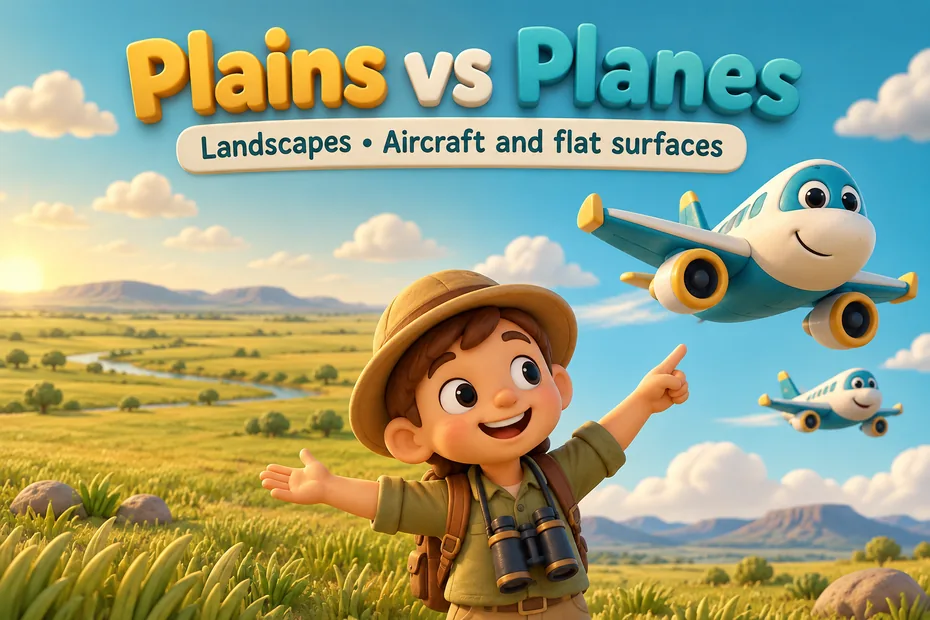
Plains vs planes: the quick answer
Plains are broad areas of relatively level or gently rolling land: “The road crossed the plains.” Planes can be airplanes, flat surfaces in geometry, or woodworking tools: “Two planes flew overhead.” The words normally sound alike, so choose the spelling by meaning rather than pronunciation.
Correction to the older article: a helicopter is an aircraft, but it is not normally called a plane. Also, a mathematical plane is not simply a rectangle or another bounded shape. A diagram may represent part of a plane with a rectangle; the ideal plane itself extends without a boundary. These distinctions make the examples more accurate.

Key facts and comparison table
| Form | Meaning | Example |
|---|---|---|
| Plains | Broad level or rolling land | The plains stretched beyond the village. |
| Planes | Airplanes | The planes landed before sunset. |
| Planes | Flat surfaces in geometry | The two planes intersected. |
| Planes | Woodworking tools | The carpenter sharpened the planes. |
| Plain | Simple, undecorated, or clear as an adjective | The directions used plain language. |
Merriam-Webster’s entries for plain and plane, together with Collins’ plane entry, record the separate meanings. A sentence may need either spelling even when it uses a word such as flat; the type of thing described matters.

Use plains for the landscape
Use plains when writing about broad land areas: “The animals moved across the plains.” A plain need not be perfectly level like a tabletop. The word can describe gently rolling country. Therefore, small changes in elevation do not automatically make the noun inappropriate.
A singular area can be a plain: “The village stands on a coastal plain.” The plural is plains: “The map shows several coastal plains.” A specific geographical name may require capitals, as in Great Plains, while the general noun stays lower case.
The landform meaning is not the same as the adjective plain. “A plain shirt” means a simple or undecorated shirt; “a shirt from the plains” identifies a landscape in relation to the shirt. Keeping those roles separate prevents the mistaken idea that all uses of the spelling concern geography.
For a caption, describe what is actually pictured: “A road crosses the open plain” or “A wide view of the plains.” The word alone does not establish which animals, crops, or climate conditions occur in a particular location.

Use planes for airplanes
In aviation contexts, plane is a familiar shortened form of airplane. “A plane is approaching the runway” concerns one airplane. “Several planes are parked nearby” concerns more than one. Jet planes and small propeller planes both fit this use.
Aircraft is the broader category. A helicopter is an aircraft with a different basic design, so avoid using planes as a universal label for every flying vehicle. If your sentence deliberately includes airplanes and helicopters, “aircraft” is often the clearer word.
A combined example makes the homophones easy to remember: “The planes flew over the plains.” The first word identifies the airplanes, and the second identifies the landscape below them. Listening to the sentence cannot establish the spelling, but reading its meaning can.
Planes in geometry and woodworking
In geometry, a plane is a flat two-dimensional surface. A sketch often uses a tilted quadrilateral to show it, but the drawing is a representation. Do not confuse the part drawn on the paper with the whole ideal surface. “Two planes intersect in a line” is a standard geometric description when the distinct planes meet.
A woodworking plane is a tool for shaping or smoothing material, especially wood. “The carpenter used a plane on the edge” names the tool. The corresponding verb describes the action: “She planes the edge,” “She planed the edge,” and “She is planing the edge.”
This means planes can be a plural noun or a present-tense verb. “The shop stores three planes” names tools; “The carpenter planes the board” describes what the carpenter does. Sentence structure distinguishes them.
A quick spelling check
- Try land or landscape. If that is the idea, plains is likely correct.
- Try airplanes. If that fits, use planes.
- Look for geometry or woodworking. Those meanings use plane and planes.
- Check adjective meaning. Simple or clear language is plain language.
The spelling checker may accept the wrong homophone, because both are valid words. Reading the entire sentence remains the best final check.
Practice and common questions
“The ___ taxied toward the runway” takes planes. “Grass covered the open ___” takes plains. “The carpenter ___ the timber” takes planes for the present-tense verb. “Please use ___ language” takes plain.
Is it Great Plains or Great Planes?
For the geographical region, write Great Plains.
Are plains always perfectly flat?
No. The word can include relatively level or gently rolling land.
Can planes refer to tools?
Yes. It is the plural of a woodworking plane as well as the plural of an airplane.
Have you ever found yourself confused between the words “plains” and “planes”? Well, you’re not alone. As an expert writer, I’ve seen this common mistake pop up time and time again. In this text, I’ll provide you with a clear understanding of when to use “plains” and when to use “planes” appropriately. Understanding the difference between these two words is crucial, especially if you want to avoid embarrassing writing errors. So, let’s immerse and unravel the mystery of “plains” and “planes” once and for all.
Key Takeaways
- “Plains” and “planes” are two words that are commonly confused in writing.
- “Plains” refers to large, flat areas of land, while “planes” refers to flat surfaces or tools used for shaping.
- “Plains” is primarily used in geographical contexts, while “planes” is more commonly used in technical or geometric contexts.
- Examples of “plains” include the Great Plains in North America and the Serengeti Plains in Africa, while examples of “planes” include woodworking planes and drafting planes.
- Understanding the difference between “plains” and “planes” is important for clear and accurate writing and to avoid embarrassing errors.
- When using “plains” correctly, consider geographical descriptions, landforms, and nature and wildlife writing.
- When using “planes” correctly, consider aviation, flat surfaces, and mathematical or scientific discussions.
What are “plains” and “planes”?
When it comes to writing, it’s essential to have a good grasp of the English language. One common source of confusion is the difference between the words “plains” and “planes.” Let’s jump into their definitions and explore how they are used.
Plains
First, let’s talk about “plains.” The word “plains” refers to large, flat areas of land with few trees and little change in elevation. They are often characterized by their wide open spaces and vast stretches of grassland. Plains can be found in different parts of the world, including North America, Africa, and Asia. They are important for agriculture and are home to diverse ecosystems.
Planes
Let’s turn our attention to “planes.” In this context, “planes” refers to flat or level surfaces, typically in the context of geometry or carpentry. Planes can be used for measurement, drawing, and construction purposes. Think of a carpenter using a hand plane to smooth out a wooden surface or an architect using a plane to create precise angles and lines in a blueprint.
The Difference between “Plains” and “Planes”
While “plains” and “planes” may sound similar, they have distinct meanings and uses:
- Definitions:
- “Plains” are flat, open areas of land, while “planes” are flat surfaces or tools used for shaping.
- Context:
- “Plains” primarily refers to geographical features, such as the Great Plains of the United States.
- “Planes” are more commonly used in technical or geometric contexts.
- Examples:
- Examples of “plains”: The Serengeti Plains in Africa, the Great Plains in North America.
- Examples of “planes”: A woodworking plane, a drafting plane used in architectural drawings.
Understanding the difference between “plains” and “planes” is important for clear and accurate writing. Confusing these two words can lead to embarrassing errors.
The difference between “plains” and “planes”
When it comes to the English language, there are several words that sound the same but have different meanings. One such pair that often causes confusion is “plains” and “planes.” Understanding the difference between these two words is essential to avoid embarrassing writing errors. In this section, I’ll explain the distinction between “plains” and “planes” to help you use them appropriately.
What is “Plains”?
“Plains” is a noun that refers to large, flat areas of land characterized by few trees and little change in elevation. These expansive stretches of land can be found all around the world. From the grassy prairies of the Midwest to the rolling savannahs of Africa, plains are vast and wide-open spaces.
Definition of Plains: Large, flat areas of land with minimal vegetation and little variation in elevation.
What is “Planes”?
On the other hand, “planes” is also a noun, but it has a different meaning altogether. In the context of geometry or carpentry, “planes” refer to flat or level surfaces. These surfaces can be found in various shapes, such as rectangles, squares, triangles, and circles. In mathematics, understanding planes is crucial to studying three-dimensional shapes and their properties.
Definition of Planes: Flat or level surfaces, typically used in geometry or carpentry.
Now that we’ve established the definitions of “plains” and “planes,” let’s explore their differences further:
- Usage: “Plains” is used to describe large, flat areas of land, while “planes” refers to flat or level surfaces used in geometry or carpentry.
- Context: “Plains” is usually associated with geography and world, whereas “planes” is more commonly used in mathematical and technical contexts.
- Examples: A grassy prairie is an example of a plain, whereas a wooden board or a sheet of paper can be examples of planes.
Remember, using the correct word in your writing is crucial for effective communication. So be sure to understand the difference between “plains” and “planes” to avoid any confusion or misinterpretation.
Now that we have gained a clear understanding of the difference between “plains” and “planes,” let’s move on to the next section where we will explore some common examples and provide further clarification on their appropriate usage.
When to use “plains” correctly
As I investigate deeper into helping you decipher the difference between “plains” and “planes,” let’s first focus on when to use “plains” correctly. The key lies in understanding the definition and context of this word.
What is the Definition of “Plains”?
“Plains” refer to vast, expansive areas of land characterized by their flatness, few trees, and minimal changes in elevation. These large stretches of open space can be found all around the world, often forming distinct landscapes.
Understanding the Difference
To avoid any confusion, it’s essential to differentiate “plains” from “planes.” While they may sound similar, they have distinct meanings. Remember, “plains” deals with geography and land, while “planes” typically refers to flat or level surfaces in carpentry or geometry.
When to Use “Plains”
Let’s explore some scenarios where using “plains” is appropriate:
- Geographical descriptions: When writing about vast grasslands without significant variations in elevation, such as the Great Plains in North America or the Eurasian Steppe, “plains” is the correct term to use.
- Landforms: Use “plains” when referencing geographic features, like coastal plains, floodplains, or even tablelands. These terms describe specific land formations that exhibit a flattened world.
- Nature and world writing: Whether you’re painting a picturesque scene or describing the breathtaking beauty of a serene countryside, incorporating the word “plains” can provide a vivid description to captivate your readers.
Examples of “Plains” in Context
To further solidify your understanding, here are some examples of “plains” used appropriately in sentences:
- The vast expanse of the American prairie showcases the breathtaking beauty of the country’s heartland.
- The fertile floodplains of the Nile River played a crucial role in the development of ancient Egypt’s agricultural society.
- The Australian Outback is known for its expansive red plains, dotted with kangaroos and eucalyptus trees.
Examples of correct usage of “plains”
As I discussed earlier, understanding the distinction between “plains” and “planes” is crucial to avoid confusion and writing errors. Now, let’s jump into some examples of correct usage of the word “plains” to solidify our understanding.
- Geographical Descriptions:
- The vast plains of the American Midwest stretch out as far as the eye can see.
- The African continent is known for its expansive grassy plains.
- Landforms:
- The Great Plains of North America are characterized by their flat terrain and minimal changes in elevation.
- The fertile plains along the river provide an ideal environment for agriculture.
- Nature and Wildlife Writing:
- The Serengeti is home to an incredible variety of wildlife, including herds of wildebeest roaming the open plains.
- The Arctic plains are inhabited by polar bears, adapted to the harsh conditions of the region.
- Historical Context:
- Plains Indians, such as the Lakota Sioux, were masterful horsemen and relied on bison for their livelihood.
- Figurative Usage:
- After hours of searching, I finally found myself in the calm plains of meditation.
It’s important to note that “plains” is a noun and is used when referring to vast, flat areas of land. These examples demonstrate the various contexts in which “plains” is appropriately used. By incorporating these examples into your writing, you can accurately convey your intended meaning and avoid any confusion with “planes.”
Keep in mind that using “plains” correctly adds depth and specificity to your descriptions, whether you’re writing about geography, nature, history, or even incorporating it figuratively.
When to Use “Planes” Correctly
When to use “planes” correctly
As we’ve discussed, the word “planes” is often confused with “plains.” While “plains” refers to vast, flat areas of land, “planes” has a completely different meaning. In this section, I’ll explain when to use “planes” correctly in your writing.
Definition of “Planes”
“Planes” can refer to a few different things. Here are the main uses of the word:
- Aircraft: “Planes” is commonly used to refer to flying vehicles, such as airplanes, jets, or helicopters. For example, “I watched as the planes soared through the sky” or “The airport was bustling with planes taking off and landing.”
- Flat Surfaces: “Planes” can also be used to describe flat or level surfaces. This can be in a literal sense, such as “The table had a smooth plane for writing,” or in a figurative sense, such as “Her emotions were on a plane surface, without any noticeable ups or downs.”
- Geometry: In mathematics, “planes” are two-dimensional surfaces that extend infinitely in all directions. This usage is more technical and not as commonly encountered in everyday writing.
When to Use “Planes” Correctly
Now that we understand the definition of “planes,” let’s explore some examples of when to use it correctly:
- Aviation: Anytime you’re referring to aircraft or anything related to flying, “planes” is the correct choice. For instance, “I enjoy watching planes take off and land at the airport.”
- Flat Surfaces: Whenever you need to describe a level or flat surface, using “planes” is appropriate. For example, “The carpenter sanded the wood until it had a smooth plane for painting.”
- Mathematical or Scientific Discussions: If you’re writing about geometry or discussing two-dimensional surfaces in a mathematical or scientific context, using “planes” is accurate.
Remember, understanding the difference between “plains” and “planes” is crucial for effective communication. The word “planes” is specific to aircraft, flat surfaces, and mathematical contexts. By using it correctly, you’ll avoid confusion and ensure your writing is accurate and clear.
Examples of correct usage of “planes”
To further clarify the appropriate usage of the word “planes,” let me provide you with a few examples that showcase its different contexts and meanings:
- Aviation: When discussing aircraft, “planes” refers to flying vehicles such as airplanes, helicopters, and jets. For instance, “I watched as the planes soared through the sky during the airshow.”
- Flat surfaces: In the area of geometry, a “plane” is a flat, two-dimensional surface that extends infinitely in all directions. For example, “The table’s surface was so smooth, it looked like a perfectly flat plane.”
- Mathematics and Sciences: The term “plane” is often used to describe two-dimensional geometric figures in mathematics and other scientific disciplines. For instance, “The equation perfectly describes the intersection of two perpendicular planes.”
- Art and Design: In artistic and design contexts, “planes” can refer to the different levels or surfaces within an artwork, particularly in sculpture or architectural drawings. An example sentence could be, “The sculptor emphasized the interplay between light and shadow on the different planes of the statue.”
These examples highlight the various contexts in which “planes” can be appropriately used. Understanding the distinctions between “planes” and other similar words, such as “plains,” is crucial to avoid confusion and ensure accurate communication.
By familiarizing yourself with these examples, you can develop a stronger grasp of when and how to use “planes” correctly in your writing. Remember, proper usage of vocabulary enhances clarity and effectiveness in conveying your ideas.
Conclusion
Understanding the appropriate usage of the word “planes” is essential for effective communication. Throughout this article, we have explored the various contexts and meanings associated with “planes.” From its reference to aircraft in aviation to its significance in geometry, mathematics, sciences, art, and design, “planes” encompasses a wide range of applications.
By delving into examples that highlight the distinctions between “planes” and similar words like “plains,” we have gained valuable insights into how to avoid confusion and accurately convey our intended message. Developing a strong grasp of these examples enables us to use “planes” correctly in our writing, ensuring clarity and precision.
So, whether we are discussing the aerodynamic features of airplanes, the flat surfaces in geometry, or the different levels or surfaces in art and design, understanding the appropriate usage of “planes” allows us to communicate with confidence and accuracy.
By incorporating this knowledge into our writing, we can elevate our language and effectively convey our ideas to the intended audience.
Frequently Asked Questions
Q: What is the article about?
A: The article discusses the various meanings and contexts of the word “planes,” including its usage in aviation, geometry, mathematics, sciences, art, and design.
Q: Why is it important to understand the different meanings of “planes”?
A: Understanding the distinctions between the various meanings of “planes” helps in avoiding confusion and ensuring accurate communication.
Q: Can you give examples of how “planes” is used in different contexts?
A: Sure! In aviation, “planes” refers to aircraft. In geometry, “planes” are flat surfaces. In mathematics and sciences, “planes” are two-dimensional geometric figures. And in art and design, “planes” can represent different levels or surfaces.
Q: How can understanding these examples help?
A: Familiarizing oneself with these examples can enhance one’s understanding of when and how to use “planes” correctly in writing. It promotes accurate usage and effective communication.


