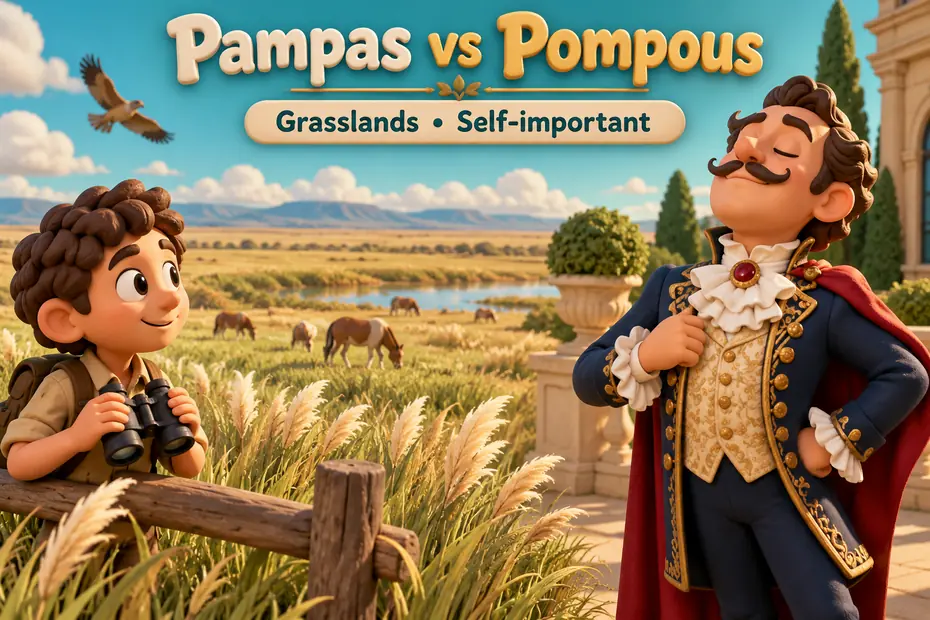
Pampas vs pompous: the quick answer
Pampas refers to grassy plains, especially the South American region called the Pampas. Pompous is an adjective commonly describing an exaggerated sense of importance or an overly grand style: “His introduction sounded pompous.” Use the first word for the landscape and the second for the manner or tone.
A simple pair of examples is “The travelers crossed the Pampas” and “The speaker gave a pompous welcome.” A person can travel through the Pampas and still sound pompous, but the words name different things. Their similar appearance does not make either spelling an alternative to the other.

Key facts and comparison table
| Point | Pampas | Pompous |
|---|---|---|
| Main role | Noun or geographical name | Adjective |
| Meaning | Plains or grassland region | Self-important or excessively grand |
| Common combination | The Pampas; pampas grass | Pompous speech; pompous manner |
| Sentence clue | Crossing, landscapes, a region | Describing a person, tone, or style |
| Spelling reminder | Ends in -as | Ends in -ous |
Merriam-Webster’s entries for pampas and pompous confirm the distinction. Collins also defines pompous in terms of an exaggerated display of importance. These are useful sources for checking the spelling instead of guessing from sound.

Pampas: a geographical word
The geographical name Pampas refers to extensive South American lowland plains across east-central Argentina, often understood to include Uruguay and the southern tip of Brazil. The exact geographical scope can depend on the reference being used. For a vocabulary example, “The photograph shows a landscape in the Pampas” identifies the region without making a claim about a particular trip.
When you name the region, capitalize Pampas: “We studied the Pampas in geography.” A lower-case use may refer more generally to plains, and pampa supplies the related singular form. Follow the context rather than deciding that every appearance of the letters must have the same capitalization.
The older text repeatedly links the word with natural beauty. That is an understandable way to describe scenery, but beauty is not part of the word’s essential definition. You can discuss agriculture, settlement, weather, or a map of the Pampas without praising the landscape. The noun identifies the place or landform; the rest of the sentence supplies the judgment.

Pampas grass is a plant name
Pampas grass is an established plant name, commonly associated with tall grasses bearing showy plumes. Write “pampas grass” in ordinary prose, rather than “pompous grass.” The name does not describe a plant behaving arrogantly.
Recognizing this compound is useful in garden descriptions, flower arrangements, and picture captions. “The arrangement included pampas grass” is a vocabulary example. It does not mean that the arrangement came from the Pampas or that every grass growing in that region has this plant name.
The spelling is enough to identify the word in this guide. If you need to identify a real specimen or decide what to grow, check the specific plant rather than treating a common name as a complete botanical description.
Pompous: a description of manner or style
In everyday use, pompous is usually critical. It can describe someone who makes an inflated show of importance, or language that sounds unnecessarily grand. “The announcement was pompous” comments on its style. “The host sounded pompous” comments on how the host came across.
This is different from confidence. A person can explain an achievement clearly without being pompous. Likewise, a formal speech is not automatically pompous. The adjective adds a judgment that the importance or grandeur feels excessive; it is stronger than simply saying “formal.”
Related forms include pompously for the manner of an action and pompousness for the quality. Compare “He gave a pompous reply” with “He replied pompously.” In the first, the adjective describes the reply; in the second, the adverb describes replying.
For a practical editing example, compare “Please read this note” with “You are hereby invited to undertake a perusal of this communication.” The second may sound pompous because it adds grandeur to a simple request. That is an illustration of tone, rather than a rule that longer words are always wrong.
Practice and common questions
Choose the word: “The class located the ___ on a map” takes Pampas. “The speech sounded unnecessarily ___” takes pompous. “The vase held dried ___ grass” takes pampas. Read what the sentence describes before choosing a spelling.
Is pompous a compliment?
In its common modern sense, it is usually a criticism. Use a different adjective if you mean respectful confidence or appropriate formality.
Should Pampas have a capital letter?
Capitalize it when naming the South American region. The common plant name pampas grass is ordinarily lower case.
Can pompous describe writing?
Yes. It can describe excessively grand or inflated prose, as well as a person’s manner.
Key Takeaways
- “Pampas” refers to vast grassy plains, particularly found in South America, while “pompous” describes someone who behaves in an arrogant and self-important manner.
- “Pampas” is used in discussions related to geography, environmental studies, or travel, while “pompous” finds its place in conversations about people’s behavior, often within social or professional contexts.
- The tone associated with “pampas” is typically neutral, while “pompous” carries a negative connotation.
- “Pampas” should be used to describe geographical features, environmental studies, or when discussing the natural beauty and biodiversity of the grasslands in Argentina and Uruguay.
- “Pompous” should be used to describe someone’s behavior when they display arrogance, self-importance, and use grandiose or inflated language to impress others.
- It is important to use these words appropriately to accurately convey the intended meaning and avoid confusion or misunderstanding.
Difference Between Pampas and Pompous
When it comes to understanding and using words correctly, it’s important to distinguish between similar-sounding terms. In this section, I’ll shed light on the difference between “pampas” and “pompous” to help you grasp their correct meanings and usage.
Definition of Pampas:
“Pampas” is a noun that refers to vast grassy plains, particularly found in South America, with fertile soil. These grasslands are known for their rich biodiversity, including herds of grazing animals and unique plant species. The term “pampas” is commonly associated with the regions of Argentina and Uruguay.
Definition of Pompous:
On the other hand, “pompous” is an adjective that describes someone who behaves in an arrogant, self-important, or ostentatious manner. It refers to individuals who display an excessive sense of their own importance and often use grandiose or inflated language to impress others.
Now that we have established the definitions of these words, it’s crucial to understand the key distinctions between them. The primary difference lies in their meaning and usage:
- Meaning: While “pampas” refers to a specific type of geographical feature – the grassy plains, “pompous” describes a certain characteristic of behavior, specifically being arrogant and self-important.
- Context: “Pampas” is used in discussions related to geography, environmental studies, or travel, where the focus is on describing or referring to the grassy plains. In contrast, “pompous” finds its place in conversations about people’s behavior, often within social or professional contexts.
- Tone: When using “pampas,” the tone is typically neutral, as it denotes a geographical feature. But, when we talk about someone being “pompous,” the tone might carry a negative connotation, as it implies an undesirable trait.
To further clarify the distinction, let’s look at a few examples:
- Example of “pampas” usage: “I dream of witnessing the vast beauty of the pampas in Argentina.”
- Example of “pompous” usage: “His pompous attitude made it challenging to have a genuine conversation with him.”
Understanding the Meaning of Pampas
Pampas and pompous are two words that are often confused due to their similar-sounding pronunciation. But, their meanings and usage couldn’t be more different. In this section, I’ll investigate into the definition and proper usage of the word “pampas.”
What is Pampas?
Pampas is a term used to describe vast grassy plains that can be found in South America, specifically in Argentina and Uruguay. These expansive landscapes are characterized by their fertile soils and abundant vegetation, making them ideal for agriculture and grazing.
Definition of Pampas
When we talk about pampas, we are referring to geographical features, environmental studies, or travel destinations. It’s important to note that the term is primarily associated with the physical characteristics of a place rather than a particular individual or behavior.
Usage of Pampas
In everyday conversations or writing, pampas is used to describe the natural beauty and biodiversity of the grasslands in Argentina and Uruguay. It can also be used to discuss the environmental impact of human activities on these fragile ecosystems.
For instance:
- “I had the opportunity to visit the picturesque pampas of Argentina during my travels. The vast stretches of grass and the diverse wildlife left me in awe.”
- “Scientists are studying the impact of deforestation on the pampas region, aiming to find ways to preserve its unique biodiversity.”
Difference Between Pampas and Pompous
It’s important to keep in mind that pampas should not be confused with the word “pompous.” While pampas refers to a type of geographic world, pompous is used to describe someone’s behavior. The word pompous carries a negative connotation and refers to someone who is overly self-important, arrogant, or showy.
To summarize, pampas and pompous are distinct words with completely different meanings and usage. Pampas is related to geographical features and environmental studies, while pompous is associated with describing people’s behavior in social or professional contexts.
Now that we have a clear understanding of the meaning of pampas, let’s explore the nuances of the word pompous in the next section.
When to Use the Word Pampas
As an expert blogger, I’m here to shed light on the appropriate usage of the word “pampas.” So, let’s immerse without further ado!
Definition of Pampas
The word “pampas” refers to vast grassy plains found in South America, particularly in Argentina and Uruguay. These expansive landscapes are characterized by their stunning natural beauty and rich biodiversity.
Geographical and Environmental Studies
In the area of geography and environmental studies, “pampas” is frequently used to describe these unique ecosystems. Scholars and researchers analyze the flora, fauna, and ecological processes found in the pampas to gain insights into the delicate balance of nature.
Travel and Tourism
If you find yourself planning a trip to South America, the word “pampas” may come up in guidebooks or travel blogs. It’s often used to highlight the mesmerizing landscapes and the opportunity to explore the rich wildlife that these grasslands offer.
Appreciating Nature’s Wonders
Using the word “pampas” allows us to appreciate the vastness and beauty of these natural wonders. It’s a way to honor and respect the unique ecosystems that exist on our planet.
- “During my visit to Argentina, I had the chance to witness the breathtaking landscapes of the pampas.”
- “The pampas are home to a diverse array of wildlife, including majestic herds of grazing animals.”
- “The environmental impact of human activities on the pampas is a concerning issue that needs our attention.”
Remember, “pampas” is not to be confused with “pompous,” which refers to someone’s behavior in a negative way. So, use “pampas” appropriately to discuss geography, environmental studies, travel, and the beauty of our natural world.
Examples of Using the Word Pampas
Now that we have a clear understanding of the word “pampas” and its significance in various fields, let’s explore some examples of how it is used in context. These examples highlight the versatility and beauty of this word, showcasing its relevance in geography, environmental studies, and travel.
- Geography: In discussions about geography, “pampas” is often used to describe the vast grassy plains of South America, particularly in Argentina and Uruguay. For instance, one might say, “The pampas of Argentina are home to diverse species of grasses, providing crucial habitats for a wide array of wildlife.” This usage helps us visualize the expansive landscapes and appreciate the unique ecological characteristics of these areas.
- Environmental Studies: Researchers in the field of environmental studies use “pampas” to analyze the flora, fauna, and ecological processes found in these grasslands. They might say, “The pampas exhibit a delicate balance of wetlands and grasslands, supporting a rich biodiversity that is vital to the overall health of the ecosystem.” By using the word “pampas” in this context, they emphasize the importance of studying and preserving these remarkable habitats.
- Travel: Guidebooks and travel blogs often highlight the mesmerizing landscapes and rich wildlife of the pampas. For instance, a travel writer might describe their experience by saying, “Exploring the pampas was a remarkable adventure, with an abundance of wildlife sightings and breathtaking sunsets over the grassy plains.” Here, “pampas” captures the essence of the journey, allowing readers to envision the expansive beauty that awaits them.
These examples demonstrate the appropriate usage of the word “pampas” in diverse settings, illustrating its significance in describing geographic features, analyzing ecological systems, and capturing the allure of travel experiences. By using “pampas” correctly, we can appreciate the vastness and beauty of these natural wonders and honor the unique ecosystems that exist on our planet.
Remember, “pampas” should not be confused with the word “pompous,” which has a completely different meaning. Understanding the distinction between these two words will enhance our communication and prevent any misunderstandings in the future.
Understanding the Meaning of Pompous
Pompous is a word that often gets confused with pampas, but they couldn’t be more different. Let me explain the meaning of pompous and how it should be properly used.
Definition of Pompous: Pompous is an adjective that describes someone who has an exaggerated sense of self-importance or grandeur. When we say someone is pompous, we are referring to their behavior, attitude, or speech that is arrogant, showy, and self-centered.
It’s important to note that pompous has a negative connotation. It is not a compliment to call someone pompous as it implies that they are boastful, egotistical, or excessively proud.
Pompous individuals tend to exaggerate their achievements, speak in a condescending or patronizing manner, and demand attention and admiration. Their behavior can often be seen as pretentious and insincere.
While it’s essential to express our opinions and believe in our abilities, it’s crucial to find a balance between confidence and arrogance. Being confident is admirable, but being pompous can drive people away and damage relationships.
In social settings, encountering a pompous person can be quite off-putting. Their need to dominate conversations and constantly demonstrate their superiority can create uncomfortable situations.
To avoid misunderstandings, it’s important to use pompous correctly and to recognize that it pertains to someone’s behavior rather than a geographical or environmental term like pampas.
So remember, the next time you come across the word pompous, think of it as describing someone’s negative attitude rather than the vast and beautiful grasslands of South America.
When to Use the Word Pompous
Pompous is an adjective that describes someone who has an exaggerated sense of self-importance or grandeur. It is important to understand the appropriate usage of the word to effectively convey your message and avoid misunderstandings. Here are some instances when it is appropriate to use the word “pompous”:
1. Describing behavior: Use the word pompous to describe someone’s behavior when they display an arrogant or conceited attitude. Pompous individuals tend to exaggerate their achievements, speak in a condescending or patronizing manner, and demand attention and admiration.
2. Negative connotation: Keep in mind that the word pompous carries a negative connotation. It is not a compliment and is used to criticize someone’s behavior. It signifies an inflated self-image and an overbearing demeanor that can be off-putting to others.
3. Formal or informal settings: You can use the word pompous in various settings, both formal and informal, to describe someone who exhibits pompous behavior. But, take caution in using it in professional or academic contexts, as it can be seen as impolite or disrespectful.
4. Writing and literature: Pompous can also be used in discussions related to writing and literature. It is often employed to describe characters, their mannerisms, or their dialogue if they are depicted as having an excessively self-important or pretentious attitude.
Remember, the word pompous should not be confused with its similar-sounding counterpart, “pampas.” While pampas refers to vast grassy plains found in South America, pompous describes someone’s behavior in a negative way. Using these words appropriately allows for effective communication and avoids any confusion or misunderstanding.
- difference between
- what is
- definition of
Examples of Using the Word Pompous
The word “pompous” is often used to describe someone who has an exaggerated sense of self-importance or grandeur. This negative term is commonly associated with people who tend to boast about their achievements, speak condescendingly or patronizingly, and demand attention and admiration. Here are a few examples of how the word “pompous” can be used in context:
- In a conversation with my colleague, he constantly interrupted me and spoke with a superior tone, as if his opinions were the only ones that mattered. I found his pompous behavior quite off-putting.
- The politician’s speech was filled with empty promises and self-congratulatory remarks, making him come across as pompous and insincere.
- During the meeting, the CEO continuously talked over his employees, dismissing their ideas and belittling their contributions. His pompous attitude created a toxic work environment.
- The professor’s lectures were often filled with unnecessary jargon and a condescending tone, making it difficult for students to engage with the material. Many found his teaching style to be pompous and unhelpful.
- The author’s writing style was pretentious and filled with unnecessary complexity, intended to showcase their intelligence rather than effectively convey the message. The book received criticism for its pompous prose.
It’s important to remember, “pompous” is a term used to criticize someone’s behavior and should not be confused with confidence or self-assuredness in a respectful manner. Using the word appropriately will help convey the negative connotation associated with someone who exhibits pompous behavior.
By understanding the meaning and appropriate usage of the word “pompous,” we can effectively communicate when we encounter individuals who display an inflated sense of self, condescension, and a constant need for attention. We must use such words judiciously to ensure clear and accurate communication in both formal and informal settings.
Tips for Proper Usage
As we navigate the world of language, it’s important to master the correct usage of words to effectively communicate our thoughts. In this section, I’ll provide you with some valuable tips for using “pampas” and “pompous” appropriately, allowing you to showcase your linguistic prowess with confidence.
Understanding the Difference
To start off, let’s reiterate the difference between “pampas” and “pompous.” While the former refers to vast grassy plains found in South America, the latter describes someone’s behavior in a negative way, specifically, an exaggerated sense of self-importance or grandeur. Understanding this distinction is crucial to avoid any confusion or misunderstanding.
Context is Key
When using these words, it’s important to consider the context in which they are being used. Here are some pointers to keep in mind:
- “Pampas”: This term is primarily used in discussions related to geography, environmental studies, or travel. Whether you’re writing a research paper, a travel blog, or simply describing the natural beauty and biodiversity of these grasslands, “pampas” is the word to choose. By using “pampas” appropriately, you can accurately convey the mesmerizing landscapes and rich wildlife of this unique ecosystem.
- “Pompous”: On the other hand, “pompous” should be used when describing someone’s behavior. This adjective is reserved for those who exude an inflated sense of self-importance, speak in a condescending or patronizing manner, and demand constant attention and admiration. By using “pompous” correctly, we can effectively communicate encounters with individuals who display these traits, whether it’s in a formal or informal setting.
Clarity and Precision
When using these words, it’s essential to strive for clarity and precision in our communication. Remember to choose words that accurately reflect the intended meaning and avoid ambiguity. Here are some additional guidelines:
- Be aware of the connotations associated with each word. While “pampas” emphasizes the beauty and ecological significance of the grasslands, “pompous” carries a negative undertone, highlighting undesirable behavior.
- Use examples and anecdotes to illustrate your point. Providing concrete instances of someone’s pompous behavior or vivid descriptions of the pampas grasslands can help convey your message more effectively.
Conclusion
Understanding the difference between “pampas” and “pompous” is crucial for effective communication. While “pampas” refers to vast grassy plains found in South America, particularly in Argentina and Uruguay, and is used in discussions related to geography, environmental studies, or travel, “pompous” is used to describe someone’s behavior in a negative way.
By using “pampas” appropriately, we can accurately describe the natural beauty and biodiversity of these grasslands, as well as the environmental impact of human activities on these ecosystems. Scholars and researchers analyze the flora, fauna, and ecological processes found in the pampas to gain insights into the delicate balance of nature. Also, the word “pampas” is often used in guidebooks and travel blogs to highlight the mesmerizing landscapes and rich wildlife of these regions.
To ensure clarity and precision in our communication, it is important to use “pampas” when discussing geography, environmental studies, or travel, and reserve “pompous” for describing negative behavior. By following these guidelines, we can effectively convey our intended meaning and avoid confusion.
Remember, the appropriate usage of words is essential for effective communication, and using examples and anecdotes can further illustrate the intended meaning of these words.
Frequently Asked Questions
Q: What does the word “pampas” refer to?
A: “Pampas” refers to vast grassy plains in South America, especially in Argentina and Uruguay. It is commonly used in discussions related to geography, environmental studies, or travel.
Q: How is “pampas” used in a sentence?
A: “Pampas” is used to describe the natural beauty, biodiversity, and environmental impact of the grasslands in South America.
Q: What is the difference between “pampas” and “pompous”?
A: “Pampas” refers to grassy plains, while “pompous” describes negative behavior.
Q: How is “pampas” used in geography and environmental studies?
A: Scholars and researchers analyze the flora, fauna, and ecological processes of the pampas to gain insights into the delicate balance of nature.
Q: How is “pampas” used in travel?
A: Travel guides and blogs often use “pampas” to highlight the mesmerizing landscapes and rich wildlife of the grassy plains.
Q: How should “pampas” and “pompous” be used correctly?
A: Use “pampas” when discussing geography, environmental studies, or travel. Use “pompous” to describe negative behavior. Accuracy and precision in communication is important.


