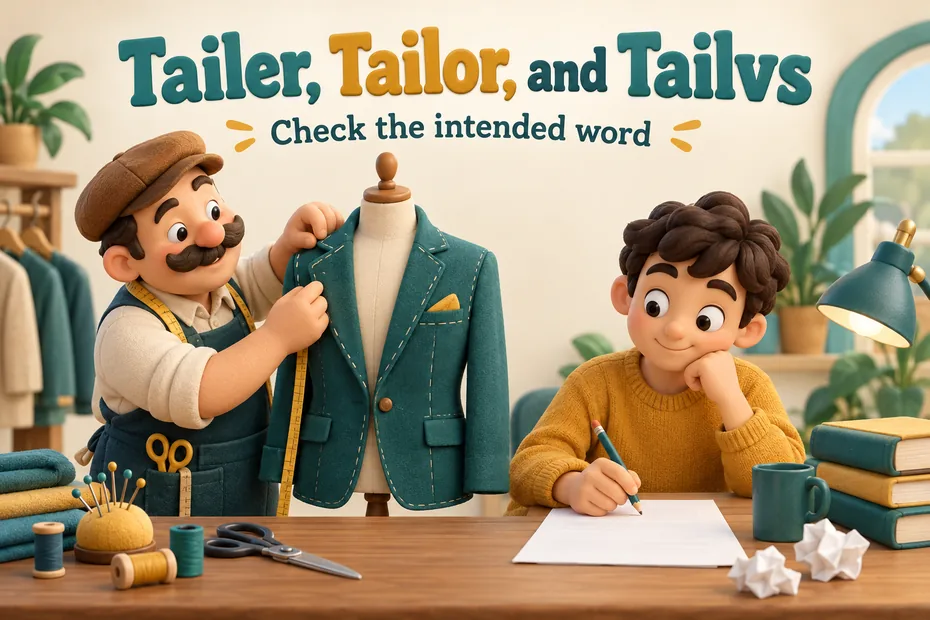
For someone who makes or alters clothing, the standard word is tailor, not tailer or tailvs. Tailer is a separate dictionary word connected with tailing or following and some specialist uses. Tailvs has no established meaning verified here, so check the original source instead of treating this as a normal two-word comparison.
Tailer, tailor, and tailvs: key facts
- Tailor names a professional who makes or alters garments.
- Tailor also means adapt something to a particular need.
- Tailer is not the standard occupational spelling for a clothing tailor.
- Tailer has its own dictionary senses, including one who tails or follows.
- Tailvs requires a source check; a meaning should not be invented for it.
What needs correcting in the original article?
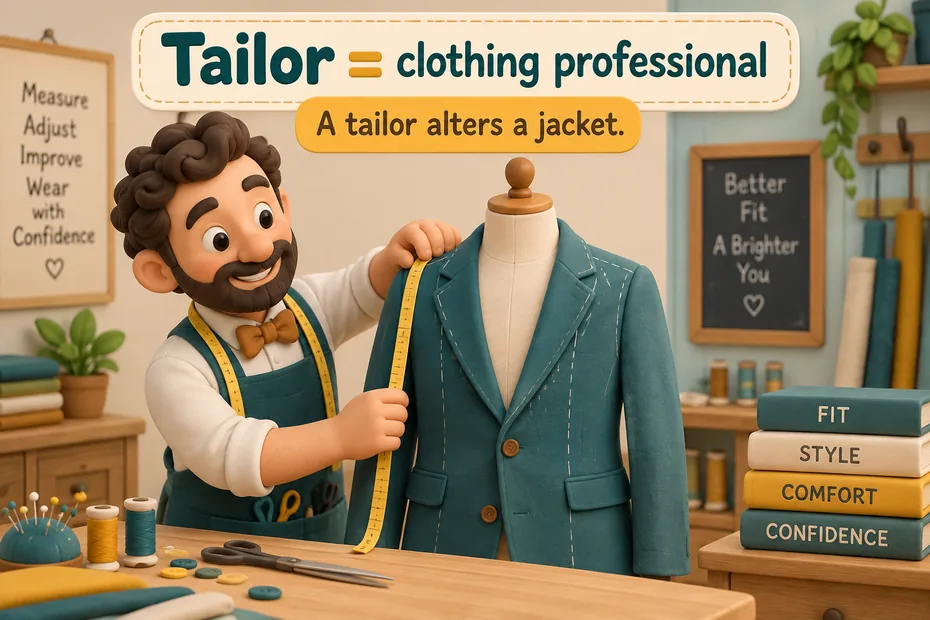
The older text below alternates between calling tailer a misspelling and recommending it for a sewing professional. The recommendation is incorrect for standard modern English. Merriam-Webster’s tailor entry identifies the clothing occupation and the verb for adapting something to a purpose. Use tailor in the garment examples.
At the same time, saying tailer is never a word would also be incorrect. Merriam-Webster’s tailer entry includes one who tails or follows, as well as several specialist senses. The accurate correction concerns the intended meaning: a valid word can still be the wrong word for a particular sentence.
Which form matches the context?
| Context | Choice | Original example | Reason |
|---|---|---|---|
| Clothing professional | Tailor | The tailor shortened the jacket sleeves. | Standard occupation noun |
| Adapt to a need | Tailor | We tailor the lesson to beginners. | Adaptation verb |
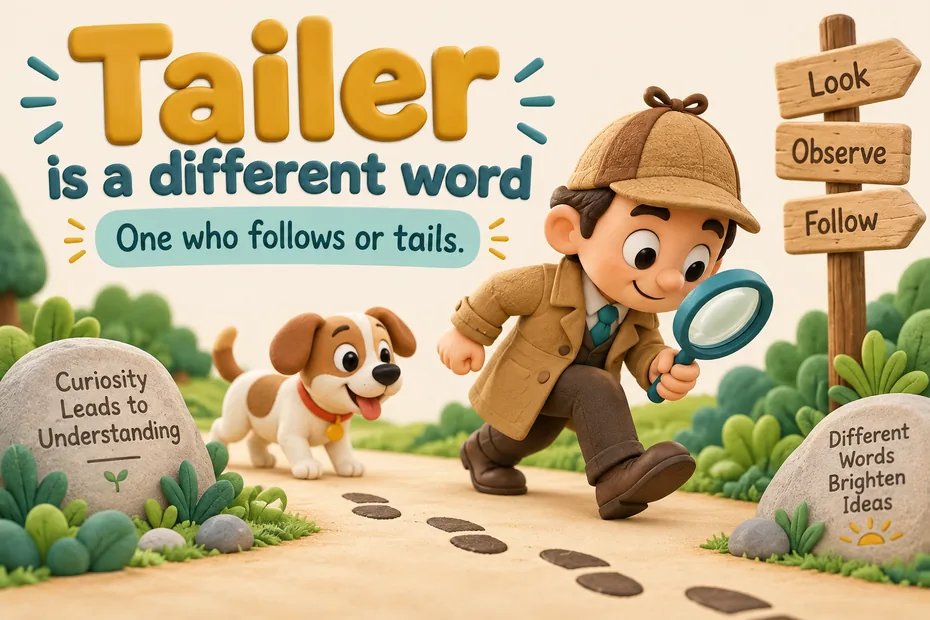
| Someone who follows | Tailer, if that specific word is intended | The glossary defines a tailer as one who follows. | Separate dictionary sense |
| Unclear token in a document | Verify tailvs | The scan contains the letters tailvs. | No meaning established from the token alone |
How do you use tailor in clothing sentences?
Write “A tailor altered my coat” when naming the professional. Tailors is the plural for several such people. The verb forms are tailors, tailored, and tailoring: “The shop tailors jackets,” “The jacket was tailored,” and “She studies tailoring.” Changing the ending to er does not supply the standard clothing noun.
Keep the occupational noun separate from a description of sewing ability. Someone who can sew is not automatically being identified by a job title. Choose tailor when that is the intended occupation, or describe the task directly: “A skilled sewer repaired the seam.” The important spelling correction is tailor for the garment-making and alteration profession.
The verb also extends beyond clothes. “Tailor the explanation to the audience” means adapt it to their needs. The tailoring image makes the figurative meaning easy to understand: the result should fit its intended recipient. Write tailored advice or a tailored lesson when describing that adaptation, rather than “tailered advice.”
What should you do when you find tailvs?
Check whether tailvs is an accidental typing error, an imperfect scan, or a deliberate identifier. Those are possibilities to investigate, not confirmed definitions. Return to the original document, inspect nearby words, and ask what sentence the author intended. Do not silently expand the token into a word whose meaning has not been established.
If the context is clothing alterations, tailor may be the intended correction. If the context is a diagram, code, product label, or name, the letters may need to be preserved until their source is identified. Spellcheckers are helpful for ordinary prose but cannot resolve every unexplained label or transcription error.
The Collins tailer entry provides a second reference for checking the legitimate word tailer. That still does not establish tailvs as its synonym. A comparison should distinguish verified vocabulary from an unresolved token, rather than present uncertain letters as an established English word.
Practice making precise corrections
- “The tailer hemmed my trousers.” For the clothing professional, change tailer to tailor.
- “We will tailor the instructions to new users.” Keep tailor for adapting.
- “The dictionary explains the specialist noun tailer.” Keep the word being discussed.
- “The scanned label reads tailvs.” Check the source before supplying a replacement.
A dependable edit preserves the intended meaning while fixing the spelling. Replacing every tailer with tailor can damage a legitimate specialist sentence; keeping tailer in every clothing example preserves an error. Use the surrounding subject matter, then confirm the dictionary sense or original document.
Frequently asked questions
Is tailer another spelling of the clothing occupation?
For standard modern writing about the person who makes or alters garments, use tailor. Tailer has separate dictionary meanings and should not be recommended as the ordinary clothing title. The original article’s garment examples need that distinction, even though tailer is a real word in other contexts.
Can tailor be used outside the clothing industry?
Yes. Tailor can mean adapt something to a particular need or purpose, as in “tailor the report to the audience.” The forms tailored and tailoring also apply in that figurative use. This meaning comes from the idea of making something fit, and it keeps the same tailor spelling.
Is tailvs definitely a typo?
It looks like an unresolved or nonstandard token in this article, but its exact origin has not been established. It could be a transcription problem or a deliberate identifier in another context. Check the original source before choosing a replacement; do not invent a definition merely to complete a comparison.
Why can a real word still be wrong in a sentence?
A dictionary word carries specific meanings. Tailer can be valid when describing one who tails or in a specialist sense, yet still be wrong when the intended meaning is a clothing tailor. Editing requires matching the word to the sentence, rather than asking only whether the spelling exists somewhere.
Key Takeaways
- “Tailer” is a likely misspelling of “tailor”, which refers to a person who makes or alters clothing professionally.
- “Tailvs” is not a recognized word in English and should generally be avoided in formal writing or conversation.
- Understanding the correct terms and their definitions is crucial for effective communication.
- “Tailer” can be used when referring to a person with sewing skills or when discussing the craft of tailoring.
- It is important to use proper and valid words in our communication to ensure clarity and avoid confusion or misunderstandings.
- Using the appropriate term “tailer” instead of misspelling “tailvs” demonstrates command of the English language and respect for accurate communication.
Understanding Tailer and Tailvs
In this section, I’ll clarify the difference between “tailer” and “tailvs” and provide a clear definition of each term. It’s important to understand these words correctly to avoid confusion and misuse.
Definition of “Tailer”
“Tailer” is not a commonly used word in English. It is likely a typographical error or a misspelling of the word “tailor.” A tailor is a person who makes, alters, or repairs clothing professionally. The word can also refer to a shop or business where these services are offered. Understanding the correct spelling and definition of “tailor” is essential for effective communication.
Definition of “Tailvs”
The term “tailvs” does not have a recognized meaning in English. It appears to be a typographical error or a miscommunication. It is important to use correct and meaningful words in any discussion or written document. Although “tailvs” appears to be an incorrect term, it’s possible that it might be a specific term used in a particular context or industry. But, without further information, it cannot be definitively defined.
To conclude, “tailer” is likely a misspelling of “tailor” and “tailvs” does not have a recognized meaning in English. Understanding the correct terms and their definitions is crucial for effective communication.
Key Differences Between Tailer and Tailvs
When it comes to the terms “tailer” and “tailvs,” it’s important to understand their definitions and how they differ from each other. Let’s break it down:
Definition of Tailer
“Tailer” is likely a misspelling of “tailor.” The word “tailor” refers to a person who makes or alters clothing. Tailors are skilled craftsmen who take measurements, cut fabric, and sew garments to create customized clothing items or modify existing ones. They play a crucial role in the fashion industry and provide tailored solutions to meet individual style and fit preferences.
Definition of Tailvs
On the other hand, “tailvs” does not have a recognized meaning in English. It seems to be a non-existent or misspelled word. It is essential to use the correct and meaningful words in our communication to avoid confusion and ensure effective understanding.
Difference between Tailer and Tailvs
The key difference between “tailer” and “tailvs” lies in their meaning and usage. While “tailer” is a legitimate word as a variation of “tailor,” “tailvs” has no valid usage in the English language. It’s crucial to differentiate between properly spelled and recognized words like “tailor” and avoid using or misspelling non-existent words like “tailvs.”
Understanding the distinctions between “tailer” and “tailvs” allows us to use appropriate and precise language in our communications. By using accurate words, we can effectively convey our message and avoid confusion. So, remember to choose your words carefully and use correct terms for clear and meaningful communication.
To conclude, “tailer” refers to a skilled clothing maker or modifier, while “tailvs” is not a recognized word in English. Using proper, valid words is essential for effective communication.
When to Use Tailer
Tailer, not to be confused with tailvs, is a word that many people mistakenly use instead of “tailor.” As a professional writer, it is important for me to emphasize the correct usage of words to ensure clear and effective communication. In this section, I will define “tailer” and explain the appropriate situations in which it should be used.
Definition of Tailer:
Tailer, derived from the word “tailor,” refers to someone who makes or alters clothing professionally. A tailor is a skilled individual who can craft garments to fit a person’s specific measurements or modify existing clothing to achieve a desired fit. Whether it’s hemming a pair of pants or creating a custom-tailored suit, a tailor’s expertise lies in their ability to bring clothes to perfection.
So, when should you use “tailer” in your writing?
- When referring to a person with sewing skills: If you are discussing the work of a professional who specializes in clothing alterations or garment creation, “tailer” would be the appropriate term to use. For example:
- I had my wedding dress altered by a skilled tailer.
- The tailor measured me meticulously to ensure the perfect fit.
- When discussing the craft of tailoring: When writing about the art and techniques involved in tailoring, it is acceptable to use “tailer” to describe the work or the craftsmanship itself. For instance:
- The tailer demonstrated remarkable attention to detail in every stitch.
- The book provides valuable insights into the rich history of tailering.
It is crucial to note that “tailer” is not the only correct spelling of this word. “Tailor” is the more widely accepted and recognized variant, with “tailer” being more commonly used in certain regions or by individuals who may not be familiar with the standard spelling.
By using the appropriate term “tailer” instead of “tailvs” or any other misspelling, you demonstrate your command of the English language and your respect for accurate and meaningful communication.
Remember, words have the power to shape our thoughts and actions, so let’s strive for precision and clarity in our language choices. We have now covered the usage of “tailer,” and in the next section, we will explore “tailvs” and shed light on its meaning or lack thereof.
When to Use Tailvs
One common mistake that people make when using the terms “tailer” and “tailvs” is confusing them with each other. But, there is a clear distinction between the two and understanding when to use each term is crucial for effective communication.
Definition of Tailvs:
“Tailvs” is not a commonly used word in English. In fact, it is not a recognized word in the English language. Hence, it should generally be avoided in formal writing or conversation. Instead, it is important to use the correct term that conveys your intended meaning.
Difference between Tailer and Tailvs:
The main difference between “tailer” and “tailvs” is that “tailer” is a word that is often mistakenly used instead of “tailor,” while “tailvs” is not a valid word in English.
What is a Tailor?
A “tailor” refers to a person who makes or alters clothing. They possess the skill and craftsmanship needed to create garments that fit well and enhance a person’s appearance. Using the correct term “tailor” is crucial when referring to these skilled individuals.
Appropriate Use of Tailer:
While “tailer” is not a recognized word in standard English, it can be used in certain contexts. For example, “tailer” could be used when referring to individuals who possess sewing skills or the craft of tailoring in a more general sense. But, it is still important to use this term judiciously and only in situations where it accurately conveys your intended meaning.
Importance of Proper Word Usage:
Using the correct and valid words in our communication is essential for effective and meaningful conversations. It ensures clarity and avoids confusion or misunderstandings. When discussing the difference between “tailer” and “tailvs,” it becomes evident that using the incorrect or nonexistent term can undermine the clarity and precision of our message.
To conclude, understanding the difference between “tailer” and “tailvs” is crucial for proper and valid word usage. While “tailer” is often mistakenly used instead of “tailor,” it is important to use the correct term that accurately reflects the intended meaning. Using proper words in our communication enhances clarity and ensures effective communication.
Best Practices for Using Tailer and Tailvs
When it comes to using the words “tailer” and “tailvs,” it’s important to understand their differences and how they should be used appropriately. Let’s investigate into some best practices for using these words effectively.
Understanding the Difference
To begin, it’s crucial to grasp the distinction between “tailer” and “tailvs.” The word “tailer” is often mistakenly used instead of “tailor,” which specifically refers to a person who makes or alters clothing. On the other hand, “tailvs” is not a recognized word in the English language and should generally be avoided in formal writing or conversation.
Defining “Tailer”
When using the term “tailer,” it’s essential to employ it in the appropriate contexts. “Tailer” can be used to refer to a person with sewing skills or when discussing the craft of tailoring. For instance, you might mention that your grandmother is an excellent “tailer” who can create beautiful garments from scratch. But, it’s crucial to note that “tailer” is not commonly used and may be unfamiliar to many individuals.
Avoiding “Tailvs”
While “tailer” has its place in certain situations, it’s important to avoid using “tailvs” altogether. As mentioned earlier, “tailvs” is not a recognized word in English. Using it in professional or formal writing may confuse readers or undermine the clarity of your message. It’s best to opt for valid and well-established words to ensure effective communication.
Enhancing Communication
By using “tailer” appropriately and avoiding the nonexistent word “tailvs,” you can enhance your communication skills. Employing the proper words for specific situations not only demonstrates your linguistic accuracy but also ensures that your message is clear and meaningful.
To conclude, understanding the nuances between “tailer” and “tailvs” is crucial for effective communication. By using “tailer” appropriately when referring to a person’s sewing skills or the craft of tailoring, and avoiding the nonexistent word “tailvs,” you can enhance your language skills and ensure clear communication. Choose your words wisely, and you’ll be on your way to more effective and meaningful interactions.
Conclusion
By understanding the difference between “tailer” and “tailvs” and using them appropriately, we can enhance our communication skills and ensure clear and meaningful interactions. The term “tailer” should be used when referring to a person with sewing skills or when discussing the craft of tailoring. It is important to remember, “tailer” is often mistakenly used instead of “tailor,” which refers to a person who makes or alters clothing. On the other hand, “tailvs” is not a recognized word in the English language and should generally be avoided in formal writing or conversation.
Using correct and meaningful words is crucial for effective communication. By using “tailer” appropriately and avoiding “tailvs,” we can convey our thoughts and ideas accurately. This not only helps us to be understood but also demonstrates our command of the English language.
To conclude, by being aware of the proper usage of “tailer” and avoiding the use of “tailvs,” we can ensure that our communication is clear, concise, and impactful. Let’s strive for precision in our language and make our words count.
Frequently Asked Questions
Q: What is the difference between “tailer” and “tailvs”?
A: “Tailer” is often mistakenly used instead of “tailor,” which refers to a person who makes or alters clothing. “Tailvs” is not a recognized word in the English language and should generally be avoided in formal writing or conversation.
Q: When should I use “tailer”?
A: “Tailer” should be used when referring to a person with sewing skills or when discussing the craft of tailoring. It is important to use the correct word to ensure effective communication.
Q: Can I use “tailvs” in my writing or conversation?
A: It is best to avoid using “tailvs” altogether. It is not a valid word and may confuse or hinder clear communication. Using proper, valid words enhances your communication skills and ensures meaningful interactions.


