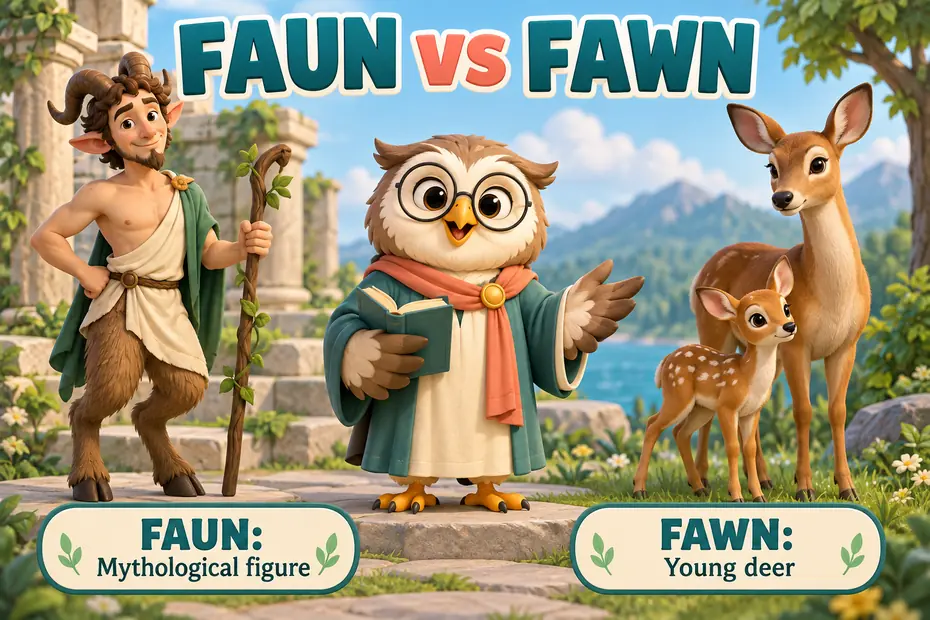
Faun vs. fawn: the quick answer
A faun is a figure from Roman mythology, commonly represented as part human and part goat. A fawn is a young deer. Fawn can also name a light grayish-brown color or work as a verb, often meaning to seek favor through excessive flattery. Write “a faun in a fantasy story,” “a fawn beside a deer,” and “fawn over a celebrity.”
Both spellings are valid, and the animal-versus-myth shortcut covers only their most familiar noun comparison. For complete definitions, see Merriam-Webster’s entries for faun and fawn. Context matters more than the similar sound.
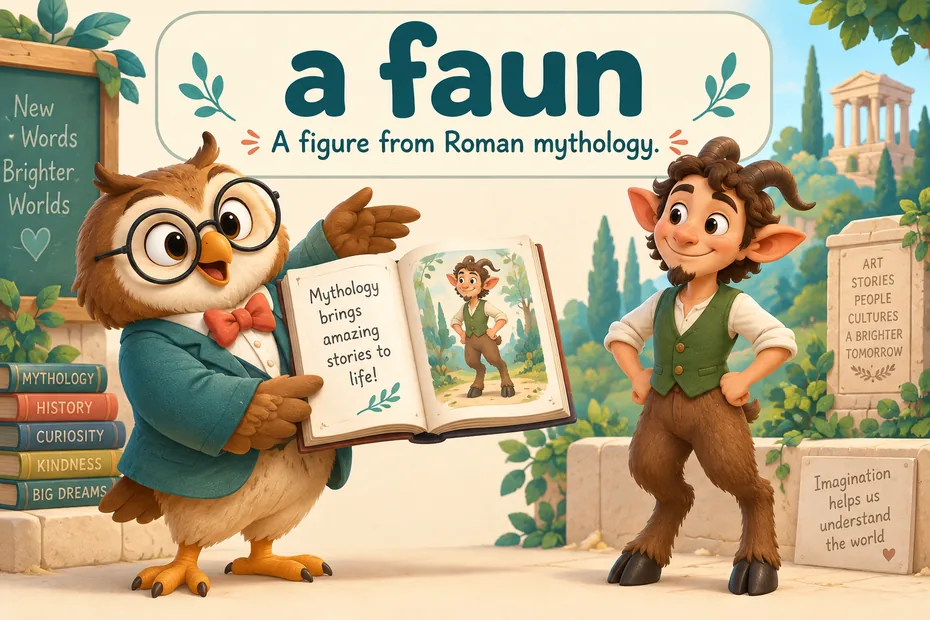
Key facts and forms
- Faun names a mythological figure; its ordinary plural is fauns.
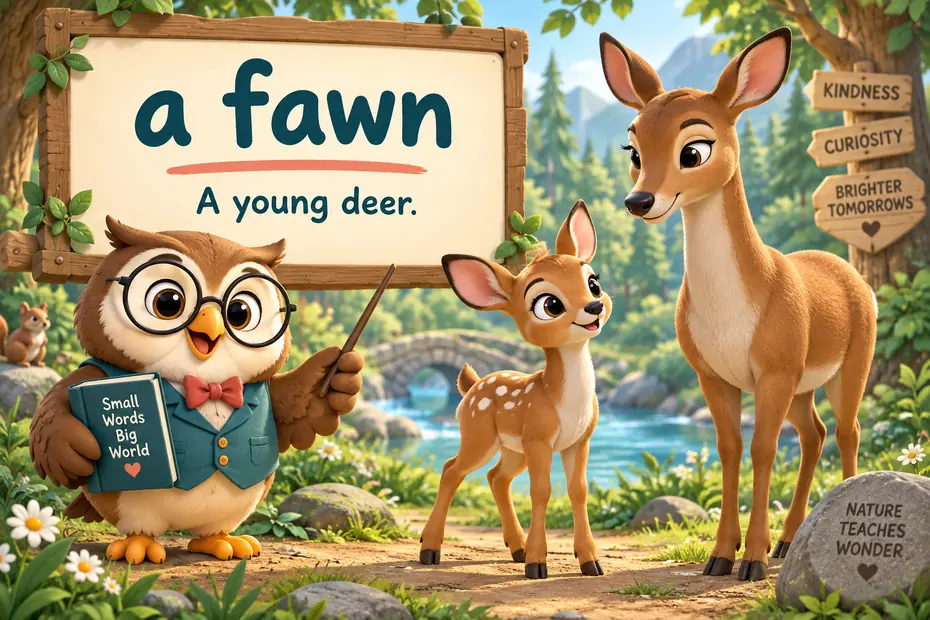
- Fawn can name a young deer; its ordinary plural is fawns.
- Fawn can also be a verb: fawns, fawned, fawning.
- Fawn has a color sense: light grayish brown.
- Fawn over or fawn on can describe flattering or excessively attentive behavior.
- Neither spelling should be capitalized merely because it is an unusual word. Proper names and sentence beginnings are different cases.
The noun faun belongs to mythology and fiction. That does not make every story’s faun identical: an author may give a particular character a distinctive personality. Avoid turning one imagined character’s behavior into a universal definition of the creature.
Comparison table
| Word | Meaning or role | Example |
|---|---|---|
| faun | Mythological figure | The mural includes a faun. |
| fawn | Young deer | A fawn appears in the woodland illustration. |
| fawn | Light grayish-brown color | The artist chose a fawn-colored background. |
| fawn | Verb involving flattery or attention | The character began to fawn over the prince. |
| fawning | Verb form or descriptive use | The narrator dislikes the fawning praise. |
In the animal row, fawn names the creature. In the praise row, fawning describes behavior. A sentence about someone who fawns is not necessarily about a deer, and a sentence about a faun does not automatically imply flattering behavior.
Example sentences with faun
- The illustrator placed a faun beside the woodland gate. Faun identifies the mythical figure in the drawing.
- Two fauns appear in the fantasy scene. The regular plural adds s.
- The faun’s flute lies on the bench. The apostrophe marks possession by one figure.
- The fauns’ costumes were designed for the play. The apostrophe follows the plural s.
- The glossary describes a faun as a Roman mythological figure. This uses the term in an explanatory sentence.
These are invented examples illustrating usage. They do not quote a particular ancient text or imply that a flute, woodland gate, or costume is required by the dictionary definition. Examples can make a term easier to picture without adding unsupported conditions to its meaning.
Example sentences with fawn
- The picture shows a fawn beside an adult deer. The noun names a young deer.
- Several fawns appear on the classroom poster. The plural takes the plural verb appear.
- The fawn’s outline was drawn in pencil. This refers to one young deer.
- The actor began to fawn over the fictional ruler. This uses the verb, not the animal noun.
- The dialogue contains fawning compliments. Fawning describes the manner of the compliments.
- The designer selected a fawn-colored fabric. This uses the color meaning.
The dictionary’s young-deer description particularly mentions an unweaned animal or one retaining its baby coat. A vocabulary lesson should not turn that description into an exact age cutoff for every species or assume every pictured fawn must have visible spots.
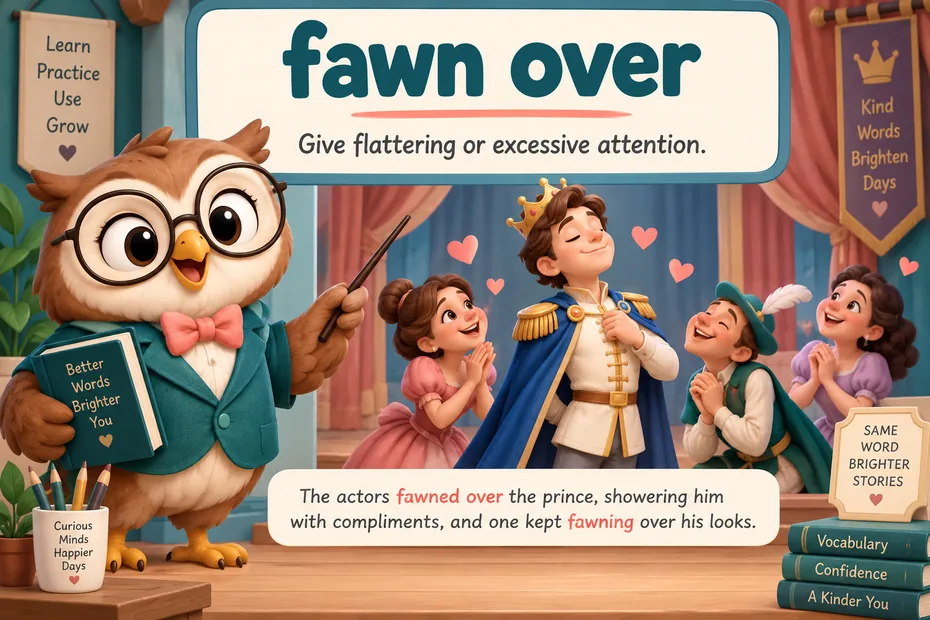
What the verb fawn implies
When used about seeking favor, fawn suggests flattering or deferential attention. It can carry criticism. “She praised the presentation” states praise without necessarily judging it excessive; “she fawned over the presenter” can suggest the narrator thinks the attention went too far.
The dictionary also records an affectionate sense, especially for a dog. Consequently, “fawn always means insincere praise” is too narrow. Read the subject and situation before deciding the tone. The meaning of one use should not be imposed on every occurrence.
Common mistakes and corrections
“A faun followed the doe.” → “A fawn followed the doe.” If the sentence describes a real young deer, use fawn. A fantasy scene might deliberately include a faun, so check the intended creature.
“The Roman statue showed a fawn with goat legs.” → “The Roman statue showed a faun with goat legs.” If the intended figure is the mythological one, choose faun.
“The fans fauned over the singer.” → “The fans fawned over the singer.” The ordinary verb comes from fawn and takes the form fawned.
“Fawn only means baby deer.” → “Fawn also has verb and color meanings.” A learner shortcut is helpful as long as it does not erase those uses.
A short practice quiz
Choose faun, fawn, or fawned: (1) “The mythical ___ carried a book.” (2) “A young deer is a ___.” (3) “The character ___ over the king.” (4) “The paint chart included a ___ shade.” (5) “Two ___s appeared in the Roman-inspired fantasy mural.”
Answers: faun, fawn, fawned, fawn, fauns. The fourth sentence concerns color rather than an animal, and the final sentence needs the mythological noun’s plural.
Frequently asked questions
Is a faun a young deer?
No. Faun names a mythological figure; fawn is the familiar spelling for a young deer.
Can fawn be a verb?
Yes. Fawn, fawns, fawned, and fawning are valid forms. Faun is not the spelling for that ordinary verb.
Does fawn-colored mean spotted?
No. The dictionary color sense is light grayish brown. Spots are not part of that color definition.
Sources and clarification
See Merriam-Webster’s faun and fawn entries. The original article follows; qualify its descriptions of age, spots, personality, and admiration with the fuller meanings above.
Have you ever found yourself confused between the words “faun” and “fawn”? Well, you’re not alone! As an experienced writer, I’ve encountered this dilemma countless times. In this text, I’ll shed some light on the difference between these two words and provide you with a simple guide on how to use them appropriately.
Firstly, let’s clarify the distinction between a “faun” and a “fawn.” A “faun” refers to a mythical creature from Roman mythology, typically depicted as a half-human, half-goat being. On the other hand, a “fawn” is a term used to describe a young deer, usually in its first year of life.
Key Takeaways
- The term “faun” refers to a mythical creature from Roman mythology, depicted as a half-human, half-goat being.
- A “fawn” is a term used to describe a young deer in its first year of life, known for its delicate features and soft spots.
- The word “faun” is not commonly used in everyday conversation, but it holds significance in mythology.
- “Faun” is associated with nature and known for its mischievous and playful nature.
- “Fawn” can be both a noun, referring to the young deer itself, and a verb, describing the act of showing affection or admiration.
- Understanding the distinction between “faun” and “fawn” will improve communication skills and prevent confusion.
Distinction between “faun” and “fawn”
When it comes to the words “faun” and “fawn,” their similar spellings often lead to confusion. To clear up any misconceptions, let’s explore the distinct meanings and usage of these two words.
What is a “faun”?
A “faun” is not a term commonly used in everyday conversation. But, it holds significance in mythology, particularly Roman mythology. In Roman folklore, a “faun” is a mythical creature with the lower body of a goat and the upper body of a human. They are often associated with nature and are known for their playful and mischievous nature.
The definition of a “faun” is quite specific, and it’s important to note that it refers to a fictional being rather than a real animal or nature phenomenon. Keep this in mind when encountering the term in literature, art, or discussions related to mythology.
What is a “fawn”?
In contrast to a “faun,” a “fawn” is a term commonly used to describe a young deer in its first year of life. These adorable creatures are known for their delicate features and soft spots.
The word “fawn” is both a noun and a verb. As a noun, it refers to the young deer itself, while as a verb, it describes the act of showing affection or admiration, similar to doting or flattering someone excessively.
It’s important to note the difference between the definition of “fawn” as a young deer and its other meanings when using the word in writing or conversation.
Now that we have explored the definitions of both “faun” and “fawn,” it should be clear that they are distinct terms with different meanings. Remember:
- A “faun” is a mythical creature from Roman mythology.
- A “fawn” refers to a young deer in its first year of life.
Understanding and correctly using these words will help you avoid confusion and improve your overall communication skills. Keep these distinctions in mind to ensure accurate usage in the future.
Remember to use each word in its appropriate context so that your writing or conversations convey the intended meaning clearly.
Understanding the term “faun”
A common confusion arises between the words “faun” and “fawn.” In this section, we’ll focus on understanding the term “faun” and its unique meaning.
First, let’s clear up any ambiguity – a “faun” is not a young deer. Rather, it is a mythical creature from Roman mythology. In Roman folklore, a “faun” is often depicted as a creature with the upper body of a human and the lower body of a goat, similar to the Greek satyr.
The term “faun” is associated with nature and is known for its mischievous and playful nature. In mythology, they were often depicted as frolicking in forested areas, enjoying music and dance. These creatures were believed to be guardians of forests and wild animals.
It’s crucial to note that the plural form of “faun” is “fauns.” This is in contrast to “fawn,” which remains the same in both singular and plural form.
To summarize, a “faun” is a mythical creature from Roman mythology, known for its half-human and half-goat appearance, mischievous nature, and association with nature.
Now that we have a clear understanding of what a “faun” is, let’s move on to exploring the term “fawn” in the next section.
| Keyword | Relevance |
|---|---|
| difference between | Not relevant |
| what is | Not relevant |
| definition of | Not relevant |
Definition and characteristics of a “faun”
Let’s start by understanding the definition and characteristics of a “faun.” Many people often mistake the term “faun” for “fawn” due to their similar spellings. But, they have completely different meanings and origins.
A “faun” is not a young deer, as some may think. Instead, it is a mythical creature from Roman mythology. In Roman mythology, a “faun” is typically depicted as a creature with the upper body of a human and the lower body of a goat. This combination of human and goat characteristics gives “fauns” a distinctive appearance.
One key characteristic of a “faun” is its mischievous nature. In mythology, “fauns” are often portrayed as mischievous beings who enjoy playing pranks on humans and causing mischief in the natural world. They are associated with forests, fertility, and a love for music and dancing. The close association with nature makes “fauns” important figures in Roman mythology.
It’s worth noting that the plural form of “faun” is “fauns.” This is different from “fawn,” which remains the same in both singular and plural forms.
Overall, a “faun” is a mythical creature known for its half-human and half-goat appearance, mischievous nature, and close association with nature. Understanding the characteristics and significance of a “faun” can help us use this term appropriately and avoid confusion with the term “fawn.”
Understanding the term “fawn”
To understand the difference between “faun” and “fawn,” it’s essential to grasp the definition of each word. While a “faun” refers to a mythical creature from Roman mythology, a “fawn” has an entirely different meaning.
A fawn refers to a young deer. It is important to note that the term “fawn” cannot be used to describe a young deer in any other context. The word specifically denotes a baby deer, usually less than a year old. Fawns are known for their adorable appearance, with their soft, spotted coat and innocent demeanor.
Characteristics of a Fawn
The defining characteristics of a fawn include:
- Youth: Fawns are in the early stages of their lives, typically less than a year old.
- Spotted Coat: They have a distinct coat pattern, featuring white spots on a brown or reddish-brown background.
- Graceful Movements: Fawns are known for their elegant and delicate movements, captivating the hearts of many observers.
Differences Between Faun and Fawn
While the terms “faun” and “fawn” may sound similar, it’s crucial to understand their distinguishing features:
- Meaning: A “faun” is a mythical creature with the upper body of a human and the lower body of a goat. In contrast, a “fawn” is a young deer.
- Origin: “Faun” derives from Roman mythology, while “fawn” comes from Old English.
- Association: “Fauns” are often associated with forests, fertility, and a love for music and dancing. On the other hand, “fawns” are simply young deer in their early stages of life.
Examples of Usage
To illustrate the proper usage of each term, here are a few examples:
- “I read an enchanting story about a mischievous faun who lured travelers into the woods with his mesmerizing flute melodies.”
- “While walking in the forest, I stumbled upon a delightful sight—a curious fawn peacefully grazing in the meadow.”
Definition and characteristics of a “fawn”
When it comes to understanding the difference between “faun” and “fawn,” it’s important to start by delving into the definition and characteristics of a “fawn.” A “fawn” is a term used to describe a young deer, typically less than a year old.
Here are some key characteristics that define a “fawn”:
- Adorable Appearance: One distinguishing feature of a “fawn” is its irresistibly cute and endearing appearance. With their big eyes, delicate features, and sometimes spotted coats, fawns capture the hearts of many animal lovers.
- Spotted Coat: Most fawns have a spotted or mottled coat, which serves as a natural camouflage, helping them blend into their surroundings and providing protection from predators.
- Graceful Movements: Fawns are known for their graceful and agile movements. They possess a certain elegance as they prance and leap through the forests and meadows.
It’s important to note that “fawn” specifically refers to the early stage of a deer’s life. As deer grow, they shed their spotted coats and develop into adult deer.
Understanding the definition and characteristics of a “fawn” allows us to differentiate between the terms “faun” and “fawn.” While a “faun” is a mythical creature from Roman mythology, the term “fawn” is grounded in the natural world and refers to a young deer.
How to use “faun” and “fawn” appropriately
As we’ve explored in the previous sections, the terms “faun” and “fawn” may sound similar, but they have distinct meanings and origins. In this section, I will guide you on how to use these words appropriately to avoid confusion or misuse.
Understanding the Difference
Let’s start by highlighting the key differences between “faun” and “fawn”:
- “Faun”: This term refers to a mythical creature from Roman mythology. A “faun” typically has the upper body of a human and the lower body of a goat. In mythology, fauns are associated with forests, fertility, and a love for music and dancing.
- “Fawn”: On the other hand, a “fawn” is a young deer. It specifically describes a baby deer that is typically less than a year old. Fawns are known for their adorable appearance, spotted coat, and graceful movements.
Proper Usage Examples
To ensure you use these words correctly, here are a few examples of their appropriate usage:
- I stumbled upon a beautiful painting depicting a faun playing a flute in the enchanted forest.
- Our trip to the national park was a delight as we spotted a curious fawn roaming near its mother.
- The novel I’m reading transports me to a magical world where fauns and other mythical creatures come to life.
- The hiker cautiously moved forward, trying not to startle the timid fawn resting by the grove.
Tips for Correct Usage
To help you remember which word to use in different contexts, consider the following tips:
- Origin and Mythology: When referring to a mythical creature or something related to Roman mythology, use “faun.”
- Young Deer: When talking about a baby deer or a young deer in general, use “fawn.”
Remember, using these terms correctly adds precision and clarity to your writing, allowing your reader to fully grasp your intended meaning.
Note: Since there is no concluding paragraph or sentence in the article, I will seamlessly transition to the next section.
Conclusion
Understanding the difference between “faun” and “fawn” is essential for using these terms appropriately. While a “faun” refers to a mythical creature from Roman mythology with the upper body of a human and the lower body of a goat, a “fawn” is a young deer.
The term “faun” is associated with forests, fertility, and a love for music and dancing. On the other hand, a “fawn” is simply a young deer in its early stages of life, known for its adorable appearance, spotted coat, and graceful movements.
By using these terms correctly, we can ensure clear and effective communication. Remember, “faun” is used to describe the mythical creature, while “fawn” specifically refers to a young deer.
So next time you’re writing or speaking, make sure to use “faun” when referring to the mythical creature and “fawn” when talking about a young deer. It’s these small details that can make a big difference in your writing and help you convey your message accurately.
Frequently Asked Questions
Q: What is the difference between a faun and a fawn?
A: A “faun” is a mythical creature with the upper body of a human and the lower body of a goat from Roman mythology. On the other hand, a “fawn” is a young deer, typically less than a year old.
Q: What are the characteristics of a fawn?
A: A fawn is known for its adorable appearance, spotted coat, and graceful movements. It is a baby deer in its early stages of life.
Q: How should I use the terms “faun” and “fawn” correctly?
A: Use “faun” to refer to the mythical creature from Roman mythology and “fawn” to describe a young deer. For example, “I saw a beautiful faun in the forest” or “The fawn looked cute with its spots”.


