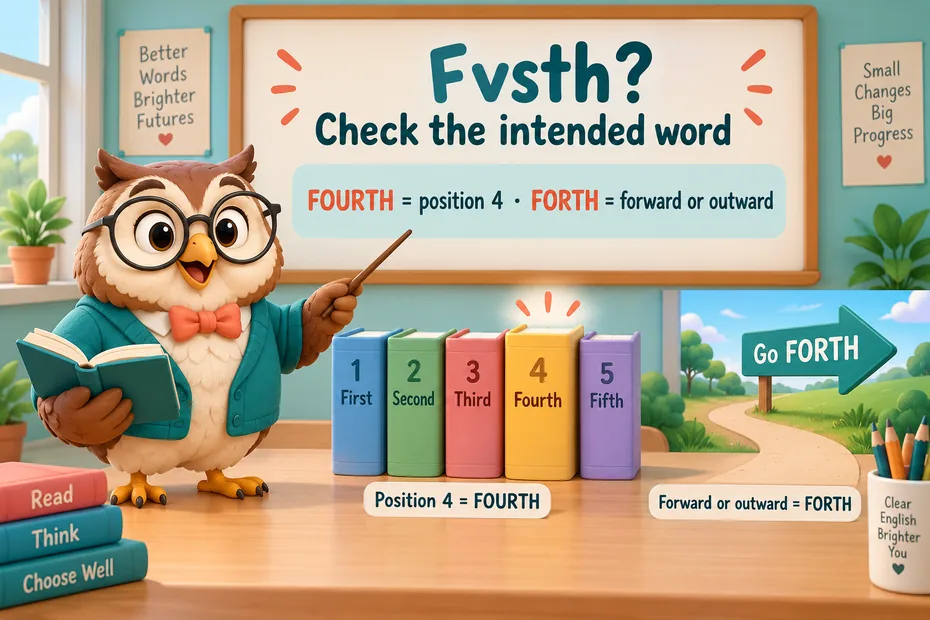
Fvsth vs. fourth: check the intended word first
Fourth is the standard spelling for position number four, and it can also mean one of four equal parts. The string fvsth in this page’s original title is not a standard spelling for either meaning. It should not be taught as a separate vocabulary word. The intended correction must come from context: a numbered position needs fourth, while forward or outward movement may need forth.
This page does not establish why the unusual string appeared. It could be an input or editing error, but its origin cannot be inferred from its appearance. The useful lesson is the real distinction between fourth and forth, both documented in Merriam-Webster.
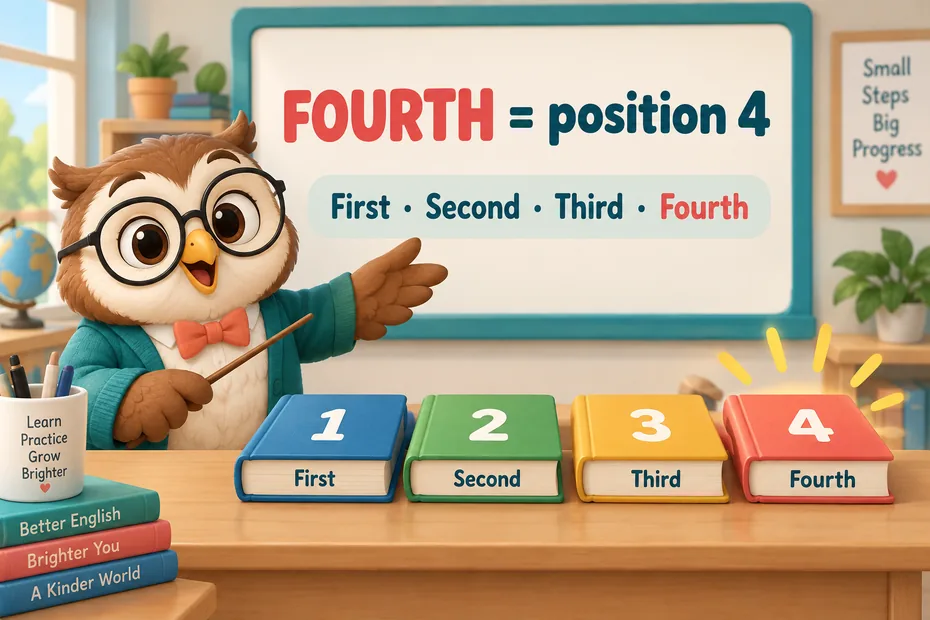
Key facts: number, fraction, or direction?
- Fourth follows third and precedes fifth in a sequence.
- 4th is the numerical abbreviation for fourth.
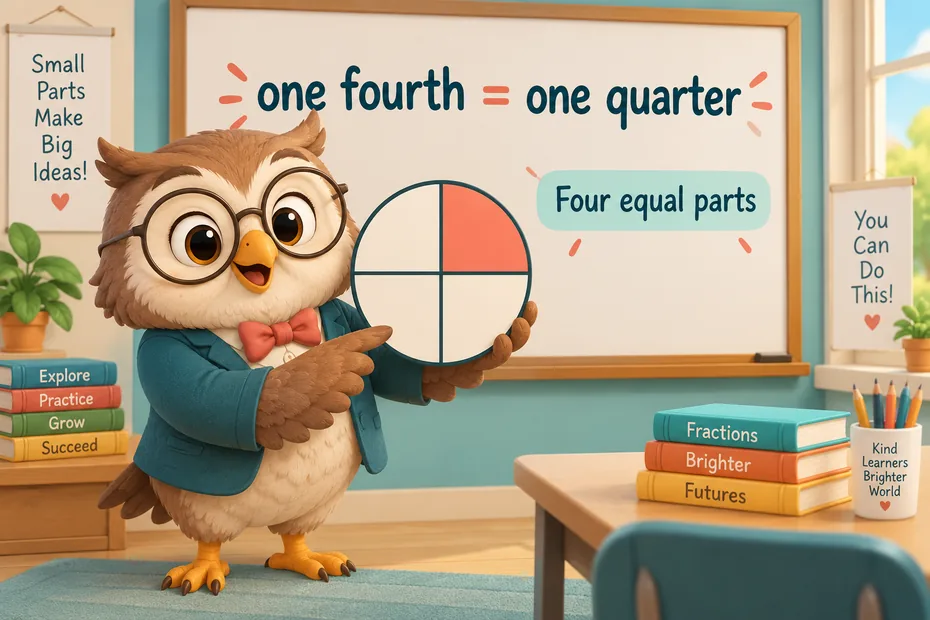
- A fourth can mean a quarter: one of four equal parts.
- Forth can mean forward, onward, or outward into view.
- Back and forth is the movement phrase; it does not refer to position number four.
- Preserve unusual strings when quoting a source exactly, but explain the issue rather than assigning an invented definition.
Comparison with practical examples
| Intended idea | Spelling | Example |
|---|---|---|
| Position number four | fourth | The fourth folder contains the notes. |
| One of four equal parts | a fourth | A fourth of the square is shaded. |
| Forward or outward | forth | The narrator asks the travelers to go forth. |
| Repeated movement | back and forth | The pendulum moved back and forth. |
| An unexplained string in a draft | fvsth | The editor flagged “fvsth” for checking. |
The final example uses the string as something being discussed. That is different from treating it as a working word. You can mention a spelling error in a lesson, quote it from a document, or reproduce a filename accurately without endorsing it as ordinary vocabulary.
How to use fourth in a sentence
Fourth is an ordinal: it identifies a place in an ordered sequence. Compare “four books,” which counts books, with “the fourth book,” which identifies one book by position. Count and position are different ideas, so exchanging four and fourth can change the meaning.
- The fourth shelf holds the dictionaries. Count the shelves in the agreed direction; the fourth is shelf number four.
- She finished fourth in the classroom puzzle. The word states a finishing position.
- This is the fourth version of the draft. The version belongs to a sequence of revisions.
- The meeting is on the fourth. When the month is clear, the word can identify its fourth day.
- A fourth of the paper is blue. Here it refers to one quarter of the whole.
- Three fourths of the diagram are shaded. Fourths is plural because the sentence refers to three equal quarter-parts.
For fractions, the parts must be equal for each to be a fourth of the whole. Cutting a shape into four unequal pieces does not make each piece one fourth. This is a meaning check that a spelling checker cannot perform.
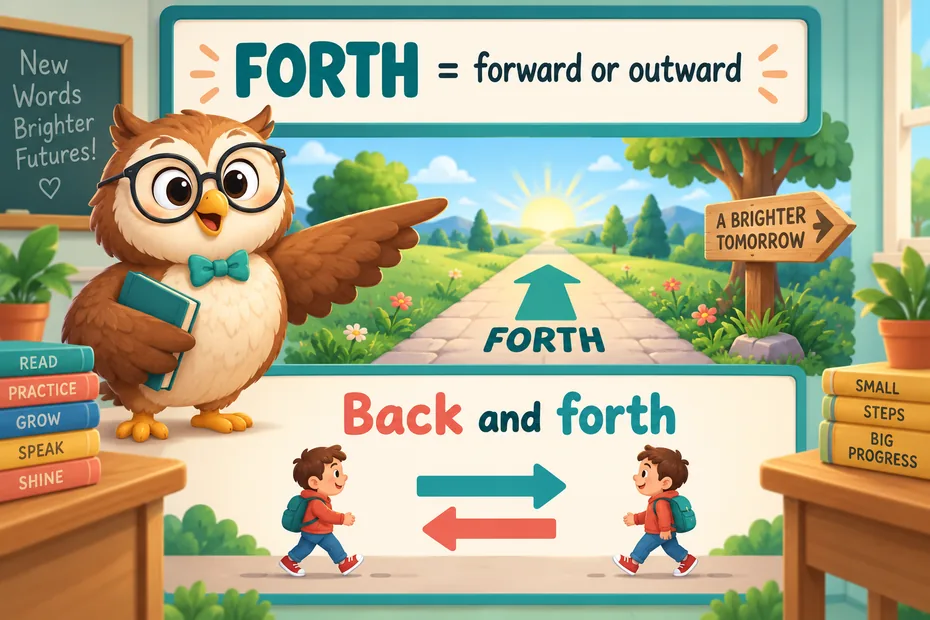
How forth changes the meaning
Forth is not the ordinal for four. It appears in movement expressions and combinations such as back and forth, bring forth, put forth, and set forth. Read the entire phrase rather than replacing one spelling solely because the words sound alike.
- The toy rolled back and forth. It moved repeatedly in opposite directions.
- The writer set forth the proposal. The writer presented the proposal.
- The group put forth several ideas. The group offered ideas for consideration.
- The story begins, “Go forth and explore.” Forth adds the idea of going onward.
Some combinations are more formal or literary than their alternatives. In an everyday instruction, “move forward” may be clearer than “go forth.” Choosing a familiar phrase is an editing decision, while choosing forth versus fourth is a meaning and spelling decision.
Common corrections
“Take the forth door.” → “Take the fourth door.” The intended instruction identifies door number four. “Take the next door” would express a different location, so check the intended sequence too.
“The swing moved back and fourth.” → “The swing moved back and forth.” The phrase describes movement, not rank.
“The fvsth page has the chart.” → Check the page number. If the writer means page four in a sequence, revise to “The fourth page has the chart.” Do not assume that every occurrence of the unusual string has the same intended replacement.
“Four of the cake is left.” → “A fourth of the cake is left.” This works if the intended amount is one quarter. If the writer means four pieces, name those pieces instead.
Practice: choose forth or fourth
Fill the blanks: (1) “This is our ___ rehearsal.” (2) “The ball rolled back and ___.” (3) “A ___ of the circle is red.” (4) “The speaker put ___ an idea.” (5) “I came ___ in the quiz.”
Answers: fourth, forth, fourth, forth, fourth. The numbered rehearsal, fraction, and finishing position need fourth. The movement phrase and the phrase meaning offered an idea need forth.
Frequently asked questions
Is fvsth another spelling of fourth?
It is not a standard spelling for the ordinal or fraction discussed here. Use fourth for those meanings. An unusual name or exact quotation would require its own context.
Should I always replace fvsth with fourth?
No. Determine the intended meaning first. Fourth suits number-four positions; forth suits relevant movement or presentation phrases. If the sentence gives too little information, ask its writer or consult the source.
Is 4th acceptable?
Yes, it represents fourth. Whether a document spells out the word or uses numerals depends on its style and context. Keep similar labels consistent.
Is fourth only an adjective?
No. It can name a position or fraction as a noun, and it appears in uses such as “finished fourth.” The whole sentence determines its role.
Sources and clarification
The definitions above are grounded in Merriam-Webster’s fourth entry and forth entry. The original discussion below should be read with this correction: fvsth is an unexplained string, not a second word with a definition or a vocabulary category.
Key Takeaways
- “Fvsth” is not a recognized word in the English language and likely a typo or misspelling.
- “Fourth” is a legitimate word with a clear definition and usage.
- “Fvsth” should not be used in any formal or informal writing, while “fourth” is commonly used in various contexts.
- Double-checking spelling and context is crucial for accurate communication.
- “Fourth” is used to indicate the position of an item in a sequence, a specific date, or a fraction of time.
- Avoid common mistakes like using “fvsth” instead of “fourth” or confusing “fourth” with other similar-sounding words.
Understanding the difference between “fvsth” and “fourth”
As a student, it’s important to have a clear understanding of the differences between commonly confused words, such as “fvsth” and “fourth.” Let’s jump into the definitions and explore their distinctions.
Definition of “fvsth”:
“Fvsth” is not a recognized word in the English language. It is likely a typo or a misspelling. When encountering such words, it’s crucial to double-check your spelling and context to ensure accuracy in your writing.
Definition of “fourth”:
On the other hand, “fourth” is a legitimate word with a specific meaning. It is an ordinal number that represents the position following “third” and coming before “fifth.” For example, if you have a list of items, “fourth” refers to the item that comes after the third one.
Now that we have established the definitions, let’s focus on the difference between “fvsth” and “fourth”:
- Existence and Legitimacy:
- “Fvsth” is not a proper word and has no recognized meaning in the English language.
- “Fourth” is a legitimate word with a clear definition and usage.
- Spelling and Context:
- “Fvsth” may be a result of a typo or misspelling, making it essential to review your writing for errors.
- “Fourth” has a consistent spelling and is used to indicate the position of an item in a sequence.
- Usage and Application:
- Since “fvsth” does not have a defined meaning, it should not be used in any formal or informal writing.
- “Fourth” is commonly used in various contexts, such as describing a position, a date, or a fraction.
It is crucial to note that while “fourth” is a well-established word, “fvsth” is not. Hence, it is important to be mindful of the correct usage of words to maintain clarity and professionalism in your writing.
Remember, honing your understanding of commonly confused words will greatly benefit your communication skills and overall academic performance. Keep practicing and referring back to reliable resources to enhance your vocabulary and fluency in English.
When to use “fvsth”
As an expert blogger with years of experience, I often come across common spelling mistakes that can easily confuse readers. One such instance is the word “fvsth.” Let’s jump into when it’s appropriate to use “fvsth” and explore the implications of this misspelling.
First and foremost, it’s crucial to mention that “fvsth” is not a recognized word in the English language. It does not have a definition or a particular context in which it can be used. This leads me to believe that “fvsth” is likely a typo or misspelling.
When writing, it’s essential to double-check our words for accuracy and clarity. If you come across the word “fvsth” in your text, it’s best to review your spelling and context to ensure precision. Replacing “fvsth” with the correct word will improve the overall quality of your writing and maintain your reader’s confidence in your expertise.
Ensuring correct spelling and using appropriate words build effective communication skills and enhance your academic performance. Remember, accuracy is key, and using recognized words contributes to the integrity and credibility of your work.
To summarize, “fvsth” should not be used in any formal or informal writing. To maintain clarity and precision in your work, always double-check your spelling and use recognized words that convey your intended meaning accurately. By doing so, you’ll showcase your expertise and help effective communication.
Examples of appropriate usage of “fvsth”
To better understand the appropriate usage of the word “fvsth,” let’s examine some examples:
- “I couldn’t find the fvsth book on the shelf.”
- In this example, the word “fvsth” appears to be a misspelling or typo. The correct word should be “fourth” which refers to the numerical position of the book on the shelf.
- “She completed the assignment on the fvsth try.”
- Once again, “fvsth” seems to be an error. The intended word here is “fourth,” indicating that the person took four attempts to complete the assignment successfully.
- “The fvsth of July is always a day of celebration in the United States.”
- Here, the word “fvsth” is once more likely a typographical error. The correct wording should be “fourth,” as it refers to the date of July 4th, which marks the Independence Day in the United States.
These examples illustrate the common confusion that can arise when using similar-sounding words such as “fvsth” and “fourth.” It is crucial to double-check our spelling and context to ensure precise and accurate communication.
Using recognized words with clear meaning contributes to the credibility and integrity of our writing. By utilizing appropriate vocabulary, we enhance the clarity and effectiveness of our message, particularly in educational and formal contexts. So, always be mindful of the words you choose and strive for accuracy in your written work.
Now that we have explored the examples of appropriate usage, let’s investigate deeper into the difference between “fvsth” and “fourth” to gain a better understanding of their meanings and contexts.
When to use “fourth”
The word “fourth” is a numerical adjective that represents the number four in a sequence. It is commonly used to describe the position of an item or event in a series. Understanding when to use “fourth” correctly is important for clear and accurate communication.
Here are some instances where “fourth” is appropriately used:
1. Sequences:
When describing the order of items in a series, use “fourth” to indicate their position. For example:
- “I am the fourth person in line.”
- “Her birthday is on the fourth of July.”
2. Dates:
When stating a specific day in a month, use “fourth” to denote its numerical position. For instance:
- “We are meeting on the fourth of November.”
- “The concert is scheduled for the fourth of December.”
3. Time:
When referring to the quarter of an hour, use “fourth” to convey the correct fraction of time. For example:
- “The meeting will start at a quarter past the fourth hour.”
It is important to note that “fourth” should not be confused with “fvsth.” While “fourth” is a recognized word in the English language, “fvsth” does not have a specific meaning or usage. Double-checking the spelling and context of words is crucial for proper communication.
The difference between “fvsth” and “fourth” will be further explored to gain a better understanding of their meanings and contexts. Stay tuned for the upcoming sections where we will dive deeper into this topic.
Continue reading to unravel the mysteries of these commonly confused words and enhance your language skills.
Examples of appropriate usage of “fourth”
As we investigate deeper into the correct usage of the word “fourth,” it’s important to provide you with clear examples that will enhance your understanding. By illustrating its correct application in various contexts, we can ensure that you feel confident in using this word accurately in your writing. So, without further ado, let’s explore some examples of appropriate usage of “fourth”:
Sequences:
- The fourth place winner in the spelling bee competition was ecstatic.
- I couldn’t believe it when my favorite contestant finished in fourth position in the race.
- This is the fourth time he has won the award for Best Director.
Dates:
- The meeting has been rescheduled to Friday, the fourth of September.
- She was born on the fourth of July.
- Our anniversary falls on the fourth of December.
- The train departs at a quarter past the fourth hour in the afternoon.
- I usually have my coffee break at around half past the fourth hour in the morning.
- The concert will begin promptly at the fourth hour in the evening.
These examples demonstrate the correct usage of “fourth” in different scenarios. Whether it’s referring to a position in a sequence, specifying a date, or indicating a specific time, using “fourth” accurately is crucial for effective communication.
By understanding the distinction between “fourth” and other words, such as “fvsth,” you can ensure that your writing is clear, precise, and credible. The next section will further explore the differences between “fvsth” and “fourth,” providing a more comprehensive understanding of their respective meanings and contexts.
Remember, mastering the correct usage of commonly confused words is an essential skill that will elevate the quality of your writing. So, keep practicing and refining your understanding to become a proficient communicator.
Common mistakes to avoid when using “fvsth” and “fourth”
When it comes to using words correctly, it’s important to pay attention to the details. Confusion can arise when words look or sound alike but have different meanings. In this section, I’ll highlight some common mistakes to avoid when using “fvsth” and “fourth.”
The Difference Between “fvsth” and “fourth”
Let’s start by understanding the difference between these two words. While “fourth” is a legitimate word in the English language, “fvsth” is not. In fact, “fvsth” doesn’t have any known meaning or usage. It’s important to remember this distinction to communicate effectively and avoid any confusion.
What is “fourth”?
“Fourth” is an ordinal number that indicates the position or rank in a series. It comes after “third” and before “fifth.” Here are some examples to illustrate its usage:
- “He finished in fourth place in the race.”
- “This is my fourth attempt at solving the puzzle.”
- “The fourth book in the series was just released.”
Common Mistakes to Avoid
Now that we have a clear understanding of “fourth,” let’s explore some common mistakes to steer clear of:
- Using “fvsth” instead of “fourth”: As mentioned earlier, “fvsth” is not a valid word in the English language. Make sure to use “fourth” when referring to a position or rank in a series.
- Confusing “fourth” with other words: Sometimes, “fourth” can be mistakenly interchanged with similar-sounding words like “forth” or “four.” Take care to use the correct word to convey your intended meaning.
- Misusing “fourth” in dates: In dates, “fourth” is commonly written as “4th” or “the 4th.” Avoid using alternative forms like “the four.” Stick with the standard format to ensure clarity and correctness.
By being aware of these common mistakes, you can improve your writing and communication skills. Remember to double-check your usage of “fourth” to avoid any confusion or unintentional errors.
Conclusion
Understanding the appropriate usage of words like “fourth” and “fvsth” is crucial for effective communication. Throughout this article, I have provided examples of how to use “fourth” correctly in different scenarios, such as sequences, dates, and time. By using “fourth” accurately, you can convey your message clearly and avoid any confusion.
It’s also important to recognize the distinction between “fourth” and other words, like “fvsth.” While “fourth” refers to a specific ordinal number, “fvsth” does not hold any meaning. By understanding the meanings and contexts of these words, you can avoid common mistakes in your writing.
Plus, I have discussed some common mistakes to avoid when using “fvsth” and “fourth.” These include using “fvsth” instead of “fourth,” confusing “fourth” with other words, and misusing “fourth” in dates. By being aware of these pitfalls, you can enhance your writing skills and ensure clarity in your communication.
To conclude, mastering the appropriate usage of “fourth” and avoiding common mistakes related to “fvsth” will significantly improve your writing and communication abilities.
Q: What does the article discuss?
A: The article discusses the appropriate usage of the word “fourth” in various situations like sequences, dates, and time.
Q: Why is it important to use “fourth” correctly?
A: Using “fourth” accurately is crucial for effective communication.
Q: What is the distinction between “fourth” and other words like “fvsth”?
A: “Fourth” is a valid word with a specific meaning, while “fvsth” is not a word at all.
Q: What are some common mistakes to avoid when using “fourth”?
A: Common mistakes include using “fvsth” instead of “fourth,” confusing “fourth” with other words, and misusing “fourth” in dates.
Q: How can readers improve their writing and communication skills?
A: By being aware of these common mistakes, readers can enhance their writing and communication abilities.


