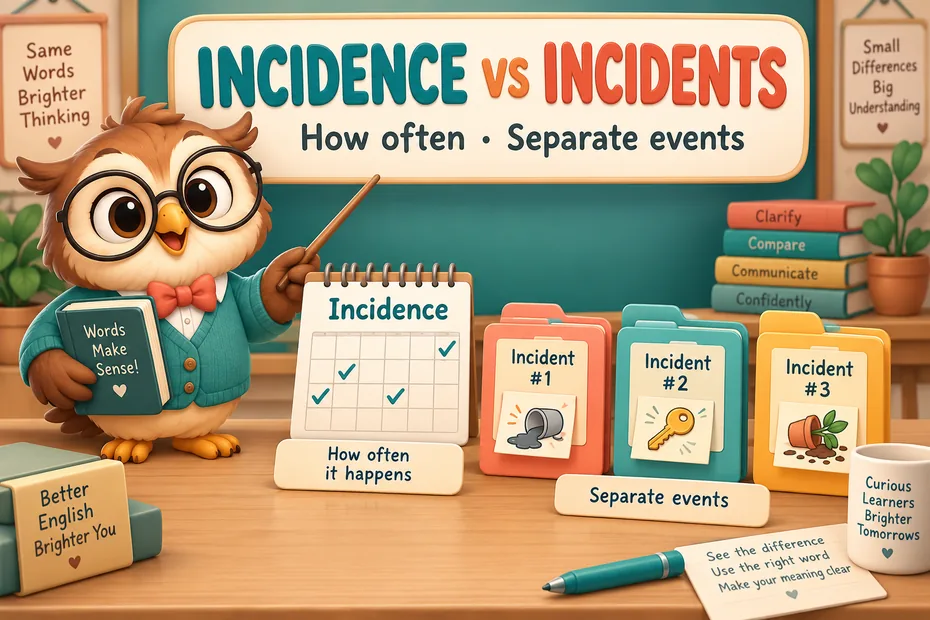
Incidence vs. incidents: the quick answer
Incidence usually refers to occurrence or the rate at which something happens. Incidents is the plural of incident, meaning separate events. “The incidence of errors declined” discusses how often errors occurred. “Three incidents were reported” counts individual events.
Choose by what you want to say: a frequency or pattern, or a set of particular happenings. The words can sound very similar, but their grammar also differs. “The incidence is low” uses a singular subject. “The incidents are recorded” uses a plural subject.
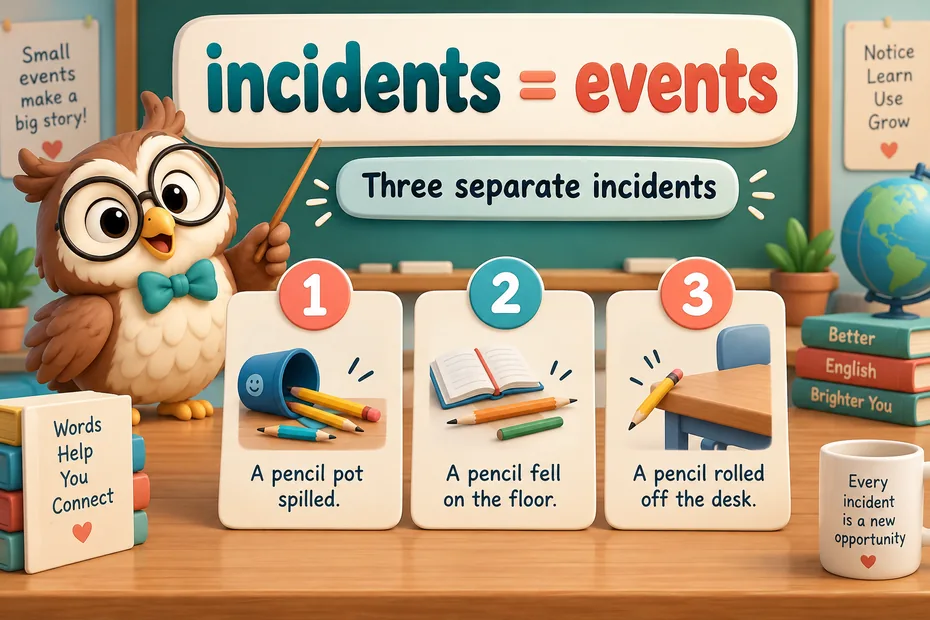
Key facts
- Incidence: commonly used for occurrence or rate, often in the incidence of.
- Incident: one event; incidents means more than one.
- Agreement: incidence is, but incidents are.
- Common descriptions: high or low incidence; isolated or repeated incidents.
- Spelling: incidence ends in -ence; incidents keeps the t of incident before its plural s.
Merriam-Webster’s incidence entry distinguishes rate or occurrence from the event meaning discussed in its incident entry. It also notes that using incidences to count separate events is often criticized. In that context, incidents is the clearer choice.
Using incidence for a pattern
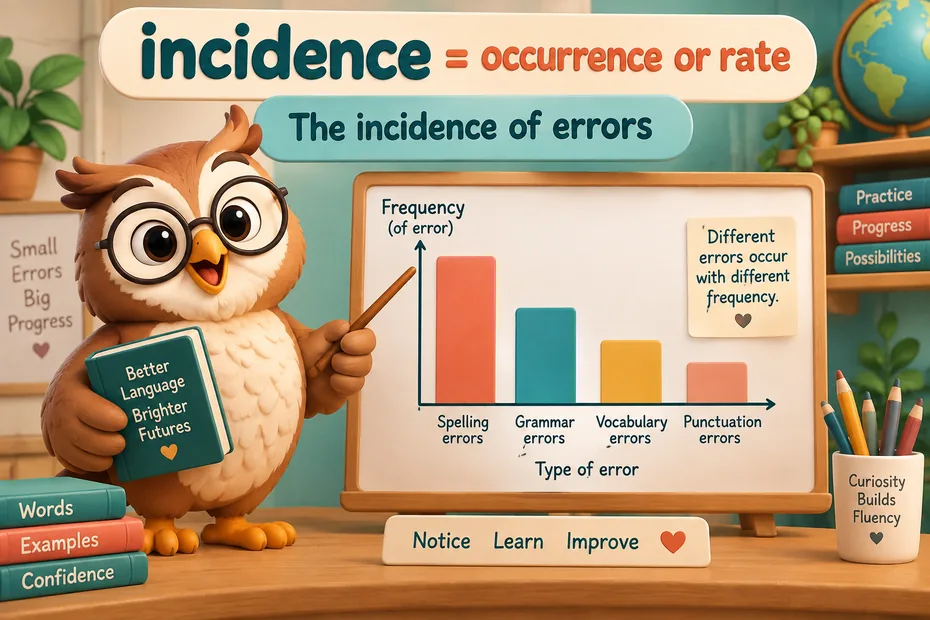
A sentence about incidence focuses on occurrence across some context. “The incidence of spelling errors was lower in the revised draft” compares a pattern in two versions. To make such a statement meaningful in a real report, explain what was counted and how the comparison was made. The word alone does not establish a measurement method.
Useful patterns include a high incidence of, a low incidence of, the incidence increased, and the incidence declined. An original example is “The workshop examined the incidence of late submissions.” This tells the reader what pattern the workshop examined, rather than listing each late submission individually.
Do not treat a raw count as a fully described rate. If a report says “ten incidents,” it has stated a number of events. To compare how often something happens, the relevant context may include a time period, population, workload, or other basis. For a vocabulary exercise, avoid inventing real statistics simply to demonstrate the word.
Using incidents for particular events
Incidents is countable. Say one incident, two incidents, or several incidents. “The report described two separate incidents” refers to two happenings. “The incidence was two separate events” blurs the intended event count and is better rewritten with incidents.
Not every incident must be a crime or disaster. An event can be minor, unusual, embarrassing, or otherwise worth describing. “The teacher recorded three minor incidents during the rehearsal” leaves their nature open. If they were pencil spills or interruptions, state that detail instead of making the word sound more alarming than the facts support.
For plural agreement, write “The incidents were recorded” and “Several incidents have been discussed.” The singular forms are “The incident was recorded” and “One incident has been discussed.” A final s changes the event noun’s number, so the surrounding verb may need to change too.
Incidence, incidents, and instances
Instance can mean a particular example or case. “This is an instance of unclear wording” points to one example. Its plural is instances. If you are counting examples in a grammar exercise, instances may express your purpose better than incidents, which often suggests a discrete event.
Compare “The incidence of interruptions increased”; “Three incidents interrupted the rehearsal”; and “We identified three instances of the same spelling error.” The first describes a pattern, the second describes events, and the third identifies examples. The different words help readers see what kind of information you are presenting.

Comparison with original examples
| Purpose | Choice | Example |
|---|---|---|
| Describe frequency | Incidence | The incidence of missing labels was low. |
| Count events | Incidents | Two incidents delayed the rehearsal. |
| Name one event | Incident | The incident was described briefly. |
| Identify examples | Instances | We found several instances of repetition. |
Corrections that improve clarity
“Three incidences occurred yesterday.” If you mean three separate events, write “Three incidents occurred yesterday.”
“The incidents of errors is low.” If you mean how often errors occur, write “The incidence of errors is low.” If you mean the individual errors, state the count or describe them directly.
“The incidence are increasing.” Use “The incidence is increasing” for the singular frequency noun. Use “The incidents are increasing in number” if you mean a growing count of particular events.
“Incidence always means disease cases.” That rule is too narrow. The word has general occurrence uses and specialized meanings, including in optics. A specialist context may require a more technical definition.
Practice and answers
- The report described four separate _____.
- The _____ of errors was lower after revision.
- One _____ delayed the meeting.
- The incidents _____ recorded. (was or were)
- We found two _____ of repeated wording. (examples)
Answers: incidents; incidence; incident; were; instances.
Frequently asked questions
Is incidents the plural of incidence?
No. It is the plural of incident. The similar sound can disguise the different spelling and meaning.
Should I use incidences for events?
For ordinary writing about separate happenings, use incidents. For examples or cases, consider instances.
What is the quickest check?
Ask “how often?” for incidence and “which events or how many events?” for incidents. Then check subject–verb agreement.
Have you ever wondered about the difference between “incidence” and “incidents”? Well, I’ll shed some light on this common confusion and help you use these words appropriately. In this text, I’ll explain the nuances between “incidence” and “incidents” and provide examples to illustrate their correct usage.
Understanding the distinction between these two words is crucial for effective communication. While “incidence” refers to the occurrence or rate of something, “incidents” are specific events or occurrences. By using these terms correctly, you can avoid misunderstandings and convey your message with precision.
So, let’s immerse and explore the differences between “incidence” and “incidents” and learn how to use them appropriately in various contexts. Whether you’re a writer, student, or simply curious about language, this article will equip you with the knowledge to express yourself accurately and confidently.
Key Takeaways
- The word “incidence” refers to the rate, frequency, or occurrence of something, while “incidents” are specific events or occurrences.
- “Incidence” is used to discuss the overall occurrence or frequency of specific events, such as cases of COVID-19 or car accidents.
- “Incidents” are plural nouns used to highlight individual occurrences or events, such as incidents during a protest or issues the police had to address.
- Understanding the distinction between “incidence” and “incidents” is crucial for effective communication and avoiding misunderstandings.
- “Incidence” is often used in healthcare, statistics, and other fields to measure the rate or likelihood of something happening, while “incidents” are used to describe specific occurrences in different contexts.
- It is important to use “incidence” when referring to rates or frequencies and “incidents” when referring to specific events or occurrences.
Incidence vs Incidents: Understanding the Difference
When it comes to the English language, there are many words that can easily be confused, leading to misunderstandings in communication. One common example is the difference between “incidence” and “incidents.” In this section, I’ll explain what each word means and provide examples to help you understand how to use them appropriately.
Definition of Incidence
The word “incidence” refers to the rate, frequency, or occurrence of something. It is used to describe the number of times a specific event happens within a given time period. For example:
- The incidence of COVID-19 cases has been increasing in recent weeks.
- The incidence of car accidents tends to rise during bad weather conditions.
In these examples, “incidence” is used to discuss the occurrence or frequency of specific events – in this case, cases of COVID-19 and car accidents.
Definition of Incidents
On the other hand, “incidents” is a plural noun that refers to individual occurrences or events. It is used when talking about separate, distinct events or happenings. For instance:
- There were several incidents reported during the protest, including vandalism and looting.
- The police responded to various incidents throughout the night, including noise complaints and disturbances.
Here, “incidents” is used to highlight the various separate events that occurred during the protest and the different issues the police had to address during the night.
Examples to Illustrate the Difference
To further illustrate the difference between “incidence” and “incidents,” let’s consider another example:
- The incidence of flu cases has increased this year, and there have been several incidents of people getting sick at the office.
In this example, “incidence” is used to talk about the overall rate or occurrence of flu cases, while “incidents” refers to the specific separate events of people getting sick at the office.
Understanding the distinction between “incidence” and “incidents” is crucial for effective communication. By using these words correctly, you can convey your message clearly and avoid confusion.
In the next section, I’ll investigate into some additional commonly confused words, so keep reading to enhance your understanding of English vocabulary.
The Definition of “Incidence”
When it comes to understanding the difference between “incidence” and “incidents,” it’s important to start with a clear definition of the term “incidence.”
The word “incidence” refers to the rate, frequency, or occurrence of something. It is often used to describe the number of times a particular event or phenomenon happens within a given time frame. Think of it as a measure of how often something happens.
For example, in epidemiology, “incidence” is used to describe the number of new cases of a disease in a specific population over a certain period of time. It helps healthcare professionals and researchers understand the spread and impact of the disease.
In other contexts, “incidence” can also refer to the probability or likelihood of something happening. For instance, in statistics, it is used to calculate the probability of an event occurring within a certain population.
Understanding the definition of “incidence” is crucial for effective communication. It allows us to convey accurate information about the rate or frequency of an occurrence, whether it’s related to health, statistics, or any other field where tracking and analyzing data are important.
Next, let’s explore the word “incidents” and how it differs from “incidence.” But before we do that, let’s take a moment to summarize what we’ve learned about the definition of “incidence”:
- “Incidence” refers to the rate, frequency, or occurrence of something.
- It is often used to describe the number of times an event or phenomenon happens within a given time frame.
- It can also refer to the probability or likelihood of something happening.
With a clear understanding of the definition of “incidence,” we can now move on to discussing the word “incidents” and its usage.
The Definition of “Incidents”
Let’s jump into the definition of “incidents” to deepen our understanding of this frequently confused word.
“Incidents” refers to particular events or occurrences, often with certain implications or consequences. Unlike “incidence,” which is concerned with rates or frequencies, “incidents” focuses on individual incidents that happen. It deals with the specific details of an event rather than its overall occurrence or frequency.
Understanding the distinction between “incidence” and “incidents” is critical because it ensures accurate and effective communication. Using these words appropriately helps convey the correct information and avoids confusion.
Here are a few examples to illustrate the usage of “incidents”:
- In criminal justice, the police documented various incidents in the crime report.
- The captain reviewed the incidents that occurred during the flight before submitting the incident report.
- The safety officer conducted an investigation into the workplace incidents and implemented preventive measures accordingly.
By familiarizing ourselves with the definition of “incidents,” we can use it correctly in our writing and conversations. This understanding allows us to convey specific details and accurately discuss individual events without the risk of miscommunication.
In the following section, we will explore the similarities and differences between “incidence” and “incidents.” Understanding these distinctions will further sharpen our language skills and help us communicate more effectively. So, keep reading to enhance your understanding of these commonly confused words.
Examples of Using “Incidence” and “Incidents”
Now that we have a clear understanding of the difference between “incidence” and “incidents,” let’s explore some examples to further solidify our knowledge and usage of these terms.
Workplace Incidents:
In the context of workplace safety, “incidents” are specific occurrences that have implications or consequences. For example, if someone slips and falls in the office due to a wet floor, it would be considered an incident. This term allows us to focus on individual events and analyze their causes, effects, and preventive measures. We can use the term “workplace incidents” to discuss accidents, injuries, or near misses that happen in a work environment.
Criminal Justice:
In the field of criminal justice, “incidents” refer to specific acts or events that require investigation or legal action. For instance, a robbery or a violent assault would be considered criminal incidents. By using the term “incidents,” we can differentiate between different criminal activities and discuss them individually. This is essential for accurately reporting and analyzing crime rates, patterns, and trends.
Healthcare:
In the healthcare industry, “incidence” and “incidents” can be used in different ways. “Incidence” is often used to indicate the rate or frequency of the occurrence of a particular disease or condition in a population. For example, we can talk about the incidence of heart disease in a certain demographic. On the other hand, “incidents” can be used to describe specific medical events or occurrences. An example of this would be adverse drug reactions or patient falls in a hospital setting.
By incorporating these examples in our vocabulary, we can effectively communicate our thoughts and ideas without any confusion or misinterpretation. Remember, it is crucial to use “incidence” when referring to rates or frequencies and “incidents” when referring to specific events or occurrences.
In the next section, we will investigate into the similarities and differences between “incidence” and “incidents” to further enhance our language skills and communication effectiveness.
Similarities and Differences between “Incidence” and “Incidents”
The distinction between “incidence” and “incidents” is key to precise communication. While both terms are related to events or occurrences, they have different implications and usage.
- Definition: “Incidence” refers to the rate or frequency of something happening, whereas “incidents” highlight specific events
How to Use “Incidence” and “Incidents” Appropriately
When it comes to using the words “incidence” and “incidents” appropriately, it’s important to understand their definitions and the context in which they are used. Let’s jump into it!
Definition of Incidence
Starting with “incidence,” this word is commonly used in healthcare contexts to refer to the rate or frequency of a disease or condition. It helps us understand the occurrence and impact of specific medical events or conditions. For instance, we might discuss the incidence of heart disease in a population to understand how common it is.
Definition of Incidents
On the other hand, “incidents” usually refer to specific occurrences that have implications or consequences. In workplace settings, “incidents” are incidents with implications or consequences such as accidents or injuries. In criminal justice, “incidents” are specific acts or events that require investigation or legal action, like robberies or assaults.
Difference Between “Incidence” and “Incidents”
While both terms share similarities in describing specific occurrences, the key difference lies in their focus. “Incidence” primarily revolves around the frequency or rate of an event, while “incidents” are focused on the specific occurrences themselves. Remember:
- “Incidence” relates to the frequency or rate of a disease or condition.
- “Incidents” pertain to specific occurrences with implications or consequences.
Understanding this distinction enables us to communicate more precisely and avoid any confusion when using these words.
Examples of “Incidence” and “Incidents”
To further solidify our understanding, let’s take a look at some examples:
- The incidence of COVID-19 cases in the city has been increasing steadily.
- A thorough investigation was conducted following the incident of an employee injury at the construction site.
- They discussed the incidents of theft that have been occurring in the neighborhood.
- Researchers are studying the incidence of cancer among different age groups.
By analyzing these examples, we can see how “incidence” and “incidents” are used appropriately in their respective contexts.
Remember, clarity and accuracy are crucial when using these words. Keep in mind the definitions and distinctions above to ensure you convey your message effectively.
Conclusion
Understanding the difference between “incidence” and “incidents” is essential for effective communication. While “incidence” refers to the rate or frequency of a disease or condition, “incidents” are specific occurrences with implications or consequences. By using these words appropriately, we can convey our message accurately and avoid confusion.
In healthcare contexts, “incidence” is commonly used to describe the frequency or rate of a disease or condition. It helps us understand the prevalence and impact of a particular health issue. On the other hand, “incidents” focus on the specific occurrences themselves and provide insight into the individual cases or events.
By providing clear examples, this article has highlighted how to use “incidence” and “incidents” correctly in different contexts. This knowledge can enhance our professional communication and ensure that we convey information accurately.
Remember, the key difference between the two words lies in their focus. “Incidence” emphasizes the frequency or rate, while “incidents” shed light on the specific occurrences. By using these words appropriately, we can communicate with precision and avoid any misunderstandings.
Frequently Asked Questions
Q: What is the difference between “incidence” and “incidents”?
A: The word “incidence” is used to refer to the rate or frequency of a disease or condition, while “incidents” are specific occurrences with implications or consequences. “Incidence” focuses on the frequency or rate of an event, while “incidents” focus on the specific occurrences themselves.
Q: Can you provide examples to clarify the correct usage?
A: Sure! For example, “The incidence of COVID-19 has increased in recent months” is correct because it refers to the rate or frequency of the disease. On the other hand, “There were several incidents of food poisoning at the restaurant” is correct because it refers to specific occurrences with consequences.


