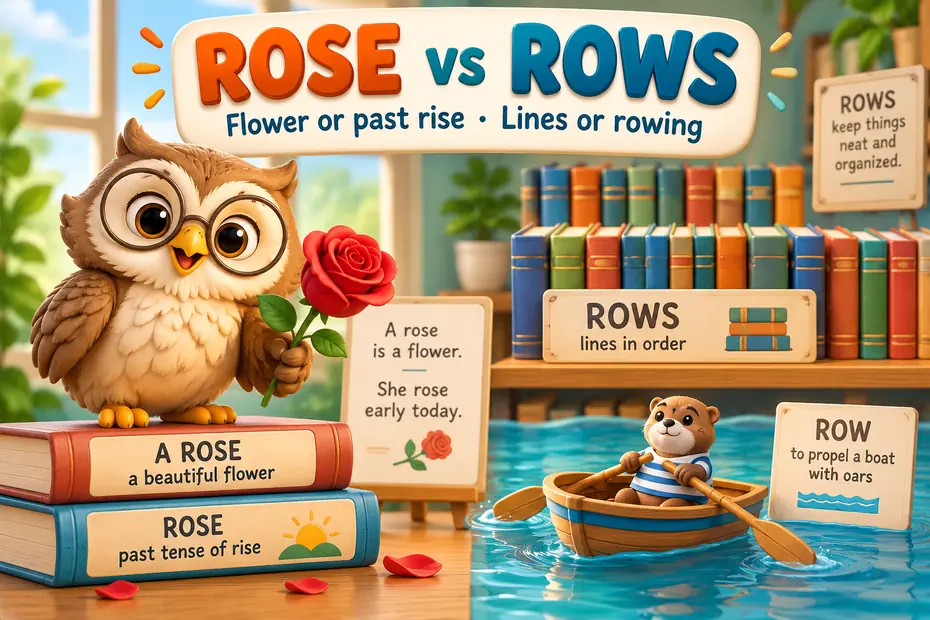
Rose can name a flower or be the past tense of rise. Rows can name lines of things or be a present-tense form of row, meaning move a boat with oars. In those uses, rose and rows sound alike: “A rose grew beside the rows of vegetables.”
What is the quickest rose-versus-rows check?
Use rose for the flower or a past increase; use rows for lines or the rowing action. Read the complete sentence before choosing, because both words have more than one grammatical role. “The water rose” needs a past verb, while “The water reflected the rows of trees” needs a plural noun.
- Flower: “She placed a rose in the vase.”
- Past movement: “The sun rose before six.”
- Lines: “The chairs stood in rows.”
- Boat movement: “He rows across the lake.”
- Plural flowers: “The garden has red roses.”
How does rose work as the past of rise?
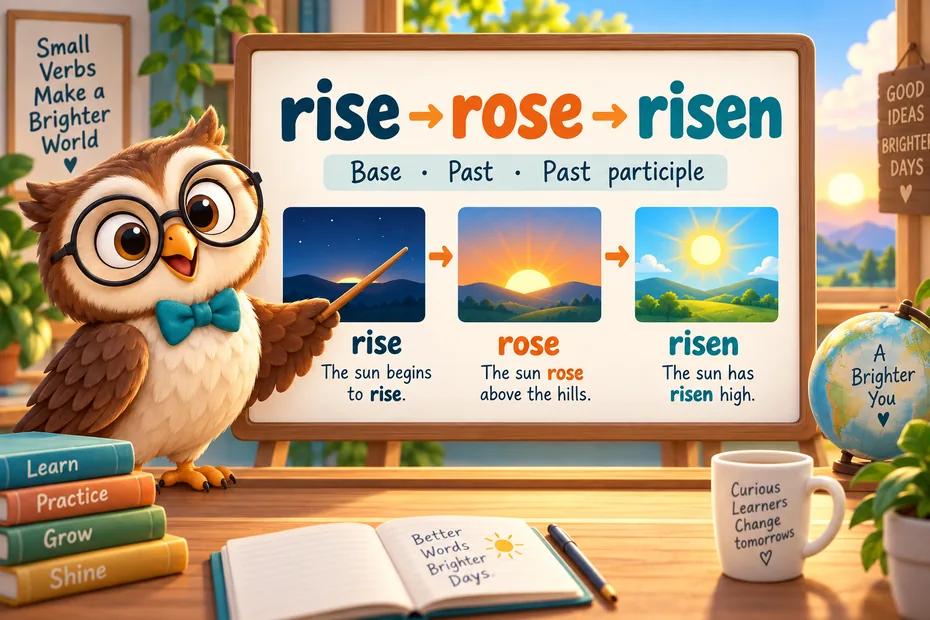
Rose describes a past rising movement or increase. The verb sequence is rise, rose, risen, as recorded by Oxford Learner’s Dictionaries. “The curtain rose” is simple past. “The curtain has risen” uses the participle after has. “The curtain will rise” uses the base form after will.
The same past form works with different subjects: “I rose,” “she rose,” and “they rose.” Do not change rose to roses just because a subject is singular. “The price rose yesterday” is a past increase; “The price rises every spring” is a present pattern. The spelling and helping words tell the reader which time construction you mean.
| Construction | Original model | Form |
|---|---|---|
| Simple present | The water rises slowly. | Rises. |
| Simple past | The water rose slowly. | Rose. |
| Present perfect | The water has risen. | Risen. |
| Past question | Did the water rise? | Rise after did. |

How do rose and roses describe flowers?
Rose is singular; roses is the ordinary plural for the flower. Merriam-Webster’s rose entry separates the flower noun from the past-tense form of rise. “A rose bloomed” names one flower. “Three roses bloomed” names several. The noun’s plural should not be confused with rows.
“Rows of roses” is a useful contrast because it contains both ideas: rows names the arrangement, and roses names the flowers arranged. “There were three rows of roses beside the path” tells the reader how the flower bed was organized. It does not claim that there were only three individual flowers.
The singular count noun normally needs a determiner: “A rose lay on the table,” “The rose lay on the table,” or “One rose lay on the table.” “Rose lay on the table” could instead name a person called Rose. Capitalization and the article help distinguish the common noun from a personal name.
Can rows be a verb as well as a noun?
Yes. Rows is the third-person singular present form of row in the boat-moving sense. “Mina rows the boat” describes Mina’s action. “Mina sits between two rows of seats” uses rows as a plural noun. Merriam-Webster’s row entry records the line noun and the rowing verb.
The retained article’s claim that rows is only a noun is therefore incorrect. A corrected teaching rule is to distinguish the two grammatical uses. With the plural noun, write “The rows are straight.” With the singular subject and verb, write “The rower rows steadily.” The -s endings look alike but mark different things.

Which examples make the meanings visible?
Name the object or event so the reader can tell which meaning you intend. These original examples cover flowers, increases, arrangements, and rowing.
- A pale rose stood in a small glass vase.
- The curtain rose as the music began.
- Her confidence rose after the practice session.
- The books were arranged in three rows.
- Rows of roses lined the narrow garden path.
- He rows the boat toward the landing.
- She rows every weekend when the lake is calm.
- The audience rose from their seats.
To proofread, replace rose with “went up” if it is a verb, or “flower” if it is a noun. Replace rows with “lines” if it names an arrangement, or “moves the boat with oars” if it is a verb. A replacement need not make elegant final prose; it is a check on the intended meaning.
Are rose and rows always pronounced alike?
No: rows has another pronunciation when it means arguments or noisy quarrels. In the line and boat senses, rows rhymes with rose. In the quarrel sense, rows rhymes with cows. The retained comparison focuses on the homophone uses, but a broader dictionary entry contains both pronunciations.
This distinction prevents a misleading universal rule. “They had several rows about the timetable” can concern arguments, while “They reserved several rows for the visitors” concerns seating. Meaning changes the pronunciation as well as the interpretation. If speaking aloud, check which sense the sentence uses.
Frequently asked questions
Is rows the plural of rose?
No. The flower’s plural is roses. Rows is the plural of row when row means a line or arrangement. “Rows of roses” combines the two correctly. If you mean several flowers without specifying their arrangement, write “roses,” not “rows.”
Should I write has rose or has risen?
Write has risen in standard English. Rose is the simple past form, while risen is the past participle used after has or have. “The temperature rose yesterday” and “The temperature has risen” are different constructions; both use the correct form for their pattern.
Can Rose be a person’s name?
Yes. A person named Rose takes a capital letter: “Rose opened the door.” The flower noun normally stays lowercase: “A rose opened in the garden.” At a sentence’s beginning, an article and the surrounding context can help the reader distinguish a flower from a name.
Original explanations, retained with corrections above
Have you ever been confused about when to use “rose” and when to use “rows”? You’re not alone. As an expert blogger, I’ve come across this common dilemma countless times. In this text, I’ll provide you with a clear understanding of when to use “rose” and when to use “rows” in your writing. Understanding the appropriate usage of these words is crucial for effective communication. So, let’s immerse and unravel the mystery behind “rose” and “rows” once and for all.
Key Takeaways
- “Rose” refers to a type of flowering plant or can be used as a verb to indicate upward movement or increase in value/popularity.
- “Rows” is the plural form of the noun “row” and refers to a line of things or a series of actions happening in sequence.
- “Rose” can be used as both a noun and a verb, while “rows” is only used as a noun.
- “Rose” is typically used in the context of nature, gardening, or to indicate upward movement, while “rows” is used in the context of organization, arrangement, or sequence.
Understanding the Difference between “Rose” and “Rows”
When it comes to the English language, there are many words that can be easily confused or misused. Two such words that often cause confusion are “rose” and “rows”. In this section, I’ll provide you with a clear understanding of the difference between these two words and how to use them appropriately in your writing.
Let’s start by defining each word.
- Rose: This word refers to a type of flowering plant belonging to the Rosaceae family. It is known for its fragrant and colorful blossoms. The word “rose” can also be used as a verb, meaning to move upward or to increase in value or popularity. For example, “The sun rose in the morning” or “Her popularity rose after winning the award.”
- Rows: On the other hand, “rows” is the plural form of the word “row”. A row is a line of things, people, or objects arranged side by side. It can also refer to a series of actions or events happening in sequence. For example, “The books were neatly arranged in rows on the shelf” or “The team won three games in a row.”
Now that we have a clear understanding of the definitions, let’s explore the key differences between “rose” and “rows”.
- Part of Speech: “Rose” can be used as both a noun and a verb, while “rows” is only used as a noun.
- Plurality: “Rose” is singular, referring to one plant or one instance of blooming, whereas “rows” is plural, denoting multiple lines or instances.
- Context: “Rose” is typically used in the context of nature, gardening, or to indicate upward movement, while “rows” is used in the context of organization, arrangement, or sequence.
To further illustrate the difference, here are a few examples:
- Rose: She smelled the fragrant rose.
- Rows: The students sat in neat rows in the classroom.
To conclude, understanding the difference between “rose” and “rows” is crucial for effective communication and clear writing. By keeping in mind their definitions, parts of speech, and contextual usage, you can confidently use these words in the appropriate context. So the next time you come across these words, remember the distinction and choose the right one for your sentence.
When to Use “Rose”
One common source of confusion in the English language is the difference between the words “rose” and “rows.” In this section, I’ll focus specifically on “rose” and provide a clear understanding to help you use it appropriately in your writing.
Definition of “rose”
The word “rose” has multiple meanings, but it is most commonly known as a noun that refers to a flowering plant of the genus Rosa. Roses are well-known for their beauty and are often associated with love and romance. Also, “rose” can also be used as a verb, which means to move upward or to get up from a lying or sitting position.
Difference between “rose” and “rows”
Let’s clarify the difference between “rose” and “rows.” Pay attention to the following points:
- Part of Speech: “Rose” is primarily used as a noun or a verb, whereas “rows” is the plural form of the noun “row” and can also be used as a verb.
- Plurality: While “rose” is singular, “rows” refers to multiple items, such as a line of objects or a series of actions.
- Context: The word “rose” typically relates to flowers or movement, while “rows” relates to lines or sequences.
Examples of using “rose”
To better understand the usage of “rose,” let me provide some examples:
- Noun: The rose bloomed beautifully in the garden.
- Verb: She rose from her chair and walked towards the door.
Remember, when using “rose,” it’s essential to pay attention to the context and ensure it aligns with the intended meaning. Understanding the difference between “rose” and “rows” will aid you in effectively conveying your message and writing with clarity.
Examples of “Rose” in Context
When it comes to the word “rose,” there are multiple contexts in which it can be used. In this section, I’ll provide examples of how “rose” is used both as a noun and a verb, giving you a better understanding of its different meanings and usages.
1. “Rose” as a noun:
- As a flower: The rose is often regarded as one of the most beautiful and romantic flowers. Its vibrant colors and delightful fragrance make it a popular choice for gifts and decorations.
- In literature: Many poets have written about the beauty and symbolism of the rose. For instance, in Shakespeare’s famous play, Romeo and Juliet, Juliet exclaims, “What’s in a name? That which we call a rose by any other name would smell as sweet.”
- To rise or move upward: As the sun began to peek over the horizon, the warm glow rose above the mountains, illuminating the world.
- To increase or improve: The company’s profits have rose significantly this year due to their successful marketing campaign.
By providing these examples, it becomes clear that “rose” can refer to a flower or be used as a verb to describe upward movement or improvement. Understanding the different contexts in which “rose” can be used will help you communicate more effectively and use the word appropriately in your writing.
Remember, “rose” and “rows” may sound similar, but their meanings and usage are distinct. It’s important to distinguish between the two to avoid confusion and ensure clear communication.
As we continue to explore the differences between these commonly confused words, let’s now investigate into examples of the word “rows” in context.
When to Use “Rows”
One of the most commonly confused words is “rows” and today, I’ll shed some light on its proper usage and clarify any misconceptions.
The word “rows” is the plural form of the noun “row.” So, when you’re referring to a line of things or a series of actions, you’ll want to use “rows.” Here are a few examples to help illustrate this:
- Definition of “Rows”: “Rows” refers to a group or arrangement of things or actions that are positioned in a line.
- Difference between “Row” and “Rows”: The key difference between “row” and “rows” lies in their plurality. While “row” refers to a single line or series, “rows” denotes multiple lines or series.
When you encounter situations where there are multiple lines or a series of something, “rows” is the correct choice. Let’s take a look at a couple of examples:
- “The shelves in the library are aligned in neat rows.”
- “The students stood in orderly rows during the assembly.”
In these instances, we are referring to multiple lines or series of objects or people. It is essential to use “rows” to accurately convey this meaning.
Understanding the difference between “row” and “rows” is crucial for clear and effective communication. Misusing these terms can lead to confusion and misunderstanding. By using “rows” when referring to a line of things or a series of actions, you can ensure that your writing is grammatically correct and conveys your intended meaning accurately.
Examples of “Rows” in Context
When it comes to using “rows” correctly, context is key. Let me provide you with some examples to help clarify its usage:
- In a garden: Imagine a beautiful garden with neatly arranged plants. You might say, “There are three rows of roses in the garden.” Here, “rows” refers to the lines in which the roses are planted. It helps describe the visual arrangement of the flowers.
- In a spreadsheet: If you work with data and use spreadsheets, you might organize information into rows and columns. For instance, you could say, “Each row in the spreadsheet represents a different month, and each column represents a specific category.” In this context, “rows” signifies the horizontal lines that categorize the data.
- In a theater: Rows are commonly used to organize seating in a theater. For example, you might say, “We had seats in the fourth row for the play.” In this scenario, “rows” represents the lines of seats that allow for orderly seating arrangements.
- In a farm field: Farmers often plant crops in rows to optimize space and help irrigation. You might hear someone say, “The corn is planted in straight rows, creating a uniform appearance.” Here, “rows” refers to the lines of crops.
Remember, using “rows” correctly depends on the specific context and the object or action you are describing. Understanding the difference between “rose” and “rows” is essential for effective communication and clear writing.
In the next section, we will explore additional examples of how to use “rose” appropriately.
Conclusion
Understanding the difference between “rose” and “rows” is crucial for effective communication and clear writing. In this text, I have provided a clear understanding of these two words and how to use them appropriately.
“Rose” refers to a flowering plant and can also be used as a verb, while “rows” is the plural form of “row” and refers to a line of things or a series of actions. The key differences between “rose” and “rows” lie in their part of speech, plurality, and context.
I have given examples of using “rose” as both a noun and a verb, highlighting its versatility in language. Also, I have explained when to use “rows” and provided examples of its proper usage in various contexts, such as a garden, spreadsheet, theater, and farm field.
By understanding the distinctions between “rose” and “rows,” you can avoid confusion and ensure your writing is accurate and precise. Remember to consider the context and intended meaning when choosing between these two words.
So, next time you encounter the words “rose” and “rows,” you can confidently use them appropriately in your writing.
Frequently Asked Questions
Q: What is the difference between “rose” and “rows”?
A: “Rose” refers to a flowering plant or can be used as a verb, while “rows” is the plural form of “row” and refers to a line of objects or a series of actions.
Q: Can you provide examples of using “rose” as a noun?
A: Certainly! Here are a few examples: “She smelled the sweet fragrance of the rose,” “He gave her a bouquet of roses,” and “There is a beautiful red rose in the garden.”
Q: How can I use “rose” as a verb?
A: Here are a few examples: “She rose from her seat,” “The sun rose over the horizon,” and “They rose to the challenge.”
Q: When should I use “rows”?
A: You should use “rows” when referring to a line of objects or a series of actions. For instance, “The garden has neat rows of vegetables,” “The spreadsheet has several rows of data,” “The theater has rows of seats,” and “The farm field is divided into rows for planting.”
Q: Why is it important to understand the difference between “rose” and “rows” in writing?
A: Understanding the difference between these words is crucial for effective communication and clear writing. Using them correctly will ensure that your message is conveyed accurately and avoid any confusion or misunderstandings.


