Pi vs. Pie vs. Pye: The Quick Difference
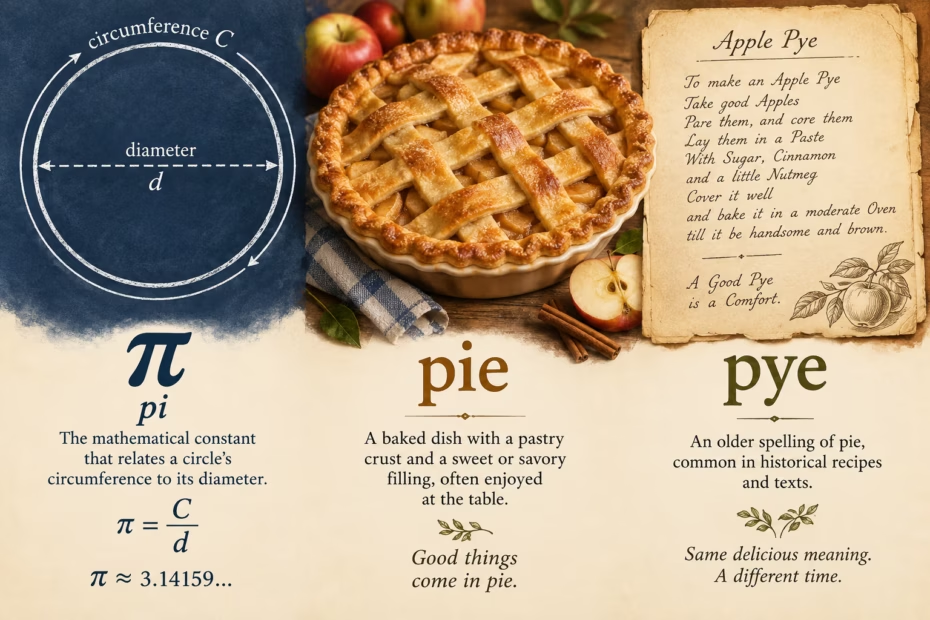
Pi (π) is the mathematical constant used with circles; pie is the familiar spelling for a baked dish and several related expressions; and pye is chiefly an older spelling of pie that you may encounter in historical texts or names. In present-day writing, choose pie for the food. Use pye when you are reproducing a historical spelling or referring to a proper name that uses it.
| Word | Usual meaning today | Example |
|---|---|---|
| pi (π) | The Greek letter or the circle constant, approximately 3.14159 | The circle’s circumference is about 6.28 cm when its diameter is 2 cm. |
| pie | A baked dish, usually with a pastry crust; also used in idioms and compounds | We baked an apple pie for dessert. |
| pye | An archaic or historical variant spelling of pie; occasionally part of a name | The transcription keeps the recipe’s original spelling, “pye.” |
Are Pi, Pie, and Pye Homophones?
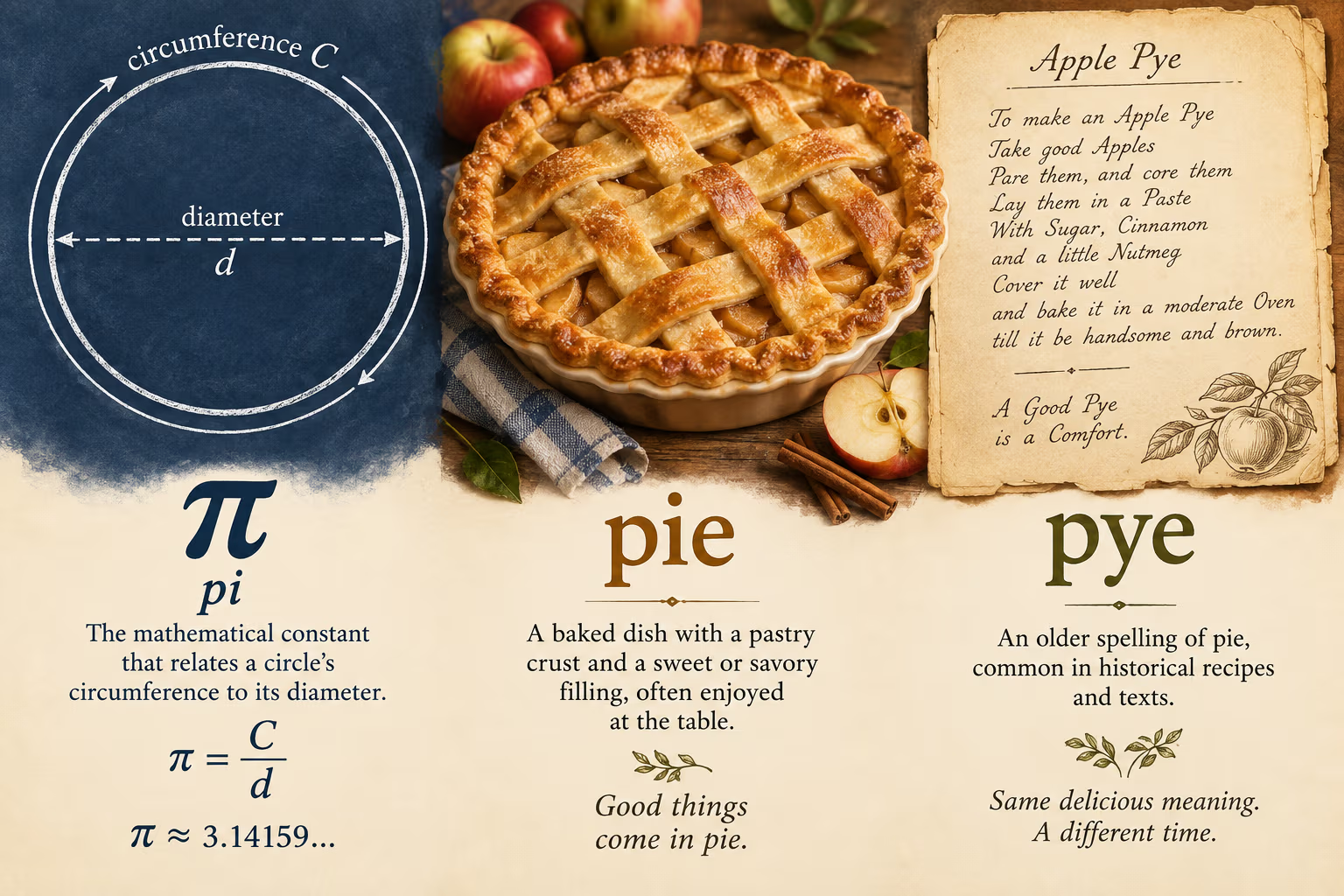
In standard English pronunciation, pi and pie are both pronounced /paɪ/, like the word my with a p. When pye is used as an old spelling of the pastry word, it represents that same spoken word. These spellings are therefore homophones in that context: they sound alike but are written differently and do not have the same everyday meaning. In English, the Greek symbol π is conventionally called “pi,” pronounced /paɪ/. See the Cambridge Dictionary entry for pi for its mathematical sense and pronunciation.
Pronunciation alone cannot tell a reader which spelling you mean. In speech, the surrounding sentence supplies the clue; in writing, spelling does that work. A formula, a recipe, and a quotation from an old cookbook each point to a different choice.
When to Use Pi (π)
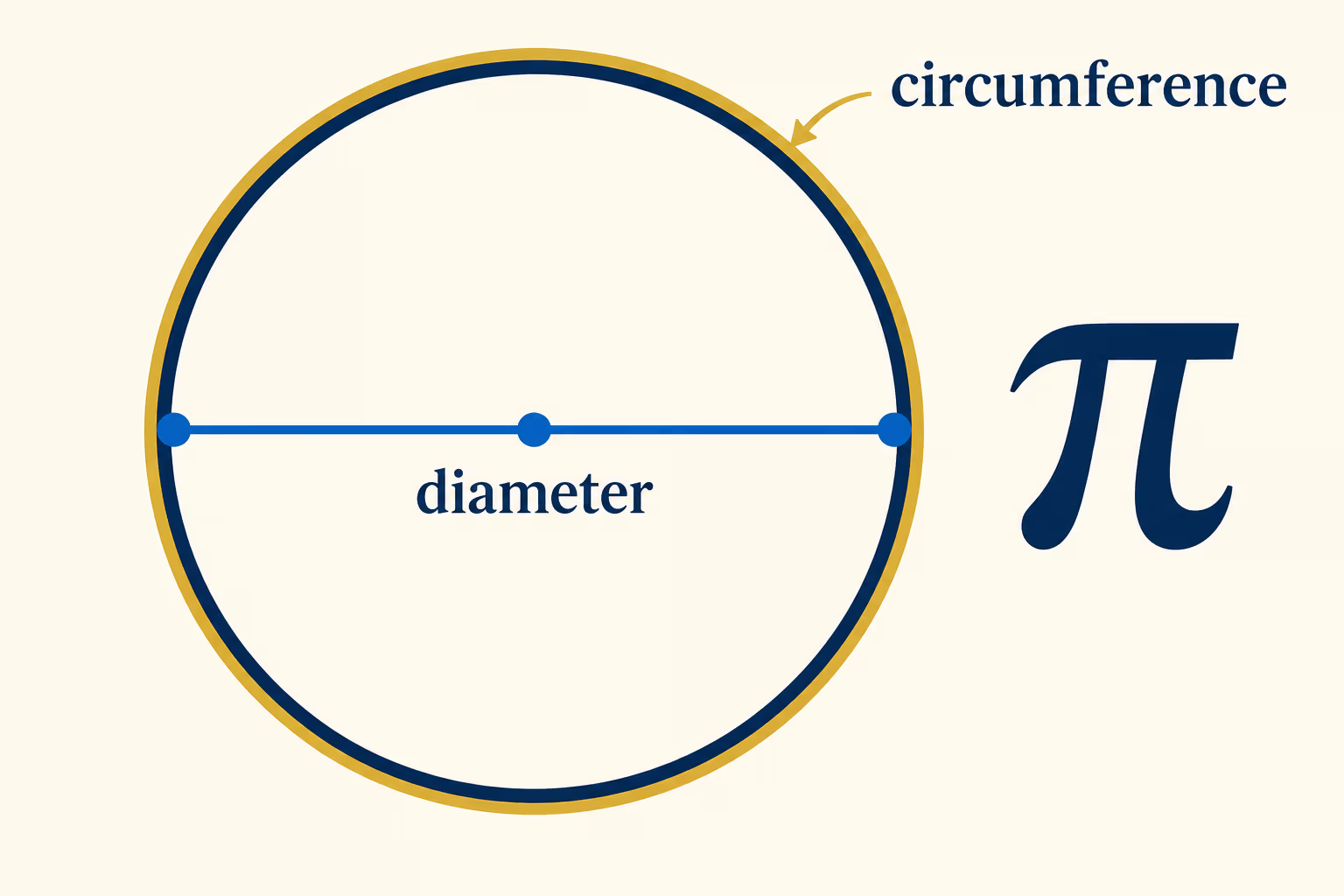
Use pi for the sixteenth letter of the Greek alphabet and, especially, for the mathematical constant written with the Greek lowercase letter π. For any circle, dividing its circumference by its diameter gives the same value: π, approximately 3.14159. The value does not depend on how large the circle is. The NIST Digital Library of Mathematical Functions gives π as the ratio of a circle’s circumference to its diameter. It is irrational, so its decimal expansion continues without ending or settling into a repeating pattern; 3.14 is a convenient approximation, not the exact value.
Two familiar circle formulas show how the constant is used: circumference C = πd (or C = 2πr) and area A = πr². Here d means diameter and r means radius, which is half the diameter. If a circle has a radius of 3 cm, its area is 9π square centimetres, approximately 28.27 cm². Keeping the units matters: radius is a length, while area is measured in square units.
Write the symbol π in equations and the word pi in ordinary prose when that is the style required: “Pi appears in the area formula for a circle” or “The symbol π represents the constant.” Do not write pie for the constant simply because its English name sounds the same.
Examples:
- Using π ≈ 3.14, a circle with a 10 cm diameter has a circumference of about 31.4 cm.
- The radius is 5 cm, so the circle’s area is 25π, or about 78.54, square centimetres.
- In class, we used the Greek letter π to label the constant.
Capital letters can signal abbreviations rather than the mathematical word. For example, PI may stand for “private investigator” in a particular context, while PIE is also an abbreviation for Proto-Indo-European. Those are context-dependent initialisms, not alternate spellings of π.
When to Use Pie
Use pie for the baked food, typically a dish with pastry and a sweet or savory filling, as in the Cambridge Dictionary definition. Examples include apple pie, pumpkin pie, and chicken pot pie. Recipes, menus, and ordinary contemporary prose use pie, not pye. Some regional varieties also call a pizza a “pie,” particularly in parts of the United States; the surrounding food context makes that sense clear.
The Cambridge Dictionary entry for pie records regional and idiomatic senses. The phrase “piece of the pie” is a share of something, such as profits or a market. “Pie in the sky” describes an appealing idea or promise that is unlikely to happen. A “pie chart” displays proportions as sectors of a circle. These expressions still spell the word pie; none uses mathematical pi just because a chart or a share may be circular.
Pie can also be a verb in informal usage, meaning to throw a cream-filled pastry at someone, usually as a prank or protest. Cambridge Dictionary records this verb as well as the food noun. Cambridge also records this informal verb sense. The verb is less common than the noun, so context should make it unmistakable: “The performer pied the volunteer with a custard pie.”
What Does Pye Mean?
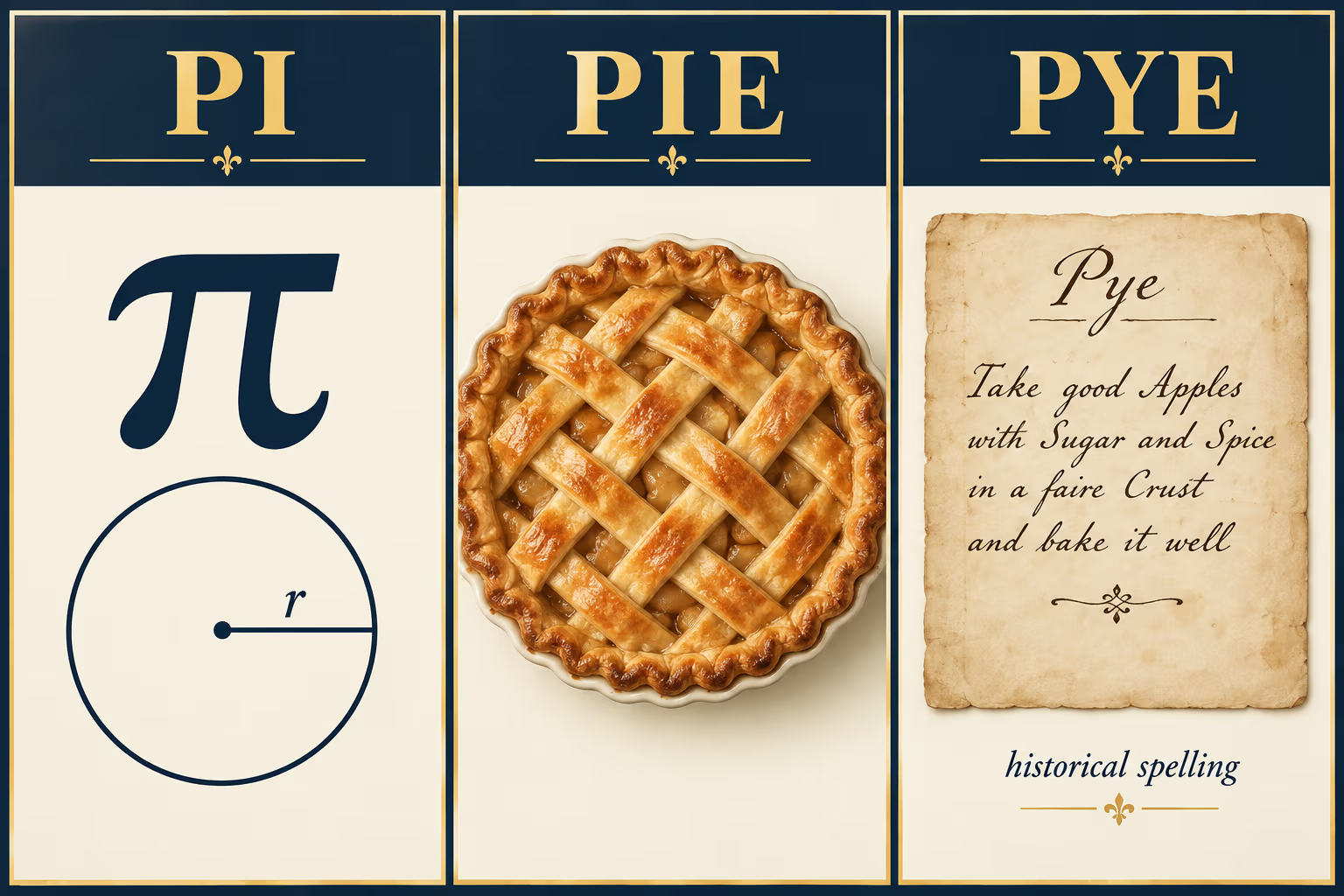
Pye is documented as an older variant spelling of the food word pie, including in historical recipes and older writing; see the Dictionary.com entry for pye and its cited Collins definition. An example appears in Hannah Glasse’s eighteenth-century cookbook The Art of Cookery Made Plain and Easy: a transcribed “Cheshire pork pye” recipe preserves the older spelling. Historical spelling was not always standardized as it is in edited modern prose, so seeing pye in an old source does not mean it is the preferred spelling today.
When quoting or transcribing a historical document, preserve pye if it is what the source prints; if helpful, add [pie] or a note to clarify the modern spelling. When you are writing a new recipe, menu, school assignment, or email, use pie. Keep the old spelling in a proper name only when that name’s official form uses it. Historical dictionaries such as Wiktionary’s entry for pye also record other old senses, so consult the specific source and date instead of assuming every occurrence means pastry.

Pi, Pie, and Pye in Example Sentences
- Pi: The diameter of the circle is 8 inches, so its circumference is 8π inches.
- Pi: The students compared 22/7 with the decimal approximation 3.14 for pi.
- Pie: She let the apple pie cool before cutting it into slices.
- Pie: The report’s pie chart showed how the budget was divided.
- Pie: Each partner wanted a larger piece of the pie.
- Pye: The museum label notes that the 1700s recipe spells the dish “pye.”
- Pye: The editor retained “mince pye” in the quotation and explained it in a note.
These examples also show a practical test: if the sentence is about measurement or a circle formula, write pi or π; if it is about food or an expression built from the food word, write pie; if you are discussing or reproducing an older form, write pye and make the historical context clear.
Common Pi, Pie, and Pye Mix-Ups
| Confusing sentence | Clearer version | Reason |
|---|---|---|
| The recipe says to add pi to the filling. | The recipe says to add pie filling. | Pi is the mathematical term; pie is the food. |
| We used pie to calculate the circle’s area. | We used π (pi) to calculate the circle’s area. | The constant is pi, often written with π. |
| I baked an apple pye for the class. | I baked an apple pie for the class. | Use the current standard spelling in new writing. |
| The museum transcribed the old recipe as “pie.” | The museum transcribed the old recipe as “pye.” | Retain the original spelling when quoting a source that actually uses it. |
The last example depends on the source: if the old page prints pie, do not change it to pye for a period flavor. Accurate transcription follows the document rather than guessing at what looks old-fashioned.
Quick Editing Checklist
- Is the sentence about a mathematical circle constant? Use pi or π.
- Is it about a baked dish, a share, “pie in the sky,” or a pie chart? Use pie.
- Does the spelling come from a historical quotation or a proper name? Keep pye only when the source or official name supports it.
- Would the reader know which meaning you intend from context? If not, add a short explanation.
For example, instead of writing “The pi was divided among four people,” specify “The pie was divided among four people” for a dessert or “The project’s budget share was divided among four people” for an allocation. Clear nouns prevent the shared sound from creating a written ambiguity.
Frequently Asked Questions
Is pye a correct spelling of pie?
Pye is a documented older spelling and can be correct when reproducing a historical source or a name that officially uses it. For a modern recipe or ordinary prose, pie is the standard choice.
Do pi and pie sound the same?
Yes. In standard English, both are pronounced /paɪ/. The mathematical letter π is conventionally named “pi” in English, which sounds like pie.
Is pi always 3.14?
No. 3.14 is a rounded approximation. Pi is an irrational constant whose decimal digits continue indefinitely without repeating; use as many digits as the calculation requires.
Can pye mean something other than a pastry?
It can. Historical dictionaries record more than one old or specialized sense, and Pye may also appear in a surname or proper name. Check the source and context instead of assuming the modern food meaning.
Should I capitalize pi?
Write pi in lowercase in ordinary prose and use the lowercase Greek symbol π in formulas. Capitalize it only at the start of a sentence or when a particular style, title, or abbreviation calls for capitals.
Summary: Choosing the Right Spelling
Use pi for the circle constant or Greek letter, pie for the baked dish and its familiar expressions, and pye when faithfully referring to a historical spelling or a name. The words may sound alike, but a sentence’s subject, notation, and time period make the intended spelling clear.
Have you ever found yourself confused about when to use “pi,” “pie,” or “pye”? Well, fear not, because I’m here to shed some light on this delightful trio of words. In this text, I’ll guide you through the proper usage of “pi,” “pie,” and “pye,” so you can confidently wield them in your writing.
First, let’s start with “pi.” Derived from the Greek letter π, “pi” is a mathematical constant representing the ratio of a circle’s circumference to its diameter. It’s a crucial element in geometry and trigonometry, and it pops up in various scientific and mathematical contexts.
Next up, we have “pie.” Ah, the word that brings to mind warm, flaky crusts and delectable fillings. “Pie” refers to a baked dish made with pastry and a sweet or savory filling. From apple pie to shepherd’s pie, this word evokes images of comfort and indulgence.
Finally, we have “pye.” Now, you might be scratching your head wondering what this word is all about. Well, “pye” is an archaic spelling of “pie,” often used in old English literature and recipes. While it may not be as commonly used today, it adds a touch of nostalgia and historical charm to your writing.
So, whether you’re discussing mathematical concepts, describing mouthwatering desserts, or adding a vintage flair to your prose, understanding the appropriate use of “pi,” “pie,” and “pye” is essential. Let’s immerse and explore each word’s unique role in our language.
Key Takeaways
- “Pi” (π) is a mathematical constant representing the ratio of a circle’s circumference to its diameter.
- “Pie” refers to a baked dish made with pastry and a sweet or savory filling, and it has a long history as a culinary treasure.
- “Pye” is an archaic spelling of “pie” often found in old English literature and recipes.
- “Pi” is used in mathematical contexts, while “pie” is used when discussing the pastry dish. “Pye” is primarily used in historical or literary contexts.
- Understanding the appropriate use of “pi”, “pie”, and “pye” is essential to avoid confusion and communicate effectively.
- “Pie” holds cultural significance and has become an enduring culinary treasure enjoyed in various settings.
What is “Pi”?
In this section, I’ll explain the definition and significance of “pi”.
“Pi” (π) is a mathematical constant that represents the ratio of a circle’s circumference to its diameter. It is an irrational number, which means it goes on infinitely without repeating. The value of pi starts with 3.14 but continues indefinitely, with decimal places that have been calculated to trillions.
The importance of pi lies in its applications in geometry and trigonometry. It is used to calculate the area and circumference of circles, as well as to solve problems involving angles, arcs, and curves. Pi plays a fundamental role in many mathematical formulas and equations, making it a vital concept for students studying mathematics and related fields.
Understanding the difference between the words “pi,” “pie,” and “pye” is crucial to avoid confusion. While “pi” refers to a mathematical constant, “pie” is a delicious baked dish made with pastry and filling. “Pye,” on the other hand, is an archaic spelling of “pie” that is found in old English literature and recipes.
Now that we have a clear understanding of what “pi” is, let’s explore the next section to investigate into the world of “pie” and its mouthwatering variations.
The Delight of “Pie”
As we dive deeper into the world of words, let’s take a break from mathematical constants and explore the delightful area of “pie.” A treat that tantalizes taste buds and brings joy to many, “pie” is a delicacy that has stood the test of time. But first, let’s understand the key difference between “pi,” the mathematical constant, and “pie,” the delicious baked dish.
Definition of “Pie”: A traditional “pie” consists of a pastry crust filled with various ingredients such as fruits, meats, or vegetables. This delectable creation is often baked until golden and consumed as a dessert or savory entrée. From classic apple pie to savory chicken pot pie, the possibilities are endless. Pie has been a beloved culinary treasure for centuries, dating back to ancient civilizations.
You might be wondering, what’s the connection between “pie” and “pi”? Well, besides the shared spelling, these words have little in common. While “pi” is a mathematical constant, “pie” is a scrumptious treat made with love and skill in the kitchen.
As a lover of all things culinary, I appreciate the intricacies and diversity of “pie.” There’s nothing quite like the smell of a freshly baked apple pie wafting through the air or the warm flakiness of a homemade crust. It’s a comfort food that brings people together, evoking memories of family gatherings and celebrations. Whether it’s a holiday feast, a casual get-together, or a simple dessert after a long day, “pie” has a special place in our hearts and on our plates.
Unraveling the Mystery of “Pye”
In this section, let’s investigate into the intriguing area of “pye” and uncover its meaning and significance.
Definition of “pye”: “Pye” is an archaic spelling of “pie” that was commonly used in old English literature and recipes. It refers to a baked dish made with pastry and filling. While “pie” is the preferred modern spelling, understanding “pye” helps us appreciate the historical roots of this beloved culinary creation.
Difference between “pie” and “pye”: The main difference between “pie” and “pye” lies in their spelling. “Pye” is an outdated variant of “pie” that is rarely used today. It’s important to note that the use of “pye” should be reserved for historical or literary contexts to maintain accuracy in our language usage.
Appreciating the Historical Context: Exploring the word “pye” allows us to connect with the rich history of English literature and culinary traditions. It’s fascinating to see how language evolves over time and how words like “pye” have transitioned to their modern forms. By understanding the background of “pye,” we can gain a deeper appreciation for the cultural significance of “pie” in various contexts.
Cultural Significance: “Pie” is more than just a delicious dish; it holds cultural significance and has become an enduring culinary treasure. Its versatility allows it to be enjoyed as a sweet dessert or a savory entrée, making it a favorite among people of all ages and backgrounds. “Pie” has the power to evoke nostalgia and bring people together, whether it’s during holiday gatherings, family reunions, or community celebrations.
By unraveling the mystery of “pye” and recognizing its historical context, we can enhance our understanding of the evolution of language and appreciate the timeless appeal of “pie.” So the next time you savor a slice of this delectable treat, you’ll not only enjoy its mouthwatering taste but also have a deeper appreciation for the journey of words that have shaped our language and culture over the centuries.
Keep reading to learn more about the significance of “pie” in different cultures and explore the different types of pies that continue to tantalize our taste buds.
When to Use “Pi”, “Pie”, or “Pye”?
As the previous sections have delved into the definitions and historical context of “pi”, “pie”, and “pye”, it’s essential to understand when and how to use these words appropriately. Let’s take a closer look at the differences and appropriate usage of each term:
“Pi”
- “Pi” (π) is a mathematical constant that represents the ratio of a circle’s circumference to its diameter. It is an irrational number, meaning it goes on infinitely without repeating.
- Use “pi” when discussing mathematical concepts, such as geometry and trigonometry, where it is used to calculate the area and circumference of circles, as well as solve problems involving angles, arcs, and curves.
“Pie”
- “Pie” refers to a delicious baked dish made with pastry and filling. It’s a culinary treasure that has stood the test of time and can be enjoyed both as a dessert or savory entrée.
- Use “pie” when talking about the delectable pastry dish. It’s versatile, comforting, and can evoke memories of family gatherings and celebrations.
- “Pye” is an archaic spelling of “pie” commonly used in old English literature and recipes. While it shares similarities with “pie”, it is primarily used in historical or literary contexts.
- Use “pye” when discussing the historical roots of the word “pie” in old English literature or exploring culinary traditions from the past.
Understanding the differences between “pi”, “pie”, and “pye” is crucial to avoid confusion and use them appropriately in different contexts. By doing so, we can enhance our language skills and maintain accuracy in our written and spoken communications.
Remember, “pi” is the mathematical constant that plays a role in calculations involving circles, while “pie” refers to the delicious pastry dish that is enjoyed globally. “Pye” is an archaic spelling of “pie” used in historical or literary settings. With this knowledge, we can confidently navigate the usage of these words and appreciate their significance in their respective fields.
Now that we have explored the definitions, connections, and appropriate usage of “pi”, “pie”, and “pye”, let’s further unravel the cultural significance and enduring appeal of “pie” in the next sections.
Conclusion
In this text, I have discussed the definitions and appropriate usage of “pi,” “pie,” and “pye.” Understanding these terms is essential to avoid confusion and ensure accurate communication.
“Pi” is a mathematical constant used in geometry and trigonometry to calculate the area and circumference of circles. It plays a crucial role in various scientific and mathematical applications.
“Pie,” on the other hand, refers to the delicious baked dish made with pastry and filling. Whether enjoyed as a dessert or a savory entrée, pie is a beloved culinary creation.
Finally, “pye” is an archaic spelling of “pie” used in historical or literary contexts. While it may not be commonly used today, it adds a touch of nostalgia and authenticity when employed appropriately.
By understanding the distinctions between “pi,” “pie,” and “pye,” we can enhance our language skills and ensure that we use these terms correctly. So, next time you come across these words, you’ll know exactly how to use them in the right context.
Frequently Asked Questions
Q: What is the definition of “pi”?
A: “Pi” is a mathematical constant (approximately 3.14159) used in geometry and trigonometry to calculate the area and circumference of circles.
Q: What does “pie” refer to?
A: “Pie” refers to a delicious baked dish made with pastry and filling that can be enjoyed as a dessert or savory entrée.
Q: What does “pye” mean?
A: “Pye” is an archaic spelling of “pie” used in historical or literary contexts.
Q: Why is it important to understand the differences between “pi,” “pie,” and “pye”?
A: Understanding the differences between these terms is crucial to avoid confusion and use them appropriately, which enhances our language skills and maintains accuracy in our communications.


