
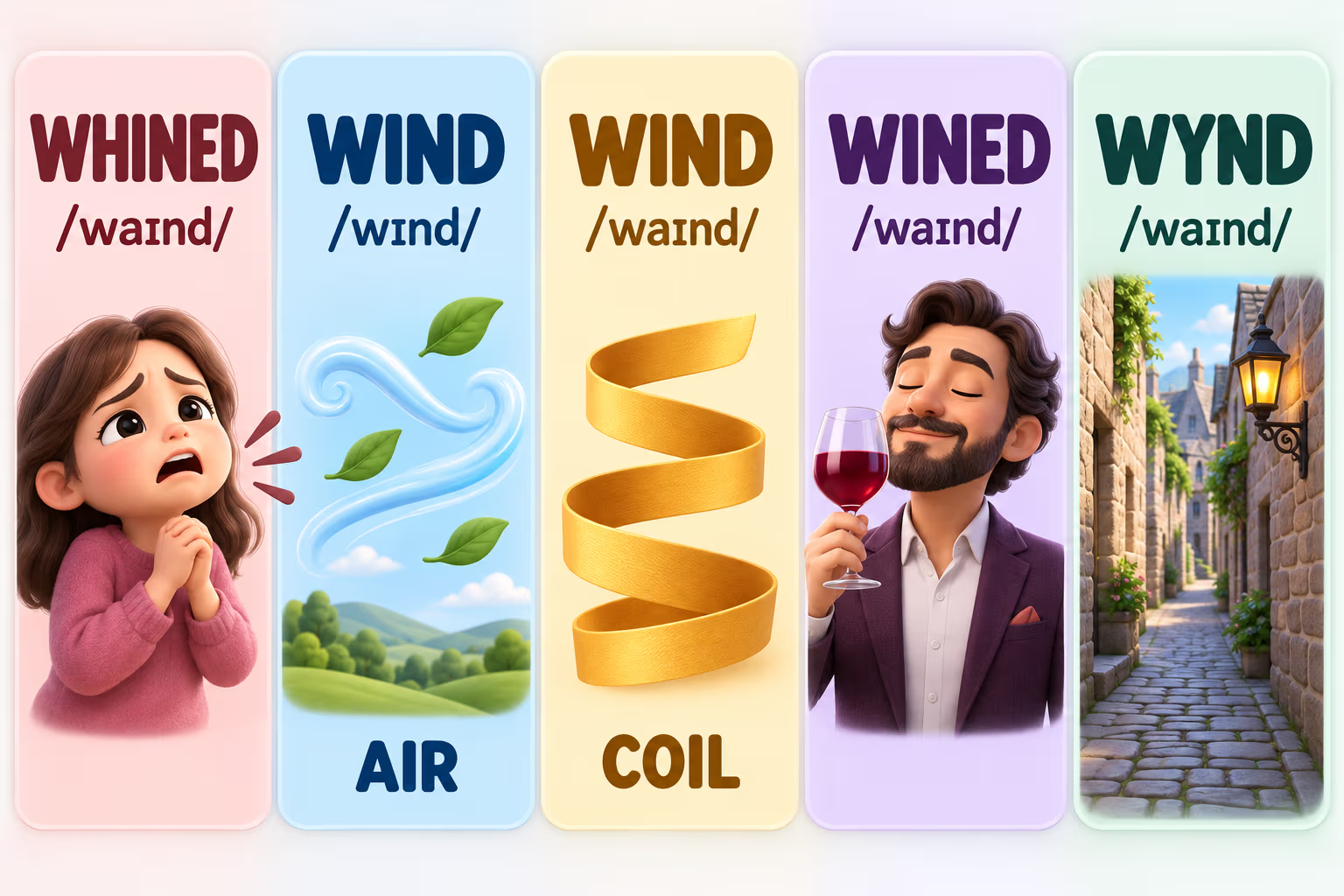
“Whined,” “wined,” and “wynd” are pronounced like /waɪnd/, as is “wind” when it means to coil or turn. The noun “wind,” meaning moving air, is pronounced /wɪnd/. Use context: someone whined, hosts wined their guests, a path wound through town, and a wynd is a lane.
Quick distinction
- Whined /waɪnd/: past tense of whine, meaning complained or made a high, plaintive sound.
- Wind /wɪnd/: moving air, as in “A cold wind blew.”
- Wind /waɪnd/: a verb meaning to coil, twist, or follow a turning course; its past tense is wound /waʊnd/.
- Wined /waɪnd/: past tense and past participle of wine, often seen in “wined and dined.”
- Wynd /waɪnd/: a Scots word for a narrow street or lane, often in a place name.
| Spelling | Pronunciation | Meaning and form | Example |
|---|---|---|---|
| whined | /waɪnd/ | Past tense of whine; complained or made a plaintive sound | The puppy whined by the door. |
| wind (noun) | /wɪnd/ | Moving air | A gust of wind rattled the windows. |
| wind (verb) | /waɪnd/ | To coil, wrap, or turn; past tense wound /waʊnd/ | Wind the cord around the spool. |
| wined | /waɪnd/ | Past tense or past participle of wine | The hosts wined and dined their guests. |
| wynd | /waɪnd/ | Scots noun for a narrow lane or street | They turned into a wynd in the old town. |
Cambridge lists whined as the past form of whine and gives different pronunciations for wind the moving air and wind the coiling verb. Oxford lists wined as both the past simple and past participle of wine. The Dictionary of the Scots Language defines a wynd as a narrow lane or street, often now found in street names. Sources: Cambridge on whined, Cambridge on wind, and Oxford on wine.
Why “Wind” Has Two Pronunciations
The spelling wind represents two words with different vowel sounds. Say the noun for moving air like sin: /wɪnd/. Say the verb for wrapping or turning like find: /waɪnd/. The surrounding sentence usually makes the intended meaning clear: a storm brings wind, while someone winds a watch or winds a path through a forest.
The verb’s past form is wound, pronounced /waʊnd/, as in “She wound the string around the parcel.” That spelling also has another meaning as a noun or verb connected with an injury, so the sentence supplies context there too. Do not substitute wined for wound when describing a coil or turn.
Whined: The Past Tense of “Whine”
Whined is the regular past tense and past participle of whine. It describes a drawn-out, high-pitched sound or a repeated complaint. A person may whine about an unfair rule; a dog may whine when it wants attention. The word can sound judgmental when it describes a person’s complaint, so choose said, asked, or complained when a neutral tone matters.
- After the delay, the travelers whined about missing lunch.
- The small dog whined softly beside the door.
Wined: A Real Past-Tense Form
Wined is a real past-tense and past-participle form of the verb wine. It is especially familiar in wined and dined, which means to entertain someone with food and drink. A host can wine guests by serving them wine; the exact sentence determines whether the emphasis is on drinking wine or providing hospitality.
- The company wined and dined prospective clients.
- They wined together at dinner before walking home.
Wynd: A Scots Word for a Narrow Street
Wynd is a Scots noun for a narrow street, lane, or alley, especially one that leads off a main thoroughfare and may curve. The Dictionary of the Scots Language notes that the word is now chiefly used in street names. It is not a general substitute for wind or wined; use it when referring to that place type or a proper street name.
The source traces the historical Scots form to an Old English form related to turning or twisting. That is more precise than the original passage’s unqualified Old Norse explanation. The pronunciation is commonly given as /waɪnd/, which rhymes with find.
How to Choose the Right Spelling
- If the subject complained or made a plaintive sound, write whined.
- If you mean moving air, write wind with /ɪ/ as in sit.
- If something is coiled or turned, use the verb wind /waɪnd/; for its past tense, use wound.
- If someone drank or provided wine, wined may fit.
- If you mean a Scots lane, use wynd.
In common English pronunciations, whined, wined, wynd, and the coiling verb wind are homophones: they sound alike but differ in spelling and meaning. The air noun wind is the exception. For spelling checks, replace the word with its meaning first: “the gust of moving air” or “complained” makes the choice easier.
Have you ever found yourself confused between words that sound similar but have different meanings? Well, I certainly have. In this text, I’ll be diving into the often mixed-up words: whined, wind, wined, and wynd. Understanding the appropriate usage of these words can make a significant difference in your writing and communication skills.
We’ll start by unraveling the distinction between “whined” and “wind.” These two words may sound alike, but they have completely different meanings. “Whined” refers to a high-pitched complaining or whimpering sound, while “wind” is the movement of air. Knowing when to use each word correctly will enhance the clarity and effectiveness of your writing.
Next, we’ll explore the subtle difference between “wined” and “wynd.” “Wined” is the past tense of the verb “wine,” meaning to treat someone to a glass of wine. On the other hand, “wynd” is a Scottish term for a narrow, winding street. Understanding the nuances between these words will enable you to convey your intended message accurately.
Key Takeaways
- “Whined” refers to a high-pitched complaining or whimpering sound, while “wind” is the movement of air.
- “Wined” is the past tense of the verb “wine,” meaning to treat someone to a glass of wine, while “wynd” is a Scottish term for a narrow, winding street.
- Understanding the difference between “whined” and “wind” is essential for clear communication.
- Knowing when to use “whined” and “wind” correctly can help enhance your writing and communication skills.
- “Wined” refers to the act of enjoying or consuming wine, while “wynd” refers to a narrow lane or alleyway.
- Accurately using “wined” and “wynd” can greatly improve your writing and communication abilities.
Whined vs Wind: Understanding the Difference
In this section, we will explore the difference between “whined” and “wind” to enhance your understanding and usage of these commonly confused words. Let’s immerse and clarify their meanings.
Definition of “Whined”
When we talk about “whined,” we’re referring to a specific sound that is often associated with complaining or whimpering. It’s a high-pitched, nasal sound that is characterized by a repetitive, irritating tone. You might hear someone whine when they’re expressing discontent, seeking attention, or feeling frustrated.
Definition of “Wind”
On the other hand, “wind” refers to the movement of air. It’s a word that can be used as a noun or a verb. As a noun, it describes the natural flow of air, which can be gentle or strong. As a verb, “wind” means to twist or turn something in a circular or spiraling motion. For example, you might “wind” a toy car so that it can move forward or “wind” through a forest path during a relaxing walk.
Pronunciation clarification: The two meanings of wind are also said differently. The air noun is /wɪnd/; the verb meaning “coil” or “turn” is /waɪnd/. The verb’s past tense is wound, not wined. Cambridge’s pronunciation guide separates these forms.
Difference Between “Whined” and “Wind”
The main difference between “whined” and “wind” lies in their meanings and usage. While “whined” is specifically related to a sound associated with complaining or whimpering, “wind” is about the movement of air or the act of twisting or turning something.
To make it clearer, here are a few key points:
- “Whined” is a verb that describes a high-pitched, irritating sound associated with complaining or whimpering.
- “Wind” can be a noun or a verb, with the noun referring to the natural movement of air and the verb meaning to twist or turn something in a circular or spiraling motion.
Knowing When to Use Whined and Wind Correctly
When it comes to writing and communication, understanding the difference between similar-sounding words is crucial. In this section, we will dive deeper into the proper usage of “whined” and “wind.” Let’s take a closer look at the definitions and contexts in which these words are used.
First, let’s clarify the meaning of “whined.” It refers to a high-pitched complaining or whimpering sound. It is often associated with the expression of dissatisfaction or irritation. For example, a child might whine when they don’t get what they want. Remember, “whined” always relates to a vocalization.
On the other hand, “wind” has multiple meanings, both as a noun and a verb. As a noun, “wind” refers to the natural flow of air in the atmosphere. It can also be used in the context of a breeze or gust of wind. As a verb, “wind” means to twist or turn something in a circular or spiraling motion. For instance, you might wind a rope around a pole or wind your way through a maze.
Understanding the difference between these two words is essential to ensure accurate communication. Confusing them can lead to misunderstandings and potentially change the intended meaning of your message.
To help solidify our understanding, let’s look at some examples:
- “She whined about having to do chores all day.” Here, “whined” is used to describe someone complaining or expressing dissatisfaction with a specific situation.
- “The wind blew the leaves off the trees.” In this example, “wind” is used as a noun to describe the natural movement of air.
- “He used a wrench to wind the clock.” Here, “wind” functions as a verb, describing the action of twisting or turning the clock mechanism.
By mastering the correct usage of “whined” and “wind,” you will enhance your writing and communication skills. Remember, practice is key to internalizing these distinctions, so keep honing your skills and use these words appropriately.
Now that we have discussed the proper usage of “whined” and “wind,” let’s move on to another set of words that are often confused: “wined” and “wynd”. Stay tuned for the next section, where we explore their meanings and usage.
Wined vs Wynd: Unraveling the Subtle Difference
Now that we’ve discussed the distinctions between “whined” and “wind,” let’s jump into another pair of words that often causes confusion: “wined” and “wynd.” Even though their similar spelling, these words have completely different meanings and should not be used interchangeably. Understanding the subtle differences between them is crucial for accurate communication and effective writing.
Definition of “wined”: When I refer to the word “wined,” I am not talking about the past tense of the verb “wine.” Instead, “wined” refers to the act of enjoying or consuming wine, usually in a social context. This term emphasizes the experience of drinking wine and often conveys a sense of sophistication or indulgence. It is essential to note that “wined” is not a frequently used word, as the more common verb form is simply “to drink wine” or “to have a glass of wine.”
Correction: The sentence above saying that wined is not the past tense of wine is inaccurate. Oxford lists wined as the past simple and past participle. The form is less common outside phrases such as wined and dined, but it is valid.
Definition of “wynd”: “Wynd” is a term that may not be as familiar to many English speakers. In certain dialects, especially Scottish or British, a “wynd” refers to a narrow lane or alleyway. It is typically found in older towns or cities, filled with historical charm. This word originates from Old Norse, where it meant a winding or curved path. “Wynd” can often evoke a sense of ambiance and intrigue, as it is associated with hidden passageways and secret corners.
Usage and origin clarification: The Scots-language dictionary describes wynd as a narrow street, lane, or alley and says it is now chiefly found in street names. It traces the historical Scots form to an Old English form related to turning or twisting, so the earlier Old Norse explanation is not supported by this source. Read the Dictionary of the Scots Language entry.
- Examples of using “wined” in a sentence:
- Last night, we wined and dined at a fancy restaurant in the heart of the city.
- The resort offers a luxurious spa experience, complete with wined tastings and pairings.
- She was wined and dined by potential investors during her business trip.
- Examples of using “wynd” in a sentence:
- We stumbled upon a quaint wynd while exploring the historic district.
- The atmospheric wynds of Edinburgh are perfect for a leisurely evening
Using Wined and Wynd Appropriately
To effectively communicate and write in English, it is important to understand the subtle differences between words that sound similar but have distinct meanings. In this section, I will focus on the proper usage of “wined” and “wynd”, two words that often cause confusion for writers and speakers. Let’s immerse and explore their definitions and how to use them appropriately.
“Wined” refers to the act of enjoying or consuming wine. It is the past tense of the verb “wine” and is commonly used in sentences like:
- Last night, I wined and dined at a fancy restaurant.
- She eagerly wined and dined her guests with a selection of fine wines.
On the other hand, “wynd” refers to a narrow lane or alleyway, often found in older towns or cities. It is a noun that describes a small, winding street. Here are a couple of examples that showcase the correct usage of “wynd”:
- I took a leisurely stroll down the charming wynd in the historic part of town.
- The festival was held in a picturesque wynd lined with quaint shops and cafes.
It is crucial to understand the precise meanings of “wined” and “wynd” to avoid confusion and ensure accurate communication. While both words may sound similar, their meanings are distinct, and using them appropriately will greatly enhance your writing skills.
By being aware of these nuances, you will be able to choose the right word for the context and convey your message effectively. Remember, accuracy in language usage is key to clear communication. So the next time you write about enjoying wine or describe a narrow alley, make sure to use “wined” and “wynd” appropriately.
In the next section, we will explore some commonly confused words, providing definitions and examples to further enhance your understanding of their correct usage. Stay tuned for more valuable insights into the English language and its intricate vocabulary.
Summary
Conclusion
Understanding the nuances between words that sound similar but have different meanings is crucial for effective communication. In this text, I have explored the confusion surrounding the words “whined” and “wind,” providing clear definitions and examples to illustrate their correct usage. By differentiating between “whined,” which refers to a high-pitched complaining sound, and “wind,” which denotes the movement of air, we can avoid confusion and convey our messages accurately.
Besides, I have introduced another pair of words, “wined” and “wynd,” highlighting their distinct meanings. “Wined” pertains to the enjoyment or consumption of wine, while “wynd” refers to a narrow lane or alleyway. By understanding these subtle differences, we can choose the appropriate word to convey our intended meaning.
Choosing the right word for the context is essential in effective writing and communication. By being mindful of these distinctions, we can ensure our messages are clear and concise. In the next section, I will explore more commonly confused words, providing definitions and examples to further enhance our understanding of their correct usage. Stay tuned for more insights on mastering the English language.
Frequently Asked Questions
Q: What is the article about?
The article discusses the confusion between similar-sounding words, specifically “whined” and “wind,” and later introduces another pair, “wined” and “wynd.” It emphasizes the importance of understanding their distinct meanings for accurate communication and effective writing.
Q: What is the definition of “whined”?
“Whined” refers to a high-pitched complaining or whimpering sound.
Q: What is the definition of “wind”?
“Wind” refers to the movement of air. It can be used as both a noun and a verb, with the noun referring to the natural flow of air and the verb meaning to twist or turn something in a circular or spiraling motion.
Q: What is the definition of “wined”?
“Wined” refers to the act of enjoying or consuming wine.
Q: What is the definition of “wynd”?
“Wynd” refers to a narrow lane or alleyway, often found in older towns or cities.
Q: Why is it important to understand the differences between these words?
Understanding the differences between these words is essential for using them correctly in writing and communication. Choosing the right word for the context is crucial to accurately convey messages and avoid confusion.
Q: What can I expect in the next section of the article?
In the next section, the article will explore some commonly confused words, providing definitions and examples to enhance understanding of their correct usage.
Common Questions About Whined, Wind, Wined, and Wynd
Are “whined,” “wined,” “wind,” and “wynd” homophones?
They rhyme when wind is the verb pronounced /waɪnd/, meaning to coil or turn. In that use, whined, wined, and wynd have the same sound. The noun wind, meaning moving air, is pronounced /wɪnd/ and does not rhyme with them.
Is “wined” the past tense of “wine”?
Yes. Wined is the past simple and past participle of the verb wine. It appears often in wined and dined, meaning entertained with food and drink. Because the form is less common on its own, writers may prefer a more direct phrase such as “served wine” when that is what they mean.
What is the past tense of “wind” when it means to coil?
The past tense is wound, pronounced /waʊnd/: “He wound the cable around the reel.” The present-tense verb is wind /waɪnd/. This is different from wined, the past form of wine, and from wind /wɪnd/, the noun for moving air.
What does “wynd” mean?
Wynd is a Scots word for a narrow street, lane, or alley, particularly one leading off a larger street. It is often preserved in Scottish street names. The word is not a spelling variant of the air noun wind; although it usually sounds like the coiling verb, its meaning and regional use are distinct.
How can I remember which spelling to use?
Attach each spelling to a picture or action: whined is a complaint, wind /wɪnd/ is moving air, wind /waɪnd/ wraps or turns, wined relates to wine, and a wynd is a lane. For the past tense of the coiling verb, remember the irregular form wound.


