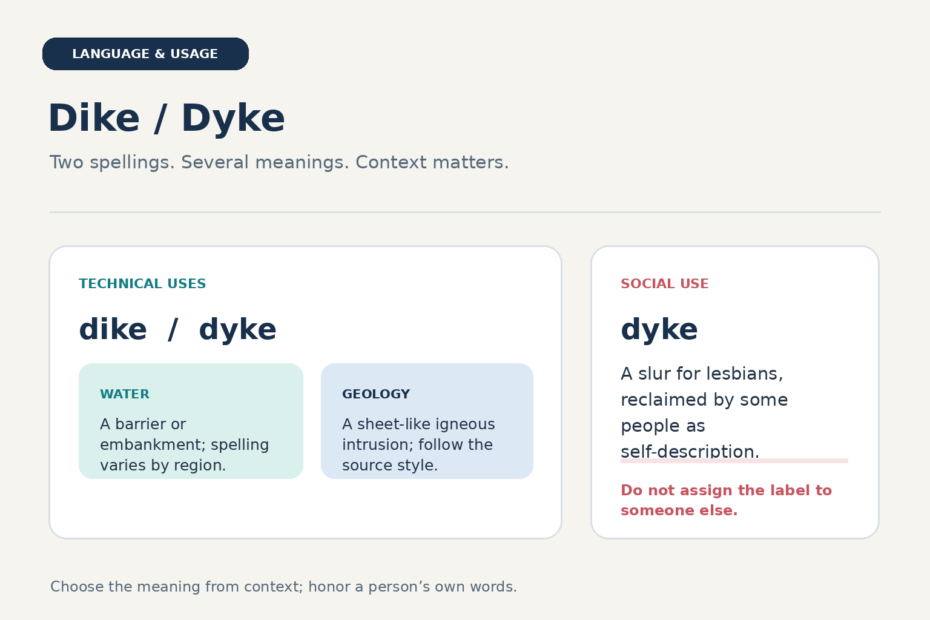
Editorial clarification: The original examples and summaries farther down this page oversimplify the distinction and include examples that should not be treated as a general license to use a slur. In current English, dike and dyke can both be spellings for a water barrier, depending on region and style; both also appear in geology for a sheet-like rock intrusion. Separately, dyke is a slur directed at lesbians and has been reclaimed by some people as a self-description. That reclaimed use is personal and context-dependent. This guide explains those meanings so readers can distinguish them accurately and discuss identity respectfully.
Dike vs. dyke: the short answer
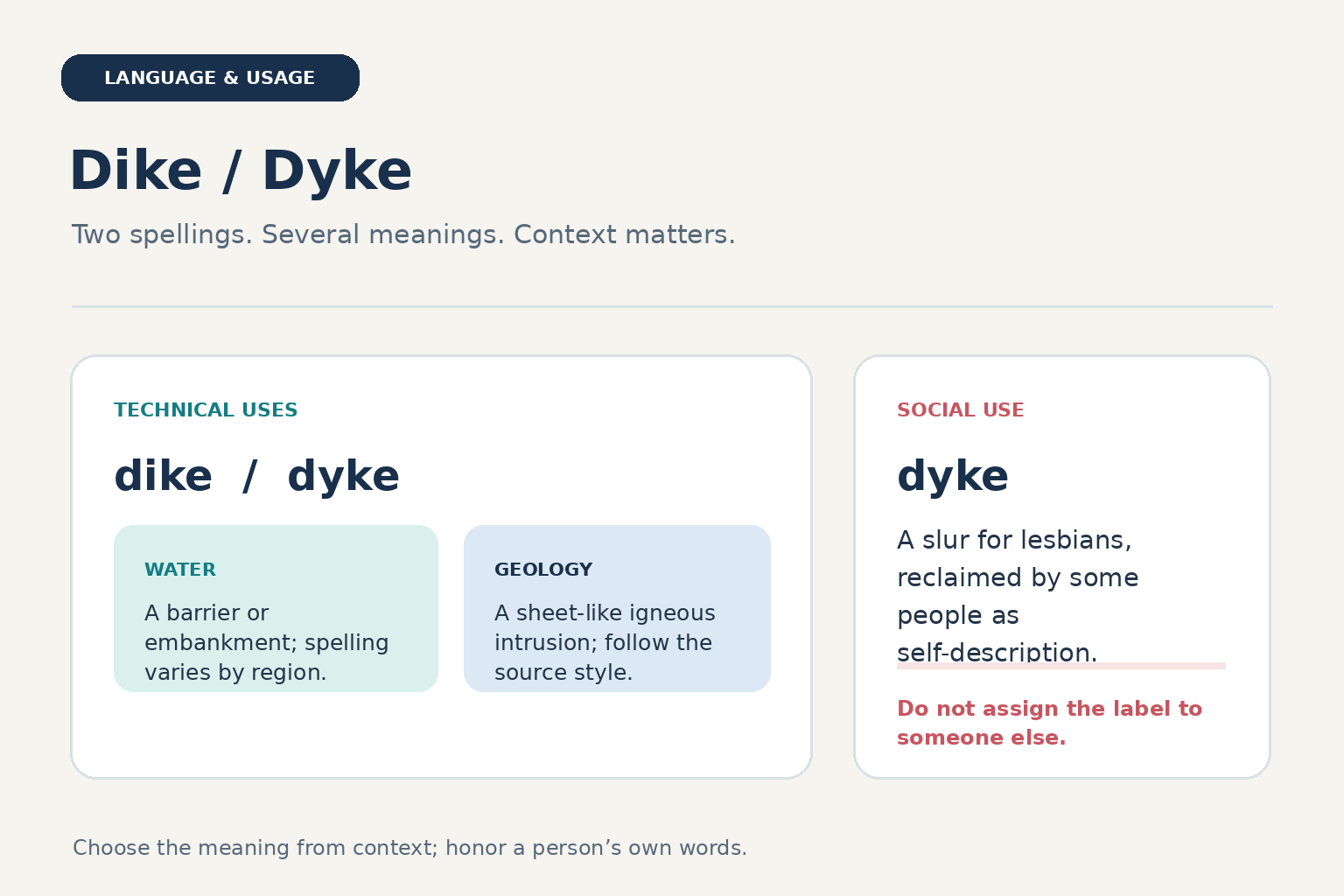
Dike and dyke are pronounced alike. For an embankment that holds back or redirects water, dike is the usual American spelling, while dyke is common in British and other Commonwealth English. In geology, either spelling may be used for a tabular igneous intrusion that cuts across surrounding rock; a publication or map may follow a regional or house style. The spelling alone does not tell you which technical meaning is intended.
The separate identity-related use of dyke is not a neutral synonym that any writer can apply to any lesbian. It has been used as an anti-lesbian slur, and some LGBTQ+ people have reclaimed it for themselves or within particular communities. Because the word remains hurtful to many people, use it for a person only when that person uses it for themself or a source makes that wording relevant. In other situations, lesbian or the person’s own preferred description is clearer and more respectful.
How spelling and meaning depend on context
| Context | What the word means | Useful writing choice |
|---|---|---|
| Flood control or drainage | An embankment, bank, or barrier that contains or redirects water; a drainage channel in some regional uses | Use dike in American English unless an official name or source uses dyke. Follow local spelling elsewhere. |
| Geology | A sheet-like body of igneous rock that cuts across older rock layers | Use the spelling adopted by the geological source, map, or style guide; both forms occur. |
| Identity or social language | Dyke has been a slur for lesbians and is reclaimed by some people as an identity term | Do not assign it to someone. Preserve it in a relevant quotation or a person’s self-identification, with context. |
When the subject is technical, surrounding nouns usually make the sense clear: river dike, drainage dyke, and basalt dike point to land or rock, not a person. In ordinary prose about identity, context still matters, but writers should not rely on readers to guess whether a charged word is being used as a slur, quoted, or reclaimed. Say what you mean directly.
Water barriers: dike, dyke, levee, and embankment
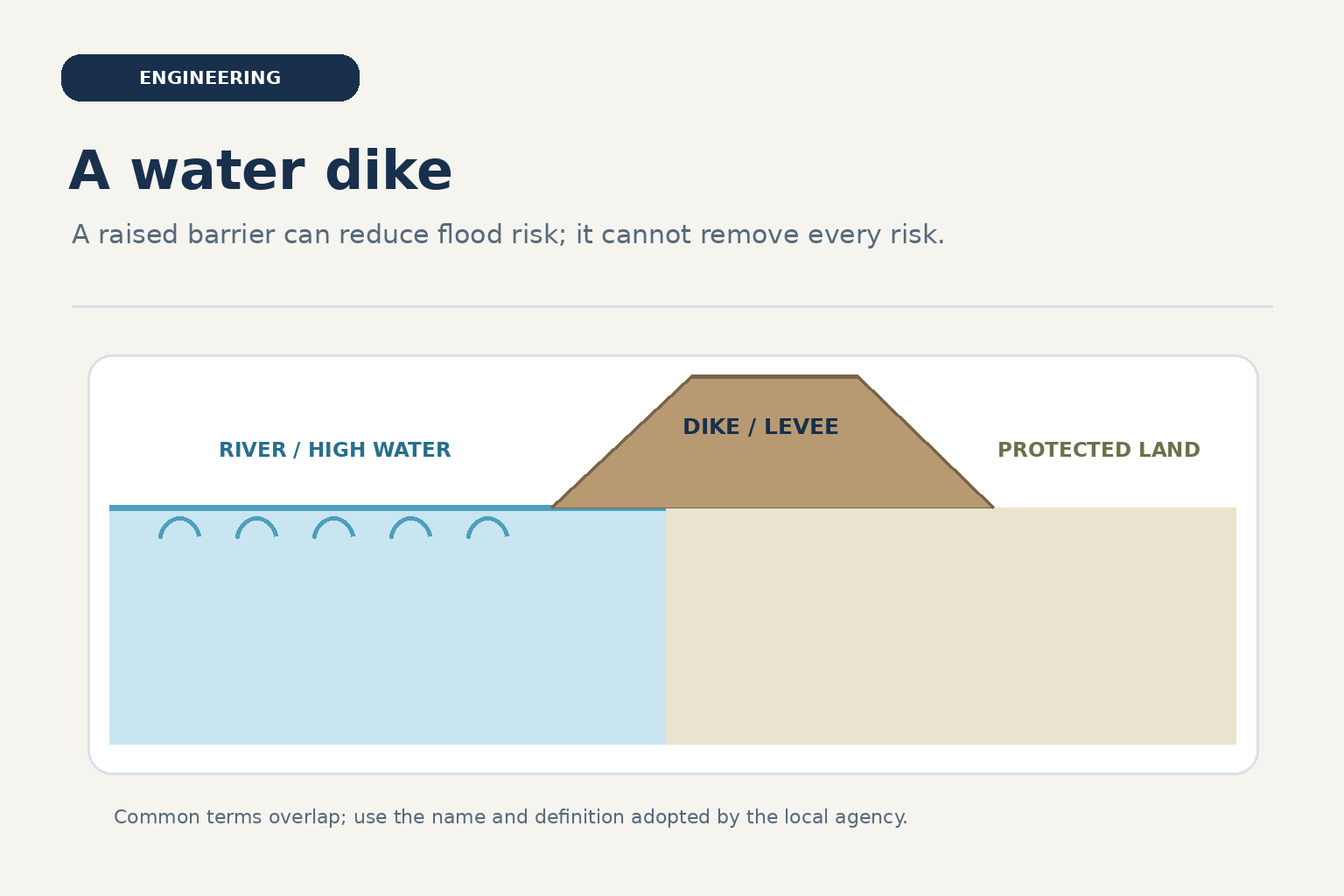
A water dike is a raised barrier built to reduce flooding, guide water, or protect low-lying land. The spelling varies by region: American technical and general writing commonly uses dike, while British usage often uses dyke. Some regional uses also apply dyke to a ditch or drainage channel, so a sentence such as “the dyke carries runoff to the marsh” may describe a channel rather than a raised bank. Check the local meaning when the difference matters.
Levee is another common term for an artificial flood barrier. U.S. Army Corps of Engineers resources describe a levee as a human-made barrier or embankment intended to reduce flood risk. In some settings, engineers, agencies, or communities use dike and levee interchangeably; elsewhere the terms have distinct technical definitions. For a real project, use the name and terminology used by its owner or the responsible local agency instead of assuming every structure works the same way.
These structures reduce risk; they do not make flooding impossible. A technically careful example is: “The district inspected the river dike before the spring flood season.” If a location’s official records call the structure a dyke, retain that spelling in its proper name, even if your surrounding article follows American spelling.
Do not confuse a dike with a dam or a seawall simply because each can affect water. A dam generally holds or controls water across a river or channel, often creating a reservoir; a dike or levee is commonly an elongated barrier that keeps water away from land or directs it along a route. A seawall is typically a coastal structure designed to resist wave action and erosion. Projects can combine these features, so use a source’s exact technical description for a specific site.
Geology: a dike or dyke cuts across rock layers
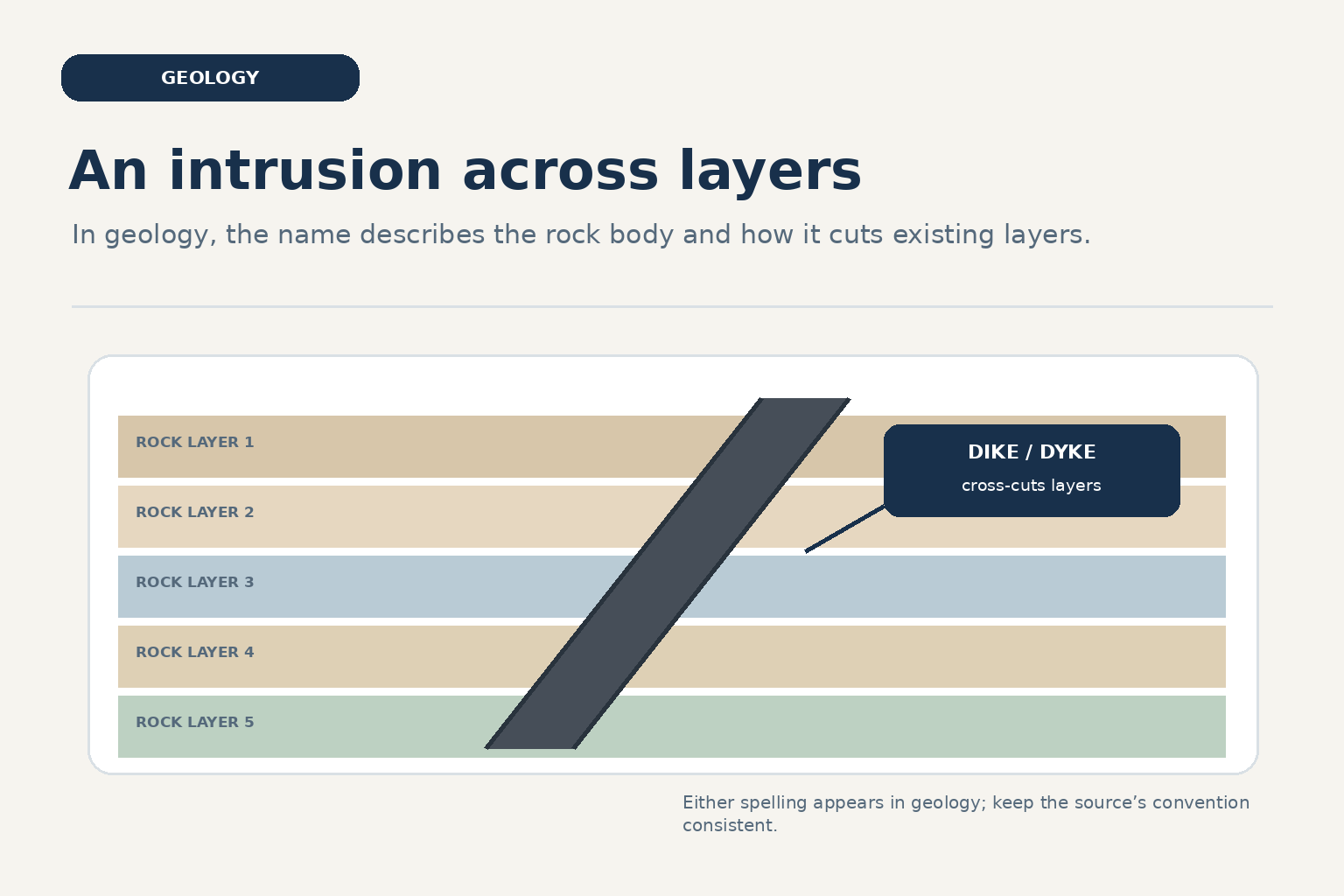
In geology, a dike (also spelled dyke) is a tabular intrusion: magma entered a crack in existing rock and later cooled, leaving a sheet-like body that cuts across the surrounding layers. Dikes may stand out as ridges after softer rock erodes, but “ridge” describes a possible landform, not the definition of the intrusion itself. The U.S. Geological Survey uses dike in its volcano glossary and notes dyke as the British spelling in geological material.
For example: “The basalt dike crosses the older sandstone beds.” Here, crosses describes the intrusion’s relation to the pre-existing layers. Do not confuse this geological feature with a flood-control embankment simply because both can form a long, narrow feature in the landscape. If you are editing a geological report, preserve the author’s chosen spelling and follow the publication’s style consistently.
Related terms have specific meanings. A sill is also a sheet-like igneous intrusion, but it generally runs parallel to existing layers. A fault is a fracture along which rocks have moved. These distinctions are useful in science writing, but a reader-facing sentence should briefly define specialized terms rather than assuming everyone knows them.
The identity-related use of “dyke”: history, reclamation, and care
In social language, dyke has been used as an anti-lesbian slur. Some lesbians and other LGBTQ+ people have reclaimed it as a word of identity, solidarity, or community; others find it painful or offensive. There is no universal rule that makes the term positive in every LGBTQ+ setting, and reclamation by some people does not remove the harm it can cause when aimed at someone else.
The safest rule for general writing is simple: do not label another person a dyke. Use lesbian when that is accurate and welcome, or use the description the person has chosen. If a person self-identifies with the reclaimed term, it may be appropriate to reflect that wording in a profile, interview, or first-person quotation when it is relevant and the person’s preference is clear. Do not infer permission from someone’s appearance, politics, relationships, or membership in a broad community.
For journalists and editors, the distinction between reporting a term and adopting it matters. GLAAD’s terminology guidance treats dyke as a derogatory epithet in mainstream reporting, with narrow exceptions for a relevant direct quotation or a person using the term for themself. PFLAG likewise explains that the word has been reclaimed and should be used for self-identification or to reflect how a person identifies. Follow the person’s own preference, the publication’s style policy, and the reason the term must appear.
If a slur is not essential to the story, paraphrase: “The speaker used an anti-lesbian slur.” If the exact word is necessary to document harassment, discuss its history, or preserve a person’s self-description, identify why it appears and avoid repeating it gratuitously in headings, captions, or examples. A content note may help when an article discusses slurs at length. Do not treat a content note as permission to use the word casually.
Reclamation is a process within communities, not a blanket change in a word’s register. A term may be affirming when chosen by one person and painful when imposed on another. Writers should not frame disagreement as a failure to understand reclamation; people can share an identity and still have different relationships to a charged word.
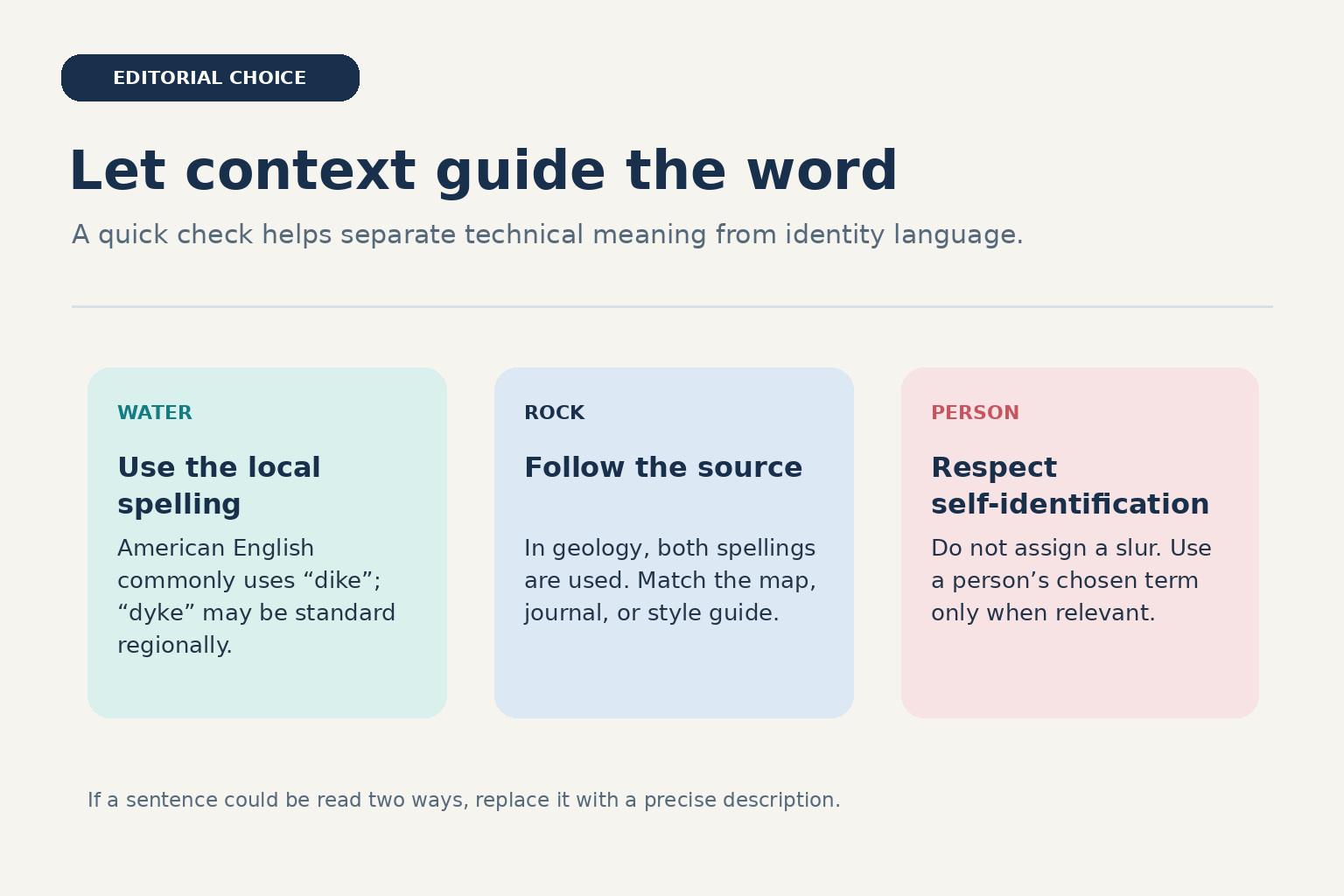
A quick decision guide
- Are you writing about a water-control structure? Use the regional spelling in the source or official name. In U.S. general writing, dike is the usual choice; elsewhere, dyke may be standard.
- Are you writing about rock? Either spelling appears in geology. Match the map, journal, or style guide and explain the term if needed.
- Are you writing about a person or community? Do not use the slur as a label for someone else. Prefer the person’s chosen identity term.
- Must you reproduce someone’s exact words? Keep a quotation only when it is relevant and contextualized. Otherwise, describe the language without repeating it.
- Could the sentence be read two ways? Replace the ambiguous word with a precise phrase such as flood embankment, igneous intrusion, or lesbian, as appropriate.
Examples in sentences
- Water management: “Crews reinforced the dike along the river before the forecast storm.”
- Regional spelling: “The local council’s report calls the coastal barrier a dyke.”
- Drainage channel: “The dyke carries excess water from the field into a managed wetland.” (This regional sense should be clear from context.)
- Geology: “A dark basalt dike cuts through the pale granite.”
- Named feature: “The map preserves the official spelling of the Great Dyke.”
- Self-description: “In the interview, the author describes herself with a reclaimed identity term.” If the exact wording matters and she has chosen to use it publicly, quote her accurately and explain that it is her own term.
- Reporting harassment: “The witness said the sign used an anti-lesbian slur.” This reports what happened without reproducing the slur unnecessarily.
Common mistakes to avoid
- Claiming one spelling always has one meaning. The two forms overlap in engineering and geology, while regional conventions differ.
- Calling the identity-related word a neutral synonym. It has a history as a slur; reclamation is personal and not universal.
- Assuming all lesbians use or accept the reclaimed term. Individual preferences vary. Do not apply the label without permission.
- Inventing a reclaimed example about a real person. Do not attribute an identity or a charged self-description to someone without a reliable, relevant source.
- Overstating what a flood barrier can do. A dike or levee can reduce flood risk but cannot guarantee protection from every event.
- Relying on vague euphemisms. When describing a person, use an accurate identity term if relevant and welcome; when describing a structure or rock feature, name its technical function.
Frequently asked questions
Are “dike” and “dyke” pronounced the same?
Yes. In common English pronunciation, they are homophones. The spelling choice depends on the meaning, region, and style convention.
Is “dyke” always offensive?
No single answer fits every context. It remains a slur when used to target someone, while some LGBTQ+ people reclaim it for themselves or a community. Because many people still find it offensive, do not apply it to someone else; respect a person’s own wording.
Can “dyke” mean a water barrier?
Yes. It is a regional spelling of dike for a barrier or embankment, and some regional dictionaries also record drainage-channel senses. Use the spelling established by the local source or proper name.
Which spelling should I use in a geology paper?
Follow the journal, map, or organization’s style guide. Both dike and dyke are used for a tabular igneous intrusion; consistency and the source’s terminology matter more than assuming the spelling marks a different geological object.
Should a writer censor the slur?
It depends on the purpose and audience. If the exact word is not necessary, paraphrase it. If it is central to a quotation, historical discussion, or person’s self-description, give context, use it sparingly, and follow the relevant editorial policy.
Sources and further reading
- Cambridge Dictionary: “dyke”, including the water-barrier and offensive identity-related senses.
- U.S. Geological Survey Volcano Hazards Program Glossary, definition of a geologic dike.
- U.S. Geological Survey, Geologic Evolution of Gunnison Gorge, which notes dyke as a British spelling variant in a geological example.
- GLAAD Glossary of Terms: LGBTQ, guidance on derogatory terms and self-reference in reporting.
- PFLAG National Glossary, guidance that a reclaimed slur should be used for self-identification or to reflect a person’s own identification.
- U.S. Army Corps of Engineers National Levee Database: What Is a Levee?, overview of levees and their flood-risk-reduction purpose.
Language note: This article discusses a slur because it is part of the spelling question. The word is included only to distinguish its social use from the technical terms; it should not be used to insult or label another person.
As a language enthusiast, I’ve always been fascinated by the subtle nuances and intricacies of words. One such pair of words that often causes confusion is “dike” and “dyke.” While they may sound similar, they have distinct meanings and contexts. In this text, I’ll investigate into the proper usage of these words and help you navigate the sometimes tricky waters of language. We’ll explore their origins, definitions, and provide examples to ensure you can confidently use them in your writing. So, let’s immerse and unravel the mystery of “dike” and “dyke” together.
Key Takeaways
- “Dike” refers to a barrier or embankment used to control or redirect the flow of water, while “dyke” is a derogatory term for a lesbian individual.
- Dikes are geological or man-made structures that prevent flooding or erosion in low-lying areas, while “dyke” has offensive connotations and should be avoided in polite conversation.
- It is important to be respectful and mindful of using appropriate language when referring to someone’s sexual orientation.
- The term “dyke” can also refer to diked areas in low-lying regions, similar to a “dike.”
- By understanding the distinct meanings and proper usage of “dike” and “dyke,” we can communicate accurately and respectfully, avoiding confusion and offense.
- Proper usage examples include discussing dikes in the context of water management or using “dyke” as a reclaimed term within the lesbian community.
What is a dike?
As we jump into the discussion of “dike vs dyke,” it is crucial to understand the difference between these two words. Let’s start by exploring what a dike actually is.
Definition of a Dike:
A dike is a geological formation or man-made structure that serves as a barrier or protection against the potential threats of water. It is commonly known as an embankment or mound that confines or controls water flow, preventing flooding or erosion in surrounding areas. Dikes are typically constructed along rivers, coastlines, or in low-lying areas prone to water accumulation.
Difference between a Dike and a Dyke:
It is important to note that “dike” and “dyke” are homophones, meaning they have the same pronunciation but differ in meaning and usage. In American English, “dike” is the preferred spelling when referring to a geological or engineering structure, while “dyke” is primarily used as a derogatory term to insult or label a lesbian individual.
Examples of a Dike:
To illustrate the concept of a dike, let’s take a look at a few examples:
- Riverbank Dike: Along major rivers, dikes are constructed to contain and regulate river flow, preventing flooding in nearby towns and villages.
- Seawall Dike: In coastal areas, dikes are built to protect against storm surges and rising sea levels, safeguarding homes, businesses, and ecosystems from coastal erosion.
- Agricultural Dike: Farmers often build dikes to control water levels in their fields, ensuring an optimal irrigation system for crops.
Understanding the purpose and characteristics of a dike can help us distinguish it from its homophone “dyke” and ensure its correct usage in our writing. Now that we have a clear understanding of what a dike is, let’s move on to explore the meaning and usage of “dyke” in the next section.
What is a dyke?
As we continue our exploration of the difference between “dike” and “dyke,” let’s dive deeper into the meaning of the term “dyke.” The term “dyke” has multiple meanings depending on the context in which it is used.
- Definition of “Dyke”: In its most common usage, “dyke” is a derogatory term for a lesbian individual. It has a negative and offensive connotation and should be avoided in polite conversation. It is essential to be respectful and mindful of using appropriate language when referring to someone’s sexual orientation.
- Etymology of “Dyke”: The usage of the word “dyke” to describe a lesbian individual originated in the early 20th century and has since been used as a slur against the LGBTQ+ community. Over time, there have been efforts to reclaim the term and use it as a reclaimed identity by some lesbian individuals. But, it is important to note that the term still carries negative connotations for many people.
- Other Meanings of “Dyke”: Also, “dyke” can also refer to a diked area commonly found in low-lying regions, such as reclaimed land or an area protected against flooding by a dike. This usage of the word emphasizes the geographical or engineering aspect similar to that of a “dike.”
It is crucial to note the stark difference between the meanings of “dike” and “dyke” to avoid any confusion or offense. While “dike” refers to a geological or engineered structure to prevent flooding or erosion, “dyke” is primarily a derogatory term referring to a lesbian individual.
Let’s move on to the next section where we will explore some examples to illustrate the proper usage of these words.
The etymology of “dike” and “dyke”
When it comes to language, understanding the etymology of words can provide valuable insights into their meanings and usage. In the case of “dike” and “dyke,” exploring their origins helps us grasp the distinct contexts in which these words are used.
The Definition of “Dike”
Let’s start by looking at the term “dike.” In its most common usage, a dike refers to a barrier or embankment built to control or redirect the flow of water. These structures are vital in managing water levels and preventing flooding in low-lying areas. For example, in the Netherlands, intricate systems of dikes have been in place for centuries to protect the land from the constant threat of the ocean.
But, it’s important to note that the word “dike” has other meanings and applications beyond its association with water management. For instance, it can also refer to:
- A geological feature, such as a ridge, formed by natural processes.
- A barrier or fence that marks boundaries or protects an area.
- A slang term for someone who exudes confidence or assertiveness.
Now that we have a clearer understanding of what “dike” means, let’s turn our attention to the term “dyke.”
The Meaning of “Dyke”
Unlike the term “dike,” “dyke” has a different connotation entirely. Historically, “dyke” has been used as a derogatory slang term to refer to a lesbian individual. It is crucial to recognize that using this term in a derogatory manner is offensive and disrespectful. It is essential to treat individuals’ sexual orientations with sensitivity and respect.
Interestingly, “dyke” can also be used in the context of diked areas in low-lying regions, similar to a “dike.” This ambiguity in meaning can lead to confusion, underscoring the importance of understanding the distinct definitions and nuances of these two words.
Conclusion
Understanding the etymology of “dike” and “dyke” reveals the different contexts in which these words are used. “Dike” pertains primarily to water management and can have additional meanings related to geography and personality traits. On the other hand, “dyke” carries a historical derogatory connotation but can also refer to diked areas. By grasping these distinctions, we can communicate effectively, avoiding confusion and using respectful language.
Understanding the distinct meanings
As we investigate deeper into the usage of “dike” and “dyke,” it becomes crucial to understand their distinct meanings. While these words may sound similar, they carry different definitions and connotations. Let’s explore their individual meanings to avoid any confusion or offense.
Definitions:
- Dike: The term “dike” primarily refers to a barrier or embankment constructed to control or redirect the flow of water. It acts as a protective wall, preventing the overflow of water in low-lying areas. But, it is worth noting that “dike” can also have other meanings in different contexts, adding to its versatility:
- In geology, a “dike” refers to a sheet-like intrusive rock that cuts across existing rock layers.
- Informally, “dike” can be used as a slang term to describe someone who exudes confidence or assertiveness.
- Dyke: On the other hand, “dyke” has historically been used as a derogatory slang term targeting lesbian individuals. It is crucial to note that using such derogatory language is disrespectful and should be avoided. But, it is important to acknowledge that “dyke” can also have non-offensive meanings, especially when referring to diked areas in low-lying regions.
Differences:
The difference in meaning between “dike” and “dyke” lies primarily in the historical usage and connotations associated with the latter. While “dike” refers to a water management structure or has geological implications, “dyke” has a specific derogatory slang meaning. It is essential to use respectful and inclusive language to avoid perpetuating prejudice and discrimination.
Conclusion:
Understanding the distinct meanings of “dike” and “dyke” is crucial to communicate accurately and respectfully. By being aware of the specific contexts and connotations these words carry, we can avoid misunderstandings and promote a more inclusive society. So let’s choose our words wisely and treat one another with the respect and acceptance we all deserve.
Remember, language has the power to shape perceptions, and it is our responsibility to use it with mindfulness and respect.
Examples of proper usage
To understand the distinction between “dike” and “dyke” and to use them appropriately, it’s important to explore some examples of their proper usage. Let’s take a look:
- Dike:
- “After heavy rainfall, the farmers constructed a dike to prevent flooding in their fields.”
- “The construction crew built a dike to redirect the river flow away from the town.”
- “The city’s engineers are planning to reinforce the coastal dike to protect against erosion.”
As you can see, “dike” is commonly used to refer to a barrier or embankment used to control or redirect water flow. It can also be used metaphorically to describe any form of barrier or protection.
- Dyke:
- “The art gallery held an exhibition featuring the works of renowned lesbian artist Frida Kahlo, celebrating the rich history and contributions of the LGBTQ+ community, particularly dyke culture.”
- “In her memoir, she proudly identifies herself as a dyke and shares her experiences growing up in a small, conservative town.”
- “The LGBTQ+ center organized a panel discussion on the challenges faced by dyke communities and the importance of inclusion and acceptance.”
In these examples, “dyke” is used as a reclaimed term within the lesbian community. It carries a positive and empowering connotation, reflecting the proud identity and culture of lesbian individuals.
It’s crucial to respect the individual’s choice of self-identification and to use language that is inclusive and respectful. When using the word “dyke” outside of the specific contexts mentioned above, it can be perceived as derogatory and offensive. Hence, it’s essential to exercise sensitivity and awareness when discussing and using these terms.
By understanding the meanings and appropriate usage of “dike” and “dyke,” we can communicate accurately and respectfully, promoting a more inclusive society. Let’s continue our exploration by delving into the historical and derogatory usage of “dyke” in the next section.
Conclusion
Understanding the difference between the words “dike” and “dyke” is crucial for effective communication and respectful language usage. By delving into their meanings and connotations, we can avoid confusion and offense.
“Dike” refers to a barrier or embankment used to control water flow, while “dyke” is a reclaimed term within the lesbian community that carries a positive and empowering connotation. It’s essential to recognize the distinct meanings of these words to communicate accurately and respectfully.
Using respectful language when referring to someone’s sexual orientation is of utmost importance. By being aware of the connotations and histories of words like “dyke,” we can create a more inclusive society.
Remember, language evolves, and it’s our responsibility to adapt and use words appropriately. By understanding the nuances of “dike” and “dyke,” we can contribute to a more respectful and understanding world.
So, whether you’re discussing water management or LGBTQ+ topics, ensure that you use these words in the correct context to promote accurate communication and foster inclusivity.
Frequently Asked Questions
Q: What is the difference between “dike” and “dyke”?
A: The word “dike” refers to a barrier or embankment used to control or redirect water flow. On the other hand, “dyke” is a reclaimed term within the lesbian community that carries a positive and empowering connotation.
Q: How should I use the words “dike” and “dyke” properly?
A: It is important to understand the distinct meanings of these words to use them accurately and respectfully. Use “dike” to refer to a barrier or embankment, and use “dyke” when discussing the reclaimed term used within the lesbian community.
Q: Why is it important to use respectful language regarding someone’s sexual orientation?
A: Respecting someone’s sexual orientation is essential to creating an inclusive society. Using appropriate and empathetic language helps promote understanding, acceptance, and respect for individual identities.
Q: How can I avoid confusion or offense when using the words “dike” and “dyke”?
A: To avoid confusion or offense, it is crucial to understand the context and appropriate usage of these words. Use “dike” when referring to a barrier or embankment and be aware that “dyke” is a reappropriated term within the lesbian community with a positive connotation.


