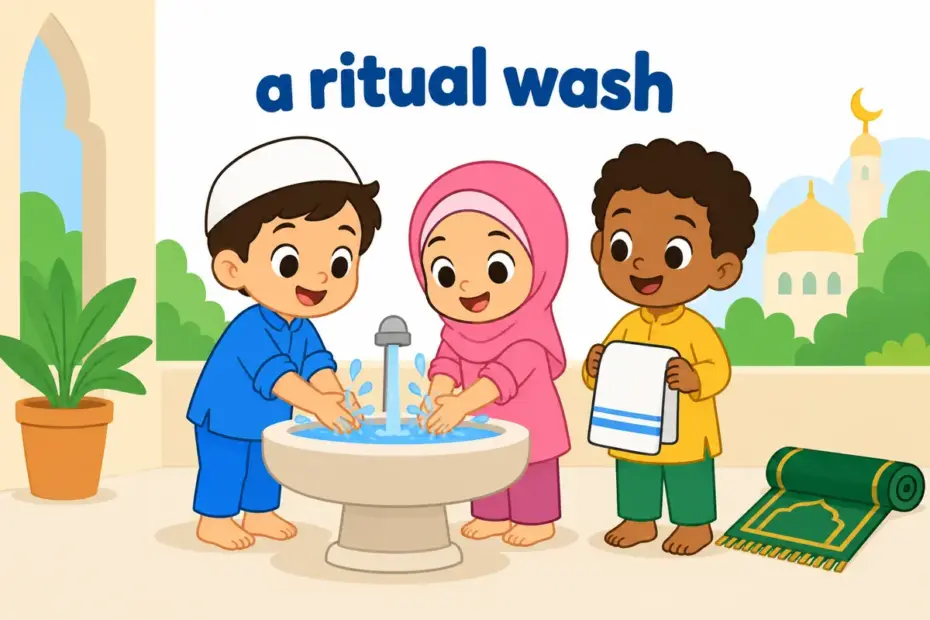
Ablution means the act of washing, especially a ceremonial washing of the body or hands. To use ablution in a sentence, treat a wash as a formal event: “The priest performed his ablutions before the ceremony.” The plural ablutions usually names the whole routine rather than one splash of water.
Ablution at a glance
- Ablution is a noun meaning a washing, especially a ritual one.
- It is usually plural: his ablutions, morning ablutions, daily ablutions.
- The commonest collocation is perform one’s ablutions.
- The register is formal and religious; wash and shower are the everyday words.
- The commonest error is confusing ablution with absolution, which means forgiveness.
What does ablution mean?
Ablution is a noun meaning the act of washing the body or hands, especially as part of a religious rite. The Cambridge entry for ablution records the ceremonial sense and the ordinary one, and the difference between them is usually signalled by the adjective. Where the washing is leisurely rather than sacred, bathe is the natural verb.
| Sense | Plain meaning | Example sentence |
|---|---|---|
| Ceremonial washing | A ritual washing before worship | Worshippers performed their ablutions before entering. |
| Ordinary washing | The routine of washing oneself | He completed his morning ablutions in a hurry. |
| Fixed usage | The plural for the whole routine | Her ablutions took only a few minutes. |
One limitation is worth stating plainly. Ablution applies to the body or hands, never to dishes or windows. Saying the ablution of the dishes sounds absurd, because the word keeps a ceremonial or personal flavour that housework does not have.
How do you use ablution in a sentence?
Put the person doing the washing first, then the plural noun: his ablutions, her ablutions. The patterns below cover almost every real sentence, and the fixed verb that goes with them is perform.
| Pattern | Example | What it signals |
|---|---|---|
| perform + one’s + ablutions | The pilgrims performed their ablutions at dawn. | The fixed, formal collocation. |
| possessive + plural ablutions | He finished his ablutions quickly. | Names a whole routine, not one wash. |
| ritual + ablution | A ritual ablution precedes the prayer. | Marks the religious kind. |
| ablution + area or block | The school built a new ablution block. | Describes a place set aside for washing. |
| before or after + ablution | They washed before the ablution began. | Places the act in a sequence. |
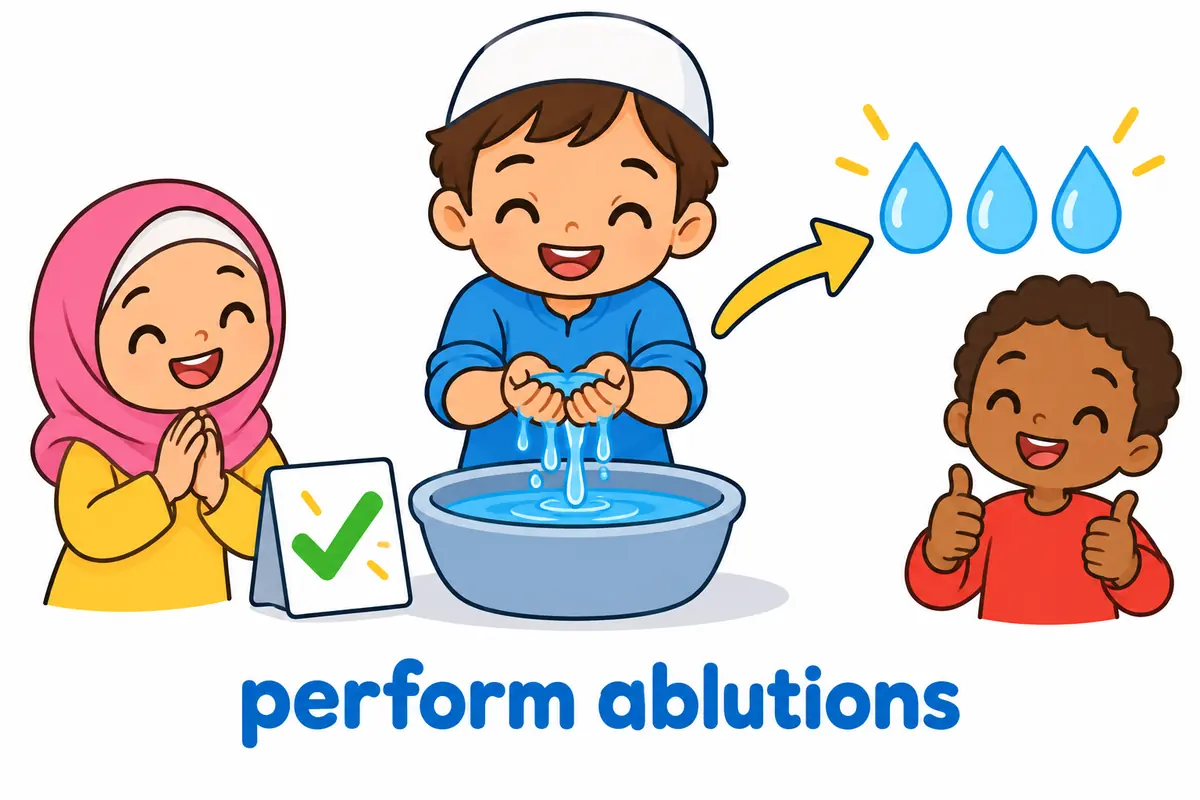
Ablution in a sentence: examples across contexts
Ablution changes register more than it changes meaning. The nine sentences below keep the same noun while moving from a temple to a refugee camp, and each one shows whether the ritual or the everyday sense is at work.
| Context | Example sentence | Why this works |
|---|---|---|
| Religious | Worshippers performed their ablutions before the dawn prayer. | Names the rite directly. |
| History class | Pupils learned how ritual ablution shaped temple life. | Uses the abstract noun in an academic frame. |
| Travel writing | The inn offered a basin for the traveller’s morning ablutions. | Treats washing as a modest routine. |
| Medical history | Surgeons once thought hand ablution a luxury. | Applies the formal noun to hygienic washing. |
| Conversation | He vanished to do his ablutions before breakfast. | The plural noun used lightly for a wash. |
| Formal writing | Ablution before prayer is prescribed in several faiths. | States a custom impersonally. |
| Narrative | She made her ablutions at the cold tap. | Old-fashioned register for a simple wash. |
| News report | The camp built extra ablution blocks for the refugees. | Uses the compound for washing facilities. |
| Humour | His elaborate ablutions left the bathroom soaked. | The plural noun can sound gently comic. |
Ablution vs absolution
Ablution is a washing of the body, while absolution is a formal pardon for sin. The two words share a religious setting and a similar sound, which is exactly why learners mix them up. The ritual dimension is what separates ablution from an ordinary wash, and a rinse of the hands is too quick to earn the name. In everyday speech, shower and wash replace the formal noun.
| Attribute | ablution | absolution |
|---|---|---|
| What it means | A washing, often ceremonial | A pardon for wrongdoing |
| Setting | Worship and personal hygiene | Confession and the courtroom of faith |
| Part of speech | Noun only | Noun only |
| Typical phrase | perform one’s ablutions | receive absolution |
| Everyday substitute | a wash | forgiveness |
Verdict: choose ablution when water is involved and absolution when sin is, because the two words sit at opposite ends of a religious service.
Word forms and grammar of ablution
Ablution is a noun with a regular plural, and it does not take a verb ending. The table also lists the rare adjective and the compound that names a washing place.
| Form | Part of speech | Example |
|---|---|---|
| ablution | noun, singular | A single ritual ablution prepared him for prayer. |
| ablutions | noun, plural | Her ablutions took only minutes. |
| ablutionary | adjective, rare | An ablutionary basin stood by the door. |
| ablution block | compound noun | The ablution block was cleaned each morning. |
| perform | verb used with ablution | They performed their ablutions together. |
Common mistakes with ablution
- Incorrect:
He took an ablution in the shower.Correct: He performed his ablutions in the shower. Rule: Ablution resists take; use the verb perform and the plural noun. - Incorrect:
The priest gave him ablution for his sins.Correct: The priest gave him absolution for his sins. Rule: Ablution is washing; absolution is forgiveness. - Incorrect:
She ablutioned before dinner.Correct: She performed her ablutions before dinner. Rule: Ablution is only a noun, never a verb. - Incorrect:
The ablution of the dishes took an hour.Correct: The washing of the dishes took an hour. Rule: Ablution is for the body, not for objects.
Practice using ablution
Work through the six items, then check the reasoning rather than only the answer.
- Fill the gap: The travellers performed their ______ at the well before setting off.
- Choose the better word: After confession the pilgrim received (ablution / absolution).
- Correct the error: She ablutioned quickly before the guests arrived.
- Build a sentence: use perform one’s ablutions about a child getting ready for a festival.
- Spot the register: which belongs in a religious guide — the faithful perform their ablutions at dawn, or everyone had a quick wash?
- Rewrite with the plural: He washed his face and hands. Use ablutions.
Answers
- ablutions — the plural noun names the whole washing routine at the well.
- absolution — confession seeks forgiveness, not washing.
- She performed her ablutions quickly before the guests arrived — ablution is never a verb.
- Model answer: Before the festival, Arun performed his ablutions at the temple tank.
- The faithful perform their ablutions at dawn — a guide keeps the formal collocation.
- He completed his ablutions at the basin — the plural noun covers face and hands together.
The bottom line
Use ablution in a sentence when the washing is formal, personal or ceremonial, and remember that the plural ablutions is the usual form. The two nuances that decide most sentences are these: the fixed verb is perform, and the word never means forgiveness. For everyday writing, wash and shower are the plainer choices.
Frequently asked questions about ablution
Is ablution always religious?
No. The word began with ritual washing and still carries that flavour, but it also covers any formal washing of the body. Writers use it for a morning routine at a basin, for camp washing facilities, and for historical hygiene. The religious sense simply makes the ceremonial meaning explicit.
What is the difference between ablution and absolution?
Ablution is a washing of the body or hands, especially a ritual one. Absolution is a formal pardon for wrongdoing. They sound alike and both appear in religious writing, which causes the confusion, but one involves water and the other involves forgiveness, so they are never interchangeable.
Is ablution singular or plural?
Both forms exist. The singular names a single washing, as in a ritual ablution precedes the prayer. The plural ablutions names the whole routine of washing, which is why perform one’s ablutions is the standard phrase. Choose the plural unless you mean one specific act.
Can ablution be a verb?
No. Ablution is only a noun, so there is no form such as ablutioned or ablutioning. To put it in a sentence with action, use perform with the noun, as in they performed their ablutions. A rare adjective, ablutionary, describes things connected with washing.
Have you ever heard of the term “ablution” before? In simple terms, ablution refers to the act of washing or cleaning oneself as a religious rite or even just as a regular cleansing routine.
This practice is common in various religions and cultures around the world, with specific rituals and customs attached to it. Whether it’s the act of cleansing before prayer in Islam or the ceremonial washing before meals in some cultures, ablution plays a significant role in promoting cleanliness and spiritual purity.
7 Examples Of Ablution Used In a Sentence For Kids
- Ablution is important before entering a temple.
- People perform ablution before offering prayers.
- Mother teaches us how to do ablution properly.
- We must wash our hands before ablution.
- In our culture, ablution is a daily practice.
- We learn about the importance of ablution in our religious studies.
- Let’s all remember to do ablution before eating.

14 Sentences with Ablution Examples
- Ablution is an important ritual before offering prayers in many Indian cultures.
- Many college students prefer to perform ablution in the morning before starting their day.
- It is customary to do ablution before participating in religious or spiritual events in India.
- Some students find peace and clarity in mind after completing their ablutions.
- Before attending a traditional event, it is common to see people performing the ablution ceremony.
- In some Indian households, ablution is done before entering the kitchen to cook or eat.
- During festivals, college students often wake up early to perform ablution before joining the celebrations.
- Some students believe that performing ablution helps them focus better during their studies.
- In certain religions, ablution is considered a mandatory practice before engaging in any kind of worship.
- Students living in hostels tend to have a designated spot for ablution within their living quarters.
- It is customary to perform ablution before attending academic or cultural events at college.
- The act of ablution is seen as a way to purify one’s body and soul before engaging in any spiritual practice.
- Some students carry a small water bottle with them to ensure they can perform ablution wherever they may be.
- Students organizing cultural events often ensure there are facilities available for ablution for participants.

How To Use Ablution in Sentences?
To use Ablution in a sentence, begin by identifying a situation in which the term fits appropriately. Ablution refers to the act of washing oneself, particularly for religious purposes.
For example, you could say, “Before performing their daily prayers, Muslims engage in ablution to cleanse themselves.” In this sentence, ablution is used to describe the ritual washing Muslims undertake as part of their religious practices.
When using ablution in a sentence, remember to consider the context in which the word is being used. The word typically conveys a sense of purification or cleansing, so make sure the sentence reflects this meaning accurately.

Another example is, “After a long day of hiking, Sarah found solace in the stream, using it for a quick ablution before continuing on her journey.” Here, ablution is used to describe Sarah’s act of cleansing herself in the stream after a tiring hike.
By paying attention to the context and meaning of ablution, you can effectively incorporate it into your sentences. Remember that practice makes perfect, so try using ablution in different contexts to become more comfortable with the word.
Conclusion
In conclusion, the act of performing ablution involves washing certain body parts to cleanse oneself before prayer in Islam. Ablution is a fundamental ritual that symbolizes purification and spiritual readiness for worship. The steps of ablution typically include washing the hands, face, arms, wiping the head, and washing the feet, all done in a prescribed manner following a specific order.
Individuals practicing Islam adhere to ablution as a way to prepare for prayer, demonstrating their devotion to God through physical and spiritual cleanliness. By following the guidelines for ablution, worshippers fulfill a prescribed religious duty essential for engaging in meaningful prayer and maintaining a connection with the divine.


