
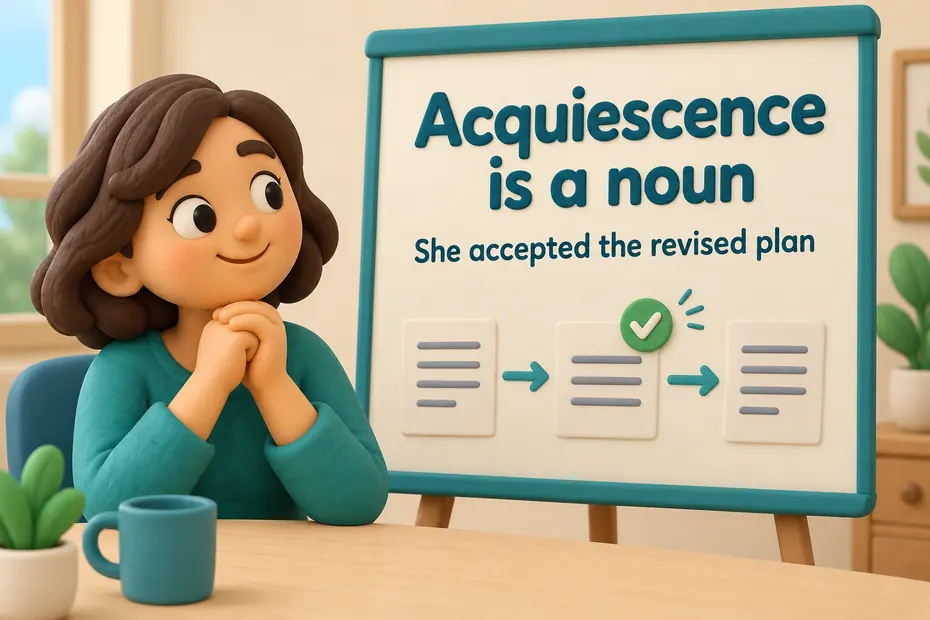
Acquiescence is acceptance of a request, decision, or situation without resistance, often with little enthusiasm. Use acquiescence in a sentence as a noun: “Her acquiescence to the revised schedule surprised the team.” The word emphasizes yielding or going along with something, rather than actively endorsing every detail of it.
- Acquiescence is a formal noun, usually used without a plural.
- Acquiesce is the related verb.
- Acquiescent is the related adjective.
- Acquiescence can be reluctant, tacit, or grudging.
- Acceptance does not necessarily imply approval or enthusiasm.
How do you use acquiescence in a sentence?
Use acquiescence to name someone’s acceptance or lack of resistance. “The committee interpreted his reply as acquiescence” makes the noun the object of as. “Her acquiescence ended the discussion” makes the noun the subject. Adding a person and a specific proposal gives the sentence a clearer meaning.
For example, “Maya’s acquiescence to the Saturday meeting allowed the team to finalize its calendar” identifies both the decision and its result. Compare “Everyone showed acquiescence,” which leaves the accepted proposal unclear. Formal vocabulary works best when the surrounding sentence stays concrete rather than becoming abstract or inflated.
| Pattern | Original example | Meaning emphasized |
|---|---|---|
| Acquiescence to | His acquiescence to the new timetable surprised us. | Acceptance of a proposal |
| Acquiescence in | Her acquiescence in the arrangement ended the dispute. | Going along with an arrangement |
| Grudging acquiescence | The plan received only grudging acquiescence. | Reluctant acceptance |
| Tacit acquiescence | The organizer interpreted the silence as tacit acquiescence. | Acceptance inferred rather than spoken |
| Without acquiescence | The decision proceeded without the group’s acquiescence. | Acceptance was absent |

Does acquiescence always mean silent agreement?
Acquiescence need not be completely silent, and reluctance is common rather than compulsory. Someone may say “All right, we can use your plan” and still acquiesce after initially objecting. The central idea is accepting or yielding without continued resistance, not a rule that the person must say nothing.
Both Cambridge and Merriam-Webster describe acceptance or passive assent. Cambridge highlights that it is often unwilling; Merriam-Webster also provides a cheerful example. In your own writing, use reluctant or cheerful if the person’s attitude matters rather than expecting the noun to convey every emotional detail.
Silence alone does not prove someone’s private agreement. “The chair interpreted the silence as acquiescence” attributes an inference to the chair. “Everyone agreed” asserts something stronger. If participants were absent, confused, or unable to respond, describe those facts rather than treating the absence of objections as reliable evidence of approval.
When is agreement or compliance a better choice?
Choose agreement when people affirm the same view or explicitly approve a proposal. Choose compliance when the important point is following a rule or instruction. Choose acquiescence when the important point is yielding, accepting, or going along without further objection. These words overlap, but their emphasis differs.
The earlier children’s examples present acquiescence as something children should always show adults. That is a value judgment, not part of the definition. Listening respectfully, raising a hand, and asking questions are distinct behaviors; none automatically demonstrates acquiescence. A more precise example is “Leo’s reluctant acquiescence meant the group used Ana’s game rules.”
Similarly, “following a deadline” is clearer as meeting a deadline or complying with a requirement. “Acquiescence to healthy study habits” is unnecessarily abstract unless someone is yielding to another person’s proposed routine. For everyday advice, “She adopted a regular study routine” communicates the action more directly.
How do the related word forms work?
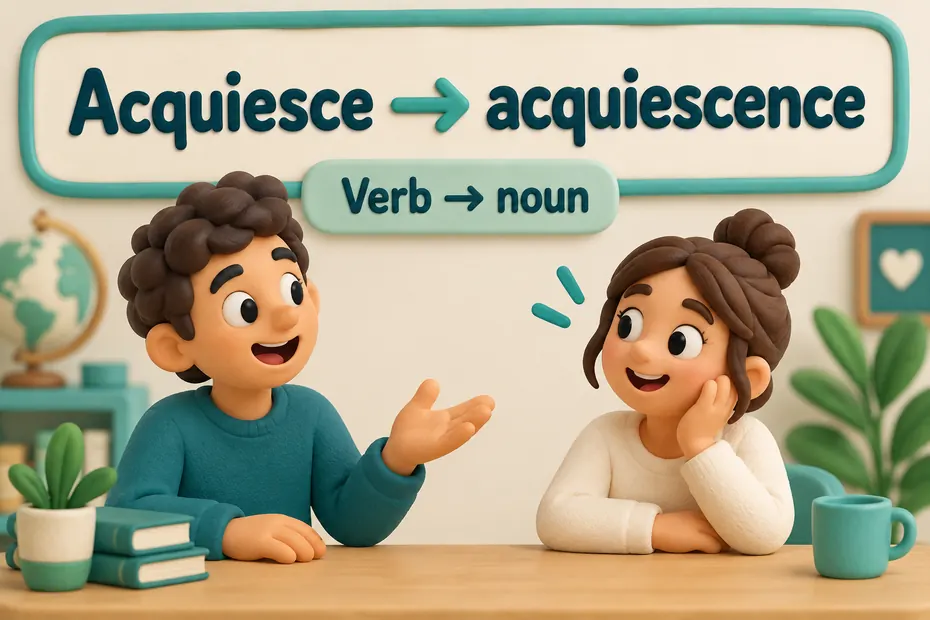
Acquiesce describes the action: “After a long discussion, Omar acquiesced to the change.” Acquiescence names the acceptance: “Omar’s acquiescence ended the discussion.” Acquiescent describes the person’s attitude: “Omar seemed acquiescent.” Keep the ending consistent with the grammatical job the word performs.
- Identify who accepts the request.
- Name what is accepted.
- Decide whether the acceptance is explicit or inferred.
- Add the reason or consequence if readers need that context.
Frequently asked questions
Is acquiescence formal English?
Yes. Acquiescence is more formal than going along with something or accepting a plan. It fits analytical writing, discussion of negotiations, and descriptions of institutional behavior. In an informal message, “She agreed to the change” may be easier to read unless her passive or reluctant response is important.
Can I say acquiescence to a request?
Yes. Acquiescence to a request is an established pattern. “His acquiescence to the request allowed the project to continue” is grammatically complete. Name the request if its content matters: “His acquiescence to the request for another meeting allowed the project to continue” removes ambiguity about what he accepted.
Does acquiescence mean someone likes the decision?
No. A person can accept a decision while disliking it. “Her grudging acquiescence to the venue change” makes that reluctance explicit. If the person actively welcomes and supports the decision, enthusiastic agreement or approval may better describe the response. Acceptance and enthusiasm are separate details in a sentence.
What is a simple example for a learner?
“His acquiescence to the new plan surprised us” is a useful learner example. Explain it as “He accepted the new plan without resisting.” Then supply a short scenario: he preferred the old plan but stopped arguing after the group discussed the alternatives. The scenario makes the formal noun concrete.
For acquiescence in a sentence, show the accepted proposal and the person’s response. Use a simpler word when passive acceptance is not the point, and qualify inferred acceptance carefully when the evidence is only silence.

Have you ever found yourself silently agreeing to something without expressing your true thoughts? That act of passively accepting or complying with a situation is known as acquiescence.
Acquiescence is often observed in scenarios where one yields to a request or a demand without voicing any objections. This behavior can stem from various reasons, such as avoiding confrontation, maintaining peace, or simply feeling indifferent towards the matter at hand.
7 Examples Of Acquiescence Used In a Sentence For Kids
- Acquiescence means agreeing without arguing.
- We should show acquiescence when our elders speak to us.
- It is important to show acquiescence in class when the teacher is talking.
- When our parents tell us to do something, we should show acquiescence.
- Acquiescence helps us to listen and learn from others.
- Showing acquiescence is a way to show respect to others.
- Let’s practice acquiescence by raising our hands before speaking in class.

14 Sentences with Acquiescence Examples
- Acquiescence to academic rules and regulations is necessary to maintain discipline on campus.
- Students often show acquiescence to the professor’s teaching methods in the hope of good grades.
- Some students express acquiescence to peer pressure to join certain clubs or groups.
- There is a sense of acquiescence when students follow strict dress codes on the college premises.
- Participating in extracurricular activities requires acquiescence to the schedule set by the organizers.
- Group projects often involve acquiescence to different opinions in order to reach a consensus.
- Students demonstrate acquiescence by following deadlines set by their professors for assignments and exams.
- Joining study groups often requires acquiescence to the preferences and study techniques of others.
- The college administration expects acquiescence from students when it comes to following campus safety protocols.
- Seeking approval for research proposals may require acquiescence to suggestions made by faculty members.
- Student council members must show acquiescence to the decisions made during council meetings.
- Acquiescence to the guidelines set by the career counseling department can be beneficial for students.
- Attending workshops on campus can help students understand the importance of acquiescence in a team dynamic.
- Demonstrating acquiescence to healthy study habits can improve academic performance.

How To Use Acquiescence in Sentences?
To use the word Acquiescence in a sentence, follow these steps:
- Understand the meaning: Before using the word, make sure you understand that Acquiescence means the act of accepting or complying with something without protest. It often implies acceptance of something reluctantly.
- Choose your context: Think about a situation where someone is agreeing to something reluctantly or giving in to a request without expressing disagreement.
- Construct your sentence: Once you have your context, formulate a sentence that includes the word Acquiescence. For example, “Despite his strong opinions, he showed acquiescence to his boss’s decision.”
- Check your sentence: Ensure that the sentence makes sense and accurately conveys the meaning of Acquiescence. It should clearly show a person accepting or complying with something passively.
- Practice using the word: Try using Acquiescence in various sentences to get comfortable with its usage. The more you practice, the easier it will be to incorporate it naturally into your vocabulary.
Remember, using new words like Acquiescence may feel challenging at first, but with practice and patience, you’ll become more confident in incorporating it into your everyday language.

Conclusion
In conclusion, acquiescence refers to the act of accepting, agreeing to, or complying with something passively or without protest. It is often demonstrated through statements or actions that indicate a willingness to go along with a decision or request. For example, “Despite his reservations, he nodded in acquiescence to the team’s decision.”
Overall, acquiescence plays a significant role in communication and decision-making processes, indicating a level of agreement or consent. Being able to recognize acquiescence in interactions can help in understanding others’ perspectives and ensuring effective communication and cooperation within various settings.


