Add up is a phrasal verb meaning to total several numbers, to amount to a figure, or to make sense. The first sense lets the particle move, so “add up the costs” and “add the costs up” are both correct, while the make-sense sense takes no object: “the story does not add up.”
Add up at a glance
- Add up is a phrasal verb with three common senses: to total, to amount to and to make sense.
- The particle up can move in the total sense: add up the figures or add the figures up.
- With a pronoun the particle must follow it: add them up, never add up them.
- The make-sense sense is intransitive and takes no object.
- Add up to is a fixed unit for reaching a total.
What does add up mean?
Add up is a phrasal verb meaning to find a total, to amount to a figure, or to make sense. The Cambridge entry for add up and the Merriam-Webster entry for add up keep these senses separate, which matters because only one of them can take an object.
| Sense | Plain meaning | Example sentence |
|---|---|---|
| Find a total | Combine numbers into one sum | Add up the receipts before you file them. |
| Amount to | Reach a particular total | The repairs add up to more than the car is worth. |
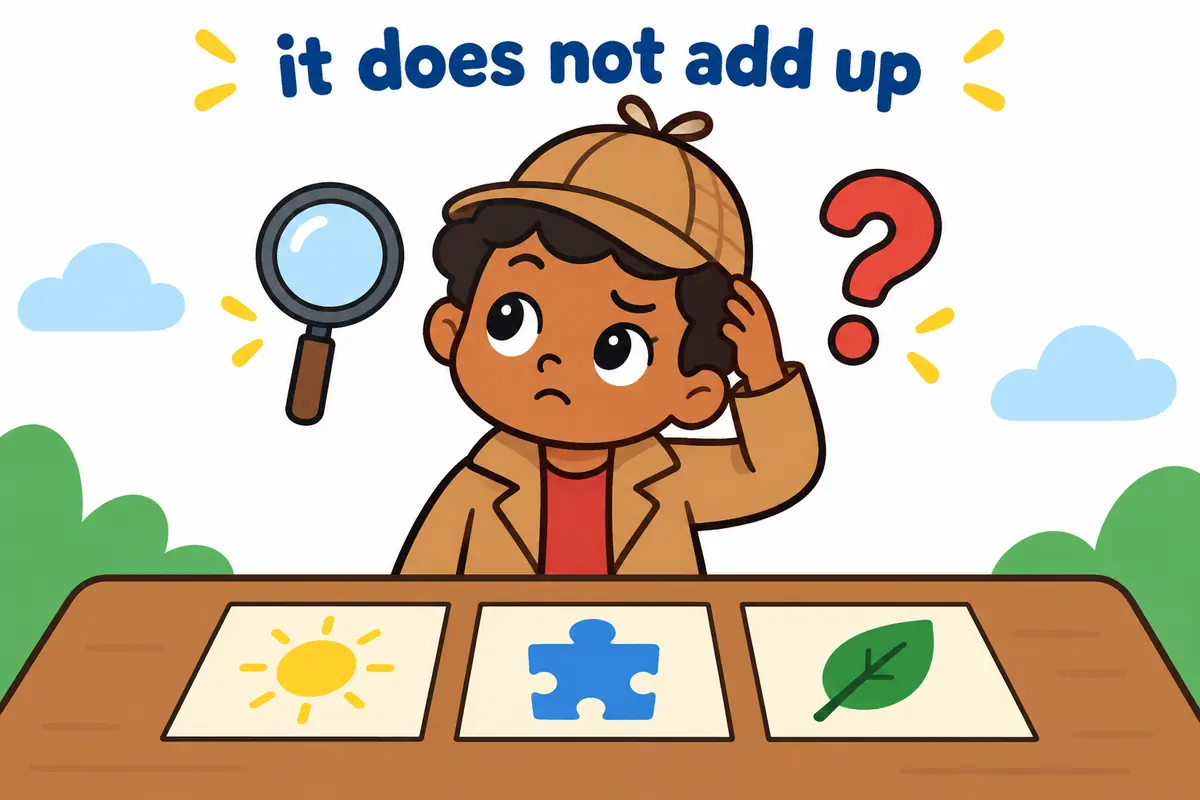
| Make sense | Seem reasonable or consistent | His story does not add up. |
When only a single act of combining is meant, plain add is enough. Add up signals a total assembled from several parts or, in the third sense, a judgment about whether the facts fit together. A quick sum makes the first sense concrete.
How do you use add up in a sentence?
Add up is separable in the total sense, not separable in the sense it shares with add up to, and intransitive when it means to make sense.
| Pattern | Example | What it signals |
|---|---|---|
| add up + object | She added up the invoices. | transitive, tallying |
| add + object + up | She added the invoices up. | particle may strand after the object |
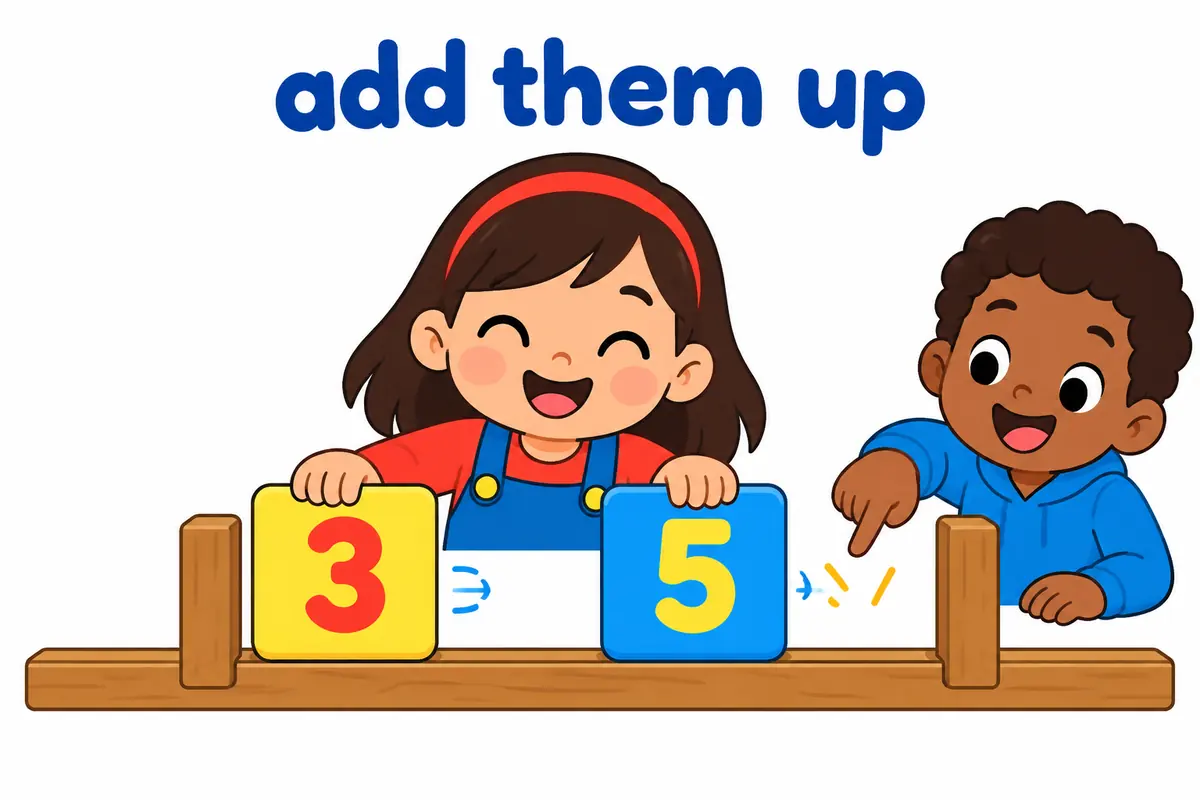
| add + pronoun + up | She added them up. | pronoun must sit between verb and particle |
| add up to + total | The bill adds up to forty pounds. | fixed unit, not separated |
| not add up (no object) | The timings do not add up. | intransitive, sense fails |
The pronoun rule is the giveaway: add them up sounds native, while add up them sounds translated. The same separability appears in other particle verbs, as when records back up a claim.
Add up in a sentence: examples across contexts
| Context | Example sentence | Why this works |
|---|---|---|
| Household | Add up the bills before you pay them. | Everyday command form. |
| Accounting | The clerk added up the day takings. | Business register. |
| Budget email | These small costs add up quickly. | Intransitive amount sense. |
| News report | Analysts added up the losses after the storm. | Journalistic tallying. |
| Detective story | None of the witness accounts added up. | The make-sense sense. |
| Classroom | Can you add up these numbers in your head? | Simple question form. |
| Academic writing | These factors add up to a clear trend. | Fixed add up to. |
| Sports report | His errors added up to an early exit. | Amounting to a result. |
| Conversation | It just does not add up. | Spoken disagreement. |
Add up vs add
| Attribute | Add up | Add |
|---|---|---|
| Core meaning | total several items | put one thing with another |
| Focus | the finished total | the single act |
| Particle | carries up | no particle |
| Separability | up may move in the total sense | not applicable |
| Make-sense sense | yes, intransitive | never |
| Register | neutral to business | neutral |
Use add for one simple act of combining and add up when the point is the finished total or whether the facts make sense.
Word forms and grammar of add up
| Form | Part of speech | Example |
|---|---|---|
| add up | phrasal verb | The totals add up. |
| adds up | third person singular | Her account adds up. |
| added up | past tense | The clerk added up the day takings. |
| adding up | present participle | He is adding up the costs. |
| add up to | phrasal verb plus preposition | The losses add up to millions. |
To calculate a single figure, plain add or calculate works, but only add up lets the particle move around its object.
Common mistakes with add up
- Incorrect: Please add up them. Corrected: Please add them up. Rule: a pronoun must sit between the verb and its particle.
- Incorrect: The bill adds up forty pounds. Corrected: The bill adds up to forty pounds. Rule: the amount sense needs the preposition to.
- Incorrect: His story does not add up the facts. Corrected: His story does not add up. Rule: the make-sense sense is intransitive and takes no object.
- Incorrect: Subtract the figures up to check the total. Corrected: Subtract the figures to check the total. Rule: up belongs with add, not with the opposite verb subtract.
- Incorrect: Add up the two numbers to make four. Corrected: Add the two numbers to make four. Rule: for a single addition, plain add is the precise verb.
Practice using add up
- Fill in the blank: Please ______ these receipts before Friday.
- Choose the better word: These delays (add / add up) to a serious problem.
- Correct the error: Could you add up them for me?
- Build a sentence: use add up in the make-sense sense about a story.
- Spot the register: Which sentence belongs in a finance memo, (A) or (B)? (A) These fees add up to a material sum. (B) The fees really add up, wow.
- Fill in the blank: The evidence did not ______.
Answers
- add up. The verb takes receipts as its object.
- add up. The phrase add up to introduces the resulting total.
- Could you add them up for me? The pronoun goes between verb and particle.
- The alibis did not add up. The sense is intransitive, so no object follows.
- (A) belongs in the memo, because it states the total in formal terms.
- add up. The verb stands alone with no object.
The bottom line
Add up is a phrasal verb that means to total, to amount to, or to make sense, and its particle moves only in the total sense. Used correctly, add up in a sentence keeps the object before up when a pronoun is involved and adds to before a figure. The make-sense sense takes no object at all.
Frequently asked questions about add up
When does add up mean to make sense?
Add up means to make sense when the subject is evidence, a story or an explanation, as in the accounts do not add up. In this sense the verb is intransitive, so no object follows it. The phrase usually appears in the negative to signal that something feels wrong.
Can you separate add up?
Yes, but only in the total sense. You can say add up the figures or add the figures up. When the object is a pronoun it must go between, as in add them up. In the amount sense and the make-sense sense, the two words stay together.
What does it mean when numbers do not add up?
When numbers do not add up, the totals fail to match, or the figures point to a result that cannot be true. In accounting it can mean a genuine arithmetic error. In everyday speech it often means the explanation itself is suspicious rather than the sums.
Is add up formal or informal?
Add up is neutral and works in speech and writing alike, including business and academic prose. Only the make-sense sense leans conversational, since it often appears in the plain negative. The total sense sits comfortably in a finance memo or a school exercise.
Have you ever heard someone say, “Let’s add up the total”? When you add up numbers, you’re combining them to find a sum.
Adding up is a simple mathematical operation where you bring numbers together to calculate a total. It’s a fundamental skill used in everyday tasks like grocery shopping, budgeting, and more.
7 Examples Of Add Up Used In a Sentence For Kids
- I have 2 mangoes. If I add up 3 more mangoes, how many will I have?
- My friend has 5 crayons. If I add up 2 crayons, how many crayons will we have together?
- I have 4 toy cars. If I add up 1 more toy car, how many toy cars will I have?
- There are 3 balloons. If we add up 4 more balloons, how many balloons will be there?
- Sarah has 6 stickers. If she add up 2 more stickers, how many stickers will she have?
- Tom has 7 marbles. If he add up 3 more marbles, how many marbles will he have?
- I had 8 books. If I add up 1 more book, how many books will I have?

14 Sentences with Add Up Examples
- Add up all your expenses for the month to see where your money is going.
- Make sure to add up all the scores correctly before submitting your final exam.
- It’s important to add up all the hours you spent studying to track your productivity.
- When studying for your exams, try to add up the key points from each chapter for easier revision.
- Remember to add up all the credits required to graduate on time.
- Add up all the research findings to draw a conclusion for your thesis.
- Add up all the costs before deciding on which college to attend.
- It’s helpful to add up all the positive feedback you’ve received to boost your confidence.
- Make sure to add up all the hours you’ve spent volunteering for your resume.
- Add up all the extra-curricular activities you’re involved in to see if you can balance them with your studies.
- Add up all the math problems correctly before submitting your assignment.
- Remember to add up all the required textbooks and materials costs for the semester.
- It’s important to add up the total number of assignments you need to complete to stay on track.
- Add up all your grades to calculate your GPA accurately.

How To Use Add Up in Sentences?
To use the phrase Add Up in a sentence, follow these steps:
- Determine the Context: First, understand the meaning of the phrase “Add Up,” which commonly means to make sense or to be reasonable. Consider how it can fit into the sentence you want to construct.
- Form a Complete Sentence: Create a sentence where the phrase “Add Up” can be used appropriately. For example, “The expenses for this month add up quickly.”
- Proper Placement: Make sure that Add Up is placed in a suitable position within the sentence. It is often used after all the relevant information has been provided to indicate a conclusion.
- Punctuation: Use proper punctuation marks such as a period at the end of the sentence where you have included the phrase “Add Up.”
- Check for Clarity: Read the sentence back to yourself. Ensure that the use of “Add Up” is clear and that your sentence effectively conveys the intended meaning.
- Practice: To gain familiarity with using the phrase “Add Up” in sentences, practice constructing various sentences with different contexts.
Using the phrase Add Up can help you express ideas concisely and effectively, making your point clear and understandable to others. Experiment with its usage in different contexts to enhance your communication skills.

Conclusion
In conclusion, when we add up all the pieces of information provided, we can see a clear pattern emerging. The sentences with “add up” illustrate the concept of combining elements to form a cohesive whole. Whether it’s adding numbers to find a total, or piecing together facts to draw a conclusion, the phrase “add up” emphasizes the importance of looking at the bigger picture.
By examining how sentences with “add up” are used, we gain insight into the process of synthesis and analysis. The phrase serves as a reminder to consider all elements in a situation to arrive at a comprehensive understanding. Overall, it highlights the significance of thorough examination and consolidation in reaching a logical conclusion.


