How to Choose Adjectives for an Aunt
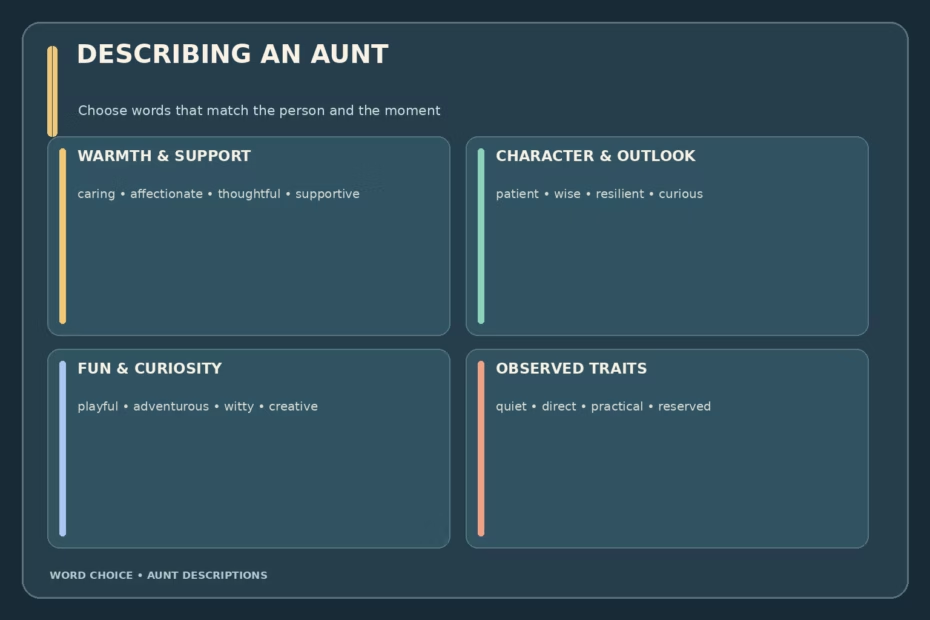
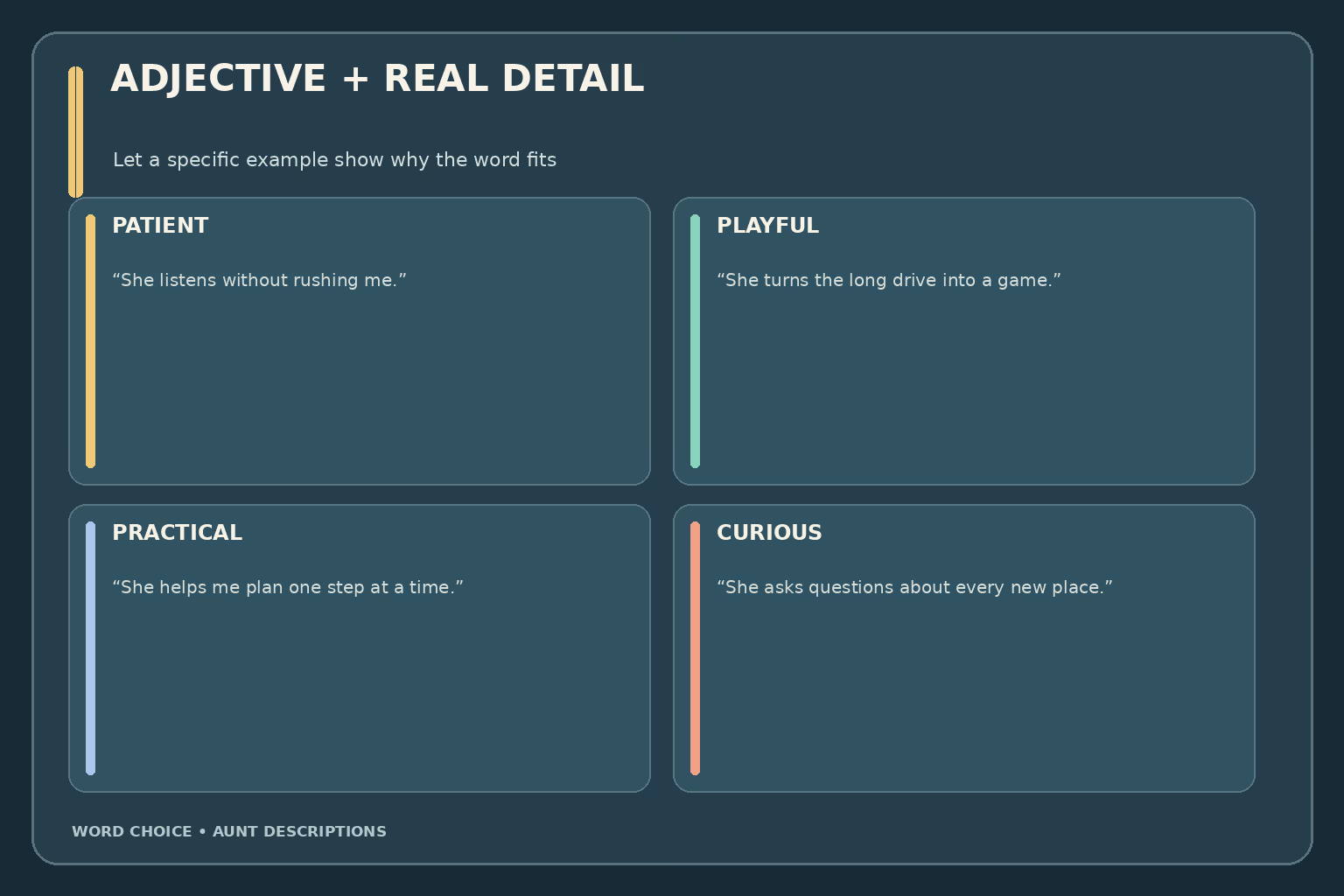
The best adjective depends on what you want to say about this particular person. Caring may describe someone who checks in when you are unwell; playful may fit the aunt who turns an ordinary visit into a game. If you are writing a greeting card, a warm word may be right. For a short introduction or family history, a more neutral detail may be clearer. One specific word supported by a real example often sounds more genuine than a long string of compliments.
Positive Adjectives for an Aunt by Quality
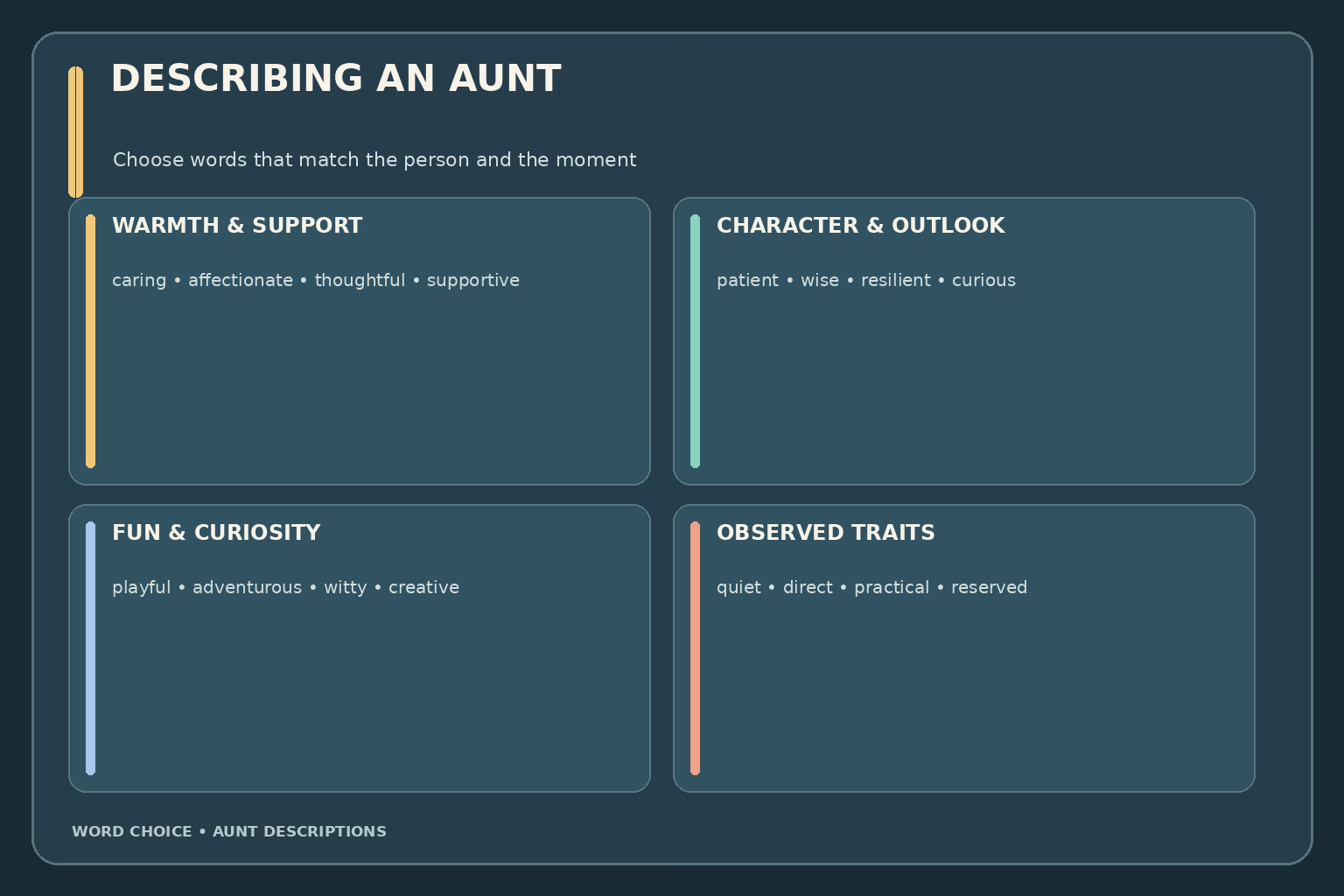
These words describe different kinds of qualities. They are options, not assumptions about every aunt: families and relationships vary, and a person can show one trait in some situations but not others.
Care and affection
- Caring: attentive to another person’s needs. “My caring aunt called to see how my first week at school went.”
- Affectionate: openly warm or loving. “Her affectionate note made me feel remembered.”
- Compassionate: responsive to another person’s difficulty. “My compassionate aunt listened when I needed to talk.”
- Thoughtful: considerate in a way that shows attention. “A thoughtful message from my aunt arrived before the interview.”
- Nurturing: supportive in a way that helps someone grow or feel cared for. “My nurturing aunt encouraged me to try again after a setback.”
Support and dependability
- Supportive: giving encouragement or practical help. “My supportive aunt came to the school play.”
- Encouraging: helping someone feel hopeful or confident. “Her encouraging words helped me begin the project.”
- Reliable: someone others can count on. “My reliable aunt always lets us know if her plans change.”
- Generous: willing to give time, attention, or resources. “My generous aunt shared her time to teach me how to bake.”
- Trustworthy: worthy of confidence or trust. “I know my trustworthy aunt will keep a private conversation confidential.”
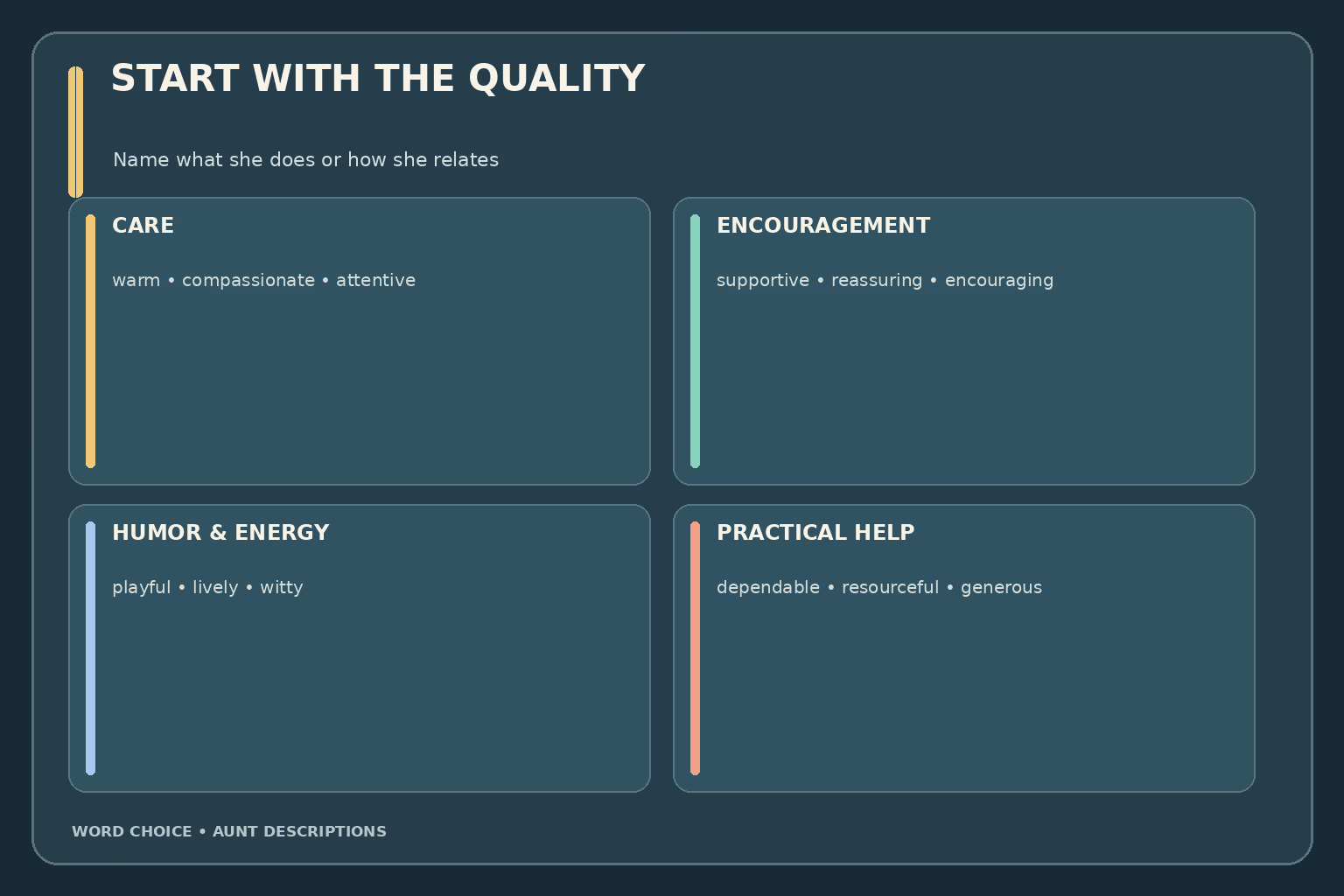
Personality, interests, and outlook
- Patient: able to wait or listen without becoming easily frustrated. “My patient aunt showed me how to knit one row at a time.”
- Wise: showing sound judgment or experience. “My wise aunt helped me think through both options.”
- Adventurous: interested in trying new activities or places. “My adventurous aunt planned a walk along the coast.”
- Curious: eager to learn or understand. “My curious aunt asks about the books I am reading.”
- Creative: able to make or imagine original things. “My creative aunt designed a handmade card.”
- Witty: clever and amusing in speech or writing. “My witty aunt made everyone laugh with a quick observation.”
- Resilient: able to recover or keep going through difficulty. “My resilient aunt rebuilt her routine after a difficult year.”
- Practical: focused on useful, workable solutions. “My practical aunt helped me make a simple moving checklist.”
Neutral and More Specific Ways to Describe an Aunt
Not every description needs to praise or criticize. Neutral adjectives can help readers picture a person without turning a short description into a judgment. Depending on what you have observed, an aunt might be quiet, reserved, direct, organized, careful, energetic, observant, or independent. Add context when a word could be misunderstood: “reserved at first in a large group” is more precise than simply labeling someone “distant.”
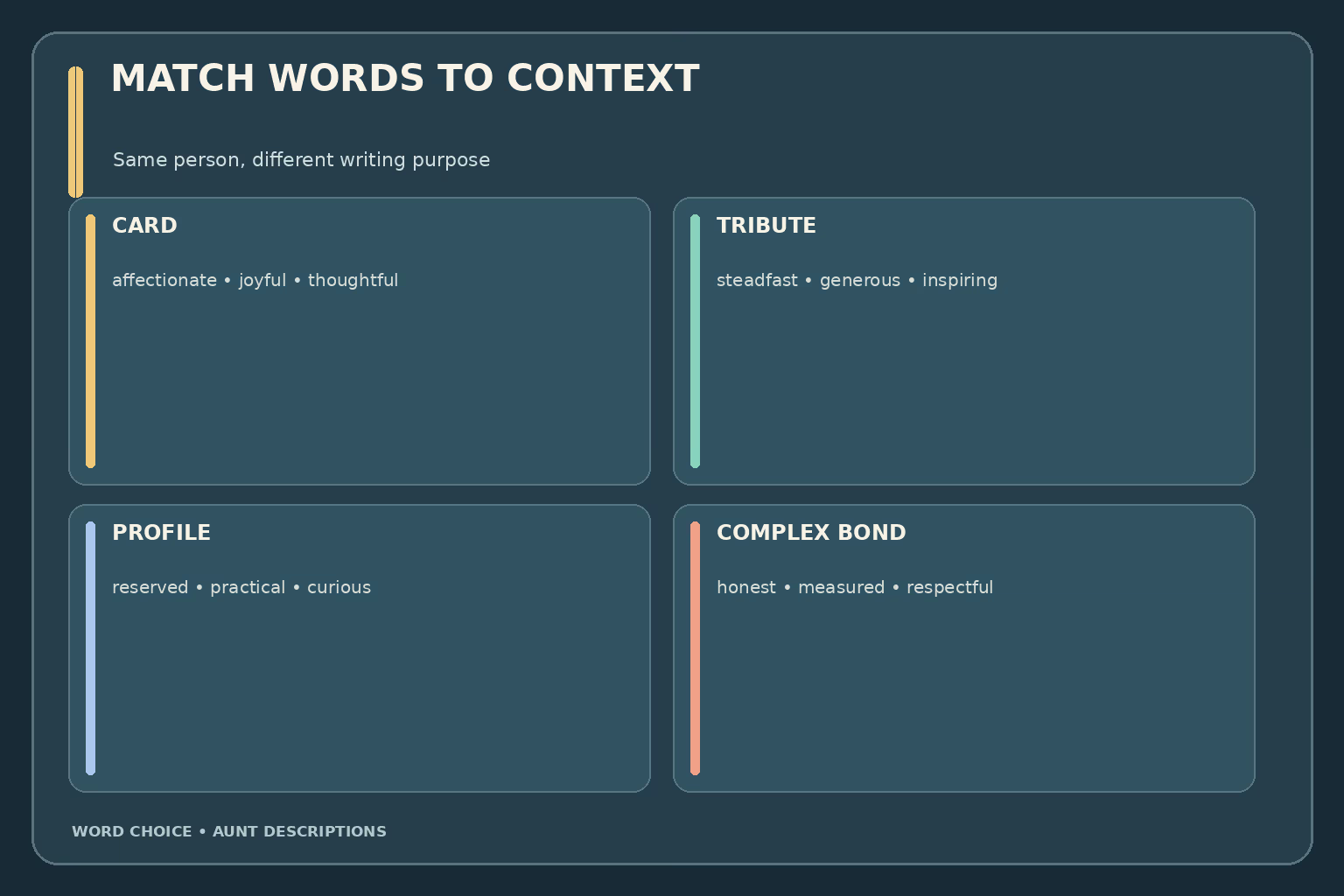
For a difficult relationship, use language that describes a behavior rather than making a sweeping judgment about someone’s character. “She often changes plans at short notice” is more concrete than “she is unreliable.” A balanced description can recognize what is hard without claiming to sum up the whole person.
Examples: Describe an Aunt in a Sentence
A useful sentence pairs an adjective with a detail that gives the reader a reason for it. Adapt these patterns to your own memories; do not include a quality that does not fit.
- Birthday card: “Your thoughtful messages and warm welcome make every visit special.”
- Thank-you note: “I appreciate how patient you were while helping me practice.”
- Family profile: “My aunt is practical, observant, and happiest when she is working in her garden.”
- Personal tribute: “Her steady encouragement gave me confidence to keep learning.”
- Neutral introduction: “My aunt is a quiet, curious person who enjoys museums and long walks.”
Tips for Writing About a Real Person
- Think of a moment: recall something she said, did, made, or taught you.
- Choose one fitting adjective: select a word that matches that moment rather than an unrelated compliment.
- Decide on tone: a card, school assignment, family profile, and private reflection may call for different wording.
- Make the relationship yours: avoid assumptions about what an aunt is supposed to do or how close relatives must be.
- Use a respectful level of detail: share only personal information that is appropriate for your audience.
Frequently Asked Questions
What are some kind words to describe an aunt?
Caring, thoughtful, affectionate, supportive, patient, generous, and encouraging can work when they genuinely fit. Add a small example to make the description personal.
How do I describe my aunt in one sentence?
Choose one or two accurate adjectives, then add a detail: “My curious aunt loves learning about local history,” or “My supportive aunt always makes time to listen.”
What can I write about an aunt in a birthday card?
Use a warm, personal message that names a quality and a memory. For example: “Your playful spirit and Sunday baking lessons are some of my favorite memories. I hope your birthday is full of things you enjoy.”
Can I describe an aunt with neutral words?
Yes. Words such as quiet, direct, organized, independent, and curious can describe observable qualities without labeling someone as wholly good or bad. Use context if a word might sound critical.
Are all aunts expected to be nurturing or close to their nieces and nephews?
No. People and family relationships differ. Treat adjectives as vocabulary choices for an individual person, not rules about what all aunts are like.
Sources and Further Reading
- Cambridge Dictionary: “aunt” (meaning and family relationship).
- Cambridge Dictionary: “caring” (meaning and usage example).
- Cambridge Dictionary: “resilient” (meaning and usage).
- Cambridge Dictionary: “witty” (meaning and usage).
Hey there! Are you looking for the perfect words to describe your amazing aunt? Well, you’ve come to the right place! In this article, I’ll be sharing a list of adjectives that will help you paint a vivid picture of your aunt’s wonderful qualities. From loving and caring to adventurous and wise, we’ll explore a variety of descriptive words that capture the essence of an aunt. So, whether you’re writing a heartfelt birthday card or simply want to express your appreciation, these adjectives will definitely come in handy. Let’s dive in and discover the perfect words to describe your extraordinary aunt!
How to Describe aunt? – Different Scenarios
When it comes to describing my aunt, I believe that she possesses a multitude of incredible qualities. Depending on the situation or context, there are various adjectives I can use to paint a vivid picture of her amazing personality. Here are a few scenarios where I find myself searching for the perfect words to describe my extraordinary aunt:
1. Writing a Birthday Card
Birthdays are special occasions where we express our love and appreciation for the people we care about. When writing a birthday card for my aunt, I want to choose adjectives that capture her unique qualities and make her feel truly cherished. Some adjectives that come to mind are:
- Caring: She is always there to lend a helping hand and offer support.
- Generous: She has a heart of gold and never hesitates to give.
- Loving: She showers us with affection and unconditional love.
- Fun-loving: She brings joy and laughter into our lives with her playful nature.
- Wise: She offers valuable advice and guidance whenever we need it.
2. Expressing Appreciation
From time to time, it’s important to express gratitude and acknowledge the impact someone has had on our lives. When expressing my appreciation for my aunt, I want to choose adjectives that highlight her positive influence. Here are some adjectives I would use:
- Inspirational: Her actions and words motivate and inspire those around her.
- Supportive: She provides the encouragement and support needed to pursue our dreams.
- Empathetic: She understands our feelings and shows compassion in every situation.
- Thoughtful: She goes above and beyond to show that she cares about our wellbeing.
- Encouraging: She is always cheering us on and pushing us to reach our full potential.
3. Talking to Others
When describing my aunt to others, I want to convey just how remarkable she is. I want to choose adjectives that accurately capture her essence and leave a lasting impression. Here are some adjectives I would use:
- Graceful: She carries herself with elegance and poise.
- Charismatic: She has a magnetic personality that draws others in.
- Trustworthy: She can be relied upon and is always true to her word.
- Adventurous: She embraces new experiences and is always up for an adventure.
- Compassionate: She has a heart full of compassion for those in need.
Describing Words for aunt in English
When it comes to describing my aunt, I am truly blessed to have someone so wonderful in my life. There are many adjectives that come to mind when I think of her, and I want to share some of these describing words with you. Whether you’re writing a birthday card, expressing appreciation, or simply talking to others about your aunt, these words will help you convey just how extraordinary she is.
- Caring:
- Generous:
- Wise:
- Supportive:
- Fun-loving:
- Reliable:
- Inspiring:
Remember, these adjectives are just a starting point. Feel free to mix and match them or even come up with your own words to describe your extraordinary aunt. Celebrate her uniqueness and let her know how much she means to you.
Adjectives for aunt
Positive Adjectives for aunt with 12 Example Sentences
When it comes to describing our aunts, there are many positive adjectives that come to mind. Here are some positive adjectives that capture the wonderful qualities of an aunt, along with example sentences to help you understand how to use them:
- Caring: My aunt is always there for me when I need a listening ear.
- Generous: My aunt surprised me with a thoughtful gift on my birthday.
- Wise: I often seek my aunt’s advice because she is wise and experienced.
- Supportive: My aunt has always been my biggest cheerleader, supporting me in everything I do.
- Fun-loving: Spending time with my aunt is always filled with laughter and fun.
- Reliable: I can always count on my aunt to be there for me, no matter what.
- Inspiring: My aunt’s dedication and hard work inspire me to strive for greatness.
- Encouraging: My aunt’s words of encouragement have motivated me to pursue my dreams.
- Understanding: My aunt has a deep understanding of my feelings and always offers compassionate support.
- Adventurous: My aunt loves trying new things and has a bold and adventurous spirit.
- Affectionate: My aunt shows her love and affection for me in the most heartwarming ways.
- Empathetic: My aunt has a special ability to understand and share the feelings of others.
Negative Adjectives for aunt with 5 example sentences
While it may be uncommon, there are instances where we may need to describe negative qualities of an aunt. Here are some negative adjectives that may describe certain aspects of their behavior, along with example sentences to illustrate their usage:
- Demanding: My aunt can sometimes be demanding, expecting things to be done her way.
- Egotistical: My aunt’s constant self-centeredness makes it difficult to have a meaningful conversation.
- Nagging: My aunt tends to nag about small things, which can be frustrating at times.
- Manipulative: My aunt has a knack for manipulating situations to her advantage.
- Jealous: My aunt often becomes jealous when others receive attention or admiration.
When describing our aunts, it’s important to remember that everyone has both positive and negative traits. By focusing on the positive qualities, we can celebrate the uniqueness and special bond we share with our aunts, while recognizing that negative traits are a part of being human.
Synonyms and Antonyms with Example Sentences
Synonyms for aunt
When it comes to describing an aunt’s qualities, there are several synonyms that can be used to capture the essence of who she is. Here are some words that can be used as synonyms for aunt:
- Caring: My aunt is always there for me, offering her support and love.
- Compassionate: One of the things I admire most about my aunt is her compassionate nature.
- Nurturing: My aunt has a nurturing spirit that makes me feel safe and loved.
- Supportive: Through thick and thin, my aunt has been my biggest supporter.
Antonyms for aunt
While we celebrate the positive qualities of an aunt, it’s important to acknowledge that everyone has their flaws. Here are a few antonyms that may describe certain aspects of an aunt’s behavior:
- Indifferent: Unfortunately, some aunts may display an indifferent attitude towards their nieces and nephews.
- Selfish: Every now and then, we come across aunts who prioritize their own needs above others’.
- Neglectful: In rare cases, there are aunts who may neglect their responsibilities towards their family.
Remember, it’s important to focus on the positive qualities and unique bond with your aunt, even though negative traits are a part of being human.
Throughout this article, we’ve explored various adjectives that can be used to describe an aunt, both positive and negative. From caring and compassionate to indifferent and neglectful, these words help us paint a more complete picture of the complex dynamics that can exist within the aunt-niece/nephew relationship.
By understanding and appreciating the diverse qualities that aunts possess, we can better navigate our relationships with them and foster stronger connections. Ultimately, our aunts play a unique and important role in our lives, and it’s essential to celebrate their presence and the impact they have on us.
Stay tuned for more exciting articles that delve into the intricacies of family relationships and explore the different roles family members play in our lives.
Conclusion
In this article, I have provided a comprehensive list of adjectives that can be used to describe the qualities of an aunt. By highlighting both positive and negative traits, I aim to offer a balanced perspective on the unique bond between aunts and their nieces or nephews. It is important to remember that no one is perfect, and even the most wonderful aunt may have her flaws.
However, it is crucial to focus on the positive qualities that our aunts possess. Whether they are caring, supportive, or adventurous, these adjectives help us appreciate the diverse range of qualities that make our aunts so special.
By celebrating the positive aspects of our aunts, we can strengthen our bond with them and create lasting memories. Let us cherish the moments spent with our aunts and express our gratitude for their presence in our lives. They play a significant role in shaping us into the individuals we are today.
So, the next time you think of your aunt, remember the adjectives that describe her best and let her know how much she means to you.


