How to choose adjectives for beautiful eyes
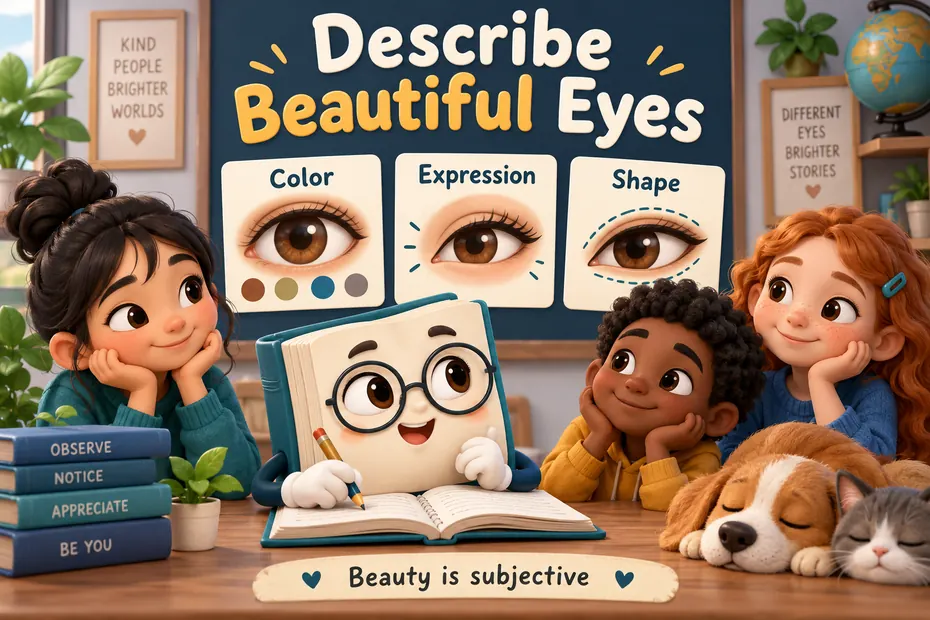
The best description says what you notice. Brown identifies a color, almond-shaped identifies a shape, and expressive suggests that an expression communicates feeling. Beautiful expresses your appreciation, but it leaves the reader to imagine the details. Combining a precise observation with one carefully chosen impression makes a sentence more useful and memorable.
Beauty is subjective. Blue eyes are not inherently more beautiful than brown eyes, and a person’s eye shape does not establish their character. For a compliment, keep the wording warm and appropriate to your relationship. For fiction, connect the description to what the character is doing in the scene instead of presenting a long inventory of features.

Start with color, shape, or light
| What you describe | Useful words | Example |
|---|---|---|
| Color | brown, blue, green, gray, hazel | Her hazel eyes caught the afternoon light. |
| Color intensity | deep, pale, dark, warm | His deep brown eyes stood out beneath the brim of his hat. |
| Shape | round, almond-shaped | She had almond-shaped eyes and a relaxed smile. |
| Visible light | bright, sparkling, luminous | Her eyes looked bright in the sunlight. |
| Overall impression | striking, captivating, lovely | I remembered her striking eyes after our conversation. |
Hazel commonly describes eyes with a mixture of brown and green tones. Use a color word that suits the person you are describing, rather than choosing one because it sounds poetic. Almond-shaped is a conventional shape description; round describes a different outline. Neither is a measure of beauty. A phrase such as wide-eyed may describe a temporary expression of surprise rather than a person’s usual eye shape.
Words associated with light can be literal or figurative. Bright may refer to reflected light or suggest an animated expression. Sparkling often combines a visual impression with enthusiasm. Luminous sounds more literary. If the scene is everyday conversation, “Your eyes look lovely in this light” may feel more natural than a dramatic string of glowing adjectives.
Describe expression without treating it as proof
Cambridge defines expressive in terms of showing thoughts or feelings. In a description, expressive eyes suggests that a glance, movement, or changing expression communicates something. You can make that meaning concrete: “Her expressive eyes widened when she heard the news.”
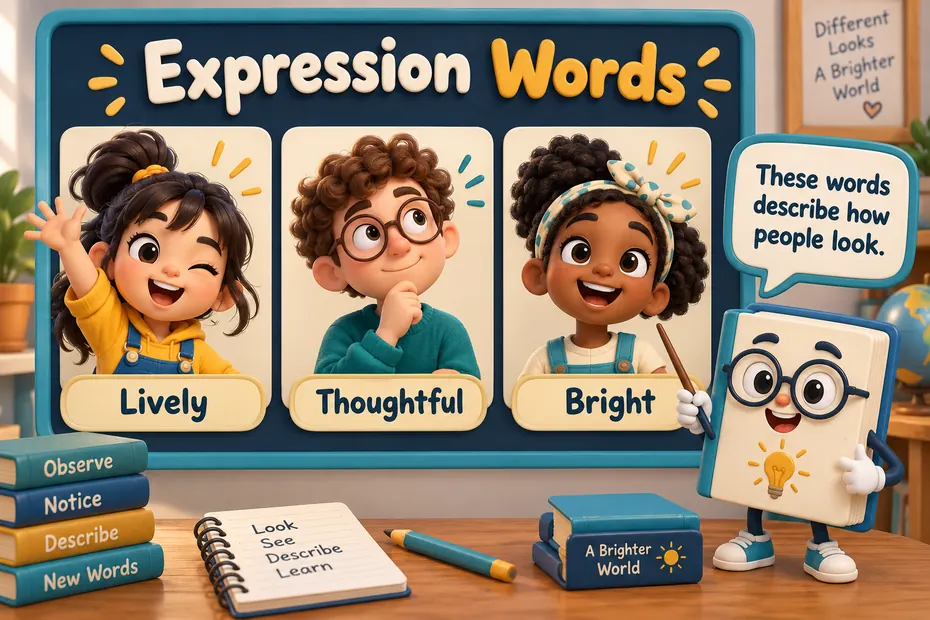
Lively, thoughtful, gentle, and intense describe impressions in a particular moment. Give the reader a visible clue instead of assuming that appearance proves a permanent personality trait. “He looked at the drawing with thoughtful eyes” works better with a surrounding action, such as pausing before answering or studying a detail. “Her eyes were gentle as she reassured the child” places the impression in a scene.
Captivating describes something that holds attention. It tells us about the observer’s response, whereas brown tells us about color. That distinction helps you choose a word: use a color or shape for identification, an expression for the moment, and an appreciative adjective for the effect on the observer.
Turn a general compliment into a specific sentence
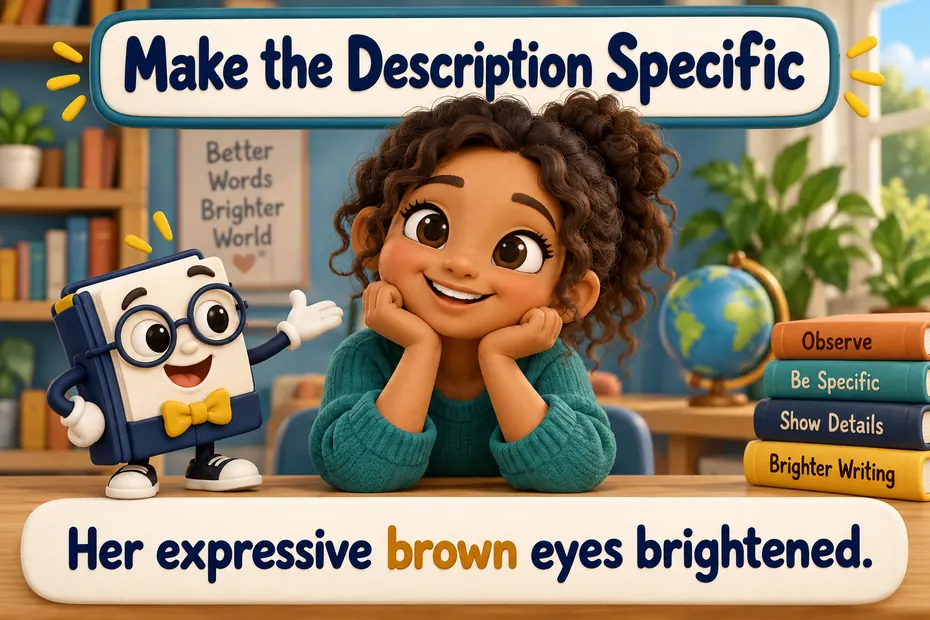
Begin with “She has beautiful eyes.” Add one detail: “She has beautiful brown eyes.” For a scene, let an action carry part of the description: “Her expressive brown eyes brightened when she recognized her friend.” The final version gives the reader color, expression, and a reason for the change without piling up adjectives.
- Casual compliment: “Your eyes look lovely in the sunshine.”
- Character description: “His warm brown eyes softened as he smiled.”
- Observation: “She has gray eyes and wears round glasses.”
- Literary description: “Her luminous eyes reflected the candlelight.”
Choose the version that fits your purpose. An identification description needs recognizable details; a compliment needs tact; a story needs movement and context. Avoid mixing unrelated images such as ocean-deep, diamond-bright, and fiery in the same short sentence. One clear image usually gives the reader more room to imagine the person.
Frequently asked questions
What can I say instead of “beautiful eyes”?
Try lovely, striking, or captivating eyes for appreciation. For greater precision, use expressive brown eyes, bright hazel eyes, or another detail that matches your observation.
Are “piercing” and “intense” always compliments?
No. Both can suggest a powerful or searching gaze, which may feel admiring, intimidating, or uncomfortable depending on the scene. In a friendly compliment, lovely or expressive may communicate warmth more clearly.
How many adjectives should I use?
One or two usually suffice. Combine different kinds of information, such as expression and color, rather than stacking several synonyms for beauty. Read the sentence aloud and remove any adjective that repeats an impression already conveyed by the action.
When it comes to describing the captivating beauty of eyes, words often fall short. The eyes, they say, are the windows to the soul, and there is no denying the power they hold. From sparkling blue orbs to deep, soulful brown, each pair of eyes tells a unique story. In this article, I’ll be diving into the world of adjectives that can be used to describe beautiful eyes, along with some examples that will bring these words to life.
Adjectives have the remarkable ability to paint a vivid picture in our minds, allowing us to appreciate the intricate details that make each set of eyes truly mesmerizing. Whether you’re describing the shape, color, or expression of someone’s eyes, there is a plethora of words at your disposal. From “captivating” and “enchanting” to “mysterious” and “alluring,” these adjectives will help you capture the essence of beautiful eyes in all their glory.
So, if you’re ready to embark on a journey of words and discover the perfect adjectives to describe those captivating eyes, read on. Let’s dive into the world of adjectives for beautiful eyes and explore the magic that lies within.
How to Describe beautiful eyes? – Different Scenarios
When it comes to describing beautiful eyes, there are a variety of scenarios to consider. Whether you’re writing a love poem, a romantic novel, or trying to capture the essence of someone’s gaze in a painting, having the right words is crucial. In this section, I’ll guide you through different scenarios and provide you with a range of adjectives to describe beautiful eyes.
- Romantic Descriptions:
- Poetic Descriptions:
- Sensual Descriptions:
- Expressive Descriptions:
Remember, the key to describing beautiful eyes is to choose words that evoke a feeling or paint a vivid picture in the reader’s mind. Whether you’re capturing the allure of a romantic encounter, the depth of an emotional moment, or the playfulness of a joyful interaction, these adjectives will help you convey the magic of beautiful eyes. Experiment with different combinations and find the perfect words to bring your description to life.
Now that we’ve explored different scenarios for describing beautiful eyes, we can move on to the next section, where we’ll delve deeper into the world of adjectives and their impact.
Describing Words for beautiful eyes in English
When it comes to describing beautiful eyes, there is a wide range of adjectives that can capture their unique beauty. Here are some words that can be used to describe beautiful eyes:
- Sparkling: When I look into her eyes, they glisten like stars on a clear night. Her eyes have a radiant and vibrant quality that draws me in.
- Enchanting: Her eyes have a magical quality, casting a spell on anyone who gazes into them. They are captivating, mysterious, and full of allure.
- Mesmerizing: One glance into his eyes and I find myself completely captivated. They have a hypnotic effect, making it hard to look away.
- Luminous: Her eyes light up the room, radiating warmth and positivity. They have a radiant glow that brings a sense of joy and serenity.
- Expressive: His eyes are like windows to his soul. They convey a wide range of emotions, from happiness to sadness, making it easy to understand what he’s feeling.
- Soulful: Her eyes have a depth that can touch your heart. They carry emotional intensity and seem to reflect her innermost thoughts and feelings.
- Piercing: His eyes have an intense gaze that can penetrate your very being. They are sharp and piercing, leaving a lasting impression.
- Mysterious: Her eyes hold a sense of mystery and intrigue. They give off an air of secrecy, making you wonder what lies behind them.
- Alluring: His eyes have a magnetic quality that draws you in. They are captivating and seductive, making it hard to resist his gaze.
- Dreamy: Her eyes have a dreamy, ethereal quality. They are enchanting and transport you to a world of fantasy and imagination.
Remember, when describing beautiful eyes, it’s important to choose words that evoke a feeling or paint a vivid picture in the reader’s mind. These adjectives can help you create a compelling and vibrant description of someone’s eyes.
Adjectives for beautiful eyes
Positive Adjectives for Beautiful Eyes with Example Sentences
When describing beautiful eyes, there are numerous positive adjectives that can capture their unique beauty. Here are 12 examples of positive adjectives that can be used to describe beautiful eyes, along with example sentences to provide a better understanding:
| Adjective | Example Sentence |
|---|---|
| Sparkling | Her eyes were sparkling like stars in the night sky. |
| Enchanting | The enchanting gaze of her eyes captivated everyone in the room. |
| Mesmerizing | I couldn’t look away from her mesmerizing eyes; they were hypnotic. |
| Luminous | Her eyes had a luminous quality that instantly drew you in. |
| Expressive | His expressive eyes revealed every emotion he felt. |
| Soulful | You could see the depth of her emotions in her soulful eyes. |
| Piercing | The piercing gaze of his eyes made me feel vulnerable and exposed. |
| Mysterious | There was a mysterious allure in her eyes that intrigued me. |
| Alluring | Her eyes had an alluring quality that made it impossible to look away. |
| Dreamy | The soft, dreamy look in her eyes made everything feel magical. |
| Radiant | Her eyes had a radiant glow that lit up the room. |
| Captivating | The captivating beauty of her eyes left everyone in awe. |
Negative Adjectives for Beautiful Eyes with Example Sentences
While we often focus on the positive aspects of describing beautiful eyes, there are also negative adjectives that can convey a different tone. Here are 5 examples of negative adjectives that can be used to describe beautiful eyes, along with example sentences:
| Adjective | Example Sentence |
|---|---|
| Dull | Her eyes looked dull and lifeless, lacking their usual sparkle. |
| Cold | There was a cold distance in his eyes that made it hard to connect with him. |
| Haunting | The haunting gaze of her eyes left a lasting impression on me. |
| Intense | His intense eyes gave off an unsettling vibe. |
| Evasive | Her eyes had an evasive quality, making it difficult to read her true emotions. |
Remember, when describing beautiful eyes, it’s important to choose words that evoke a feeling or paint a vivid picture in the reader’s mind. These adjectives can help you capture the unique beauty and impact of someone’s eyes without exaggeration or relying on exclamation points.
Synonyms and Antonyms with Example Sentences
Synonyms for beautiful eyes
When it comes to describing beautiful eyes, there are many synonyms that can perfectly capture their unique beauty. Let’s explore some of these synonyms:
- Sparkling: Her eyes were sparkling like diamonds in the sunlight.
- Enchanting: I couldn’t help but be captivated by her enchanting eyes.
- Mesmerizing: His mesmerizing eyes held me in a trance.
- Luminous: The actress had a pair of luminous eyes that shone brightly on screen.
- Expressive: Her expressive eyes spoke volumes without uttering a single word.
- Soulful: He had deep, soulful eyes that revealed his inner emotions.
- Piercing: The model’s piercing eyes could cut through any heart.
- Mysterious: There was a mysterious allure in her eyes that drew people in.
- Alluring: His alluring eyes were impossible to resist.
- Dreamy: She had dreamy eyes that seemed to hold a world of fantasies.
Antonyms for beautiful eyes
On the other hand, there are also antonyms that can be used to describe eyes with different characteristics. Here are a few examples:
- Dull: His eyes lacked the spark and appeared dull and lifeless.
- Cold: Her cold eyes revealed her lack of warmth and compassion.
- Haunting: The haunting look in his eyes left a lasting impression.
- Intense: His intense gaze made me feel like he could see into my soul.
- Evasive: Her evasive eyes avoided any direct contact, giving off an air of mysteriousness.
Remember, when choosing adjectives to describe beautiful eyes, it is important to choose words that evoke a feeling or paint a vivid picture in the reader’s mind.
Conclusion
Describing beautiful eyes requires the use of carefully chosen adjectives that can capture their unique allure and charm. In this article, we have explored a range of positive adjectives that can be used to paint a vivid picture of beautiful eyes. From “sparkling” to “captivating,” these words evoke a sense of enchantment and mesmerization.
However, it’s important to remember that there are also negative adjectives that can be used to describe beautiful eyes. Words like “dull,” “cold,” and “evasive” can convey a different aspect of their beauty, adding depth and complexity to the description.
By selecting adjectives that evoke a feeling or create a vivid image in the reader’s mind, we can truly capture the essence of beautiful eyes. Synonyms and antonyms have been provided, along with example sentences, to help illustrate the usage of these adjectives.
When describing beautiful eyes, it is crucial to choose adjectives that not only highlight their physical attributes but also evoke emotion and create a lasting impression in the reader’s mind. The right words can truly bring the beauty of eyes to life.


