Adjectives for Bees: Meanings and Examples
Useful adjectives for bees describe what you can observe—color, body covering, movement, behavior, or pollination role. Words such as fuzzy, striped, solitary, social, and pollen-covered are more precise than calling every bee gentle or busy, because species and situations differ.
Key facts at a glance
- Choose an adjective that names an observable feature or a supported role.
- Fuzzy, striped, and golden describe appearance.
- Solitary and social describe different nesting or group behaviors.
- Pollinating and pollen-covered describe activity or a visible moment.
- A behavior word such as docile can depend on species and circumstances.
How to choose adjectives for bees
Bees differ in size, color, life history, and behavior. The U.S. Fish & Wildlife Service notes that bee species show a wide range of shapes, sizes, colors, and behaviors, and that most native bee species in the United States are solitary pollinators. Describe the bee you can observe instead of implying that every species shares the same traits.
Use appearance adjectives for a close description, behavior adjectives for what the bee is doing, and ecological terms when explaining its role. If the species is unknown, prefer a visible detail such as striped or pollen-covered over a precise-sounding label you cannot verify.
Adjectives for a bee’s appearance
| Adjective | What it describes | Example phrase |
|---|---|---|
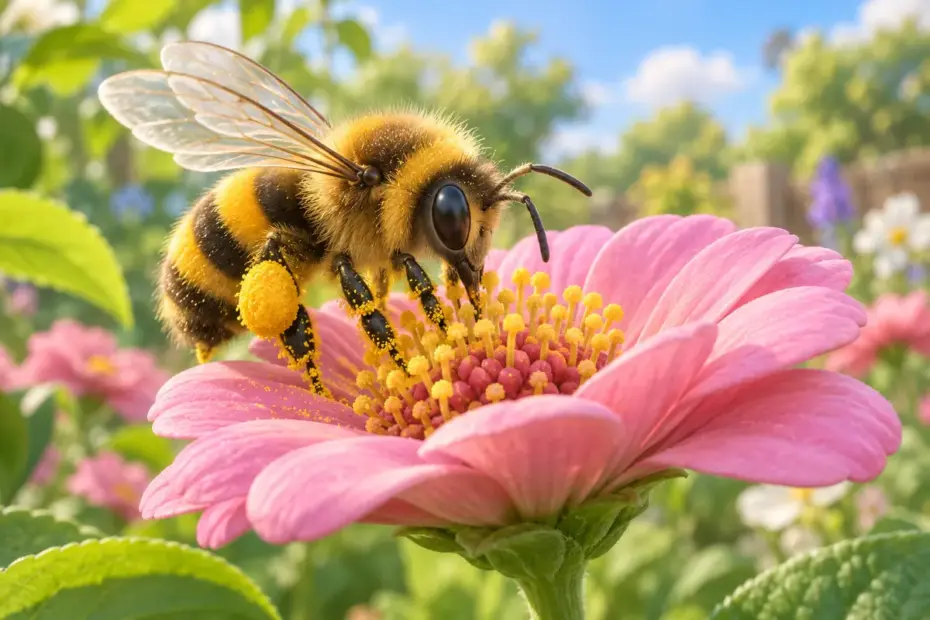
| Fuzzy | A visibly soft or hairy body. | a fuzzy bumblebee on a flower |
| Striped | Alternating bands of color. | a striped bee hovering near the hive |
| Golden | A yellow-gold appearance, often in the light. | a golden bee crossing the sunny garden |
| Black-and-yellow | A visible color pattern. | a black-and-yellow bee visiting a blossom |
| Small | Relative size; most useful with a comparison or context. | a small bee exploring the clover |
| Robust | A sturdy or broad-bodied appearance. | a robust bee settling on the flower head |
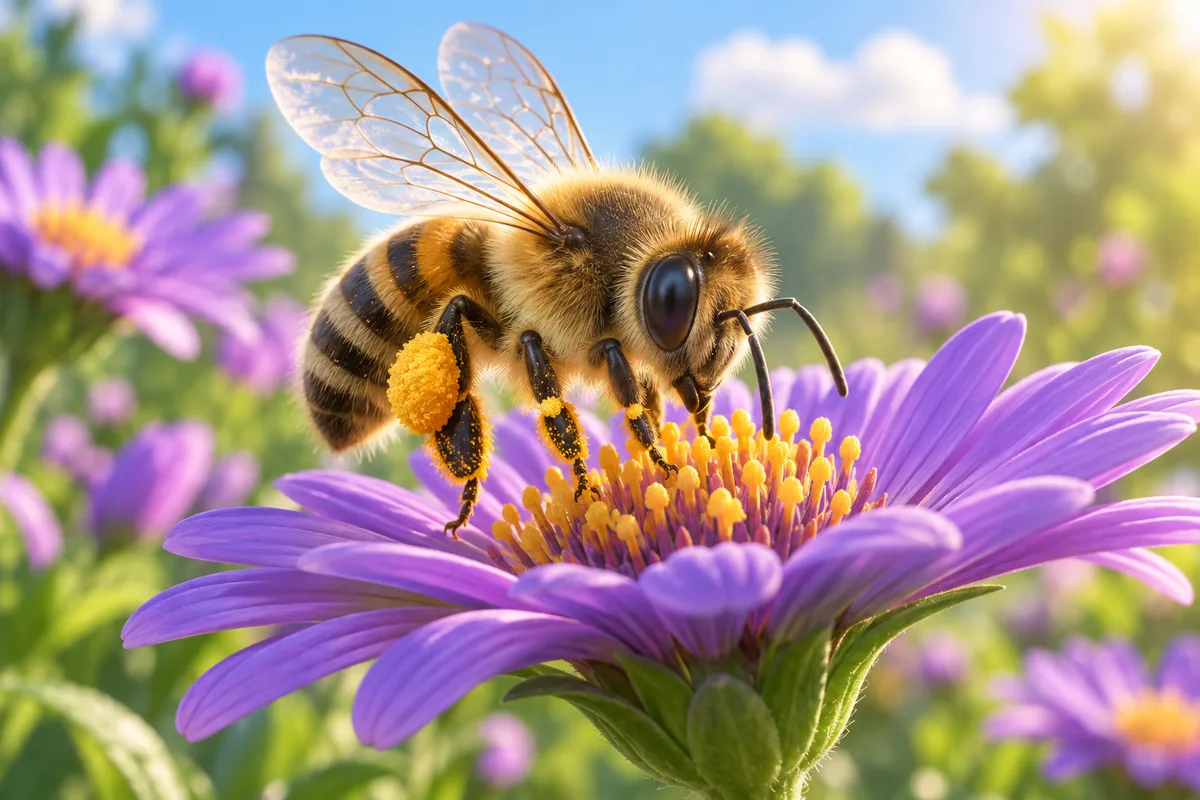
| Pollen-covered | Pollen visibly clinging to the bee. | a pollen-covered bee leaving the bloom |
| Winged | Having wings; a broad descriptive feature. | the winged bee rose above the herbs |
| Native | Belonging naturally to a particular region. | a native bee nesting in the garden |
Adjectives for bee behavior and activity
| Adjective | Meaning or use | Example phrase |
|---|---|---|
| Solitary | Nesting or living alone rather than in a colony. | a solitary bee searching for a nesting spot |
| Social | Living in a group or colony. | a social bee returning to its nest |
| Foraging | Searching for nectar, pollen, or other food. | a foraging bee moving between flowers |
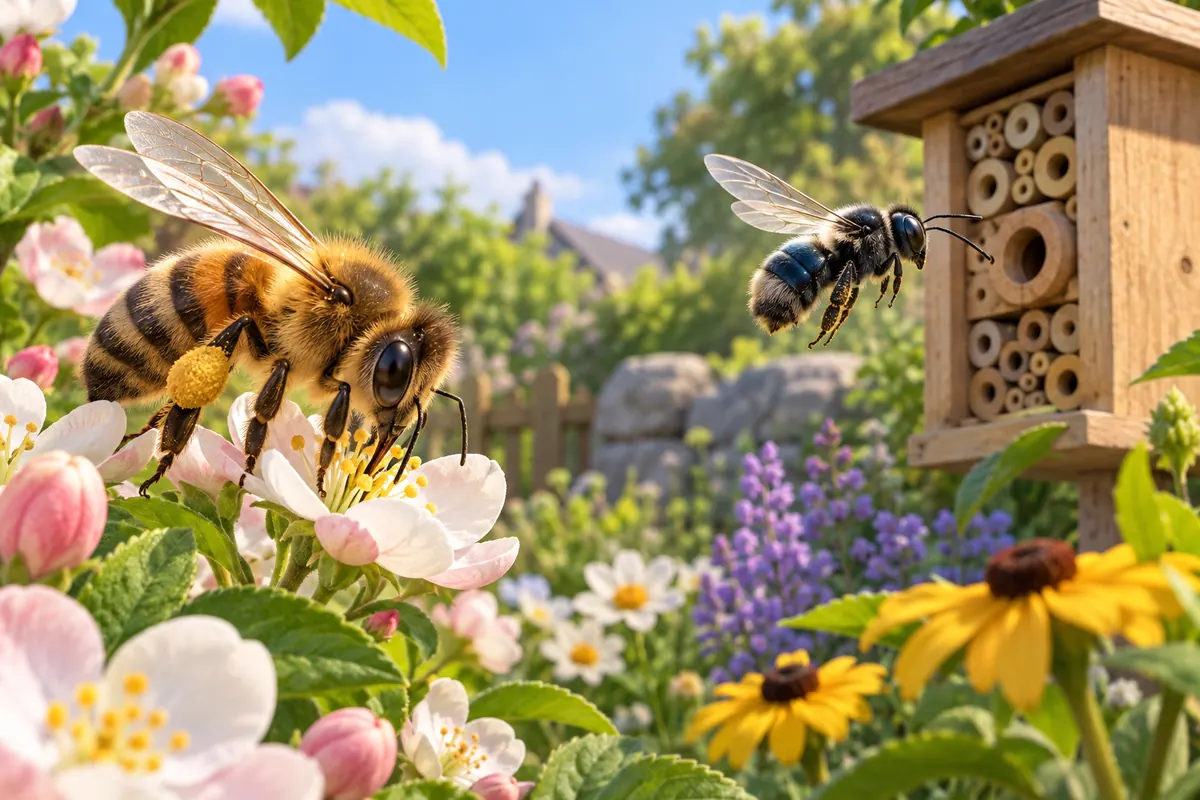
| Pollinating | Moving pollen between flowers as part of its activity. | a pollinating bee visiting apple blossoms |
| Hovering | Remaining briefly in the air near a flower. | a hovering bee paused above the bloom |
| Industrious | Working steadily; often a figurative or literary description. | an industrious bee gathering nectar |
| Resting | Temporarily still or inactive. | a resting bee on a sunlit leaf |
| Defensive | Responding protectively to a perceived threat. | a defensive colony near its nest |
| Docile | Seeming calm or not readily aggressive in a particular context. | a docile bee observed from a safe distance |
Words such as defensive and docile should be used with care. Behavior can depend on species, the bee’s situation, and how close a person is to a nest. Avoid encouraging readers to handle or disturb bees; describe observations from a safe distance.
Adjectives for bees in sentences
- A fuzzy bumblebee settled on the purple flower.
- The striped bee hovered over the clover before landing.
- A pollen-covered bee flew from the apple blossom to the next tree.
- The solitary bee disappeared into a small opening in the soil.
- Social bees moved between the hive and the garden.
- A foraging bee visited the herbs beside the path.
- The industrious bees worked among the spring flowers.
- A native bee emerged from its nest in the morning sun.
- The tiny bee rested on a leaf after crossing the garden.
- We watched the pollinating bee from the other side of the fence.
Use precise, respectful descriptions
For a scientific or educational description, name the species when known and use behavior terms carefully. For creative writing, a phrase such as golden, pollen-dusted bee can create a clear picture without claiming a biological identity. Avoid treating “busy as a bee” as a literal description; it is a familiar comparison, not a measurement of activity.
Frequently asked questions about adjectives for bees
What are positive adjectives for bees?
Pollinating, industrious, and helpful can convey a positive impression, especially in writing about flowers or gardens. Use pollinating when describing the activity, and treat industrious as figurative. Specific, observable words are usually more accurate than broad praise when it fits.
What adjective describes a bee covered in pollen?
Pollen-covered or pollen-dusted describes a bee with visible pollen on its body or legs. The first sounds more literal; the second can feel lighter or more literary. Either phrase works best when the pollen is actually visible in the scene being described.
Are all bees social?
No. Some bees live in colonies, while many species nest alone. The U.S. Fish & Wildlife Service notes that most native bee species in the United States are solitary pollinators. If you do not know a bee’s species or nesting behavior, describe what you observed rather than calling it social.
Can I describe a bee as docile?
You can use docile to describe a calm-seeming bee in a particular observation, but it should not be treated as a guarantee of safety. Behavior varies by species and circumstances. Keep a respectful distance, especially near a nest, and avoid handling wild bees.
I’ve always been fascinated by the incredible world of bees. These tiny creatures play a vital role in our ecosystem, pollinating flowers and producing honey. But have you ever stopped to think about the many different types of bees and their unique characteristics? In this article, I’ll be exploring a range of adjectives that can be used to describe bees, along with examples to help you visualize these descriptions. So, whether you’re a nature enthusiast or simply curious about the fascinating world of bees, join me as we dive into the world of adjectives for bees.
When it comes to describing bees, there’s no shortage of words to choose from. From their appearance to their behavior, bees possess a multitude of qualities that can be captured with the right adjectives. In this article, I’ll be sharing a variety of descriptive words that can help paint a vivid picture of these remarkable creatures. Whether you’re picturing a buzzing bumblebee or a diligent worker bee, these adjectives will help you bring these fascinating insects to life.
So, get ready to explore the world of bees through the lens of adjectives. From their vibrant colors to their tireless work ethic, we’ll uncover the many facets of these incredible creatures. So, without further ado, let’s dive into the world of adjectives for bees and discover the beauty and wonder that lies within these tiny yet mighty insects.
How to Describe bees? – Different Scenarios
Bees are fascinating creatures with unique characteristics. When it comes to describing bees, there are many scenarios and aspects to consider. Let’s explore some different scenarios where we can use adjectives to describe bees:
Physical Appearance:
- Dapper: Sleek black bodies adorned with fuzzy stripes, like miniature bumblebees in tuxedos.
- Iridescence: Wings shimmering with rainbow hues, catching the sunlight like tiny stained glass windows.
- Diligent: Busy legs laden with pollen dust, like industrious gold prospectors returning from the fields.
- Fuzzy ambassadors: Soft, velvety bodies covered in fine hairs, perfect for collecting pollen treasures.
- Agile navigators: Powerful wings buzzing rapidly, propelling them with precise movements through a world of flowers.
Behavior:
- Energetic whirlwinds: Zipping from flower to flower in a blur of motion, pollinating the world with every dance.
- Communicative souls: Performing waggle dances, sharing the location of nectar sources with their hivemates.
- Cooperative citizens: Working tirelessly in a harmonious community, each bee playing its crucial role.
- Guiding lights: Sun-loving souls, navigating by the position of the sun and landmarks to find their way home.
- Tenacious protectors: Fiercely defending their hive against any threat, buzzing and stinging as a united front.
Nectar Collection:
- Nectar sommeliers: Discerningly sipping from blooms, selecting the most flavorful and nutritious offerings.
- Pollen-dusted dancers: Their bodies dusted with colorful pollen, like tiny, furry ballerinas adorned with confetti.
- Humble gatherers: Working tirelessly from dawn to dusk, carrying their loads back to the hive to feed the colony.
- Liquid gold miners: Extracting precious nectar from hidden floral treasures, fueling the entire beehive.
- Alchemists of the natural world: Transforming nectar into honey, a magical elixir with countless uses.
Hive Life:
- Buzzing metropolis: A hive filled with the communal hum of activity, each bee contributing to the greater good.
- Honeycomb labyrinth: An intricate network of hexagonal cells, filled with golden honey and buzzing with life.
- Nursery haven: Queen attended to by worker bees, ensuring the continuation of the colony’s lifeblood.
- Thriving ecosystem: A miniature world within, where every member plays a vital role in its survival.
- Symphony of purpose: The synchronized movements and sounds of the hive composing a unique and captivating orchestra.
Environmental Impact:
- Silent pollinators: Essential players in the ecosystem, ensuring the reproduction of countless plants and fruits.
- Guardians of biodiversity: Their tireless work supporting the delicate balance of nature’s web.
- Climate change warriors: Vulnerable to environmental shifts, yet persisting as crucial indicators of planetary health.
- Underappreciated heroes: Often overlooked, yet playing a vital role in securing our food supply and ecosystem health.
- Tiny ambassadors of nature: Reminding us of the interconnectedness of life and the importance of protecting our shared environment.
Describing Words for bees in English
Bees are fascinating creatures that play a vital role in our environment and food production. They come in different shapes, sizes, and colors, and it’s fun to use adjectives to describe them. In this section, I’ll share with you some describing words for bees in English.
Physical Appearance:
- Adjectives like “fuzzy,” “stripy,” and “colorful” can be used to describe the appearance of bees. They are covered in tiny hairs that give them a fuzzy texture. Some bees have stripes on their bodies, while others are more colorful with shades of yellow, black, or even metallic tones.
Behavior:
- Bees are known for being “busy,” “hardworking,” and “organized.” They are constantly buzzing from flower to flower, collecting nectar and pollen. Bees have a strong work ethic and are dedicated to their hive and queen. They are also very organized in their tasks, with each bee having a specific role to play in the colony.
Nectar Collection:
- Bees are “nectar-gathering” experts. They use their long proboscis to sip nectar from flowers. The nectar is then stored in their honey stomachs to be brought back to the hive. Bees are “persistent” in their search for nectar and can travel long distances to find the best flowers.
Hive Life:
- Inside the hive, bees are “cooperative,” “social,” and “busy.” They work together to build and maintain their hive, with each bee having a specific job. Some bees are “pollen gatherers,” while others are “nurse bees” taking care of the young. The queen bee is the “dominant” bee in the hive, laying eggs and guiding the colony.
Environmental Impact:
- Bees are “essential,” “critical,” and “vital” to our ecosystem. They are the main pollinators of many flowering plants, helping them reproduce and produce fruits and seeds. Without bees, our food system would be severely impacted, as many crops rely on bee pollination. Bees are important for biodiversity and the balance of nature.
Adjectives for bees
Positive Adjectives for Bees
Bees are truly remarkable creatures, and there are many positive adjectives that can be used to describe them. Here are 12 example sentences showcasing the different positive traits of bees:
- Busy: Bees are always buzzing around, working tirelessly to gather nectar and pollen.
- Organized: Bees live in highly structured hives, with designated roles for each member of the colony.
- Diligent: Bees are diligent in their nectar-collecting duties, visiting numerous flowers in search of the sweet liquid.
- Efficient: Bees have a system in place that efficiently allows them to collect nectar and pollen.
- Cooperative: Bees work together as a team, with each bee playing a vital role in the success of the colony.
- Resourceful: Bees are resourceful creatures, utilizing the resources available to them in their environment.
- Industrious: Bees are known for their industrious nature, constantly staying active and productive.
- Vital: Bees are vital pollinators, playing a crucial role in the reproduction of many plant species.
- Persistent: Bees show great perseverance in their search for nectar, even in challenging weather conditions.
- Harmonious: Bees live in harmony within their hive, displaying a remarkable level of cooperation.
- Resilient: Bees are resilient insects, able to adapt to various environmental conditions.
- Fascinating: Bees are fascinating creatures, with their intricate social structures and unique communication methods.
Negative Adjectives for Bees
While bees have many positive attributes, it’s important to acknowledge that they can also have negative qualities. Here are 5 example sentences highlighting some of the negative aspects of bees:
- Aggressive: In certain circumstances, bees can display aggressive behavior if they feel threatened.
- Stingy: Bees have stingers and can sting if they perceive a danger to themselves or their hive.
- Intrusive: Bees can occasionally be intrusive, especially when searching for sources of nectar.
- Opportunistic: Bees can sometimes be opportunistic feeders, taking advantage of available food sources.
- Destructive: In rare cases, bees may cause damage by creating their hives in unwanted areas.
It’s important to remember that while these negative traits exist, they are not representative of bees as a whole. Bees are incredibly important pollinators and play a vital role in our ecosystems.
Synonyms and Antonyms with Example Sentences
Synonyms for bees
Bees can be described using various synonyms that emphasize different aspects of their behavior and characteristics. Here are some synonyms for bees:
| Synonym | Definition |
|---|---|
| Buzzing | Bees are known for the buzzing sound they make as they fly around. |
| Pollinators | Bees play a vital role in pollination, transferring pollen from one flower to another. |
| Honey-makers | Bees produce honey by collecting nectar from flowers and processing it in their hives. |
| Busy | Bees are constantly active, collecting nectar, building and maintaining their hives, and caring for their young. |
| Team-workers | Bees work together and have specific roles within the colony to ensure its survival. |
| Industrious | Bees are hardworking creatures, constantly gathering resources and building intricate honeycombs. |
| Efficient | Bees have a well-organized work system and are efficient in their pollination and honey production. |
Example sentences:
- The buzzing bees filled the garden with sound as they collected nectar from the flowers.
- Bees are important pollinators, helping plants to reproduce and grow.
- The honey-makers in the hive were busy converting nectar into delicious honey.
- The busy bees went about their tasks, never wasting a moment of their time.
- Bees are highly team-workers, each bee having a specific role to contribute to the functioning of the colony.
- The industrious bees tirelessly gathered nectar and pollen, ensuring the survival of their colony.
- Bees are incredibly efficient in their pollination efforts, ensuring the health and diversity of plant life.
Antonyms for bees
While bees are generally known for their positive characteristics, there are some antonyms that can be used to describe them in a negative light. It’s important to note that these antonyms do not reflect the true nature of bees as a whole, but rather highlight contrasting traits. Here are some antonyms for bees:
| Antonym | Definition |
|---|---|
| Lazy | Although bees are known for their industriousness, this antonym implies a lack of motivation or productivity. |
| Solitary | Bees are highly social insects, living and working together in colonies. This antonym suggests being isolated or alone. |
| Unproductive | Bees are prolific pollinators and honey producers, but this antonym suggests a lack of productivity or achievement. |
Example sentences:
- Unlike bees, which are known for their productivity, lazy insects prefer to laze around instead of working.
- Bees are not solitary creatures, instead thriving in close-knit colonies and working together for the benefit of the community.
- Unlike bees, which are highly productive, unproductive insects do not contribute much to their environment.
Remember, these antonyms are used to contrast the positive attributes of bees, highlighting their exceptional qualities and importance in our ecosystems.
Conclusion
In this article, I have explored the various adjectives that can be used to describe bees. From positive attributes like being busy, organized, diligent, and efficient, to negative traits such as aggression and destructiveness, we have seen that bees possess a wide range of characteristics. However, it is important to note that these negative traits do not define bees as a whole.
We have also discussed synonyms for bees, such as buzzing, pollinators, honey-makers, and team-workers, which further highlight their industrious and efficient nature. On the other hand, antonyms like lazy and solitary serve to contrast the positive qualities of bees and emphasize their exceptional qualities.
Throughout this article, I have stressed the significance of bees as pollinators in ecosystems. Their vital role in maintaining biodiversity and supporting food production cannot be understated. By understanding and appreciating the various adjectives that describe bees, we gain a deeper appreciation for these fascinating creatures and their importance in our world.
So, the next time you encounter a buzzing bee, take a moment to reflect on the many adjectives that can be used to describe them. From their incredible work ethic to their essential role in our ecosystems, bees truly are remarkable creatures.


