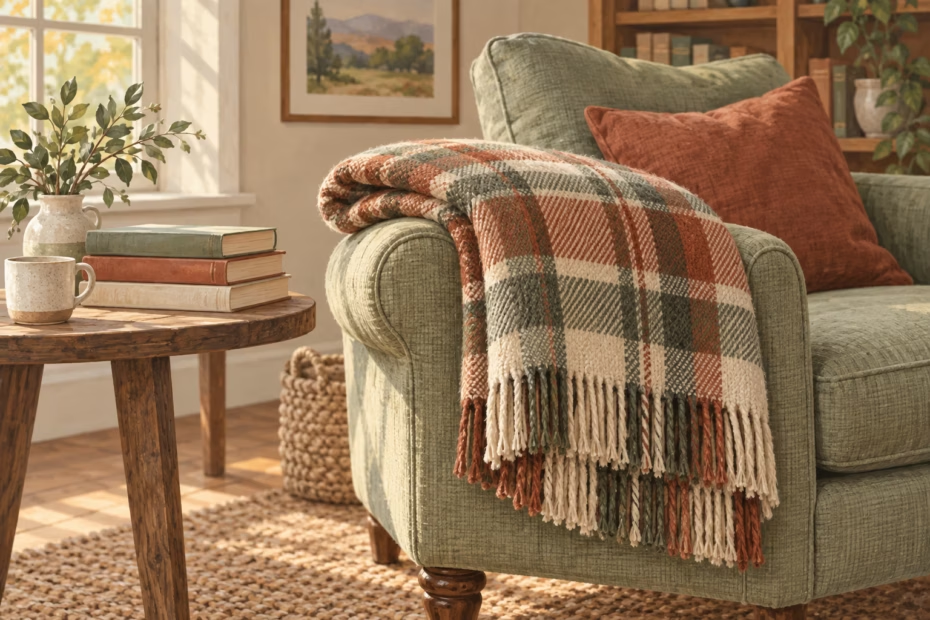
Adjectives for Blankets: Choose Words by What You Notice
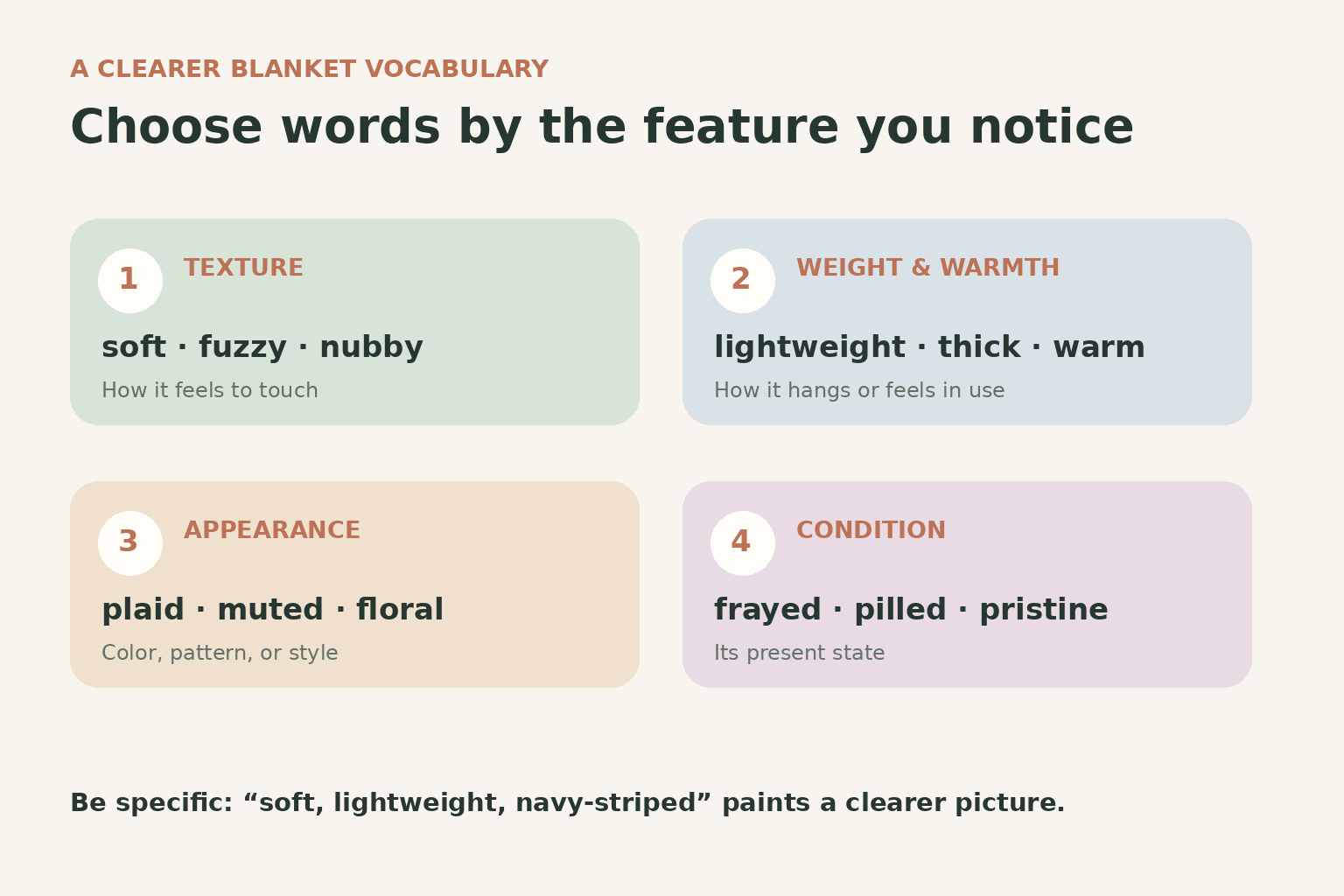
A useful blanket description tells a reader something observable: how the surface feels, how the fabric hangs, what the pattern looks like, or whether the blanket is light or substantial. The best adjective depends on the detail you want to emphasize. Soft describes touch; plaid describes a pattern; lightweight describes weight. A blanket may be all three at once.
Use the lists below as a vocabulary bank, then pair one or two precise adjectives with a concrete detail. Instead of stacking words such as “cozy, lovely, beautiful, wonderful,” write, “The lightweight cotton blanket has a blue windowpane check and a smooth, cool surface.” That sentence gives the reader a clearer picture.
Blanket Adjectives by Attribute
Texture and surface
These words focus on what a blanket feels like to the hand. Actual feel depends on the fiber, yarn, finish, weave, and how the item has been washed, so describe the sample in front of you rather than assuming every blanket made from one fiber feels identical.
- Soft — pleasant and yielding to the touch: “The soft cotton blanket felt gentle against my arms.”
- Fuzzy — covered with a fine, loose surface nap: “A fuzzy fleece throw warmed her knees during the film.”
- Plush — thick and soft, often with a raised pile: “The plush blanket added a cushioned layer to the chair.”
- Smooth — even rather than rough: “Its smooth sateen face slid easily across the sheet.”
- Nubby — marked by small raised knots or bumps: “The nubby woven blanket had a tactile, handmade look.”
- Velvety — soft and dense with a short nap: “The velvety surface caught the light along each fold.”
- Scratchy or coarse — rough against the skin: “The coarse wool felt scratchy until she added a cotton layer.”
- Pilled — dotted with small fiber balls after wear: “The pilled throw looked well used, though it still covered the sofa.”
Weight, thickness, and warmth
Weight and warmth are related but not interchangeable. Heavy tells how much a blanket weighs or presses down; warm describes the comfort it provides in a given setting. A thin blanket may still feel warm indoors, and a thick one may be too warm for a mild evening.
- Lightweight or airy — easy to lift, with a less substantial feel.
- Thin or fine — relatively little thickness; neutral descriptions, not automatic criticism.
- Thick, lofty, or substantial — more depth or body.
- Warm, toasty, or insulating — gives a sense of warmth in context; avoid promising a particular temperature rating unless a product specifies one.
- Breathable — allows air to pass through the material; use when you have a reliable basis for describing that property.
Example: “The thin, lightweight blanket was enough for a sunny afternoon, while the thick wool layer felt warmer once the room cooled.” The comparison describes a situation without claiming one adjective applies to every item made from the same material.
Color, pattern, and style
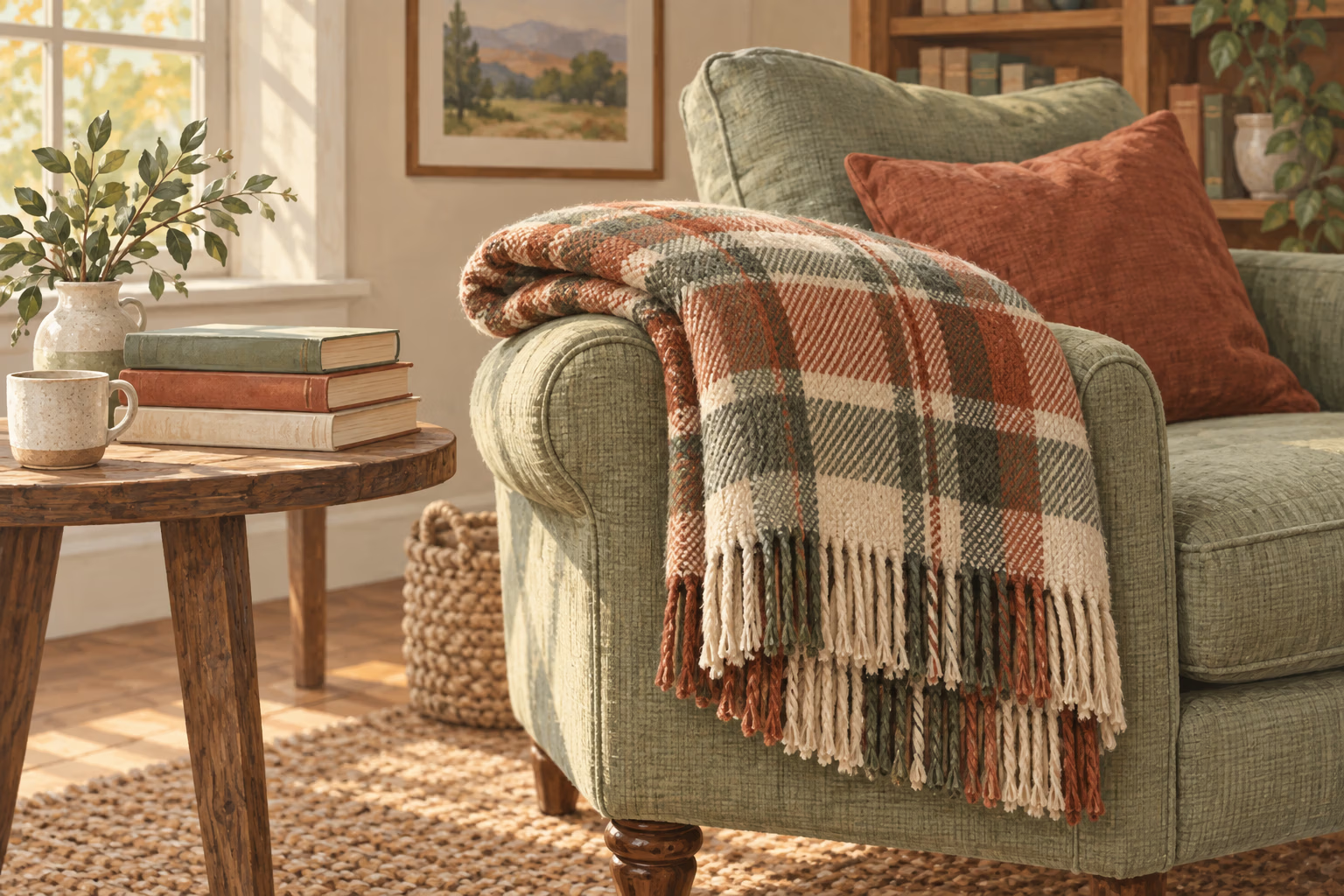
Appearance words can make a short description specific. Color adjectives include ivory, rust, sage green, navy, muted, and vivid. Pattern words include striped, checked, plaid, geometric, floral, speckled, and solid-color. Style words such as traditional, minimal, rustic, or playful express an impression, so anchor them in a visible detail.
For example, “a playful blanket” is subjective, while “a playful blanket with oversized yellow stars” explains what creates that impression. “A muted blue-and-gray plaid” is more informative than “a pretty blanket.”
Construction, size, and condition
Some useful adjectives describe how a blanket is made or how it has held up. Quilted describes layers joined by stitching; knitted and crocheted name looped constructions; woven describes interlaced yarns. A reversible blanket has a usable face on each side. These are more precise than using “quilt” or “afghan” as if either word were interchangeable with every blanket.
Size terms include compact, lap-sized, oversized, and bed-sized. If dimensions matter, give the measurements because “large” means different things for a travel throw and a bed covering. Condition words include frayed, faded, snagged, well-worn, pristine, and freshly laundered. They describe the item’s present state, not its original quality.
Positive, Neutral, and Critical Descriptions
Positive adjectives are helpful when they match what you can observe: soft, warm, lightweight, colorful, reversible, and well-made. Neutral words such as thin, plain, heavy, or small can be complimentary or critical depending on context. Critical words such as scratchy, stiff, frayed, and pilled point to a particular drawback or sign of wear.
Rather than calling a blanket simply “bad,” name the issue: “The blanket feels stiff after washing,” “A loose thread is beginning to fray at one corner,” or “The surface has small pills.” Specific observations make reviews and product descriptions fairer and more useful.
Blanket Description Examples
- For a product listing: “A lightweight, reversible cotton blanket in a muted sage-and-cream stripe.”
- For a review: “The plush pile feels soft, but the blanket is heavier than I wanted for travel.”
- For a story: “She pulled the faded, patchwork blanket up to her chin.”
- For a room description: “A rust-colored knitted throw softened the clean lines of the chair.”
- For a comparison: “The woven coverlet is flatter and smoother than the fluffy fleece throw.”
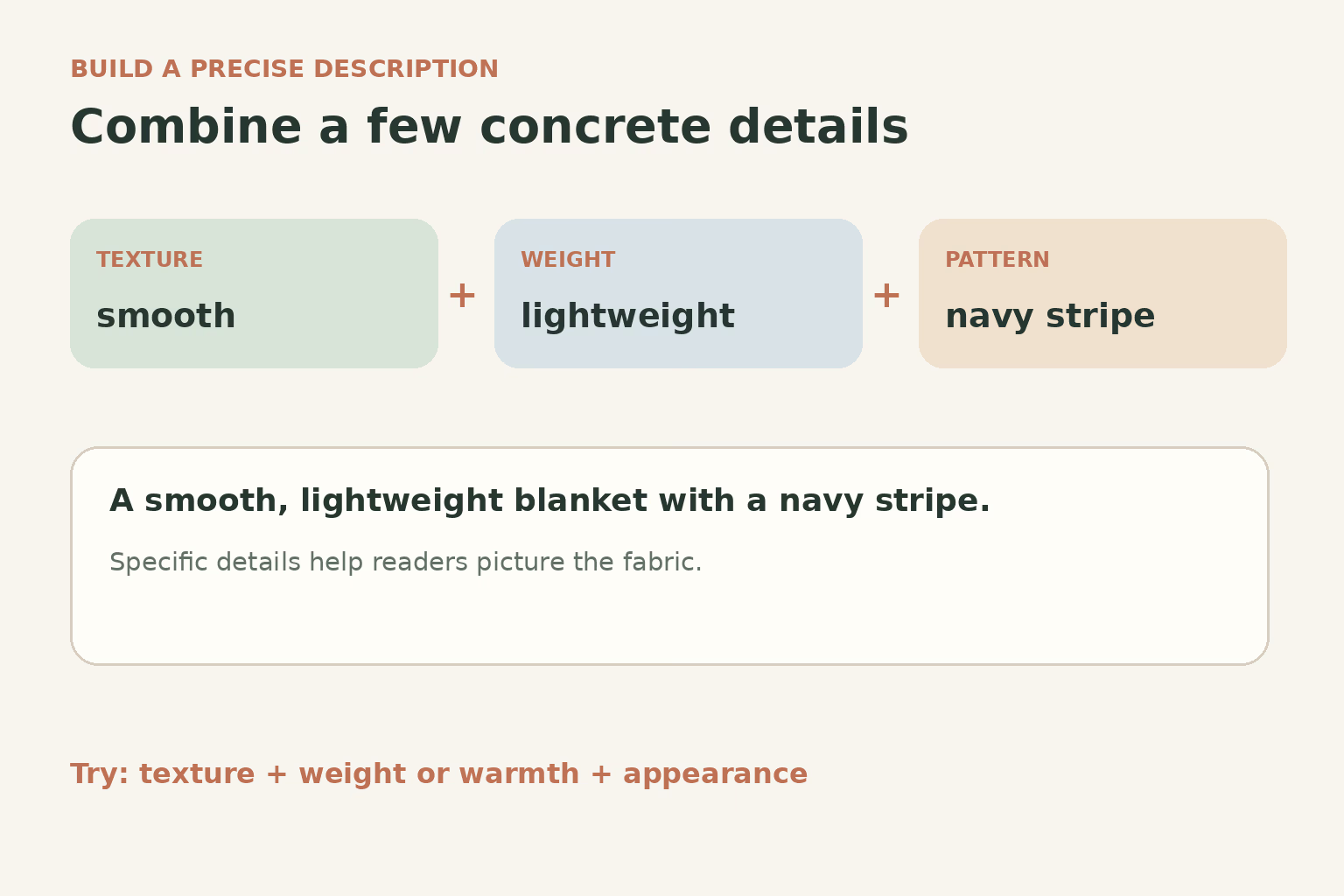
A simple writing pattern is texture + weight or warmth + appearance: “a smooth, lightweight, navy-striped blanket.” Add construction or condition if it helps: “a smooth, lightweight, navy-striped woven blanket with neatly bound edges.” Usually two or three well-chosen adjectives are easier to picture than a long chain of near-synonyms.
Choosing the Right Word and Caring for the Blanket
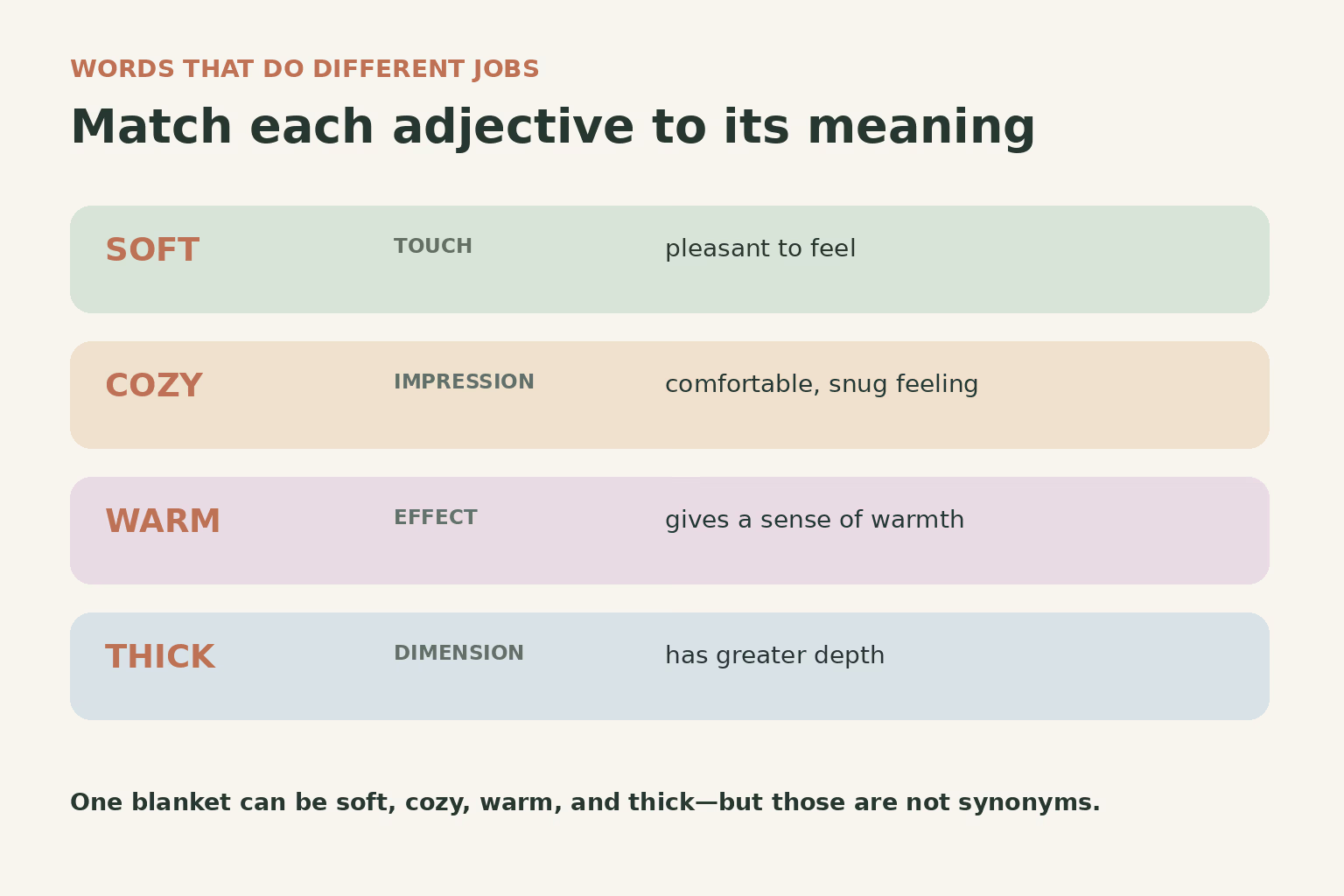
When choosing among similar words, ask what a reader could verify. Fuzzy and fluffy suggest a raised surface; soft reports a tactile impression; cozy describes the comfortable feeling a blanket can create. Luxurious is an opinion about appearance or feel, not a material specification. A clear sentence distinguishes what you noticed from what you infer.
Likewise, adjectives do not replace product details. If fiber content, dimensions, or care instructions matter, check the blanket’s label and describe those facts directly. Fibers behave differently, and blends or finishes can change care needs. University of Georgia Cooperative Extension advises following permanent care-label instructions and notes that wool may shrink or felt unless it is washable or specially treated. Do not assume every wool, cotton, or polyester blanket can be washed the same way.
Safety note: A regular blanket should not be placed in an infant’s sleep space. The U.S. Consumer Product Safety Commission advises keeping blankets and other soft bedding out of an infant’s crib, bassinet, or play yard. For current guidance, follow official safe-sleep recommendations and the instructions for any specifically designed wearable sleep product.
Quick Reference: Useful Blanket Adjectives
| What you describe | Possible adjectives | Example |
|---|---|---|
| Touch | soft, smooth, nubby, fuzzy, scratchy | a nubby handwoven blanket |
| Weight or thickness | lightweight, thin, thick, lofty, heavy | a lofty winter blanket |
| Appearance | striped, plaid, floral, muted, vivid | a muted floral pattern |
| Construction | woven, knitted, crocheted, quilted, reversible | a reversible woven cover |
| Condition | frayed, faded, pilled, pristine, well-worn | a well-worn family blanket |
For the clearest description, match the adjective to the feature you mean and support it with a useful noun or detail. “A soft blanket” is a good start; “a soft, lightweight blanket with a navy windowpane check” lets the reader imagine it.
Sources and Further Reading
- University of Georgia Cooperative Extension: Understand Your Fibers
- University of Georgia Cooperative Extension: Quality and Selection
- U.S. Consumer Product Safety Commission: Safe sleep and soft bedding
The original article follows, retained in full. This added guide clarifies word choice and includes current source-based care and sleep-safety context.

When it comes to snuggling up on a cozy winter evening or adding a touch of comfort to your bed, a blanket is an essential item. But have you ever wondered how to describe the perfect blanket? In this article, I’ll be sharing a list of adjectives that will help you find the right words to describe your favorite blanket. From soft and warm to luxurious and fluffy, these adjectives will bring your blanket to life and make it even more inviting. So, whether you’re a fan of chunky knit blankets or prefer a lightweight fleece, get ready to discover the perfect adjectives to describe your beloved blanket.
A blanket can be more than just a functional item; it can be a source of comfort and relaxation. From the moment you wrap yourself in its embrace, you want to feel a sense of coziness and contentment. That’s where the power of descriptive adjectives comes in. By using the right words, you can paint a vivid picture of your blanket and evoke the emotions that come with it. In this article, I’ll be providing you with a range of adjectives, along with examples, to help you find the perfect words to describe your blanket. Whether you’re looking for adjectives to describe the texture, color, or overall feel of your blanket, you’ll find them all here. So, let’s dive in and discover the world of adjectives for blankets.
How to Describe blanket? – Different Scenarios
When it comes to describing a blanket, there are several factors to consider. Whether you’re discussing the texture, color, or overall feel, using the right adjectives can help bring your description to life. In this section, I’ll guide you through different scenarios and provide examples of how to describe a blanket effectively.
- Texture
- Color
- Weight
- Pattern
- Size
Remember, the key to describing a blanket effectively is to choose adjectives that accurately convey its characteristics. Whether you’re describing the texture, color, weight, pattern, or size, these adjectives will help paint a vivid picture in the reader’s mind.
Describing Words for blanket in English
When it comes to describing blankets, there are a plethora of adjectives that can be used to paint a vivid picture in the reader’s mind. In this section, I will provide you with a list of descriptive words that can be used to describe blankets. Whether you are a preschool teacher looking to teach easy words to kids or a parent trying to engage your child’s imagination, these adjectives will help you accurately convey the characteristics of different blankets.
Here are some examples of descriptive words for blankets:
- Texture: Soft, smooth, fluffy, cozy, plush, velvety, silky
- Color: Vibrant, bold, pastel, soothing, vibrant, earthy, neutral
- Weight: Lightweight, heavy, warm, snuggly, thick, thin
- Pattern: Striped, checkered, floral, geometric, polka-dotted, plaid
- Size: Small, large, oversized, king-sized, queen-sized, baby-sized
Using these adjectives, you can create vivid descriptions of blankets that engage the senses and capture the attention of young learners. For example, you could say, “This soft and fluffy blanket is perfect for snuggling up on a cold winter night” or “The vibrant colors of this striped blanket will add a pop of fun to any room.”
Remember, by using descriptive words, you can transport your audience to the world of blankets, allowing them to feel the cozy warmth and visualize the unique characteristics of each one. Providing children with a rich vocabulary of descriptive words not only expands their language skills but also encourages creativity and imagination.
So, the next time you want to describe a blanket, take a moment to consider the texture, color, weight, pattern, and size. Let your words paint a picture that captures the essence of the blanket and sparks the imaginations of those who hear or read your description.
Adjectives for blanket
Positive Adjectives for Blanket with 12 Example Sentences
When it comes to describing blankets, there are a variety of positive adjectives that can help paint a vivid picture. Here are some examples of positive adjectives you can use to describe a blanket:
- Soft: The blanket is incredibly soft and cozy, perfect for snuggling.
- Warm: This blanket provides warmth and comfort on chilly nights.
- Fluffy: The blanket is fluffy, like a cloud, making it extra cozy.
- Cuddly: This blanket is so cuddly, it’s like getting a hug from a teddy bear.
- Cozy: Wrap yourself up in this cozy blanket for a feeling of instant relaxation.
- Snuggly: The blanket is so snuggly, you won’t want to leave its embrace.
- Inviting: This blanket’s inviting texture beckons you to curl up and unwind.
- Silky: The blanket has a silky smooth texture that feels luxurious against the skin.
- Plush: This plush blanket is like a soft cloud, offering ultimate comfort.
- Dreamy: Wrap yourself in this dreamy blanket for a night of sweet slumber.
- Gentle: The blanket’s gentle touch provides a soothing sensation.
- Huggable: This blanket is huggable, like a warm embrace on a cold day.
Negative Adjectives for Blanket with 5 Example Sentences
While blankets are often associated with positive qualities, there are negative adjectives that can be used to describe them as well. Here are some examples of negative adjectives you can use to describe a blanket:
- Scratchy: Unfortunately, this blanket feels a bit scratchy against the skin.
- Thin: The blanket is thin and doesn’t provide much warmth.
- Stiff: This blanket has a stiff texture that is not very comfortable.
- Itchy: Beware, this blanket may make you feel itchy due to its rough fabric.
- Frayed: The edges of this blanket are frayed, indicating wear and tear.
Remember, describing a blanket using adjectives helps create a vivid image for the reader. Whether you’re teaching young learners about descriptive words or simply looking to accurately convey the characteristics of your favorite blanket, these adjectives can make your descriptions more engaging and captivating. So, go ahead and use these adjectives to bring your blankets to life in the minds of your audience!
And as we continue on with our discussion about adjectives for blankets, we’ll now delve into the topic of colors.
Synonyms and Antonyms with Example Sentences
Synonyms for blanket
When it comes to describing a blanket, there are several synonyms that can help us paint a vivid picture. These words can be used interchangeably with “blanket” to provide a variety of descriptions. Here are some examples:
| Synonym | Definition |
|---|---|
| Cover | Something that is used to envelop or protect something else. |
| Wrap | To enclose or fold something around another object. |
| Quilt | A type of blanket made by sewing two layers of fabric with padding in between. |
| Afghan | A knitted or crocheted blanket, often with an intricate design. |
| Throw | A smaller blanket that is intended for decorative or lightweight use. |
Let’s see them in action:
- I snuggled under my cozy cover as I read my favorite book.
- She wrapped herself in a warm blanket after coming in from the cold.
- Grandma made me a beautiful quilt to keep me warm at night.
- The colorful afghan brought a touch of comfort to the room.
- He draped the soft throw over the back of the sofa for a pop of color.
Antonyms for blanket
On the other hand, antonyms can help us describe blankets that are different from the norm. They can highlight specific characteristics that set a particular blanket apart. Here are some examples:
| Antonym | Definition |
|---|---|
| Bare | Not covered or clothed; exposed. |
| Thin | Having little thickness or density. |
| Small | Not large in size or quantity. |
| Unadorned | Plain or lacking embellishment. |
| Sparse | Not dense or crowded; having few things scattered over an area. |
Let’s see them in action:
- The bed was bare and cold without a blanket to cover it.
- She preferred a thin blanket during the summer months.
- The baby’s crib had a small blanket to keep him warm at night.
- He liked the beauty of an unadorned blanket that let the fabric speak for itself.
- Their picnic blanket was sparse, allowing them to enjoy the grass beneath their feet.
By using synonyms and antonyms, we can expand our vocabulary and create more precise descriptions of blankets. Whether we want to convey warmth, texture, or design, these words provide us with the tools to do so.
Conclusion
In this article, we explored the world of adjectives that can be used to describe blankets. We started by discussing the importance of using synonyms and antonyms to provide a wide range of descriptions. By using words like “cover,” “wrap,” “quilt,” “afghan,” and “throw,” we can convey different aspects of a blanket’s purpose and style.
Additionally, we explored the use of antonyms such as “bare,” “thin,” “small,” “unadorned,” and “sparse” to highlight specific characteristics of a blanket. These words allow us to emphasize factors like thickness, size, or simplicity.
By incorporating a variety of adjectives into our descriptions, we can paint a more vivid picture of blankets, whether we’re discussing their warmth, texture, or design. This not only adds depth to our writing but also enables us to engage our readers and make our descriptions more captivating.
So, the next time you want to describe a blanket, remember to explore the world of adjectives. By doing so, you’ll be able to create descriptions that are both informative and engaging, making your writing stand out.


