Adjectives for Architecture: 800+ Words & Examples
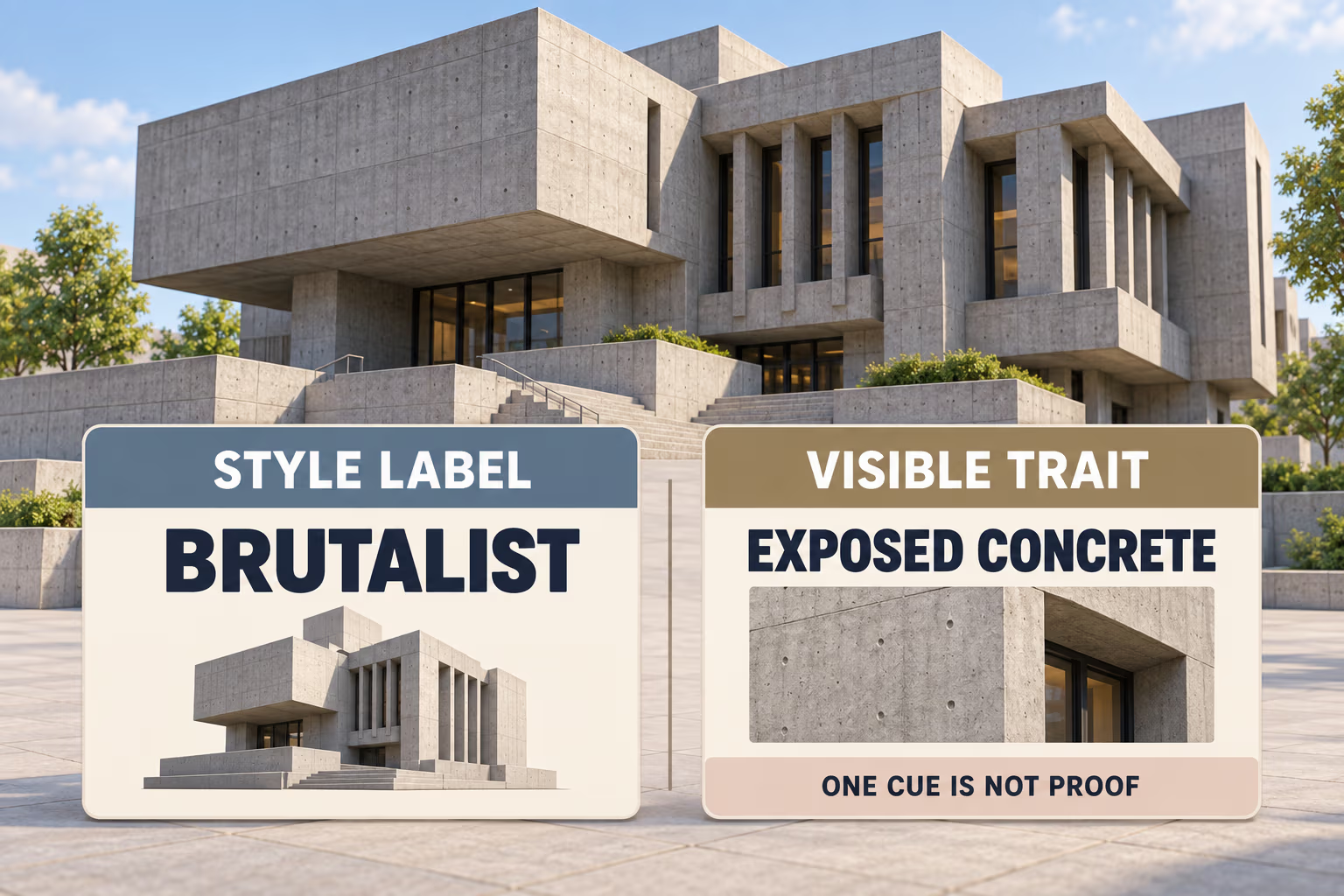
Architecture adjectives are clearest when they name a specific feature: towering for height, symmetrical for balanced arrangement, stone-faced for a visible exterior, ornate for abundant decoration, or welcoming for the impression a space creates. Words such as Gothic, Art Deco, and Brutalist can identify architectural traditions or styles; they are not interchangeable with ordinary visual traits, and one feature alone does not establish a building’s style.
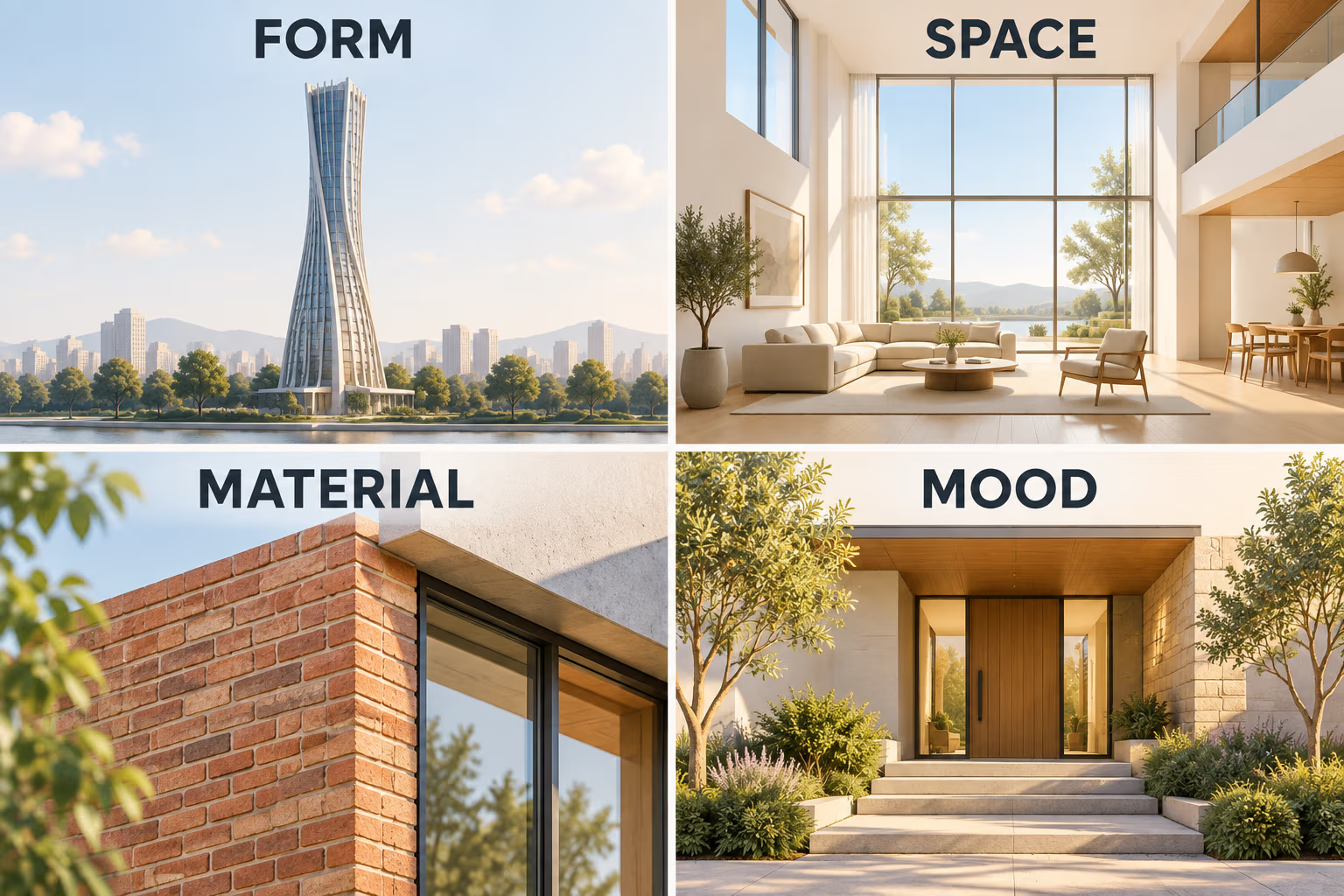
Form and scale: describe what you can see, such as a tall, low-slung, compact, or angular building.
Space and layout: use open, enclosed, symmetrical, or irregular for a spatial quality or arrangement.
Materials and surface: choose a visible description such as brick-faced, timber-framed, glazed, or textured.
Details and ornament:ornate, sculptural, restrained, and finely detailed describe different treatments.
Condition and setting: distinguish observable condition such as weathered from context such as urban or riverside.
Mood or impression: words such as austere, monumental, and welcoming express a response; support them with details readers can picture.
Form, space, materials, and mood answer different questions about a building.
Choose a Word for the Feature You Mean
Begin with evidence, then select an adjective that describes it. The National Park Service describes architectural design through related elements such as form, plan, space, structure, style, scale, ornamentation, and materials. Separating these dimensions helps a writer avoid treating a surface material, a building’s condition, and a style label as though they meant the same thing. For example, brick-faced identifies a visible finish; it does not by itself tell you the building’s structural system or historical style. See the National Park Service glossary.
What you are describing
Useful adjectives
Example sentence
Overall form or scale
towering, low-slung, compact, broad
The low-slung library extends along the edge of a planted courtyard.
Arrangement and space
symmetrical, open, enclosed, irregular
A symmetrical entrance sits between two matching wings.
Visible surface or material
brick-faced, stone-clad, timber-framed, glazed
The glazed entrance reflects the trees across the street.
Decoration and detail
ornate, sculptural, restrained, finely detailed
Restrained trim keeps attention on the carved stone doorway.
Visible condition
weathered, repaired, intact, faded
Weathered stone surrounds the newer timber door.
Setting or surroundings
urban, rural, riverside, tree-lined
The riverside pavilion opens toward a public walkway.
Impression or atmosphere
austere, monumental, graceful, welcoming
A broad entry and bright lobby make the small gallery feel welcoming.
Choose words that match what you can observe; use a source or specialist assessment for claims about hidden construction or historic significance.
Architecture Style Labels Are Different from Visual Adjectives
Gothic, Baroque, Art Deco, Modernist, and Brutalist are often used as names for historical movements, architectural styles, or design traditions. In ordinary description, words such as pointed, ornate, geometric, minimal, and angular describe visible qualities instead. There is overlap: an adjective can be part of a style name and also have a broader descriptive use, so explain which sense you mean.
A visual trait can inform a style description, but it is not proof of a style on its own.
Kind of term
Examples
How to use it carefully
Style or movement label
Gothic, Art Deco, Modernist, Brutalist
Use when the building’s features and context support the classification; qualify it when you are not certain.
Visible form or detail
pointed, geometric, angular, ornate
Name the feature directly, such as a pointed arch or geometric window pattern.
Material or finish
brick-faced, stone-clad, glazed, timber-framed
Describe only what is visible; do not infer the concealed structure from a surface finish.
Impression
dramatic, austere, inviting, monumental
Present this as an interpretation and point to the scale, light, detail, or arrangement that creates it.
Style terms have historical and regional context; descriptive adjectives report a feature or an impression.
The Getty’s Art & Architecture Thesaurus (AAT) is a structured vocabulary used to organize concepts in art, architecture, conservation, archaeology, and cultural heritage. It is useful when a writer needs a consistent term, but a broad list of everyday adjectives is not the same thing as a vetted classification glossary. National Park Service survey guidance recommends standard architectural-history terminology where possible and recognizes regional variation; when a property does not fit a known category, describing its major stylistic features can be more accurate than forcing a label. A precise note such as “a symmetrical facade with a central entrance and repeated window bays” is more informative than guessing a style from one striking feature. See the NPS Guidelines for Local Surveys.
Describe Materials, Condition, and Mood Separately
A building description becomes more useful when it separates what the surface is made of, what condition it appears to be in, and how the design feels to an observer. Stone-clad describes a visible finish; weathered describes visible effects of exposure; majestic communicates an impression. Do not turn a visual impression into a technical conclusion: a photograph may suggest wear, but it cannot establish whether a structure is safe or identify hidden materials.
Observation
More exact wording
Why it helps
What the exterior looks like
“A pale stone facade has narrow vertical windows.”
It names visible features without guessing the building’s full construction.
How parts are arranged
“The central doorway is framed by evenly spaced columns.”
It gives a reader a concrete picture of proportion and order.
How a room feels
“A high ceiling and broad windows make the hall feel airy.”
It connects a subjective impression to features that may produce it.
How a building appears to have aged
“The paint is faded, and the stone around the entry is weathered.”
It reports visible condition without claiming age, cause, or structural status.
For a description of a home rather than a building in general, see adjectives for a house. Our guides to adjectives for big and adjectives for old can help when scale or age is the focus. In each case, use a word that fits the noun and the evidence available.
A Simple Method for Describing a Building
Choose one dimension: form, layout, surface, detail, condition, setting, or atmosphere.
Record visible evidence: note the outline, openings, materials, ornament, light, and relation to nearby space.
Select the narrowest useful adjective: use tall or towering for height, symmetrical for balanced arrangement, and ornate for elaborate decoration.
Separate fact from impression: “brick-faced” is an observation; “welcoming” is an interpretation. Both can help if the sentence makes the distinction clear.
Check style and history: apply a named style only when its recognized features and context support the term; otherwise describe the traits you can see.
Compare “The building is beautiful” with “A narrow stone facade rises above a recessed entrance, while the open lobby draws daylight through high windows.” The second example does not tell the reader what to feel; it gives observable details and lets the impression follow. Keep the original A–Z vocabulary below as a broad word bank, then use this method to choose terms that are accurate for your sentence.
Adjectives are words that describe or modify another person or thing in a sentence. They are often used to describe the physical appearance of something, but can also describe the feeling that something evokes. In the context of architecture, adjectives can be used to describe the overall appearance of a building, the specific features of a particular architectural style, or the feeling that a particular space evokes.
When describing the overall appearance of a building, some common adjectives used to describe architecture include: imposing, grand, majestic, stately, elegant, graceful, and sophisticated. When describing the specific features of a particular architectural style, some common adjectives used to describe architecture include: ornate, detailed, intricate, and sculptural. When describing the feeling that a particular space evokes, some common adjectives used to describe architecture include: welcoming, warm, inviting, cozy, and comfortable.
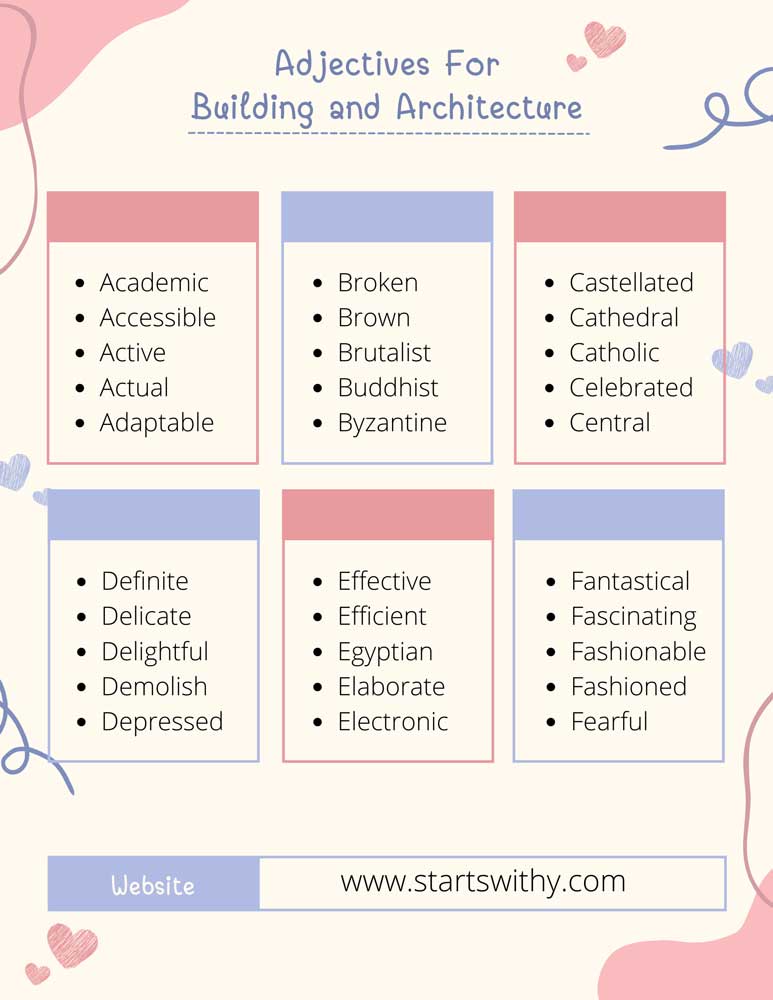
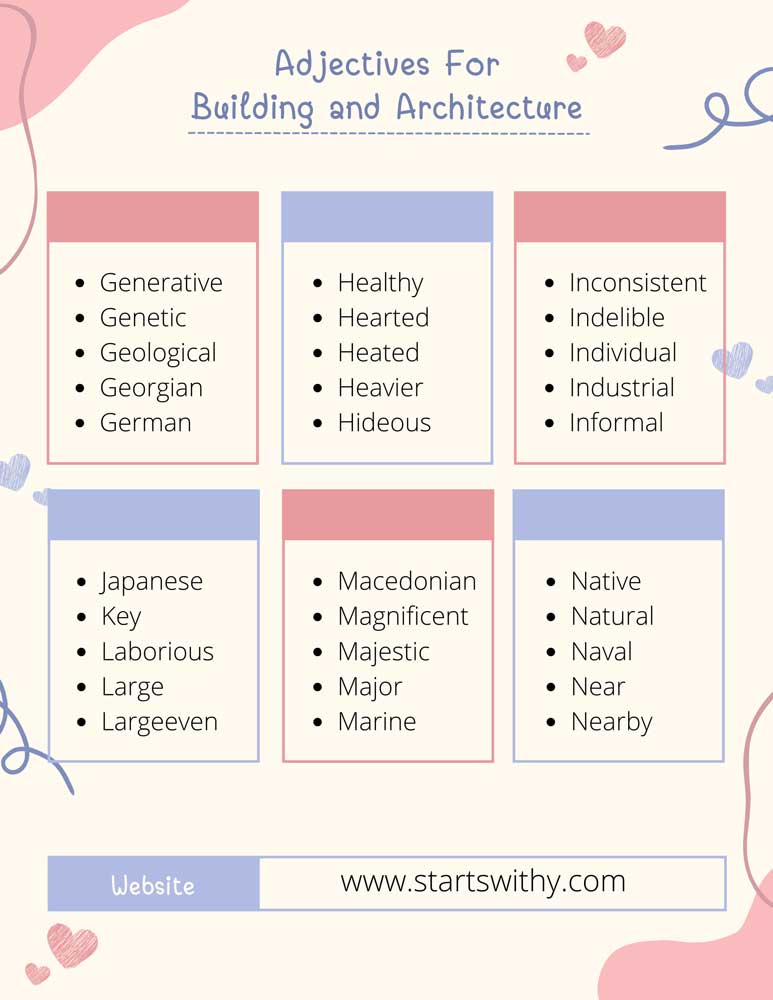
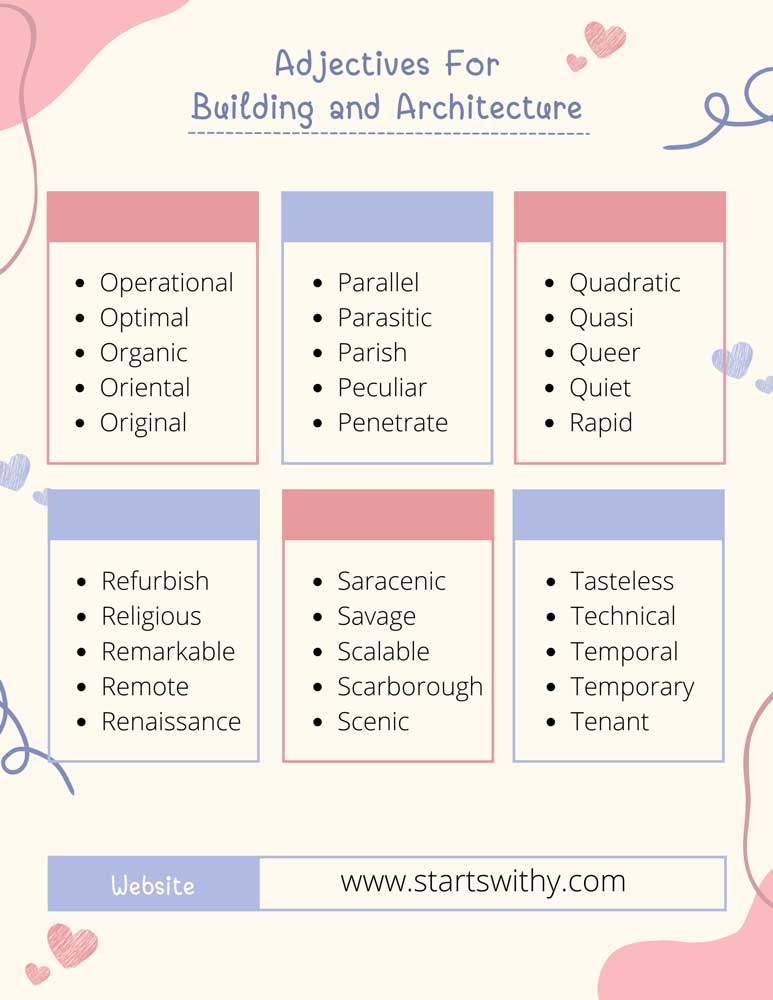
Adjectives For Building and Architecture
When it comes to adjectives for building and architecture, there are a few key words that come to mind: strong, sturdy, reliable, and long-lasting. However, there are many other words that can be used to describe buildings and architecture. Here is a list of some other adjectives that can be used to describe buildings and architecture:
Beautiful: A building or piece of architecture that is beautiful is pleasing to look at. It may have intricate details or be pleasingly symmetrical.
Elegant: An elegant building or piece of architecture is refined and stylish. It is often simple in design, but still makes a statement.
Grand: A grand building or piece of architecture is impressive in size or scope. It is often ornate and luxurious.
Historic: A historic building or piece of architecture is significant for its age or for its association with important events.
Massive: A massive building or piece of architecture is very large. It may be tall, wide, or both.
Modern: A modern building or piece of architecture is characterized by clean lines and a minimalistic design.
Stunning: A stunning building or piece of architecture is breathtaking or awe-inspiring. It is often grand or beautiful.
A
Abbey
Academic
Accessible
Active
Actual
Adaptable
Adequate
Adjacent
Adjoining
Administrative
Advanced
Aerial
Affordable
African
Aged
Agricultural
Airy
Alive
Allusive
Alquist
Amazing
Ambitious
Ampere
Anatomic
Ancient
Antiquated
Arab
Arabic
Architectural
Artistic
Assyrian
Athletic
Attendant
Autohan
Average
Awful
B
Babylonian
Bandwidth
Barbarian
Baroque
Baseless
Beautiful
Beloved
Bizarre
Black
Blue
British
Broad
Broken
Brown
Brutalist
Buddhist
Byzantine
C
Canadian
Capable
Capacious
Castellated
Cathedral
Catholic
Celebrated
Central
Certain
Chaotic
Characteristic
Charred
Chaste
Cheap
Cheerful
Chief
Chinese
Christian
Circular
Cistercian
Civic
Civil
Civilian
Classful
Classic
Classical
Clean
Close
Cobblestone
Cognitive
Collaborative
Collegiate
Colonial
Colossal
Comfortable
Commercial
Commodious
Communal
Communist
Compact
Compelling
Competitive
Complete
Complex
Complicated
Compositional
Computational
Concrete
Condo
Congregational
Connectionist
Conscientious
Conscious
Consequent
Conservatory
Considerable
Conspicuous
Construction
Contemporary
Contiguous
Continuous
Contrived
Contriving
Convenient
Conventional
Conventual
Convert
Cool
Coöperative
Coral
Cornered
Corporate
Corral
Correct
Corresponding
Corrugated
Costly
Countless
Coveted
Cozy
Crazy
Creamy
Creative
Creditable
Crowded
Crude
Cultural
Curious
Cycladic
Cyclopaean
Cyclopean
Cytoskeletal
D
Dainty
Damaged
Damaging
Damned
Damp
Dangerous
Dark
Decent
Decorated
Dedicated
Deep
Defensive
Definite
Delicate
Delightful
Demolish
Depressed
Descript
Deserted
Desirable
Detached
Devastated
Development
Devoid
Didst
Digital
Dignified
Dilapidated
Dim
Dimensional
Diminished
Dingy
Dirty
Disappointing
Disciplinary
Disconnected
Dismal
Disparate
Disreputable
Dissimilar
Distant
Distended
Distinct
Distinctive
Distinguished
Diverse
Diversified
Domestic
Dominican
Doorman
Doric
Doubt
Doubtless
Drab
Dramatic
Dreadful
Dreary
Dull
Dumpy
Dutch
Dynamic
E
Earthly
Eastern
Easy
Ebri
Eccentric
Ecclesiastical
Educational
Edwardian
Effective
Efficient
Egyptian
Elaborate
Electronic
Elegant
Elementary
Elevated
Eleventh
Eligible
Enchanted
Engineered
English
Enormous
Entire
Environmental
Episcopal
Erectedstone
Essential
European
Exact
Exce
Excellent
Exclusive
Executive
Expensive
Exploded
Exquisite
Extant
Extensive
Exterior
External
Extra
Extraordinary
Extravagant
Extreme
F
Fabulous
Fair
Familiar
Family
Famous
Fanciful
Fancy
Fantastic
Fantastical
Fascinating
Fashionable
Fashioned
Favourite
Fearful
Federal
Female
Feudal
Filthy
Final
Financial
Fine
Finer
Finnish
Fireproof
Firm
Fit
Flaming
Flat
Flemish
Flex
Flexible
Flimsy
Floor
Florentine
Florid
Flush
Foreign
Fortified
French
Friendly
Functional
Future
Futuristic
G
Generative
Genetic
Geological
Georgian
German
Giant
Gigantic
Global
Gloomy
Glorious
Goodly
Gorgeous
Gothic
Governmental
Graceful
Grand
Gray
Grecian
Greek
Green
Grim
H
Handsome
Hard
Harmonic
Hateful
Haunted
Hazardous
Headquarter
Healthy
Hearted
Heated
Heavier
Heavy
Height
Heroic
Hideous
Hierarchical
Historic
Historical
Hoc
Holiest
Homeless
Homely
Horizontal
Huge
Human
Humble
Hybrid
Hydraulic
I
Ignoble
Illegal
Imagechip
Imaginative
Immense
Impressive
Improved
Improvisational
Inconsistent
Indelible
Independent
Indian
Individual
Industrial
Informal
Inhabited
Initial
Innovative
Innumerable
Institutional
Interesting
Interior
Internal
International
Intrusive
Ional
Ionic
Iot
Iroquois
Irregular
Islamic
Isolated
Italian
J | K | L
Japanese
Key
Laborious
Large
Largeeven
Largegovernment
Lateral
Legislative
Leisurely
Light
Locale
Localized
Locked
Lofty
Logical
Lonely
Loose
Loveliest
Luxurious
M
Macedonian
Magnificent
Majestic
Major
Marine
Martial
Marvelous
Mass
Massive
Mayan
Mean
Mechanical
Mediaeval
Medical
Medieval
Mediocre
Medium
Memorial
Mental
Mere
Meretricious
Mesopotamian
Middle
Mighty
Military
Miserable
Missionary
Mixed
Mock
Modern
Modernist
Modernized
Modest
Modular
Molecular
Monastic
Mondrian
Mongolian
Monotonous
Monstrous
Monumental
Moorish
Moroccan
Mortal
Mortuary
Mouldy
Movable
Multi
Multiple
Multithreaded
Municipal
Muscular
Musical
Muslim
Mutant
Mysterious
Mystical
N
Narrow
Native
Natural
Naval
Nazi
Near
Nearby
Nearer
Neat
Needful
Neo
Neoclassical
Neocolonial
Neoliberal
Nepean
Net
Newer
Nice
Nipa
Noble
Noblest
Nondescript
Normal
Northern
Notable
Noteworthy
Nuclear
Numerous
O
Oblong
Obstructive
Occupancy
Occupied
Octagonal
Octavian
Odd
Odious
Offensive
Official
Olden
Ominous
Online
Open
Operational
Oppersight
Optimal
Ordinary
Organic
Organizational
Oriental
Original
Ornamental
Ornate
Orogenic
Outer
Outlying
Outside
Outstanding
Overall
Overcrowded
Overnight
Oversized
P
Pagan
Palatial
Palladian
Parallel
Parasitic
Parish
Past
Patient
Paved
Peculiar
Penetrate
Perfect
Permanent
Perpendicular
Perpetual
Persian
Pet
Phoenician
Physical
Picturesque
Pink
Pious
Plain
Playable
Poetical
Pointed
Polished
Polluted
Ponderous
Poor
Popular
Portable
Postal
Postmodern
Powerful
Practical
Pre
Precinct
Precious
Preferred
Premier
Preparatory
Present
Pressed
Prestigious
Pretentious
Previous
Primary
Prime
Princely
Principal
Priory
Prized
Pro
Prodigious
Programmable
Progressive
Prodigious
Programmable
Progressive
Prominent
Proof
Proper
Prosaic
Proud
Provincial
Pseudo
Psychological
Pueblo
Puny
Pure
Puritan
Q
Quadrangular
Quadratic
Quasi
Queer
Quiet
R
Rainscreened
Ramshackle
Rapid
Rare
Real
Rear
Rectangular
Red
Reddish
Reënforced
Reformation
Refurbish
Regular
Religious
Remarkable
Remote
Renaissance
Rental
Repeatable
Representative
Reputable
Required
Requisite
Residence
Residential
Resistant
Respectable
Respected
Respective
Responsible
Resumé
Retail
Retired
Revivalist
Rich
Ridiculous
Rise
Ritualistic
Rival
Robust
Rococo
Romaic
Roman
Romanesque
Romantic
Rotten
Rotunda
Rough
Round
Rowhouse
Royal
Rude
Rudest
Rugged
Ruined
Ruinous
Rural
Rustic
S
Sacred
Sacristy
Sad
Safe
Saracenic
Savage
Scalable
Scaleable
Scarborough
Scenic
Scientific
Seamless
Secular
Secure
Secured
Sedate
Seemly
Semi
Semicircular
Seminary
Senior
Separate
Seventh
Severe
Shabby
Shaped
Shed
Shoddy
Shorter
Showy
Sickest
Sided
Significant
Silent
Simple
Singaporean
Single
Sixth
Sized
Skilful
Skinny
Skoolie
Sleek
Sleep
Slender
Slight
Slim
Slimmer
Slow
Slummy
Slung
Smart
Solemn
Solid
Solitary
Sombre
Sooty
Sophisticated
Sound
Southern
Soviet
Spacious
Spanish
Spare
Speculative
Spiritual
Splendid
Square
Squat
Stable
Stalinist
Stalwart
Standalone
Standard
Stately
Steadfast
Storey
Storied
Story
Stout
Straggling
Straight
Strange
Strata
Strategic
Strawbale
Strictest
Striking
Structural
Stunning
Stupendous
Sturdy
Sublime
Substantial
Subterranean
Successful
Sudden
Suitable
Sumptuous
Sunfish
Superb
Superior
Supportive
Sustaiable
Sustainable
Swift
Swiss
T
Tasteful
Tasteless
Technical
Temporal
Temporary
Tenant
Terminal
Terrific
Thatched
Thin
Timeless
Tiny
Titanic
Tolerant
Torched
Tougher
Traditional
Trampapproached
Transitional
Ttc
Turkish
Typical
U
Ugly
Ukrainian
Ultra
Unassuming
Uncanny
Uncompleted
Unconventional
Undefended
Unfinished
Unfit
Unharmed
Unibody
Unidentified
Unified
Uniform
Uninteresting
Unique
Unit
Unitthe
Universal
Unlighted
Unmarked
Unoccupied
Unplastered
Unprecedented
Unpretending
Unpretentious
Unremarkable
Unroofed
Unsanitary
Unsightly
Unusual
Unwieldy
Upright
Urban
Usable
User
V
Vacant
Vacated
Valuable
Varied
Vast
Venerable
Venetian
Verdant
Vernacular
Versatile
Victorian
Vile
Virtualized
Visible
Visionary
Vocabulary
Vulnerable
W | Y
Warm
Washed
Weird
Western
Wholesome
Wide
Winged
Wireless
Wiry
Wonderful
Wondrous
Wooden
Worldly
Worthless
Worthwhile
Worthy
Wrong
Year
Yellowish
How to Describe Architecture?
Describing architecture is akin to painting a vivid image with words. While the buildings and structures themselves may be static, the right descriptions make them come alive, highlighting their nuances, form, and the emotions they evoke. It’s essential to choose the right words to describe architecture, combining the historical, aesthetic, and functional dimensions of a structure.
To begin with, adjectives to describe architecture often hinge on the period from which the structure originates. Terms like ‘Gothic,’ ‘Baroque,’ ‘Modernist,’ or ‘Art Deco’ not only pinpoint the time but also evoke particular styles and motifs. Delve deeper, and one might describe a building as ‘asymmetrical,’ pointing out its non-uniformed balance, or ‘ornate,’ showcasing the intricate detailing adorning its façade.
Another layer of understanding is added with architectural words to describe buildings. For instance, ‘buttress,’ ‘cornice,’ ‘lintel,’ or ‘parapet’ are specific elements of structures that provide both function and form. To the uninitiated, a building might simply have supporting walls, but an ‘arcade’ is a series of arches, supported by columns or piers — more than just a passage but an embodiment of design.
The sheer grandeur of a skyscraper or the delicate latticework in an ancient temple window can stir deep emotions. While one might be ‘towering’ and ‘imposing,’ suggesting dominance over a city’s skyline, the other is ‘intricate’ and ‘ethereal,’ hinting at skilled craftsmanship and devotion. These nuances are crucial when attempting to convey the ethos of a structure.
However, it’s not just about technicalities. Words to compliment architecture should encapsulate the emotion a building exudes. Saying a mansion is ‘majestic’ or a bridge is ‘elegant’ paints a picture in the reader’s or listener’s mind. Descriptions such as ‘breathtaking’ or ‘harmonious’ can portray the powerful impact a piece of architecture has on its observers.
In summary, describing architecture is an art that marries technical knowledge with poetic expression. It requires a balance between understanding the intricacies of design and construction, and the ability to convey the visceral experience of standing before a masterpiece. With the right words, one can traverse time, cultures, and geographies, all within the realm of architectural wonders.
Final verdict
When it comes to adjectives for building and architecture, there are endless possibilities. Whether you’re looking to describe a grandiose structure or a more humble abode, there’s an adjective out there that will fit the bill. The next time you find yourself in need of some descriptive words, be sure to peruse this list of adjectives for building and architecture.
Frequently Asked Questions About Architecture Adjectives
What are good adjectives to describe architecture?
Choose words for a visible quality: towering for height, symmetrical for arrangement, ornate for elaborate detail, or stone-clad for an exterior finish. Words such as welcoming describe an impression, so connect them to features such as light, scale, or an accessible entrance.
What is the difference between an architecture style and an adjective?
A style label such as Art Deco or Brutalist refers to a design tradition or classification. A descriptive adjective such as geometric or angular names a quality a viewer can notice. Features may support a style identification, but one feature by itself does not prove that a building belongs to a movement.
Is “modern” an architectural style?
Modern can simply mean current or relatively recent in everyday writing. Modernist is often used for a particular architectural movement or design approach. Because usage and period boundaries can vary, explain the intended meaning or name visible features when a formal classification is uncertain.
Does “historic” just mean old?
No. Old describes age, while historic usually signals historical association or significance. A weathered appearance alone does not establish a building’s age or historical importance. If you only know what is visible, describe it as old-looking, weathered, or faded rather than making an unsupported historical claim.
How can I describe a building without guessing its style?
Name the form, arrangement, surface, and details you can see: for example, “a broad brick facade with a centered doorway and evenly spaced windows.” This gives readers a clear image without assigning a style based on one cue. If a recognized style matters, check reliable architectural-history sources and relevant regional context.
Use Specific Words for Specific Features
The strongest description does more than praise or criticize a building. It identifies the form, material, arrangement, or atmosphere you mean, then uses an adjective that fits the evidence. The retained A–Z list offers possibilities; a precise detail and careful distinction between style and trait make those choices more useful.