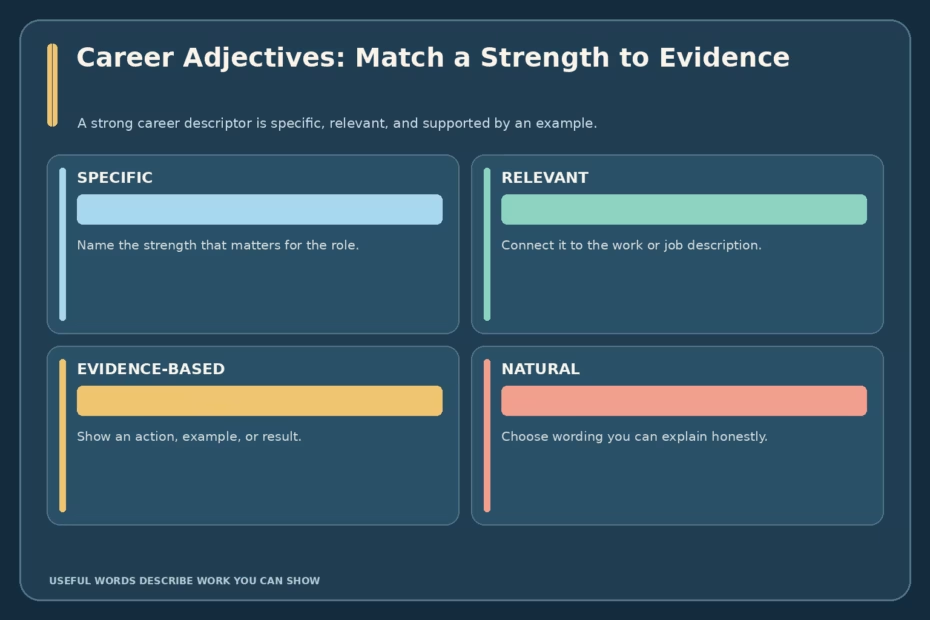
Career Adjectives: A Quick Guide
Career adjectives describe the strengths, working style, or professional qualities you bring to a role. Useful choices include analytical, adaptable, collaborative, dependable, and resourceful. Choose a word that fits the job and support it with a real example: “I am adaptable” is less persuasive than describing how you adjusted a project plan when priorities changed.
How to Choose the Right Adjective for Your Career
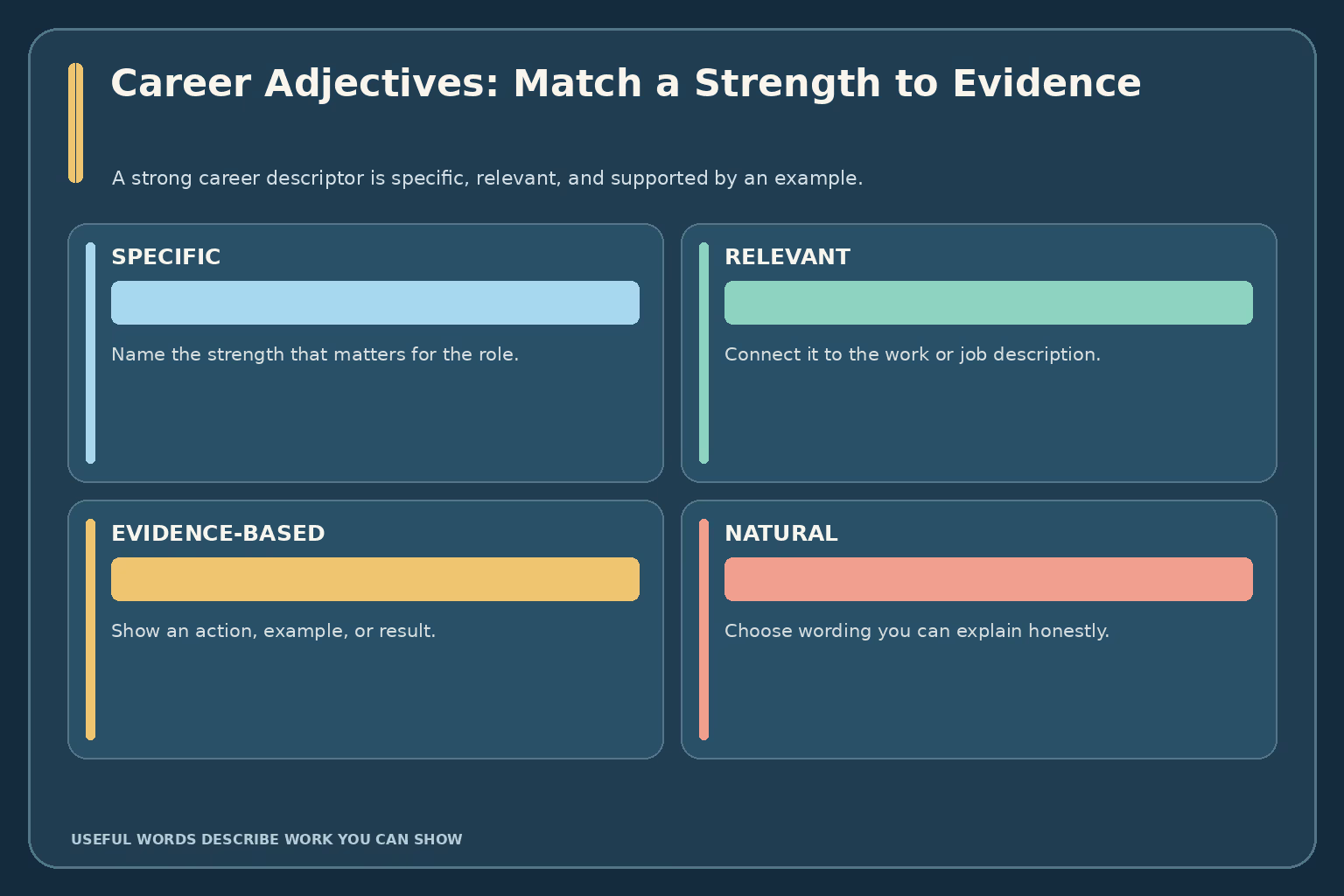
Start with the work the employer needs done. Read the job description and note its recurring responsibilities, such as analyzing data, coordinating projects, serving customers, or explaining technical information. Then choose one or two adjectives that accurately describe how you have handled similar work. Avoid copying a long list of traits into an application; a focused example gives each word meaning.
- Identify the relevant strength. For a role that involves troubleshooting, analytical or resourceful may fit. For a role built around shared deliverables, collaborative or dependable may be more useful.
- Connect the word to an action. Describe what you did, who or what it helped, and what changed. Use a concrete project, responsibility, or outcome rather than a claim about your personality alone.
- Check that the word is accurate. Be prepared to explain the example in an interview. If you cannot name a situation that demonstrates the quality, choose a more precise word or describe a skill you are still developing.
- Use natural language. A familiar word that clearly fits is stronger than an inflated synonym that sounds unlike you. The goal is to make your contribution easy to understand.
Career Adjectives by Professional Strength
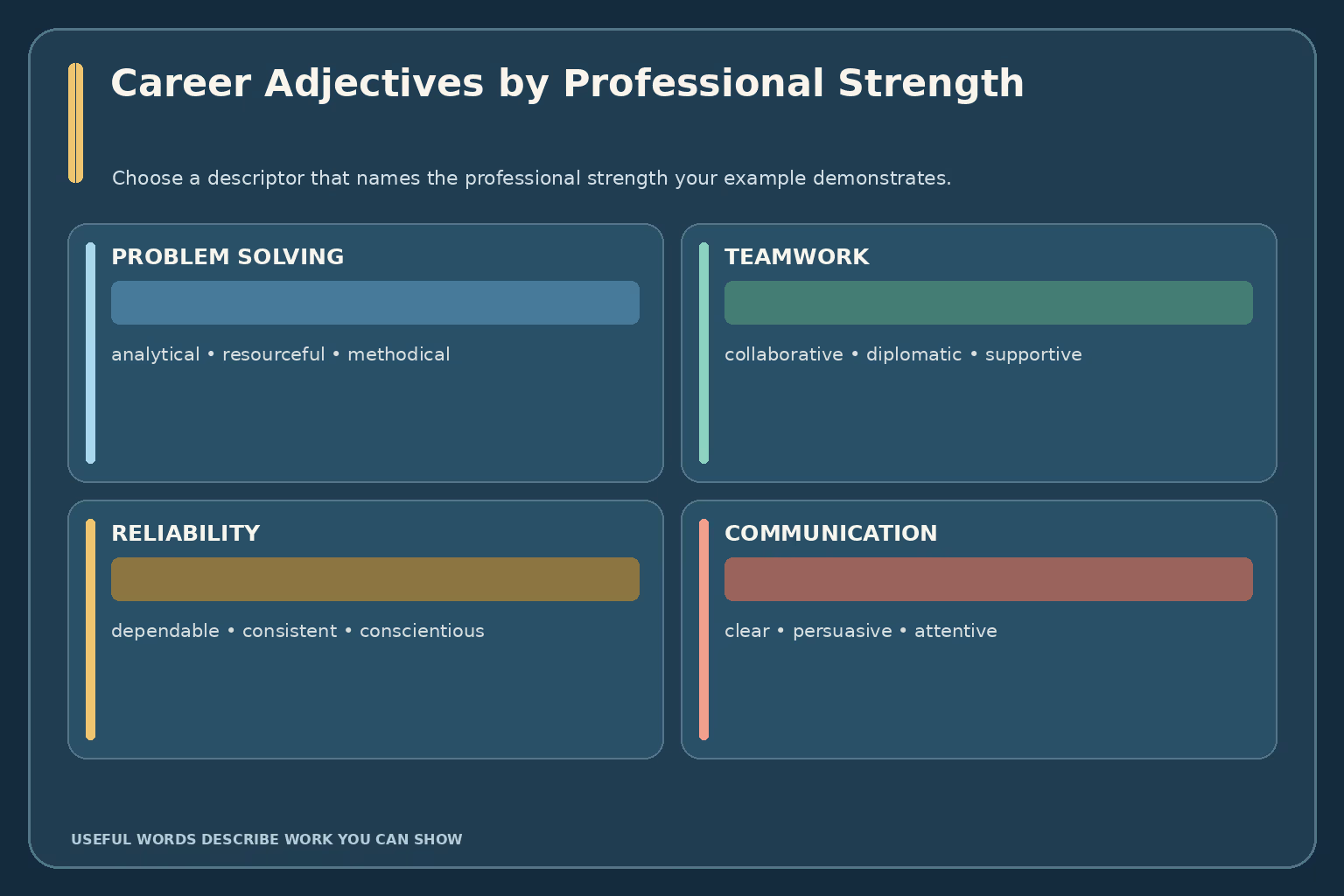
These categories can help you find a starting point. The best choice still depends on the specific role and the evidence you can provide.
| Strength | Adjectives to consider | Example evidence |
|---|---|---|
| Problem solving | Analytical, resourceful, methodical, perceptive | Found the cause of a recurring issue and tested a workable fix. |
| Planning and organization | Organized, systematic, thorough, detail-oriented | Tracked dependencies and kept several deadlines visible to a team. |
| Teamwork and leadership | Collaborative, supportive, diplomatic, decisive | Resolved a handoff problem or aligned a group on clear next steps. |
| Communication | Clear, persuasive, attentive, articulate | Explained a complex change to people with different levels of familiarity. |
| Reliability and care | Dependable, conscientious, consistent, responsible | Followed a quality process and raised risks before they became delays. |
| Learning and change | Adaptable, curious, resourceful, resilient | Learned a new tool or adjusted a workflow after requirements changed. |
| Initiative and results | Proactive, driven, focused, enterprising | Identified a gap, proposed a solution, and carried it through. |
Some descriptive terms overlap. Dependable emphasizes that people can count on you; conscientious suggests care and responsibility in how work is done; and consistent points to steady performance over time. Resourceful emphasizes finding ways forward with available tools, while innovative is more suitable when you can point to a new idea, method, or solution. Use the word whose meaning matches the example, not simply the one that sounds most impressive.
How to Use Career Adjectives on a Resume
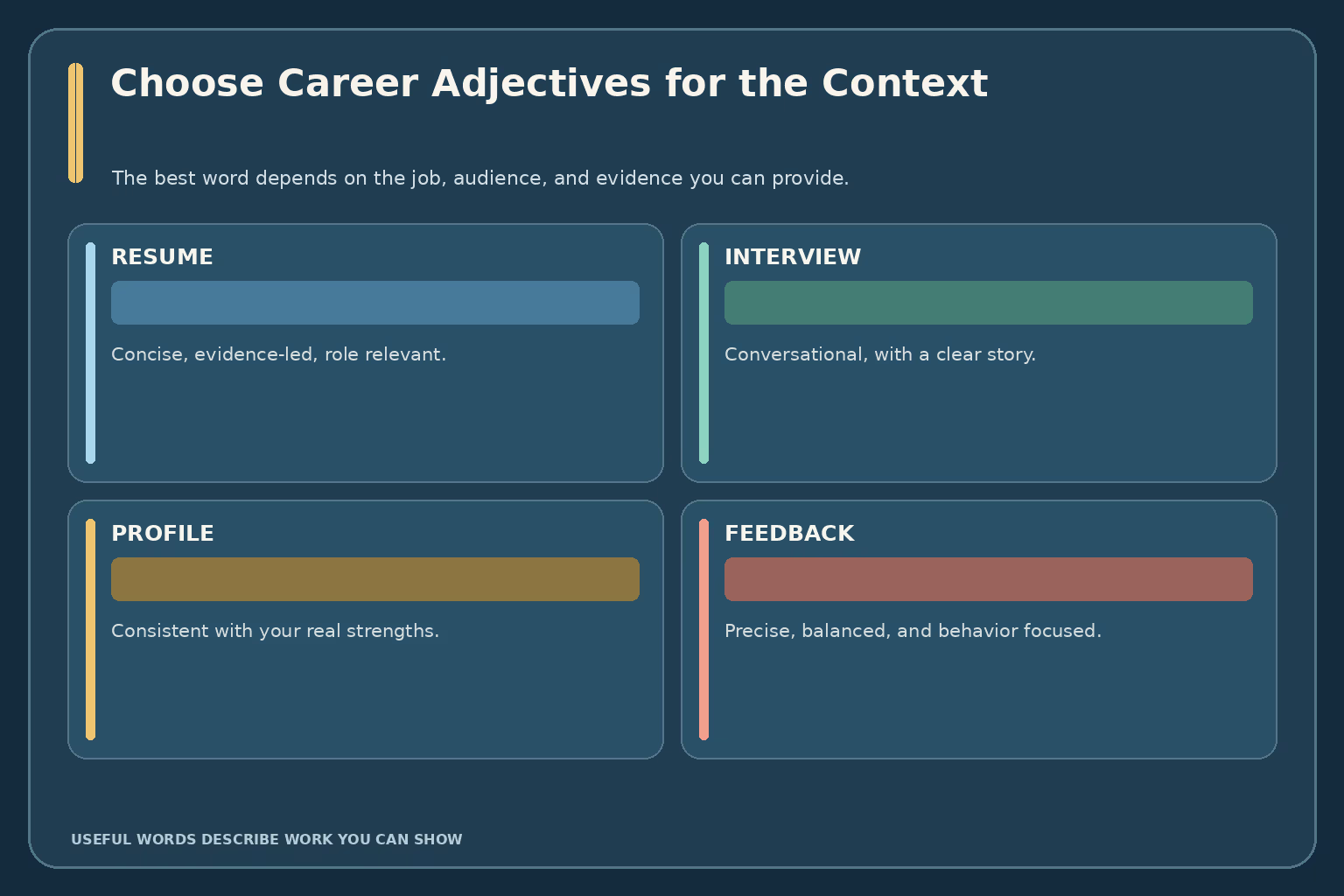
On a resume, adjectives work best when they clarify a concise summary or help describe the conditions behind an accomplishment. Do not let them replace the accomplishment itself. Harvard’s career guidance recommends tailoring a resume to the employer’s needs and using active, specific language; its career center also cautions that broad, familiar claims often provide little detail. See the Harvard resume and cover-letter guide and its advice on context-specific resume language.
Instead of writing “I am a motivated, hardworking, detail-oriented professional,” choose the one quality that matters most and demonstrate it in a bullet. For example:
- Broad claim: “Highly organized project coordinator.”
- Evidence-led version: “Coordinated a shared project tracker across four teams, surfacing schedule risks before weekly milestones.”
- Broad claim: “Excellent communicator and team player.”
- Evidence-led version: “Translated customer feedback into a concise weekly brief that helped product and support teams prioritize recurring issues.”
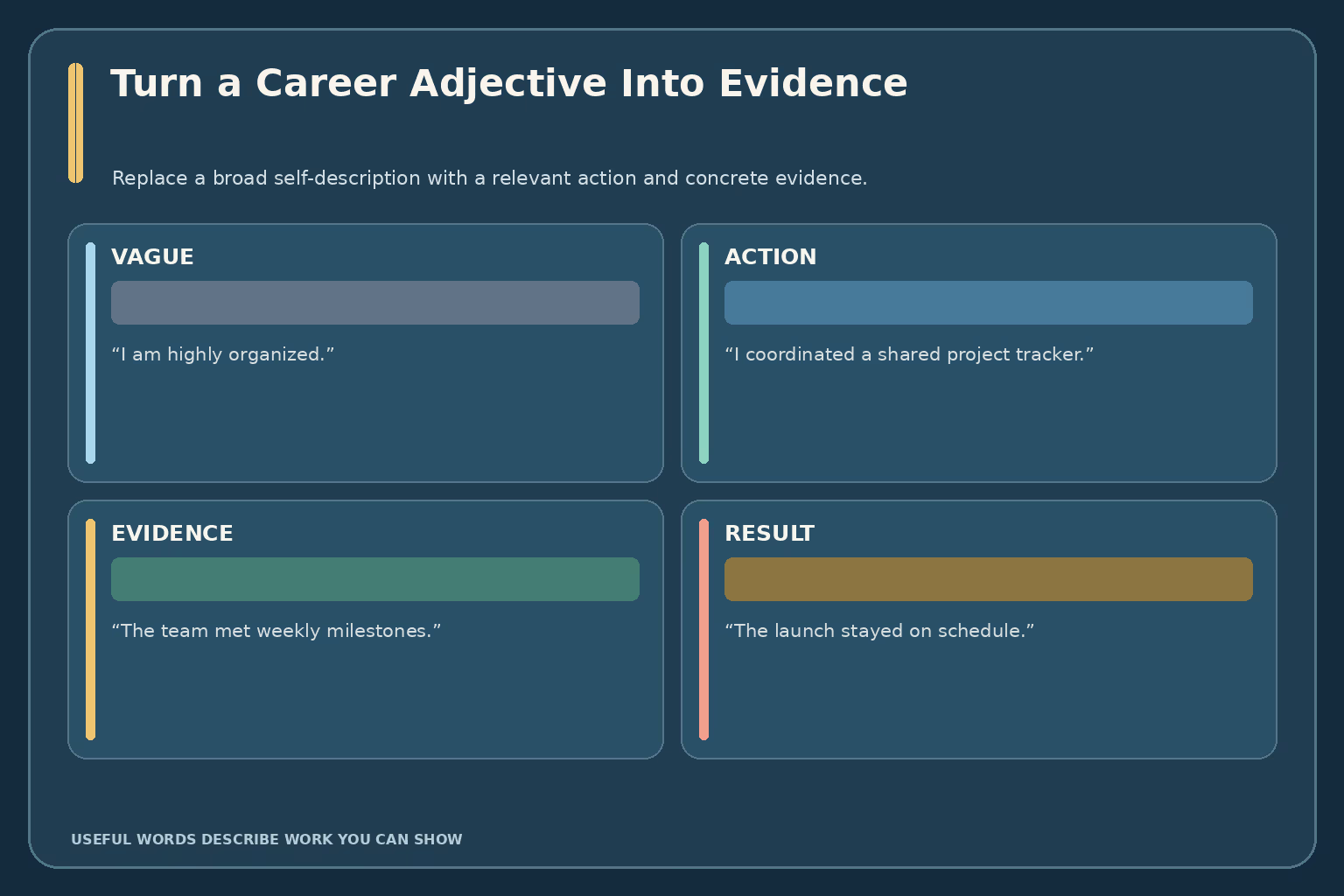
Where it is truthful, include the scope or outcome: a deadline met, a process clarified, a customer problem resolved, or a measurable improvement. Do not invent a metric. If exact numbers are unavailable, describe the deliverable and its effect plainly. Action verbs such as analyzed, coordinated, resolved, and documented can communicate your contribution more directly than stacking several adjectives together.
Career Adjectives for Interviews and Profiles
In an interview, choose an adjective that can introduce a short story. Name the situation, explain the action you took, and share the result or lesson. “I’m collaborative” becomes more credible when followed by how you brought colleagues together to solve a specific handoff problem. Keep the adjective in proportion to the story and give credit accurately to teammates.
For a professional bio or online profile, select a few consistent qualities that fit your current work. For example: “A detail-oriented editor who helps research teams turn complex findings into clear public guidance.” This pairs a descriptor with the work and audience. A bio does not need every positive trait; specific experience and a clear focus are more memorable than a string of generic praise.
Work-style terms can also have nuanced meanings. O*NET describes work styles such as dependability, attention to detail, and integrity as distinct tendencies relevant to work. Its work-styles guide is useful for distinguishing qualities instead of treating them as interchangeable synonyms.
Career Adjectives to Use Carefully
Words such as perfect, genius, unmatched, and world-class can sound exaggerated unless the context clearly supports them. Phrases like hardworking, passionate, and team player are not inherently wrong, but they are common and broad. Explain what the quality means in your work: what you sustained, what you cared about improving, or how you contributed to a team goal.
Negative adjectives should also describe behavior rather than label a person. In performance feedback, “the handoff was inconsistent” is more constructive than “the employee is unreliable” when the issue is a specific process. In your own application, acknowledge a development area with context and describe the steps you are taking to improve it.
Frequently Asked Questions
What are good adjectives to describe a career?
Useful examples include analytical, adaptable, collaborative, dependable, resourceful, thorough, and proactive. Choose words that fit your work and the role, then support them with a specific example.
Which adjectives should I use on a resume?
Use one or two relevant descriptors, especially in a short profile, and let your experience bullets show the evidence. Active verbs and clear results usually communicate more than a long list of self-descriptive adjectives.
How can I describe myself professionally without sounding boastful?
Use measured wording and focus on actions. Rather than calling yourself exceptional, describe the project you handled, the problem you addressed, or the contribution your colleagues could observe.
Are “hardworking” and “motivated” good career adjectives?
They can be accurate, but they are broad. Explain the behavior behind the word, such as following through on a demanding assignment, setting a useful goal, or consistently meeting a commitment.
What is the difference between a career adjective and a resume action verb?
An adjective labels a quality, such as organized or adaptable. An action verb tells what you did, such as organized, adapted, analyzed, or coordinated. A strong application often pairs a concise quality with a concrete action and result.
Looking to enhance your career vocabulary? In this article, I’ll be sharing a comprehensive list of adjectives that can be used to describe different aspects of your professional journey. Whether you’re writing a resume, cover letter, or simply want to impress in an interview, having a strong arsenal of descriptive words at your disposal can make all the difference. From highlighting your skills and accomplishments to showcasing your work ethic and personality traits, these adjectives will help you paint a vivid picture of your career prowess. So, let’s dive in and explore the power of words when it comes to shaping your professional image.
When it comes to describing your career, it’s essential to choose the right adjectives that accurately capture your strengths and accomplishments. From “innovative” and “ambitious” to “dedicated” and “resourceful,” these adjectives can help you stand out from the competition and leave a lasting impression on potential employers. Moreover, using specific and impactful adjectives can also help you convey your unique qualities and personal brand. So, whether you’re a seasoned professional or just starting out, this article will provide you with a valuable resource to elevate your career narrative. Let’s explore some of the most powerful adjectives that can amp up your professional profile.
How to Describe career? – Different Scenarios
How to Describe a Career? – Different Scenarios
When it comes to describing a career, choosing the right adjectives is crucial in order to accurately convey your strengths, accomplishments, and personal brand. The adjectives you use should effectively highlight your unique qualities and leave a lasting impression on potential employers. Let’s explore how to describe your career in different scenarios:
1. Job Interviews:
During a job interview, it’s important to use adjectives that showcase your skills, experience, and suitability for the role. Here are some examples:
- Detail-oriented: When applying for positions that require strong attention to detail, mentioning this adjective can demonstrate your meticulousness.
- Results-driven: If you are a goal-oriented individual, using this adjective can highlight your ability to achieve desired outcomes.
- Adaptable: This adjective conveys your flexibility and ability to navigate changing situations, which is valued in many work environments.
2. Resume and Cover Letter:
In your resume and cover letter, it’s essential to use adjectives that grab the reader’s attention and make your application stand out. Consider using the following examples:
- Innovative: If you have a track record of coming up with fresh ideas and implementing creative solutions, this adjective can showcase your ability to think outside the box.
- Collaborative: Emphasize your ability to work well with others by using this adjective, which is particularly important in team-oriented environments.
- Resourceful: This adjective highlights your ability to find solutions and overcome challenges using the resources at hand.
3. Networking Events:
When attending networking events, it’s important to describe your career in a way that sparks interest and engages others. Consider using these adjectives:
- Passionate: Show your enthusiasm for your field by using this adjective to convey your strong interest and dedication.
- Motivated: By using this adjective, you can highlight your drive and determination to succeed in your career.
- Adventurous: Use this adjective to describe your willingness to take risks and explore new opportunities, which can make you memorable to others.
Remember, choosing the right adjectives for describing your career depends on the specific context and audience. It’s important to select words that accurately reflect your strengths and accomplishments.
Describing Words for career in English
When it comes to describing your career, using the right adjectives can make a significant impact. The words you choose can effectively showcase your skills, experience, and personal brand to potential employers, colleagues, or networking contacts. In this section, I’ll provide you with a variety of powerful adjectives that you can use to accurately describe your career in different contexts.
- Dedicated: This adjective highlights your commitment and loyalty to your work. It shows that you are devoted to achieving your goals and consistently give your best effort. For example, “I am a dedicated software engineer who is passionate about creating efficient and user-friendly applications.”
- Innovative: If you are known for your creativity and ability to think outside the box, this is the adjective for you. It demonstrates your ability to come up with fresh ideas and solutions to challenges. For instance, “As an innovative marketer, I strive to find unique and impactful ways to connect with target audiences.”
- Detail-oriented: Employers appreciate individuals who pay attention to the smallest details and produce high-quality work. Use this adjective to showcase your meticulousness and precision. For example, “I am a detail-oriented accountant who consistently delivers accurate financial reports.”
- Collaborative: A collaborative individual works well in a team environment, values input from others, and actively contributes to achieving shared goals. This adjective demonstrates your ability to work effectively with colleagues. For instance, “I am a collaborative project manager who excels at leading cross-functional teams to successfully complete complex projects.”
- Adaptable: Being adaptable means you can navigate change with ease and thrive in dynamic work environments. This adjective highlights your flexibility and ability to quickly adjust to new situations. For example, “As an adaptable teacher, I am able to tailor my teaching methods to meet the diverse learning needs of my students.”
Using these adjectives can help you effectively describe your career qualities in different situations like job interviews, resumes, or networking events. Remember to choose words that accurately reflect your strengths and accomplishments, and consider the context and audience when selecting them. With the right adjectives, you can create a compelling narrative that sets you apart from others in your field.
Now that you have some powerful adjectives to choose from, let’s take a look at how to effectively apply them in your job search materials.
Adjectives for career
When it comes to describing your career, using the right adjectives can make all the difference. These powerful words can help highlight your skills, experience, and personal brand in various scenarios like job interviews, resumes, cover letters, and networking events. In this section, I’ll share some positive and negative adjectives that you can use to accurately depict your career. Let’s dive in!
Positive Adjectives for Career
Choosing positive adjectives can create a strong impression and showcase the best aspects of your professional journey. Here are 12 examples of positive adjectives that can help you make a lasting impact:
| Adjective | Definition |
|---|---|
| Dedicated | Committed and focused on achieving goals |
| Innovative | Creative and capable of original thinking |
| Detail-oriented | Thorough and highly attentive to work |
| Collaborative | Skilled at working cooperatively with others |
| Adaptable | Able to adjust and thrive in different situations |
| Ambitious | Driven and eager to accomplish challenging goals |
| Proactive | Takes initiative and anticipates future needs |
| Reliable | Consistently delivers high-quality work |
| Resourceful | Efficient in finding creative solutions |
| Versatile | Able to handle a variety of tasks and responsibilities |
| Resilient | Capable of bouncing back from setbacks |
| Confident | Self-assured and believes in their abilities |
Using these positive adjectives, you can effectively convey your strengths and accomplishments in a confident and compelling way.
Negative Adjectives for Career
While it’s important to highlight your strengths, it’s also essential to be aware of negative adjectives that could inadvertently portray you in a less favorable light. Here are 5 examples of negative adjectives that you should avoid when describing your career:
| Adjective | Definition |
|---|---|
| Incompetent | Lacks the necessary skills or abilities |
| Disorganized | Lack of order or structure in work |
| Unreliable | Not dependable or trustworthy |
| Inflexible | Resistant to change or unable to adapt |
| Indecisive | Difficulty making decisions or sticking to them |
By avoiding these negative adjectives, you can present yourself in a more positive and competent light, focusing on your strengths and accomplishments.
Remember, choosing the right adjectives for your career is essential in creating a favorable impression. It’s important to consider the context and audience when selecting these words. Whether you’re writing a resume or attending a job interview, use adjectives that accurately reflect your strengths and accomplishments, showcasing your unique attributes.
Synonyms and Antonyms with Example Sentences
Synonyms and Antonyms with Example Sentences
Synonyms for career
When it comes to describing your career, using a variety of adjectives can help paint a vivid picture of your skills and accomplishments. Here are some synonyms that you can use to showcase different aspects of your career:
- Dedicated: I am committed to my work and put in my best effort every day.
- Innovative: I constantly seek new ideas and approaches to solve problems and drive innovation in my field.
- Detail-oriented: I pay careful attention to the smallest details to ensure high-quality work.
- Collaborative: I enjoy working in teams and am skilled at fostering positive relationships and achieving common goals.
- Adaptable: I am flexible and able to adjust to new situations and challenges.
Remember, it’s important to choose the synonym that best reflects your strengths and accomplishments in a particular context.
Antonyms for career
While positive adjectives can help you stand out, it’s equally important to avoid using negative adjectives that could paint you in a less favorable light. Here are some antonyms, or opposite words, that you should steer clear of when describing your career:
- Lazy: I am a hardworking and motivated professional who consistently goes above and beyond.
- Uncreative: I am always looking for new ways to add value and think outside the box.
- Careless: I take great care in my work and ensure that I deliver high-quality results.
- Individualistic: I thrive in collaborative environments and enjoy working with others towards a common goal.
- Inflexible: I am adaptable and open to change, which allows me to thrive in dynamic work settings.
By avoiding negative adjectives, you can present yourself in a positive light and highlight your strengths and achievements. Remember, context and audience are key when choosing the right words to describe your career.
Feel free to check out the table below for a quick reference:
Synonyms for career
| Synonym | Example Sentence |
|---|---|
| Dedicated | I am committed to my work and put in my best effort. |
| Innovative | I constantly seek new ideas and drive innovation. |
| Detail-oriented | I pay careful attention to the smallest details. |
| Collaborative | I enjoy working in teams and achieving common goals. |
| Adaptable | I am flexible and able to adjust to new challenges. |
| Antonym | Example Sentence |
|---|---|
| Lazy | I am a hardworking and motivated professional. |
| Uncreative | I am always looking for new ways to add value. |
| Careless | I take great care in my work and deliver quality. |
| Individualistic | I thrive in collaborative environments. |
| Inflexible | I am adaptable and open to change. |
Conclusion
Describing your career with the right adjectives is crucial in showcasing your strengths and accomplishments. Throughout this article, we have explored the significance of using adjectives to accurately portray different aspects of your professional journey.
By utilizing synonyms like dedicated, innovative, detail-oriented, collaborative, and adaptable, you can effectively highlight your positive attributes. Conversely, it is equally important to avoid negative adjectives such as lazy, uncreative, careless, individualistic, and inflexible, as they may not present you in the best light.
Remember, the choice of adjectives should be tailored to the specific context in which you are describing your career. Whether it’s in a resume, cover letter, or job interview, selecting the right words can make a significant impact.
So, take the time to assess your strengths and achievements, and then choose adjectives that accurately reflect them. Craft your career narrative with intention and precision, allowing potential employers or clients to see the value you bring to the table.
The power of adjectives in describing your career cannot be underestimated. Use them wisely, and watch as they elevate your professional image and open doors to new opportunities.


