
Good adjectives for a contribution describe the work, result, or gift: a project contribution can be useful, substantial, or collaborative; a donation can be generous or recurring; a comment or article can be thoughtful, original, or well supported. When reviewing a person’s effort, name the specific action and its impact rather than treating one contribution as proof of character.
At a glance: choose words for the contribution’s meaning
Cambridge Dictionary uses contribution for help toward a shared goal, money or other support, and writing submitted for publication. The noun’s meaning changes with context, so the best adjective changes too. “Useful help,” “a recurring donation,” and “a thoughtful article” describe different things.

Choose an adjective for the thing being described
Project work and practical help
Use useful, substantial, well organized, or timely when the word fits the work’s outcome. Collaborative describes how people worked together; it does not by itself prove that the final result was complete or effective. For example: “Rae’s concise checklist was useful because it helped the volunteers notice three missing supplies before the event.”
For school, work, and community projects, tie praise to a goal: “The annotated map made the route easier to follow” is clearer than “That was amazing.” When a contribution needs revision, describe the part that needs attention: “The second section is incomplete; add the interview source before Friday’s review.”
Financial gifts and other support
Financial, recurring, one-time, and in-kind identify the form or timing of support. Generous is an appreciative judgment about a gift in context; use it when that judgment is appropriate, and do not infer a donor’s character or financial situation from one donation. If the amount is known and relevant, neutral details such as “a $25 contribution” or “a monthly contribution” are more precise.
Example: “The neighborhood group received a generous contribution of folding tables and bottled water” identifies an in-kind gift; “the recurring contribution covered the monthly printing cost” explains its practical role.
Writing, publication, and discussion
A submitted article, comment, or discussion point may be thoughtful, relevant, original, concise, or well supported. Specify what it adds: “Her comment connected the survey result to the project’s second goal” tells readers why it was relevant. In a publication, “clear,” “well researched,” and “carefully sourced” can describe qualities of the text without making a broad claim about its author.
Separate the result, the process, and the person
An adjective can evaluate the contribution (“incomplete draft”), describe the process (“collaborative review”), or label the contributor (“careless person”). Those statements are not interchangeable. A limited result may reflect unclear directions, missing resources, a short deadline, or a first attempt; by itself, it does not establish that someone is lazy, unreliable, or incapable.
The Education Endowment Foundation defines feedback as information about performance relative to learning goals. Its review says feedback focused on the task, subject, and self-regulation tends to give specific information for improvement, while feedback about people as individuals tends to be the least effective of those approaches. That evidence is about learning settings, but its practical lesson here is useful: describe the work and the next step, not an assumed personality trait. See the EEF feedback evidence summary.
Use Situation–Behavior–Impact for specific feedback
The Center for Creative Leadership’s Situation–Behavior–Impact (SBI) model offers a simple structure: identify the situation, state the observable behavior, and explain the impact. Keep observations separate from interpretation. If useful, ask about intent after sharing the impact rather than guessing why someone acted as they did. CCL describes SBI as a feedback method, not a substitute for context or conversation.
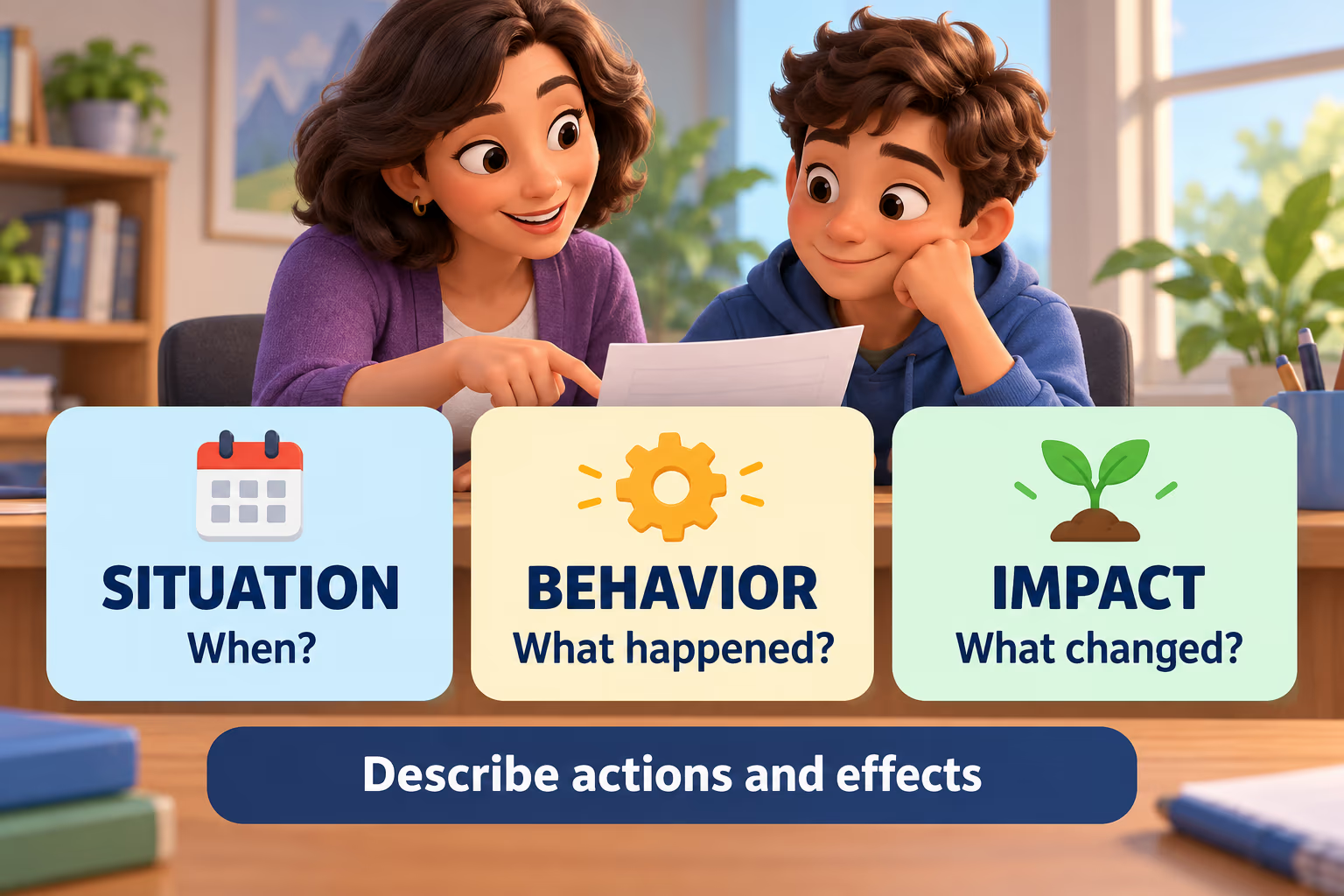
Situation: “During Tuesday’s community-project review…” Behavior: “…the supply list did not include quantities for the final two activities.” Impact: “…so the coordinator could not finish the order before the deadline.” A constructive next step is: “Could you add those quantities by noon tomorrow?” This is direct about the contribution while leaving room to clarify what happened.
Positive feedback can be just as concrete: “At Monday’s planning meeting, you summarized the three options and recorded each decision; that helped the group finish its plan.” The situation, action, and result make the praise specific and repeatable.
When you mean shared effort, see our guide to adjectives for teamwork. For a quick check, ask: What did the contribution add? What evidence supports the adjective? Does the sentence judge a piece of work, an action, or a whole person?
Reading the original adjective lists fairly
The original examples below are preserved. Some negative words can sound like labels about a contributor. Read them as claims that need specific evidence, and revise toward the observable action, deliverable, or effect when giving real feedback.
When it comes to describing the impact of someone’s contribution, words can be incredibly powerful. They have the ability to capture the essence of someone’s efforts and convey the magnitude of their influence. In this article, I’ll be exploring a range of adjectives that can be used to describe contributions, accompanied by examples to illustrate their usage.
Whether it’s a small gesture or a monumental achievement, finding the right words to describe someone’s contribution can make all the difference. From “significant” to “profound,” these adjectives have the power to paint a vivid picture of the impact someone has made. So, let’s dive in and explore the world of adjectives that can be used to describe contributions, and discover how these words can elevate our appreciation for the efforts of others.
How to Describe contribution? – Different Scenarios
When it comes to describing someone’s contribution, finding the right words is crucial. The words we choose can shape how we appreciate and acknowledge the efforts of others. Let’s explore different scenarios and the adjectives that can be used to describe contributions in each.
- In a Kindergarten Setting: As a preschool teacher, I believe it’s essential to teach young children the value of making contributions, no matter how small. Here are some adjectives that can be used to describe their efforts:
- Helpful: Children who assist their peers or teachers in the classroom are being helpful.
- Thoughtful: When kids show consideration and empathy towards others, we can describe their actions as thoughtful.
- Creative: The ability to think outside the box and come up with unique ideas is a valuable contribution, and we can use the word “creative” to describe it.
- In a School Project: When students work together on a school project, their contributions are essential to its success. Here are some adjectives to describe their efforts:
- Collaborative: Working effectively as a team and combining everyone’s skills makes the project collaborative.
- Diligent: Students who put in consistent effort and work hard on their tasks are being diligent.
- Innovative: Bringing new and original ideas to the project demonstrates innovation.
- In a Community Service: Making a contribution to the community is a powerful act that deserves recognition. Here are some adjectives that can be used to describe such contributions:
- Impactful: Contributing in a way that creates a significant positive effect on the community is impactful.
- Selfless: When individuals prioritize the needs of others over their own, we consider their contributions to be selfless.
- Inspiring: Contributions that motivate and encourage others to take action are inspiring.
Remember, the words we use to describe contributions have the power to elevate our appreciation for the efforts of others. Whether it’s in a Kindergarten setting, a school project, or community service, finding the right adjectives can accurately convey the magnitude of someone’s contributions.
In the next section, I’ll provide more examples of adjectives that can be used to describe contributions in different contexts. So, let’s continue exploring the world of descriptive words together.
Describing Words for contribution in English
When it comes to describing someone’s contribution, finding the right words can make a world of difference. The words we choose have the power to elevate our appreciation for the efforts of others and recognize the impact they have made. In this section, I’ll provide you with some examples of adjectives that can be used to describe contributions in different scenarios.
Describing Contributions in a Kindergarten Setting
In a kindergarten setting, it’s important to recognize and acknowledge the contributions of young children. Here are some adjectives that can be used to describe their efforts:
- Helpful: The child was very helpful in cleaning up the toys after playtime.
- Creative: I was impressed by the child’s creative artwork during craft time.
- Kind: The child showed kindness by sharing their toys with their classmates.
- Hardworking: The child exhibited a great work ethic during group activities.
- Thoughtful: The child’s thoughtful gestures brightened up the classroom.
Describing Contributions in a School Project
When describing contributions in a school project, it’s important to highlight the efforts and achievements of each student. Here are some adjectives that can be used:
- Dedicated: The student was dedicated to the project, putting in extra hours to ensure its success.
- Innovative: The student’s innovative ideas brought a fresh perspective to the project.
- Resourceful: The student showed great resourcefulness in finding solutions to challenges.
- Collaborative: The student actively collaborated with their team members, fostering a positive working environment.
- Detail-oriented: The student’s attention to detail ensured a high-quality final product.
Describing Contributions in Community Service
When it comes to community service, individuals make valuable contributions that positively impact others. Here are some adjectives to describe these contributions:
- Compassionate: The volunteer’s compassionate nature made a difference in the lives of those they helped.
- Selfless: The individual’s selfless acts of service inspired others to get involved.
- Empathetic: The volunteer showed empathy towards those in need, truly understanding their struggles.
- Impactful: The individual’s efforts had a significant and lasting impact on the community.
- Generous: The volunteer’s generosity made a difference in the lives of many people.
Adjectives for contribution
Positive Adjectives for Contribution with 12 Example Sentences
When it comes to describing someone’s contribution, finding the right words is crucial. The words we choose have the power to elevate our appreciation for the efforts of others. Here are some positive adjectives that can be used to describe contributions:
- Dedicated: She has been dedicated to helping her classmates with their projects.
- Resourceful: He is incredibly resourceful and always comes up with unique ideas.
- Dependable: Sarah is a dependable team member who can be relied upon to get the job done.
- Creative: His creative approach to problem-solving has greatly contributed to the success of the project.
- Enthusiastic: Emma’s enthusiastic participation in class discussions has inspired her peers.
- Proactive: Mark took the proactive initiative to organize a fundraising event for a charitable cause.
- Collaborative: The team members showed great collaborative spirit in working together towards a common goal.
- Innovative: The innovative solutions she proposed helped us overcome the obstacles we faced.
- Motivated: Jack’s motivated attitude has been an inspiration to others.
- Passionate: She is truly passionate about making a positive impact in her community.
- Resilient: Despite facing challenges, he remained resilient and continued to contribute significantly.
- Empathetic: Her empathetic nature made her approachable to everyone and made a significant impact on the community.
Negative Adjectives for Contribution with 5 Example Sentences
While it’s important to highlight positive contributions, there may be instances where negative adjectives are necessary to address areas for improvement. Here are some negative adjectives that can be used to describe contributions:
- Inconsistent: His contributions have been inconsistent, sometimes showing dedication, but at other times appearing disengaged.
- Unreliable: She has been unreliable in meeting project deadlines, causing delays.
- Disengaged: John’s disengaged attitude has hindered progress and collaboration within the team.
- Unproductive: Despite being part of the group, he has been largely unproductive and has not contributed meaningfully.
- Indifferent: Her indifferent attitude and lack of interest have made it difficult to work together effectively.
Recognizing both positive and negative contributions is essential for continuous improvement and growth. These adjectives provide a range of descriptions that can help in accurately and effectively conveying someone’s contribution.
Synonyms and Antonyms with Example Sentences
Synonyms for Contribution
When it comes to describing someone’s contribution, it’s important to have a wide range of adjectives to choose from. Here are some synonyms that can help you emphasize the positive aspects of their work:
- Valuable: “Her contribution to the team was highly valuable.”
- Significant: “His significant contribution played a key role in the project’s success.”
- Notable: “She made a notable contribution to the company’s growth.”
- Essential: “His essential contribution ensured the smooth execution of the plan.”
- Impactful: “Their impactful contribution had a lasting effect on the organization.”
Using these synonyms can help you convey the importance and value of someone’s contribution in a more diverse and powerful way.
Antonyms for Contribution
While it’s essential to recognize positive contributions, it’s also important to address areas for improvement. Here are some antonyms that can be used to discuss the negative aspects of someone’s work:
- Ineffective: “His contribution to the project was ineffective and didn’t yield the desired results.”
- Insignificant: “Her contribution was insignificant and had little impact on the overall outcome.”
- Negligible: “Their contribution was negligible, and it went unnoticed by the team.”
- Unhelpful: “His unhelpful contribution hindered the progress of the project.”
- Detrimental: “Her detrimental contribution had a negative effect on team morale.”
By using these antonyms, you can provide constructive feedback and encourage individuals to improve upon their weaknesses in order to achieve better results.
Remember, finding the right words to describe someone’s contribution is crucial for providing feedback and fostering growth. Whether you’re highlighting the positive aspects or addressing areas for improvement, using a variety of synonyms and antonyms can enhance your communication and promote continuous development.
Conclusion
Describing someone’s contribution accurately and effectively is crucial for recognizing their efforts and encouraging growth. In this article, we have explored the significance of using the right adjectives to describe contributions, both positive and negative.
By utilizing positive adjectives, we can highlight the strengths and achievements of individuals, motivating them to continue their excellent work. Conversely, negative adjectives can be employed to address areas for improvement constructively, fostering personal and professional growth.
The article has provided a comprehensive list of synonyms and antonyms that can be used to describe someone’s contribution. These words enable us to provide meaningful feedback and encourage continuous improvement. By using a variety of adjectives, we can offer a well-rounded assessment of someone’s work and provide them with the tools they need to excel.
Remember, the words we choose to describe contributions have a powerful impact on individuals and teams. By selecting the right adjectives, we can inspire and empower others to reach new heights. So, let’s continue to choose our words wisely and recognize the value of each person’s unique contribution.
Frequently asked questions about contribution adjectives
What are strong adjectives for a contribution?
Choose a word that matches the contribution and evidence: useful or substantial for project work, generous for a gift when that judgment fits, and thoughtful or well supported for writing or discussion.
How do I describe a student’s contribution constructively?
Name the work and connect it to the learning goal: “Your labeled diagram shows the water cycle clearly; add arrows to show where evaporation happens.” This gives the student a specific success and a next step without turning one assignment into a judgment about ability.
Is “generous” the right word for every donation?
Not necessarily. Generous is evaluative and depends on context. If you only need to report the fact, say whether a contribution was financial or in-kind, one-time or recurring, and include an amount only when it is known and relevant.
What is the difference between a contribution adjective and a contributor adjective?
A contribution adjective describes the work or gift, as in “a useful report.” A contributor adjective describes a person, as in “a thoughtful volunteer.” For feedback, an example of an observed action is usually clearer and fairer than a broad personal label.
How can I describe a contribution that needs improvement?
Use specific terms such as incomplete, unclear, or not yet supported only when they match the evidence. State what is missing and what change would meet the goal; avoid guessing at motive or character.


