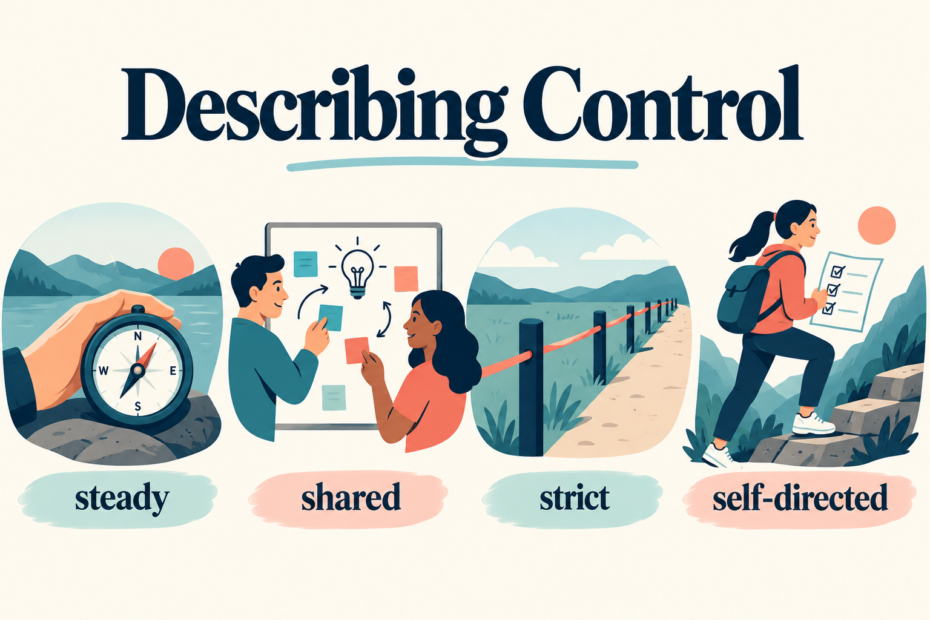
Adjectives for control describe how authority, influence, or self-discipline is used. Choose balanced or measured when it is fair, decisive when a clear choice is needed, and domineering or coercive when someone limits others excessively. The best word depends on who has control, what they are controlling, and how their actions affect people.
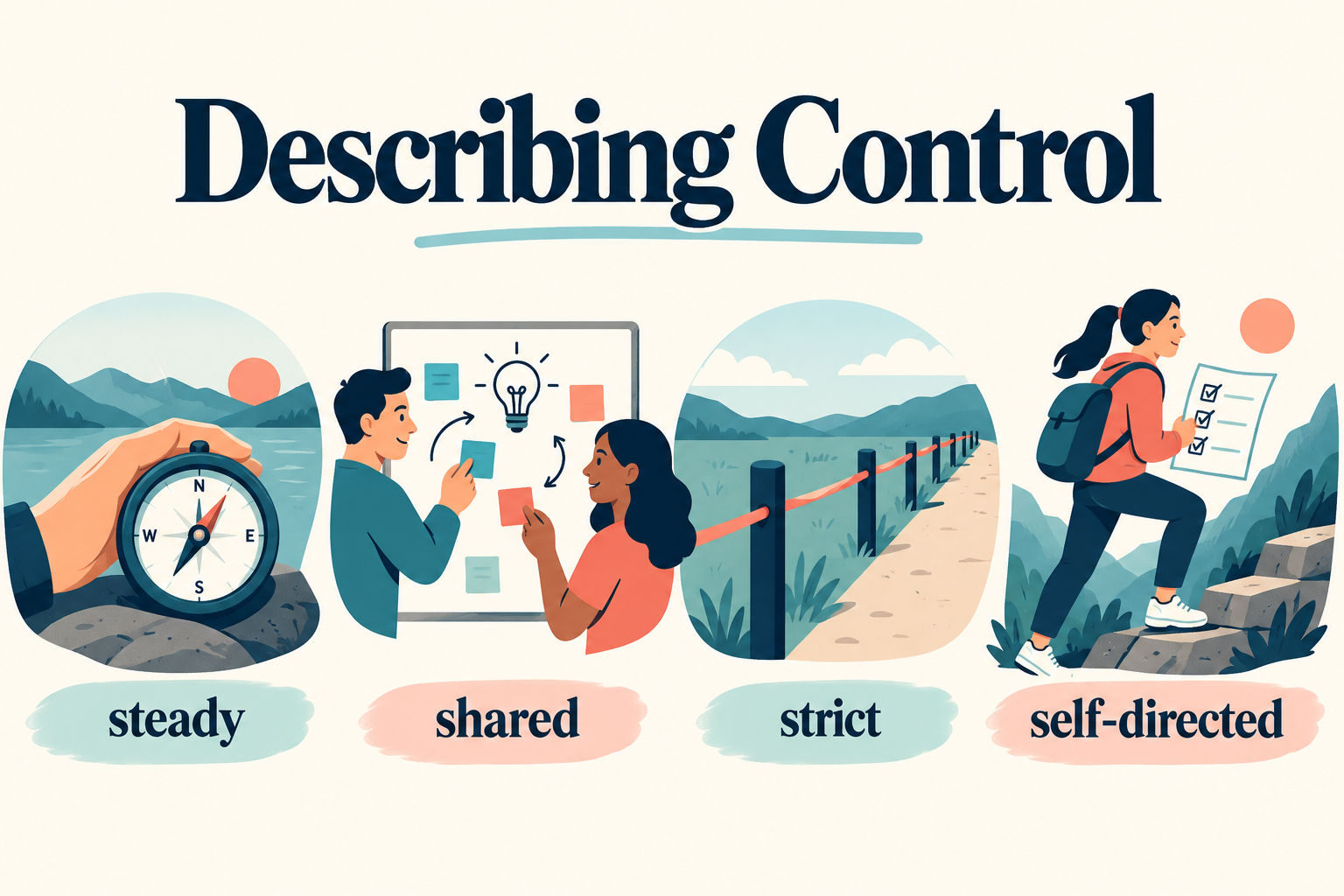
How to choose an adjective for control
Control is usually a noun or verb, not an adjective. These describing words label the manner, degree, or effect of control. Cambridge defines the noun in terms of the act or power of controlling, and the verb includes limiting or directing something. In everyday writing, that means the context matters: controlling your own reactions is different from controlling a team or restricting other people’s choices.
Use the quick guide below to select a word with the tone you intend:
| Context | Useful adjectives | What the words suggest |
|---|---|---|
| Self-control | disciplined, composed, restrained, self-directed | Managing one’s own actions or reactions |
| Leadership | decisive, assured, responsible, supportive | Setting direction while considering the group |
| Fair processes | balanced, measured, consistent, orderly | Applying rules predictably and proportionately |
| Strong limits | firm, strict, restrictive, rigid | How closely boundaries are enforced |
| Excessive influence | controlling, domineering, manipulative, coercive | Pressure, intrusion, or reduced autonomy |
| Limited authority | shared, collaborative, decentralized, flexible | Decisions or responsibility distributed among people |
Positive, neutral, and negative descriptions
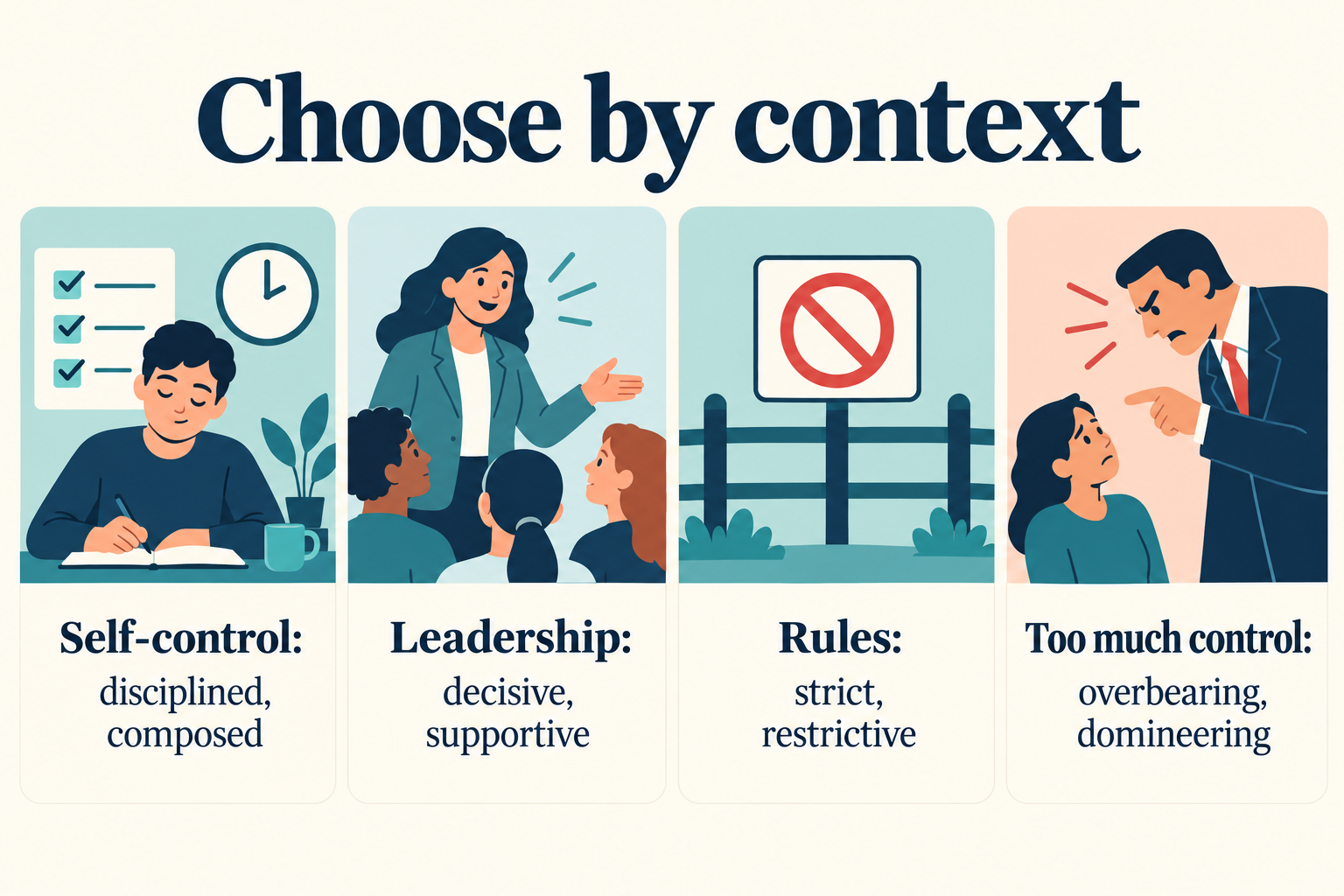
A positive adjective often signals that control is used with judgment and respect. Balanced control considers different needs; measured control avoids overreacting; responsible control includes accountability; and supportive leadership gives people direction without taking away every choice. For example: “The coordinator took a measured approach, setting a deadline while letting each person choose how to complete the task.”
Neutral words describe the method without deciding whether it is good or bad. Firm means steady and unlikely to yield; strict emphasizes close enforcement of rules; structured points to an organized process; and centralized means that decisions are concentrated in one place or group. “The lab follows a strict procedure” describes the rule closely, while “a centralized system” identifies where decisions are made.
Negative words make the effects clearer. A domineering person tries to direct others authoritatively; a manipulative person uses indirect or deceptive influence; and coercive control relies on pressure or threats. Micromanaging emphasizes excessive attention to other people’s small tasks. These terms are stronger than firm or strict, so use them when the example supports that judgment rather than as interchangeable synonyms.
Examples in sentences
- After taking a breath, Lena stayed composed and answered the criticism calmly.
- The captain made a decisive call when the weather threatened the schedule.
- A balanced policy protects safety while leaving room for reasonable exceptions.
- His rigid plan allowed no adjustment when new information arrived.
- The supervisor’s micromanaging style required approval for even minor choices.
- The group adopted a collaborative process and shared responsibility for the result.
- The official used coercive tactics to force people to comply.
- A self-directed student sets goals and monitors progress independently.
Control, controlled, and controlling
Control names authority, regulation, or the act of directing something. Controlled often describes something kept within limits, or a person who keeps their reactions from showing strongly. Controlling can simply mean exercising control (“a controlling mechanism”), but when describing a person it often suggests intrusive behavior (“a controlling partner”). Add context so readers can tell which meaning you intend.
Similarly, strict does not automatically mean unfair: a strict safety rule may protect people. Restrictive focuses on limiting options, while rigid suggests little ability to adapt. For a person or leadership style, authoritative usually means confident and in charge; authoritarian more often implies demanding obedience with limited freedom. These distinctions help describe actions precisely instead of treating every kind of control as the same.
Frequently asked questions
What is a positive adjective for control?
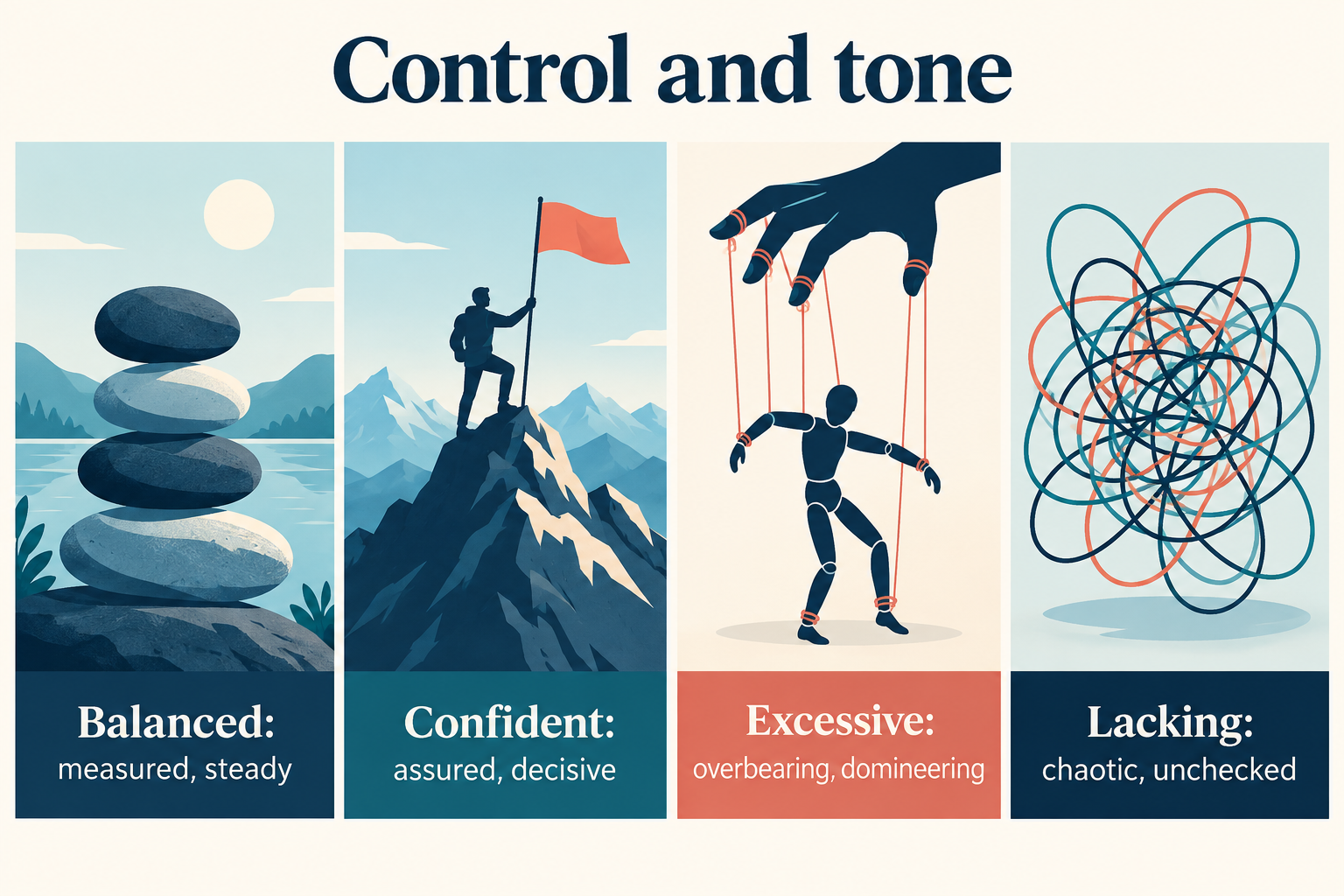
Balanced, measured, responsible, and supportive can describe control used fairly and thoughtfully. The right choice depends on what the person is doing.
What adjective means too much control?
Domineering, overbearing, and controlling suggest excessive influence over other people. Use coercive when pressure or threats are central to the example.
What is the difference between strict and controlling?
Strict describes close enforcement of a rule or standard. Controlling describes directing or limiting behavior and, when applied to a person, often carries a critical tone. A strict policy can be clearly defined without one person behaving in a controlling way.
How can I describe control over emotions?
Use composed or calm for an outwardly steady response, restrained when someone deliberately holds back a reaction, and self-disciplined when they consistently manage their behavior. Psychology’s APA Dictionary describes self-regulation as controlling one’s behavior through self-monitoring, evaluation, and reinforcement; the everyday adjective should still match the particular example.
Sources for usage
- Cambridge Dictionary: control — noun and verb senses used to distinguish authority, direction, and limits.
- APA Dictionary of Psychology: self-regulation — a psychology definition relevant to self-control and managing behavior.
Original cover image
When it comes to describing control, there are a plethora of adjectives that can capture the essence of this powerful concept. Whether you’re talking about personal control, emotional control, or even control over a situation, having the right words to express it can make all the difference. In this article, I’ll be sharing a variety of adjectives that can help you articulate the different facets of control, along with examples to illustrate their usage. So, if you’re ready to enhance your vocabulary and delve into the world of describing control, let’s dive right in!
Control is a fundamental aspect of our lives, influencing how we navigate through various circumstances and interactions. It can be empowering, reassuring, or even daunting at times. To accurately convey the nuances of control, we need adjectives that can paint a vivid picture in the minds of our readers. From “firm” and “assertive” to “disciplined” and “commanding,” these adjectives allow us to capture the different shades of control that exist. With the help of examples, we’ll explore how these adjectives can be used in everyday situations, providing you with a valuable toolkit for effective communication. So, let’s embark on this linguistic journey and discover the descriptive power of adjectives for control.
How to Describe control? – Different Scenarios
When it comes to describing control, it’s important to have the right words to accurately convey the level of authority, influence, or guidance involved. Whether it’s a firm hand in a leadership position or a disciplined approach to personal goals, different scenarios require different adjectives to fully capture the essence of control.
Here are a few examples of how control can be described in various situations:
- Firm control: This is characterized by a strong and unwavering grip over a situation or a group of people. An individual with firm control is assertive and decisive, making sure that their authority is respected and followed. Examples include a teacher maintaining order in the classroom or a CEO leading a company with confidence.
- Commanding control: In this scenario, control is exercised in a way that demands respect and obedience. The person in control has a presence that inspires others to follow their lead. A military general commanding troops or a charismatic speaker addressing a large audience are prime examples of commanding control.
- Disciplined control: This describes a situation where control is maintained through self-discipline and a strict adherence to rules or regulations. It involves having a strong sense of personal accountability and focus. An athlete who maintains a strict training regimen or a student who diligently follows a study schedule demonstrates disciplined control.
- Guiding control: This type of control emphasizes guidance and mentorship. The person in control acts as a source of support, providing direction and advice to others. A parent helping a child navigate through challenges or a mentor providing guidance to a mentee exemplify guiding control.
- Balanced control: Sometimes, control is best described as a balance between assertiveness and flexibility. This approach allows for adaptability while still maintaining authority. A project manager overseeing a team or a team leader coordinating tasks among members showcase balanced control.
Remember, control is not limited to these scenarios, and the adjectives used to describe it can vary depending on the context. By expanding your vocabulary and incorporating these adjectives into your communication, you’ll be able to effectively convey the nuances of control in different situations.
| Firm | Assertive | Disciplined | Commanding | Guiding | Balanced |
|---|---|---|---|---|---|
| Strong and unwavering | Decisive and confident | Self-disciplined | Demanding respect and obedience | Providing guidance and |
Describing Words for control in English
In the English language, there are several adjectives that can be used to describe control. These words can help convey the level of authority, influence, or guidance involved in different situations. Whether it’s describing a person’s ability to maintain discipline or a leader’s firm grip on a situation, choosing the right adjective can make all the difference in how we understand and communicate control.
Here are some common adjectives used to describe control and their examples:
- Firm Control: When someone has a firm control, it means they have a strong and unwavering influence over a situation or a group of people. It implies a sense of authority and decisiveness. For example:
- Commanding Control: This adjective describes someone who has a powerful and authoritative control over others. It suggests a strong presence and the ability to give clear instructions. For example:
- Disciplined Control: When control is described as disciplined, it signifies a strict and structured approach to maintaining order and authority. It implies adherence to rules and regulations. For example:
- Guiding Control: This adjective conveys a sense of leadership and guidance. It suggests a person who leads others by providing direction and support. For example:
- Balanced Control: When control is described as balanced, it suggests a harmonious combination of authority and flexibility. It implies a person who can maintain control while also allowing for autonomy. For example:
By incorporating these descriptive words into our vocabulary, we can effectively convey the nuances of control in different situations. Whether it’s firm control, commanding control, disciplined control, guiding control, or balanced control, having a diverse range of adjectives at our disposal allows us to communicate with clarity and precision.
Adjectives for control
Positive Adjectives for Control with 12 Example Sentences
When it comes to describing control, there are a variety of positive adjectives that can effectively convey a sense of authority, guidance, and influence. Here are twelve examples of such adjectives along with example sentences to illustrate their usage:
| Adjective | Meaning | Example Sentence |
|---|---|---|
| Strong | Having the power or ability to control effectively | I had strong control over the situation and managed to resolve the conflict peacefully. |
| Confident | Showing certainty and self-assurance in control | The teacher confidently maintained control over the noisy classroom. |
| Empowering | Enabling others to take control and make decisions | The empowering leadership style encouraged team members to show initiative. |
| Influential | Having the power to shape or direct outcomes | His influential presence allowed him to exert control over the decision-making process. |
| Balanced | Maintaining control in a fair and equitable manner | She demonstrated balanced control by listening to everyone’s opinions before making a decision. |
| Authoritative | Possessing unquestionable expertise and control | The authoritative figure in the room commanded respect and obedience. |
| Guiding | Providing direction and support in controlling situations | The coach played a guiding role in helping the team regain control of the game. |
| Calm | Exhibiting a composed demeanor while in control | Even in challenging situations, she remained calm and in control. |
| Responsible | Taking charge and being accountable for control | As team captain, she had to exercise responsible control over team activities. |
| Efficient | Demonstrating control with maximum effectiveness and minimal wasted effort | The project manager’s efficient control ensured smooth and timely completion of tasks. |
| Organized | Exercising control in a methodical and well-structured manner | With her organized approach, she effortlessly managed multiple projects simultaneously. |
| Motivated | Displaying the drive and determination to maintain control | The team’s motivated leader inspired everyone to stay focused and in control. |
Negative Adjectives for Control with 5 Example Sentences
While control is often seen as a positive trait, there can be situations where it takes a negative form. Here are five examples of negative adjectives that describe control, along with example sentences to provide context:
| Adjective | Meaning | Example Sentence |
|---|---|---|
| Domineering | Exerting control in a tyrannical or oppressive manner | His domineering control over his subordinates stifled creativity and growth. |
| Manipulative | Using control in a deceitful or cunning way to achieve personal gain | She manipulatively controlled others to further her own agenda. |
| Micromanaging | Excessive control over small details, resulting in a lack of autonomy | The manager’s micromanaging control stifled employee morale and creativity. |
| Dictatorial | Exercising control with an authoritarian and oppressive approach | The leader’s dictatorial control created a culture of fear and suppressed individuality. |
| Repressive | Imposing control in a manner that restricts freedom or expression | The government’s repressive control over media limited access to unbiased information. |
As you can see, the way we describe control can vary greatly depending on the situation and context. Incorporating these adjectives into our vocabulary allows us to effectively communicate the nuances of control in different scenarios, whether positive or negative.
Synonyms and Antonyms with Example Sentences
Synonyms for Control
When it comes to describing control, there are various synonyms that can effectively convey the sense of authority, guidance, and influence. Let’s take a look at some synonyms for control and their example sentences:
| Synonym | Example Sentence |
|---|---|
| Power | With great power comes great responsibility. |
| Influence | Her words had a strong influence on my decision. |
| Authority | The manager has the authority to make the final decision. |
| Command | The general commanded his troops with precision. |
| Mastery | He has achieved mastery over his emotions. |
| Dominance | The king ruled with absolute dominance over his kingdom. |
Antonyms for Control
On the other hand, there are also antonyms that describe control in a negative form. These words emphasize the lack of control or the absence of authority. Here are some antonyms for control and their example sentences:
| Antonym | Example Sentence |
|---|---|
| Chaos | The lack of control resulted in chaos. |
| Anarchy | Without rules, anarchy will prevail. |
| Disorder | The classroom descended into disorder as the students misbehaved. |
| Freedom | Sometimes, letting go can lead to a sense of freedom. |
| Release | I felt a sense of release when I finally let go of my worries. |
| Spontaneity | The best moments often happen with a touch of spontaneity. |
As you can see, the way we describe control can vary greatly depending on the situation and context. Whether we want to convey a positive sense of authority or acknowledge the absence of control, incorporating these adjectives into our vocabulary allows us to effectively communicate the nuances of control in different scenarios.
Conclusion
Having the ability to accurately describe control is essential in effective communication. Throughout this article, I have explored various adjectives that can be used to describe control, both in a positive and negative light. By incorporating these descriptive words into our vocabulary, we can convey a sense of authority, guidance, and influence.
The synonyms for control provided in this article offer a wide range of options to express different degrees of control in various situations. From “dominant” to “commanding,” these adjectives allow us to effectively communicate the level of authority and power we possess.
On the other hand, the antonyms for control shed light on the absence or lack of control. Words like “chaotic” and “unruly” highlight situations where control is lost or non-existent. These negative descriptors help us understand the consequences of a lack of control and the impact it can have.
The adjectives presented in this article equip us with the tools to describe control in a nuanced and precise manner. By choosing the right words, we can effectively convey our intentions and create a clear understanding of control in any given scenario.


