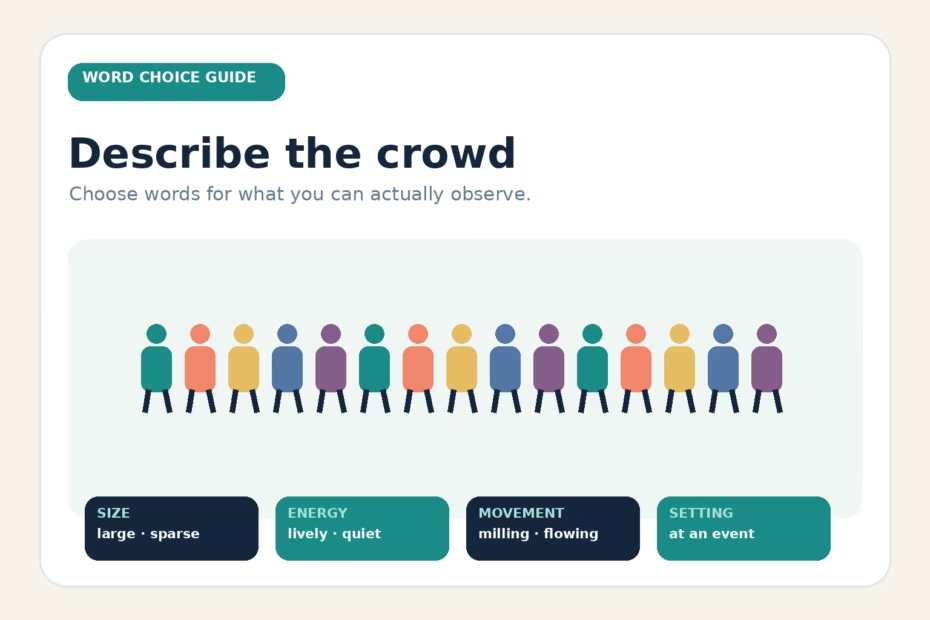
Quick answer: Describe a crowd by naming what you can observe: its size (large, sparse), energy (lively, quiet), movement (milling, flowing), or mood (festive, tense). Pair the adjective with a concrete detail and setting so readers understand what made the group seem that way.

When it comes to describing a crowd, the right choice of adjectives can make all the difference. Whether you’re a writer trying to paint a vivid picture or a speaker aiming to captivate an audience, having a repertoire of descriptive words at your disposal is essential. In this article, I’ll be sharing a comprehensive list of adjectives that can be used to describe crowds, along with examples to help you understand their usage. So, let’s dive in and explore the world of adjectives for crowds!
How to Describe crowd? – Different Scenarios
When it comes to describing a crowd, using the right adjectives is essential. It allows us to paint a vivid picture in the minds of our readers or listeners. In this section, I’ll provide you with a variety of adjectives that you can use to describe crowds in different scenarios. Let’s dive in:
1. Sporting Events
- Energetic: A roaring crowd filled with enthusiasm and excitement.
- Passionate: Fans showing intense dedication and love for their team.
- Boisterous: A loud and rowdy crowd, cheering and chanting in unison.
- Frenzied: An excited and wild crowd that can’t contain their emotions.
- Electric: A charged atmosphere, with the crowd buzzing in anticipation.
2. Concerts or Music Festivals
- Hyped: An enthusiastic and lively crowd, eagerly waiting for their favorite artist to perform.
- Ecstatic: Fans experiencing immense joy and happiness, dancing and singing along.
- Thrilled: A crowd filled with excitement and anticipation, reacting to every beat of the music.
- Unified: A crowd that feels connected, singing and swaying together as a single entity.
- Unforgettable: A crowd that leaves a lasting impression, creating an unforgettable experience.
3. Protests or Demonstrations
- Vocal: A crowd that is not afraid to voice their opinions and demands.
- United: People coming together, standing side by side for a common cause.
- Empowered: A crowd feeling strong and motivated, fighting for change.
- Resilient: A determined crowd, standing firm in the face of adversity.
- Impactful: A crowd that leaves a powerful message, demanding attention and action.
- Diverse: A crowd representing different cultures and backgrounds.
- Curious: People eager to explore and discover new things.
- Animated: A lively and animated crowd, enjoying the sights and sounds.
- Captivated: A crowd that is completely engrossed and amazed by the experience.
- Festive: A celebratory crowd, immersed in the spirit of the occasion.
Describing Words for crowd in English
As a writer or speaker, it is important to have a wide range of adjectives to effectively describe crowds in various settings. Whether you’re talking about a sporting event, a concert, a protest, or a diverse group of people, using the right adjectives allows you to paint a vivid picture in the minds of your audience. In this section, I’ll provide you with a selection of descriptive words to enhance your descriptions of crowds.
1. Lively – Imagine a bustling crowd full of energy and excitement. This adjective is perfect for describing crowds that are vibrant, animated, and full of life. For example, “The concert venue was filled with a lively crowd, dancing and singing along to every song.”
2. Enthusiastic – Use this adjective to portray a crowd that is passionate, eager, and highly engaged. For instance, “The fans in the stadium were enthusiastic, cheering with unwavering support for their team.”
3. United – When you want to highlight a sense of togetherness and solidarity within a crowd, this word is ideal. You can say, “The protesters stood united, their voices echoing through the streets as they demanded change.”
4. Eclectic – Sometimes a crowd is made up of individuals from various backgrounds and interests. In such cases, you can describe them as eclectic, diverse, and varied. For example, “The gallery opening attracted an eclectic crowd, representing different cultures and artistic styles.”
5. Awed – Use this adjective to describe a crowd that is amazed, captivated, or in awe of something. You could say, “As the fireworks lit up the sky, the crowd stood in awed silence, mesmerized by the dazzling display.”
6. Curious – Sometimes a crowd is characterized by curiosity, intrigue, and a desire to explore or discover. You might say, “The crowd gathered around the magician, their curious eyes fixed on every trick he performed.”
7. Festive – Picture a crowd that is joyous, celebratory, and in a mood of revelry. This adjective is perfect for describing crowds at festivals or parties. For instance, “The street parade was filled with a festive crowd, dancing, and laughing in colorful costumes.”
Adjectives for crowd
Positive Adjectives for Crowd
When describing crowds, it’s important to use adjectives that paint a positive and vibrant picture. Here are twelve examples of positive adjectives you can use to describe a crowd:
| Adjective | Definition | Example Sentence |
|---|---|---|
| Lively | Full of energy and excitement | The crowd at the concert was lively, dancing and singing along. |
| Enthusiastic | Eager and passionate | The supporters were enthusiastically cheering for their team. |
| United | Coming together as one | The crowd stood united, raising their voices for a common cause. |
| Eclectic | Diverse in style or characteristics | The art exhibition attracted an eclectic crowd, with people from all walks of life. |
| Captivated | Completely absorbed or fascinated by something | The crowd was captivated by the magician’s amazing tricks. |
| Curious | Interested and wanting to know more | The curious crowd gathered around to see what was happening. |
| Festive | Joyful and celebratory | The crowd at the carnival was festive, enjoying the music and games. |
| Engaged | Fully involved and actively participating | The engaged crowd responded with applause and cheers. |
| Supportive | Providing encouragement and assistance | The supportive crowd rallied behind the performers, cheering them on. |
| Invigorated | Filled with renewed energy and enthusiasm | The crowd left the motivational seminar feeling invigorated and inspired. |
| Harmonious | Marked by agreement or unity | The harmonious crowd sang in perfect unison, creating a beautiful melody. |
| Vibrant | Full of life, brightness, and activity | The vibrant crowd at the street festival created a lively atmosphere. |
Negative Adjectives for Crowd
Sometimes, crowds can display negative characteristics. Here are five examples of negative adjectives you can use to describe a crowd:
| Adjective | Definition | Example Sentence |
|---|---|---|
| Rowdy | Noisy, disorderly, and disruptive | The rowdy crowd was causing a disturbance at the football match. |
| Aggressive | Hostile and ready to attack | The aggressive crowd threw objects at the speaker, disrupting the event. |
| Chaotic | Completely disordered and lacking control | The chaotic crowd pushed and shoved, trying to get to the front. |
| Indifferent | Showing no interest or concern | The indifferent crowd barely reacted to the performer’s efforts. |
| Discontented | Dissatisfied and expressing displeasure | The discontented crowd shouted their grievances at the town hall meeting. |
By using the appropriate adjectives, you can vividly describe crowds and paint a clear picture in the minds of your audience. Whether it’s a lively and enthusiastic crowd at a concert or a rowdy and chaotic one at a protest, choosing the right words will help convey the atmosphere and emotions in a more engaging way. Avoid exaggeration and use these adjectives thoughtfully to enhance your descriptions.
Synonyms and Antonyms with Example Sentences
Synonyms for crowd
When it comes to describing crowds, there are various synonyms you can use to add depth and richness to your descriptions. Here are some synonyms for the word “crowd” along with example sentences:
| Synonym | Example Sentence |
|---|---|
| Gathering | The gathering of people at the concert was electrifying. |
| Assembly | The assembly outside the courthouse was large and united. |
| Throng | People thronged the streets during the festival parade. |
| Mob | A mob of protesters marched through the city demanding change. |
| Herd | The herd of fans rushed towards the stage when their favorite artist appeared. |
Using these synonyms, you can paint a more vivid picture of the different types of crowds you encounter in various scenarios.
Antonyms for crowd
On the other hand, if you want to describe a smaller or less crowded gathering, you can use antonyms of “crowd.” Here are some antonyms for the word “crowd” along with example sentences:
| Antonym | Example Sentence |
|---|---|
| Sparse | There were only a sparse number of attendees at the lecture. |
| Scattered | The scattered audience made it difficult to generate a sense of excitement. |
| Few | Only a few people showed up for the early morning yoga class. |
| Empty | The seats in the theater were empty, except for a handful of latecomers. |
| Individual | Each individual stood apart from the others during the social distancing guidelines. |
These antonyms can be used to describe smaller, more intimate gatherings or areas with fewer people.
Remember, the choice of words is crucial when describing crowds as it can greatly impact the reader’s understanding and engagement with the scene. Use these synonyms and antonyms to create vivid and engaging descriptions without resorting to repetitive language.
How to choose adjectives for a crowd
Start with the part of the scene you want readers to picture. A crowd can be large without being loud, lively without moving, or quiet while still attentive. Keeping size, energy, movement, and setting separate helps you choose a precise adjective instead of piling on near-synonyms.
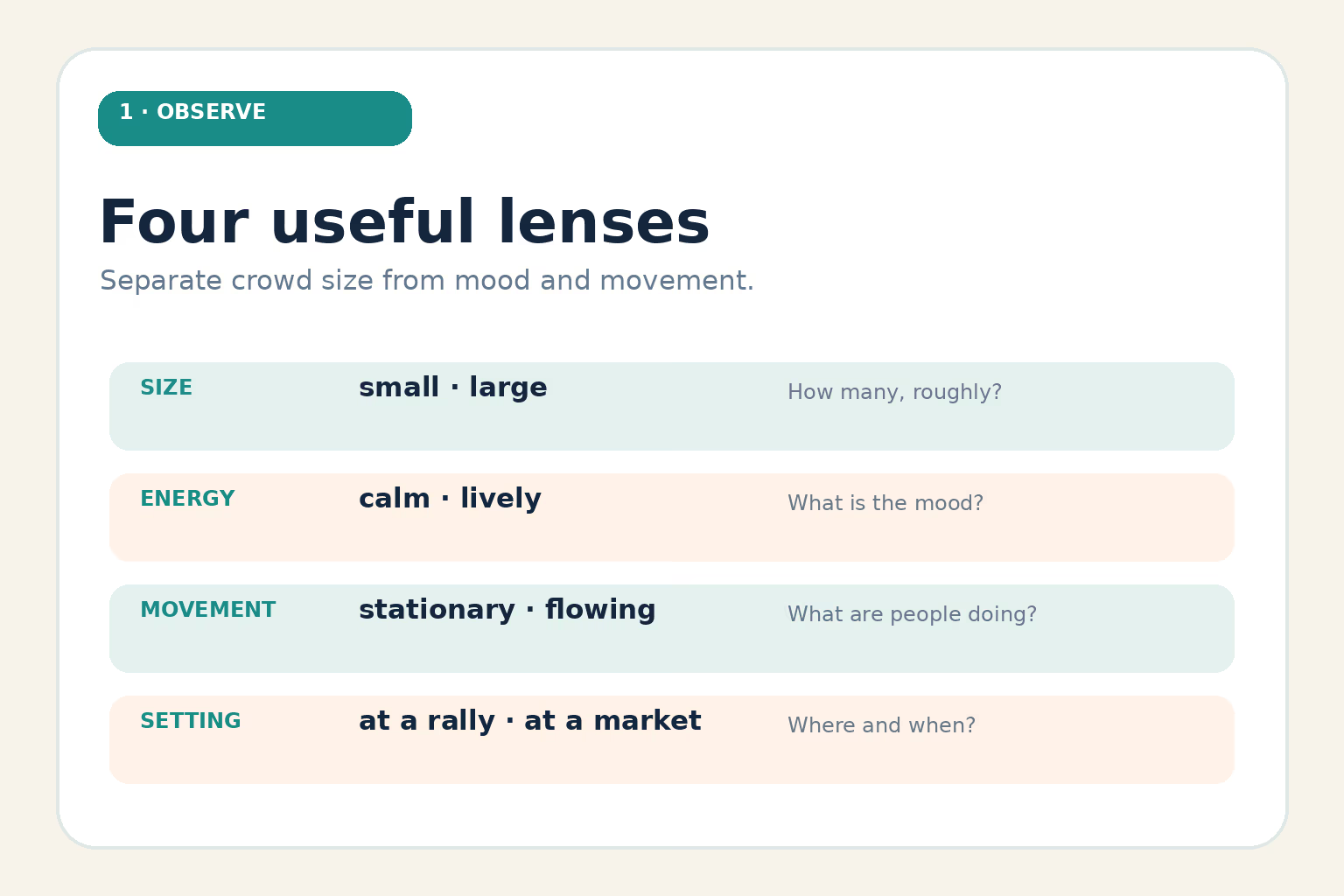
| What you notice | Useful adjectives | Example |
|---|---|---|
| Size or distribution | large, small, sparse, packed | A sparse crowd waited near the side entrance. |
| Sound or energy | quiet, lively, boisterous, subdued | The lively crowd clapped between songs. |
| Attention | attentive, curious, captivated, distracted | An attentive crowd followed the speaker’s demonstration. |
| Movement | stationary, milling, flowing, slow-moving | A slow-moving crowd crossed the plaza after the show. |
| Shared response | cheering, expectant, celebratory, tense | An expectant crowd watched as the curtain began to rise. |
| Composition | mixed, diverse, local, international | A diverse crowd visited the neighborhood food fair. |
These words describe different dimensions, so combine them when that adds useful detail: “a large, quiet audience,” “a small but enthusiastic group,” or “a diverse crowd moving slowly toward the gates.” Avoid assuming that every person in a group feels or behaves alike.
Turn a broad label into a specific description
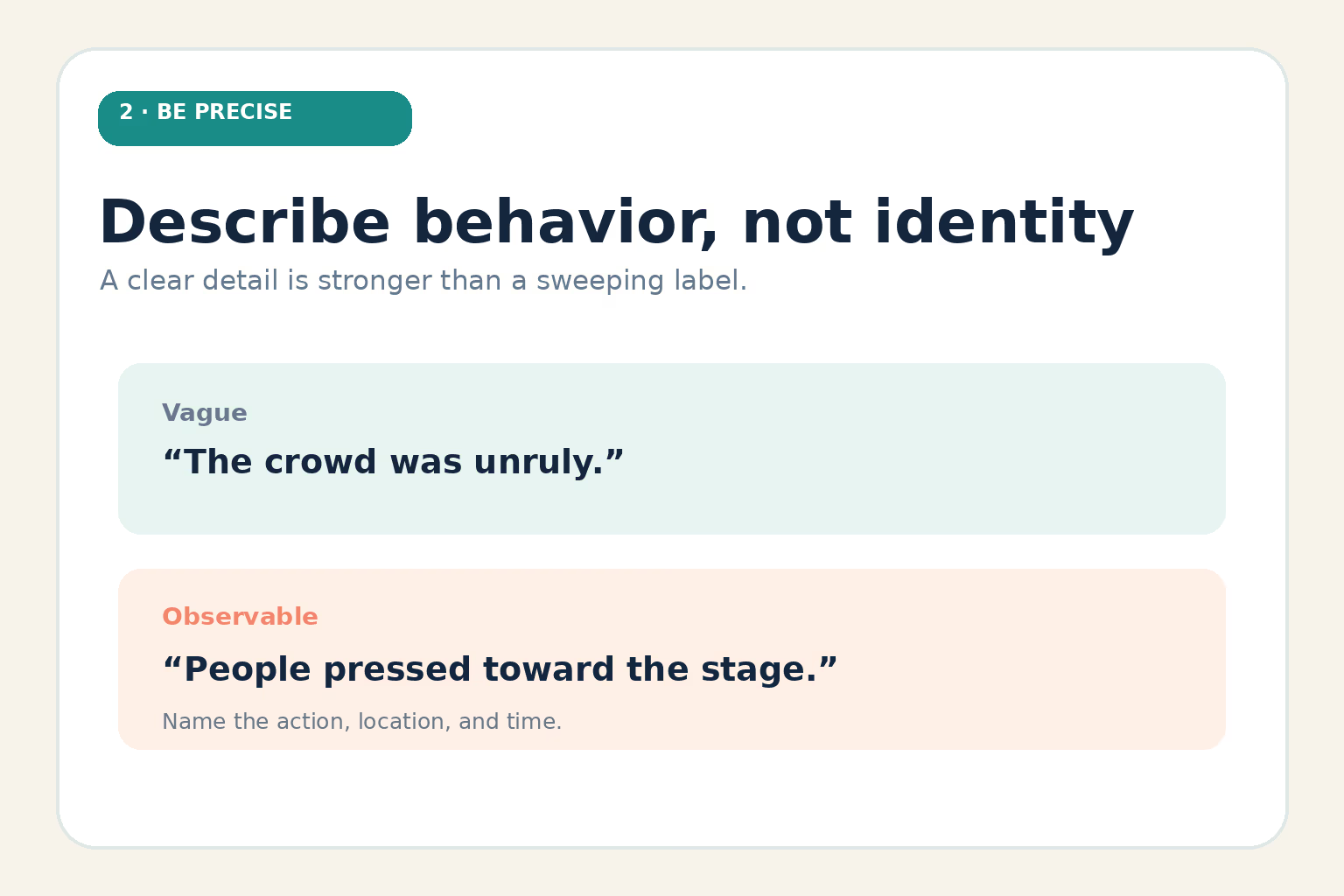
Words such as rowdy, agitated, or orderly are interpretations. Support them with the action, place, and moment you observed. Instead of writing “the crowd was unruly,” explain what happened: “Several people pressed toward the stage while staff asked visitors to leave the aisle clear.” The detail lets readers form their own picture.
Use a simple sentence pattern
Try adjective + crowd + observable detail: “The expectant crowd grew quiet as the lights dimmed.” Or name the people and action directly: “Fans in the front rows cheered when the team entered.” For reporting, add a time or location when it matters: “At 8 p.m., a slow-moving line stretched from the north gate to the plaza.” These patterns are clearer than stacking adjectives such as “huge, loud, crazy, excited crowd.”
Crowd words and their nuance
Some words describe a group neutrally; others carry a judgment. Cambridge defines a crowd as a large group of people gathered together, and describes a throng as a crowd or large group. Mob is more loaded: Cambridge marks it as usually disapproving and defines it as a large, angry crowd. Use it only when the context supports that meaning, not as a casual synonym for any gathering.
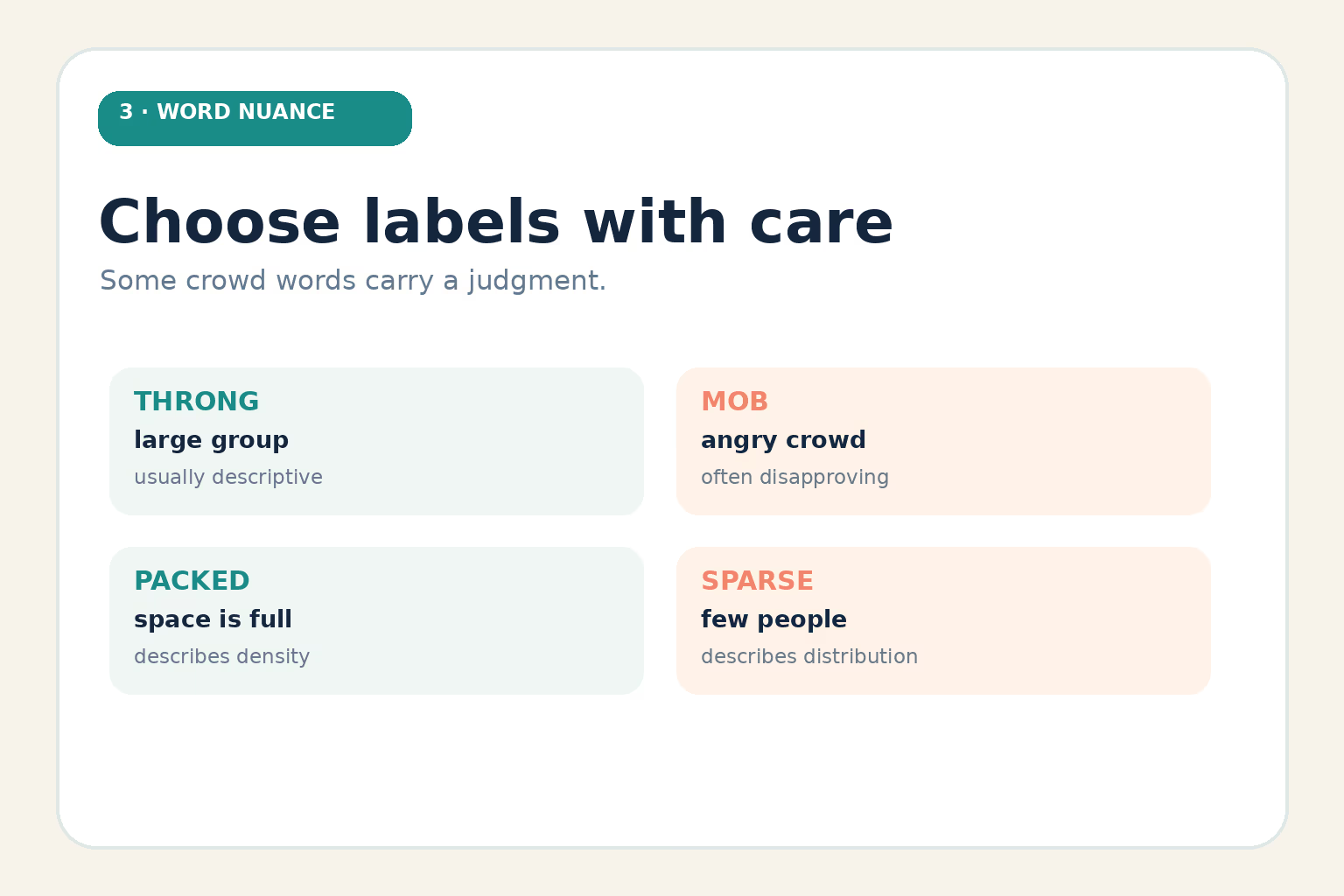
Packed and sparse describe how people are distributed through a space; neither is a direct opposite of crowd. Likewise, individual names one person, while few and empty describe smaller numbers or an unoccupied place. A crowd can be sparse, and an individual can be part of a crowd. Choose the word that matches the intended meaning rather than forcing an antonym pair.
For descriptions involving possible crowding risks, keep a vocabulary choice separate from a safety assessment. The UK Health and Safety Executive says event organizers should consider crowd movement as people arrive, circulate, leave, and disperse, and monitor numbers and distribution. An adjective such as dense or surging can describe an observed scene, but a label alone does not establish whether a venue or event is safe.
Examples by setting
- At a concert: “A lively crowd sang along near the stage while the seated audience listened quietly.”
- At a sports match: “The enthusiastic supporters cheered as the home team entered the field.”
- At a public meeting: “A small, attentive crowd asked questions after the presentation.”
- At a street festival: “A diverse, festive crowd browsed the stalls and watched the dancers.”
- After an event: “A slow-moving crowd left through the west gate in steady lines.”
Specific nouns can sharpen the image too. Use audience for people watching a performance or talk, spectators for observers at an event, supporters for people backing a team or cause, and queue or line when people are waiting. These choices often tell readers more than adding another adjective.
Frequently asked questions
What is a positive adjective for a crowd?
Lively, enthusiastic, supportive, attentive, and festive can be positive when they fit the scene. Choose one based on what people are doing: a crowd that listens closely is attentive, while one that celebrates together may be festive.
What is a negative adjective for a crowd?
Rowdy, hostile, or restless may describe a difficult atmosphere, but these words are subjective. If accuracy matters, name the visible behavior—such as shouting, interrupting, or pressing forward—and identify who did it rather than assigning one trait to everyone present.
Is “mob” a synonym for “crowd”?
It can refer to a kind of crowd, but it is not neutral in every context. Cambridge describes mob as usually disapproving and associates it with anger. For a neutral large group, use crowd, throng, or gathering where appropriate.
What is the opposite of a crowded place?
Uncrowded, sparsely populated, or nearly empty may fit, depending on the scene. Crowd names a group; crowded describes a place containing many people or things, so the best opposite depends on the sentence.
Conclusion
Describing crowds accurately is essential for creating vivid and engaging scenes in writing. Throughout this article, we have explored the significance of choosing the right adjectives to depict crowds in various contexts. From sporting events and concerts to protests and diverse gatherings, we have provided a range of adjectives and examples to help you paint a detailed picture.
In addition, we have introduced synonyms and antonyms for the word “crowd,” expanding your vocabulary and enabling you to describe different types of crowds in diverse settings. These words can also be applied to smaller, more intimate gatherings, enhancing your ability to set the scene and capture the reader’s attention.
Remember, the words we choose have a profound impact on how readers perceive and engage with our writing. By utilizing the appropriate adjectives, we can transport our audience into the heart of the crowd, immersing them in the energy, atmosphere, and emotions that define each unique gathering.
So, whether you’re crafting a thrilling action scene or painting a vivid backdrop for your story, selecting the right adjectives for crowds is an essential skill that will elevate your writing to new heights.


