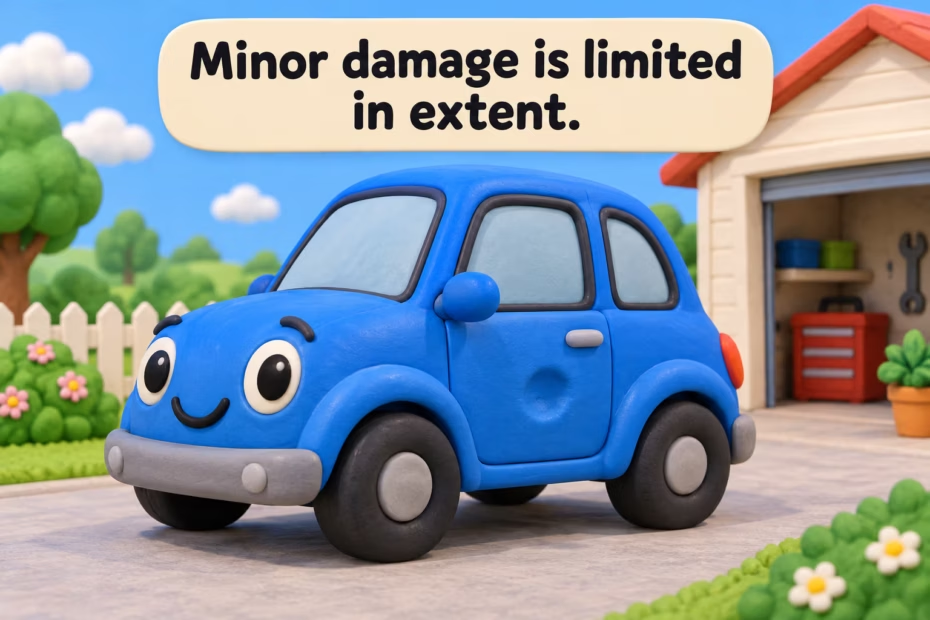
What adjectives describe damage?
Adjectives for damage describe its extent, location, visible form, or known effects. Choose a word such as minor, superficial, extensive, or devastating only when it fits the evidence; use damaged for an affected object and separate words for a person’s reaction or financial status.
At a glance
- Pair a severity word with a specific object, place, or function.
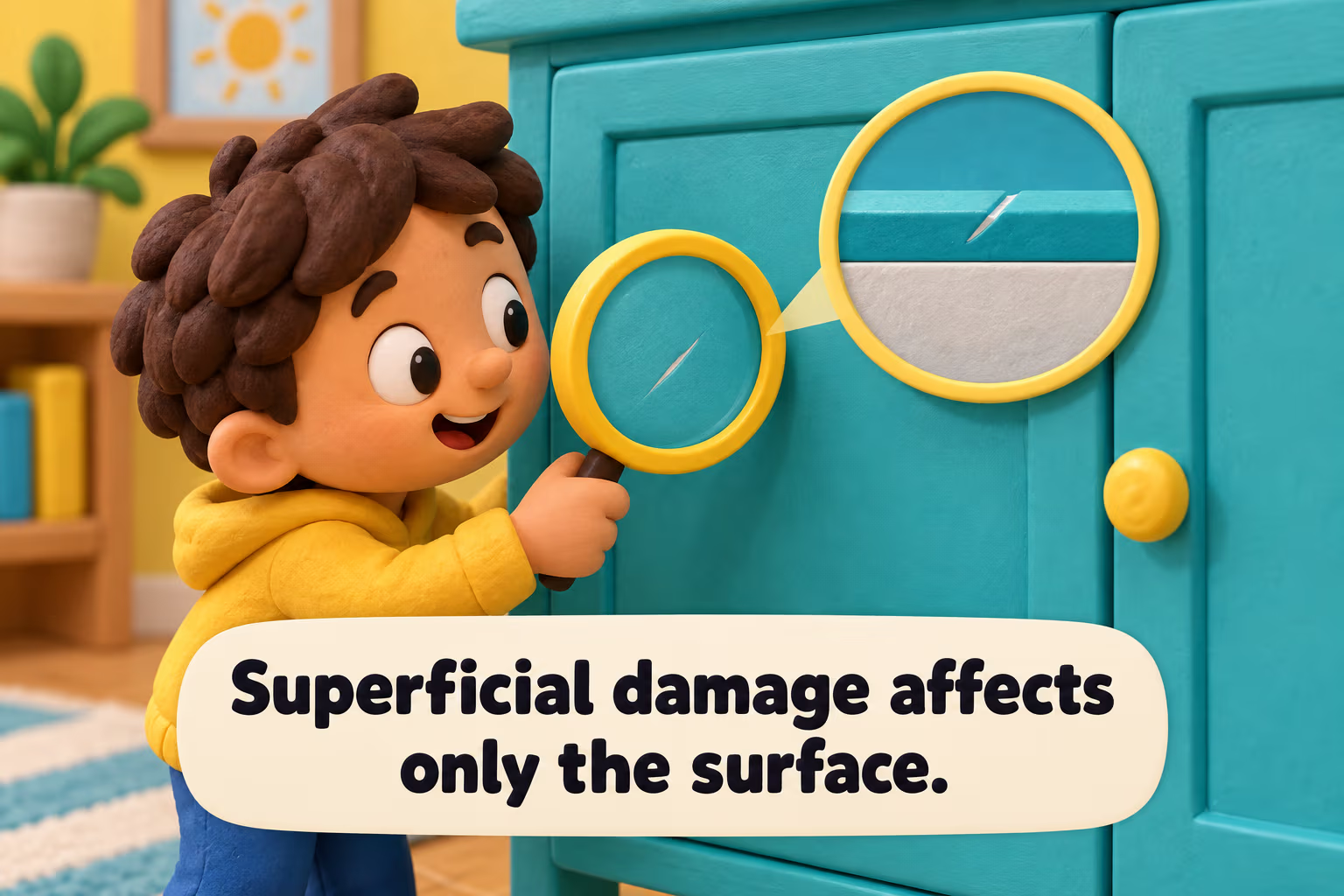
- Superficial describes surface-only damage; appearance alone does not prove safety.
- Repairable, reversible, and temporary describe different possible outcomes.
- Words such as devastated may describe a person’s reaction rather than damage itself.
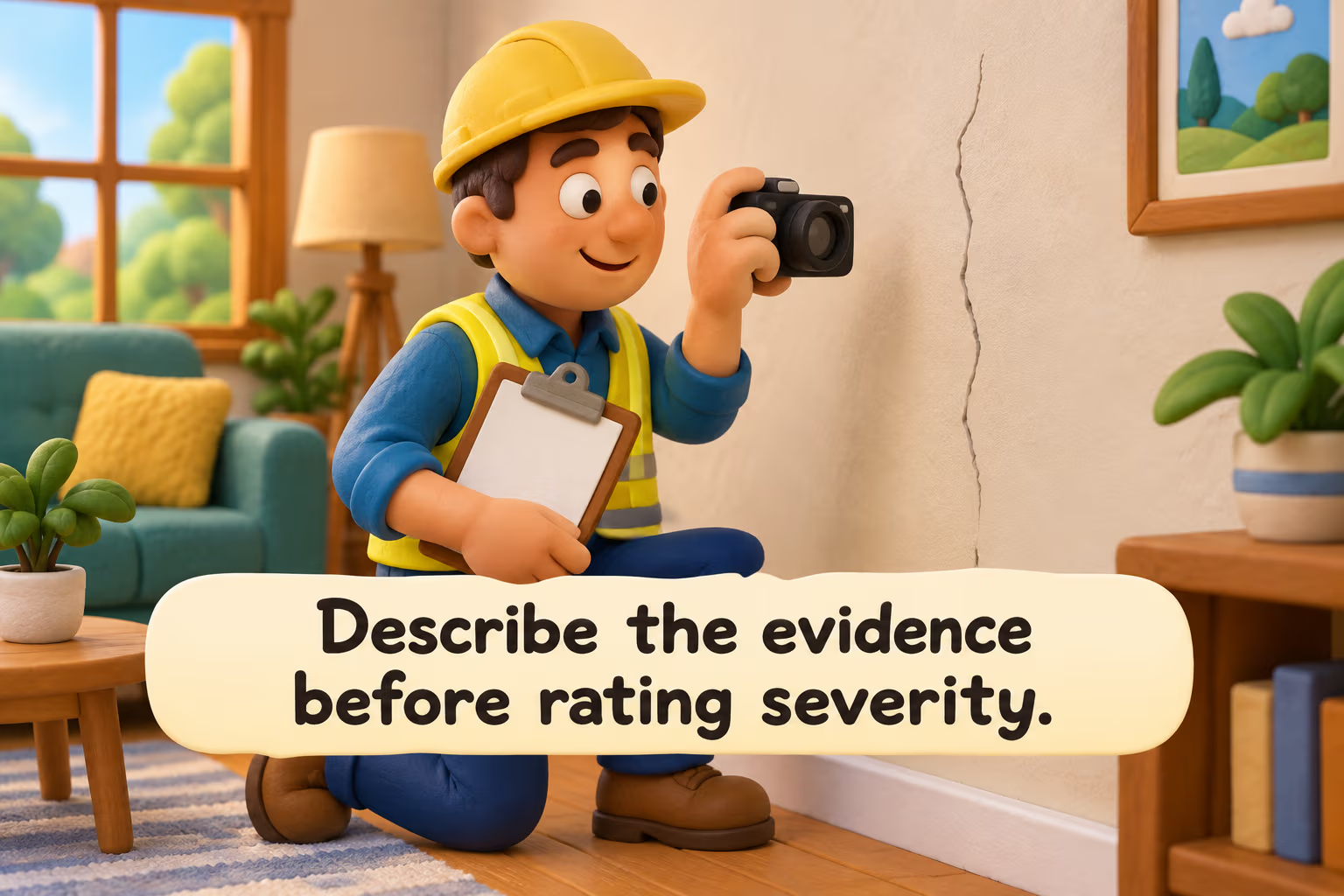
- Describe what is observable before using a rating or a broad severity label.
How should you describe damage accurately?
A useful description names what was affected and what can be observed: “a shallow scratch on the cabinet door” is more specific than “bad damage.” If the cause, extent, safety, or repair needs are not confirmed, avoid making them sound certain. A descriptive adjective can summarize an observation, but it does not replace an inspection or a formal assessment.
- Name the affected item, person, system, or resource.
- State the visible form or known change, such as a crack, dent, outage, or loss of function.
- Add a qualified degree word only when the available evidence supports it.
- Separate observed facts from estimates, causes, and predictions about repair or recovery.
How do severity, surface, and outcome words differ?
Severity adjectives give a broad sense of degree, while surface and outcome words answer different questions. In ordinary writing, minor, slight, serious, severe, extensive, devastating, and catastrophic are relative descriptions, not universal measurements. Their meaning depends on the thing affected and the evidence available.
| Word or group | What it describes | Example or limit |
|---|---|---|
| Minor, slight | A comparatively limited degree or extent. | “The storm caused minor damage to the fence.” The phrase gives no universal numeric threshold. |
| Serious, severe | Substantial concern or impact, with context determining the scale. | “The outage caused severe disruption to the clinic.” Explain what function was affected when possible. |
| Extensive | A large spread, area, or amount affected. | “Water damage covered several rooms.” The word concerns scope and does not by itself identify the cause. |
| Superficial | Damage limited to the outer surface. | A shallow scratch may be superficial; appearance alone cannot establish that an injury or defect is harmless. |
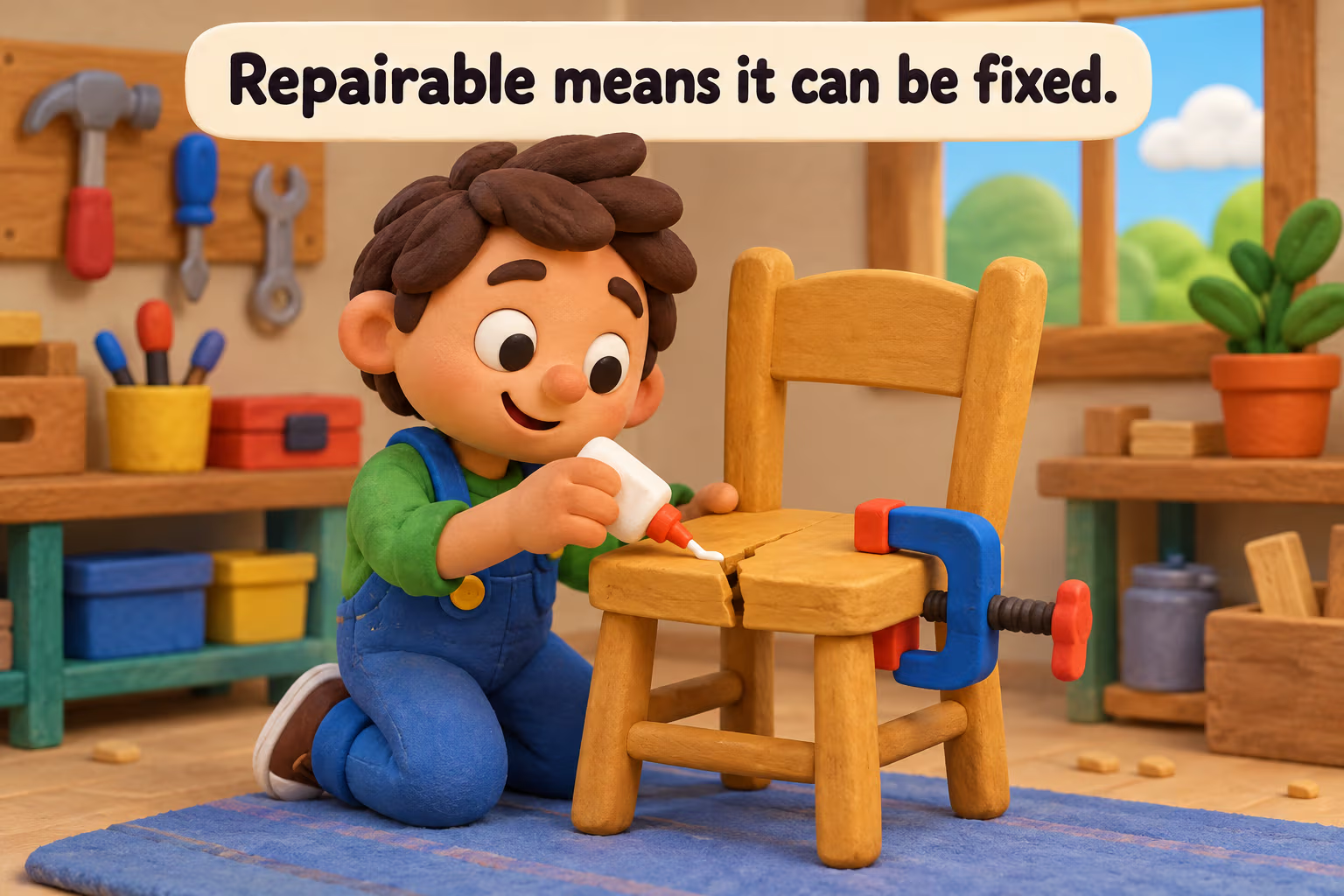
| Repairable | Whether something can be repaired. | A repairable item may still need substantial work; the word does not mean “minor.” |
| Reversible, temporary | Whether a change can be changed back, or how long it lasts. | These describe reversibility or duration, not the visible degree of damage. |
| Recoverable | Whether a particular amount, asset, or data can be recovered. | Specify what can be recovered; the word is not a general synonym for repaired. |
Movable means capable of being moved, so it is not a usual measure of damage severity or repair status. A clearer sentence is “The panel is dented, but the dent can be repaired.” The word fixable also describes a possible remedy, not how small or unimportant the damage is.
Which adjectives describe an affected person or financial condition?
Some words grouped in damage lists describe the person or circumstances affected, rather than the damage itself. For example, devastated, heartbroken, betrayed, and rejected can describe feelings or a person’s experience; bankrupt, impoverished, and foreclosed refer to financial or legal circumstances.
Use emotional words with care. A single event does not establish a diagnosis, and traumatized should reflect the person’s own description or a supported context rather than an assumption made by an observer. When a financial sentence sounds unnatural, name the concrete consequence: “The repair costs strained the household budget” is clearer than “The expenses debilitated his finances.” The source’s example “The house was foreclosed” applies foreclosed to a property; it is a legal circumstance, not a general degree word for damage.
Are the source “positive” and “negative” labels literal?
No. “Positive” and “negative” are the source article’s group labels for words associated with comparatively limited versus more serious damage; damage itself is not being praised. The lists also mix degree words with surface descriptions and outcomes. A repair option such as fixable or repairable does not establish low severity, and a word’s fit depends on what it modifies.
Are the listed synonyms and antonyms the same part of speech?
No. The source’s “Synonyms for Damage” table contains nouns for related kinds or effects of harm, including harm, destruction, devastation, ruin, and impairment. Impairment emphasizes reduced function; destruction suggests a much greater degree of damage. These words can be useful related terms without being interchangeable in every sentence.
The “Antonyms for Damage” table lists verbs or actions: protect, preserve, repair, restore, and fortify. Those actions may prevent or address damage, but they are not direct antonyms of the noun damage. Contrasting states include undamaged, unharmed, and intact.
Do damage adjectives use a formal rating scale?
Ordinary adjectives such as minor, severe, and catastrophic do not have one universal measurement. Named systems apply only within their stated scope. For example, the U.S. National Weather Service’s Enhanced Fujita (EF) Scale rates tornado intensity from damage indicators and degrees of damage; it is not a general adjective scale for car, building, emotional, or financial damage. See the National Weather Service EF Scale explanation.
When it comes to describing damage, having a wide range of adjectives at your disposal can make all the difference. Whether you’re writing a report, describing an accident, or simply trying to convey the severity of a situation, using the right adjectives can help paint a vivid picture in the reader’s mind. In this article, I’ll be sharing a comprehensive list of adjectives for damage, along with examples of how they can be used effectively.
From minor scratches to catastrophic destruction, the English language offers a plethora of words to describe various degrees of damage. By choosing the right adjectives, you can accurately convey the extent and nature of the harm inflicted. Whether you want to describe a car with a “dented” fender, a house with “extensive” water damage, or a phone with a “cracked” screen, having a diverse vocabulary of adjectives will enhance your ability to communicate effectively.
In the following sections, I’ll be categorizing adjectives for damage based on the type of harm they describe, such as physical, emotional, or financial. By exploring these categories, you’ll be equipped with a comprehensive toolkit of adjectives that will elevate your writing and enable you to vividly describe various forms of damage. So, without further ado, let’s dive into the world of adjectives for damage and discover how to bring your descriptions to life.
How to Describe damage? – Different Scenarios
When it comes to describing damage, it is essential to choose the right adjectives to accurately convey the extent and nature of harm inflicted. Let’s explore different scenarios and see how we can use adjectives to describe damage.
1. Physical Damage
When something is physically damaged, it means there is visible harm or injury to its structure or appearance. Here are some adjectives commonly used to describe physical damage:
- Cracked: The vase fell off the shelf and is now cracked.
- Dented: The car’s bumper is dented after the collision.
- Shattered: The mirror fell and shattered into a thousand pieces.
- Scratched: The table has deep scratches from the rough use.
- Torn: The book’s pages are torn and can no longer be read.
2. Emotional Damage
Emotional damage refers to the harm inflicted on a person’s mental or emotional well-being. Here are some adjectives that can be used to describe emotional damage:
- Devastated: She was devastated after the loss of her pet.
- Heartbroken: He felt heartbroken when his best friend moved away.
- Traumatized: The accident left her traumatized and fearful.
- Betrayed: She felt betrayed when her secret was revealed.
- Rejected: He felt rejected after not being invited to the party.
3. Financial Damage
Financial damage refers to the harm caused to one’s financial situation or resources. Here are some adjectives that can be used to describe financial damage:
- Bankrupt: The company went bankrupt and had to close down.
- Impoverished: The family became impoverished after losing their jobs.
- Ruined: His gambling addiction ruined his financial stability.
- Debilitated: The unexpected medical expenses debilitated his finances.
- Foreclosed: The house was foreclosed due to unpaid mortgage.
By using these adjectives, we can vividly describe various forms of damage in different scenarios. It’s important to choose adjectives that accurately depict the specific type of harm and enhance our ability to express ourselves effectively.
Now that we’ve explored different scenarios of damage, let’s move on to the next section of our article – “Adjective Categories for Damage”.
Describing Words for damage in English
When it comes to describing damage, choosing the right adjectives can help us accurately convey the extent and nature of harm. By using specific words, we can enhance our ability to express ourselves effectively. Let’s explore some describing words for damage in English:
- Physical Damage: When something is physically harmed or broken, we can use adjectives to describe the extent of the damage. Here are a few examples to illustrate:
- Emotional Damage: Sometimes, damage isn’t visible on the outside but can affect us deeply on the inside. To describe emotional harm, consider using these adjectives:
- Financial Damage: Damage can also extend to our wallets or bank accounts. Here are a few words to describe financial harm:
Remember, the key to accurately describing damage is to choose adjectives that specifically depict the type of harm involved. This not only helps us communicate clearly but also allows us to accurately convey the severity and impact of the damage.
Note: The examples provided are meant to serve as a guide. Feel free to use these words as a starting point and expand upon them as needed.
Stay tuned for the next section where we will explore “Adjective Categories for Damage,” where we’ll delve deeper into different types of damage and the adjectives associated with them.
Adjectives for damage
Positive Adjectives for Damage
When describing damage, it’s important to choose words that accurately convey the severity and impact. Here are some positive adjectives that can be used to describe damage:
| Adjective | Example Sentence |
|---|---|
| Minor | The scratch on my car was minor. |
| Superficial | The cut on my finger was superficial. |
| Slight | The damage to the painting was slight. |
| Negligible | The impact of the fall was negligible. |
| Fixable | The broken window is fixable. |
| Reversible | The damage to the fabric is reversible. |
| Movable | The dent in the car is movable. |
| Recoverable | The data loss is recoverable. |
| Manageable | The damage to the room is manageable. |
| Repairable | The leak in the pipe is repairable. |
| Temporary | The damage caused by the storm is temporary. |
| Resolvable | The issue with the software is resolvable. |
Negative Adjectives for Damage
To effectively communicate the severity of damage, consider using negative adjectives. Here are some examples:
| Adjective | Example Sentence |
|---|---|
| Severe | The damage to the building was severe. |
| Devastating | The fire had a devastating impact. |
| Irreversible | The damage to the computer is irreversible. |
| Catastrophic | The flood caused catastrophic damage. |
| Overwhelming | The emotional damage was overwhelming. |
Remember, choosing the right adjectives is crucial in accurately describing damage. Whether it’s positive or negative, using descriptive words helps convey the extent and impact of the harm.
Synonyms and Antonyms with Example Sentences
Synonyms for Damage
When it comes to describing damage, it’s important to have a variety of words at your disposal to accurately convey the severity and impact. Here are some synonyms for “damage” that can help you effectively communicate the extent of harm:
| Synonym | Definition | Example Sentence |
|---|---|---|
| Harm | Physical or emotional injury or damage | The storm caused extensive harm to the house. |
| Destruction | The act of damaging or ruining | The fire resulted in the complete destruction of the building. |
| Devastation | Overwhelming destruction or damage | The earthquake left behind a scene of utter devastation. |
| Ruin | The state of being completely destroyed | The floodwaters caused the ruin of many homes. |
| Impairment | Weakening or deterioration of function | The accident caused a permanent impairment of his sight. |
Antonyms for Damage
On the flip side, when discussing damage, it’s also useful to have antonyms in your toolkit to describe the absence of harm. Here are some antonyms for “damage” that can help you contrast the impact:
| Antonym | Definition | Example Sentence |
|---|---|---|
| Protect | To guard or defend against harm or damage | The Car seatbelt is meant to protect the passengers in case of an accident. |
| Preserve | To keep in a particular condition or prevent decay | He took extra steps to preserve the artwork from any damage. |
| Repair | To fix or restore something that is damaged | The mechanic was able to repair the engine, saving us from costly repairs. |
| Restore | To bring back to a former or original condition | The renovation project aims to restore the historic building to its former glory. |
| Fortify | To strengthen or reinforce | She took vitamins to fortify her immune system and prevent illness. |
Choosing the right words to describe damage is key to effective communication. Whether you need to emphasize the severity or discuss the absence of harm, having a comprehensive list of synonyms and antonyms can enhance the clarity of your descriptions.
Conclusion
Describing damage accurately is crucial for effective communication, especially when conveying the severity and impact of harm. In this article, I have provided a comprehensive list of synonyms and antonyms for the word “damage,” along with example sentences for each descriptive word. By using these adjectives, you can paint a vivid picture and evoke the appropriate emotions in your audience.
Choosing the right words to describe damage can make a significant difference in how your message is received. Whether you’re writing a report, an article, or simply discussing an incident, utilizing these descriptive words will enhance your communication skills and ensure that your message is clear and impactful.
Remember, words have the power to convey emotions and evoke empathy. By incorporating these adjectives into your writing, you can effectively communicate the severity and impact of harm, allowing your audience to fully grasp the extent of the damage.
So, next time you need to describe damage, refer to this list and choose your words wisely. Your ability to accurately convey the impact will undoubtedly leave a lasting impression on your readers or listeners.
Frequently Asked Questions About Adjectives for Damage
What is a good adjective for minor damage?
Minor or slight can describe damage that is limited in degree or extent, when the facts support that description. “The door has a slight scratch” is more specific than “the door is slightly damaged.” These words are qualitative; they do not set a universal threshold or prove that an item is safe.
Does superficial damage mean an item is harmless?
No. Superficial means limited to the surface, but surface appearance alone cannot establish safety or rule out a deeper problem. The term can describe a shallow mark on an object or an injury’s outer appearance. For a safety concern, describe what is visible and rely on an appropriate assessment.
Are repairable and reversible synonyms?
No. Repairable means something can be repaired or put back into working condition. Reversible means a change can be changed back, and temporary describes duration. A damaged chair may be repairable without being unchanged, while a temporary outage may end without physical repair.
What is the difference between damaged and damaging?
Damaged usually describes something that has been harmed, as in “a damaged roof.” Damaging often describes something that causes harm, as in “damaging winds” or “a damaging rumor.” The noun damage names harm, while the verb damage means to harm or impair something.
Are protect and repair antonyms of damage?
Protect and repair are verbs for actions that prevent or address harm; they are not direct antonyms of the noun damage. To describe the opposite state, use an adjective such as undamaged or intact. Word class matters when choosing a synonym or contrast.
How can I describe damage without overstating it?
Name the affected item, location, and observable change before applying a degree word. For instance, “a crack runs along the outer tile” states evidence; “severe structural damage” adds an assessment that may need inspection. Separate observations from estimates, causes, repair predictions, and formal ratings.
Sources and further reading
- Cambridge Dictionary: damage — noun and verb uses.
- Cambridge Dictionary: harm — harm as injury or damage.
- Cambridge Learner’s Dictionary: minor — limited importance or seriousness.
- Cambridge Dictionary: superficial — surface-level senses.
- Cambridge Dictionary: repairable — capable of being repaired.
- Cambridge Dictionary: devastating — causing great damage or destruction.
- National Weather Service: Enhanced Fujita Scale — tornado damage indicators and degrees used to estimate wind speeds.


