Adjectives for Fall: Meanings, Examples & Word List
Useful adjectives for fall describe specific weather, colors, sounds, settings, or personal reactions. “Autumnal” means typical of autumn; “chilly” and “windy” are more useful when paired with observed conditions, while “cozy” expresses a subjective impression. The season’s timing and appearance vary by hemisphere and climate.
At a glance
Fall and autumn name the same temperate season; fall is especially common in US English.
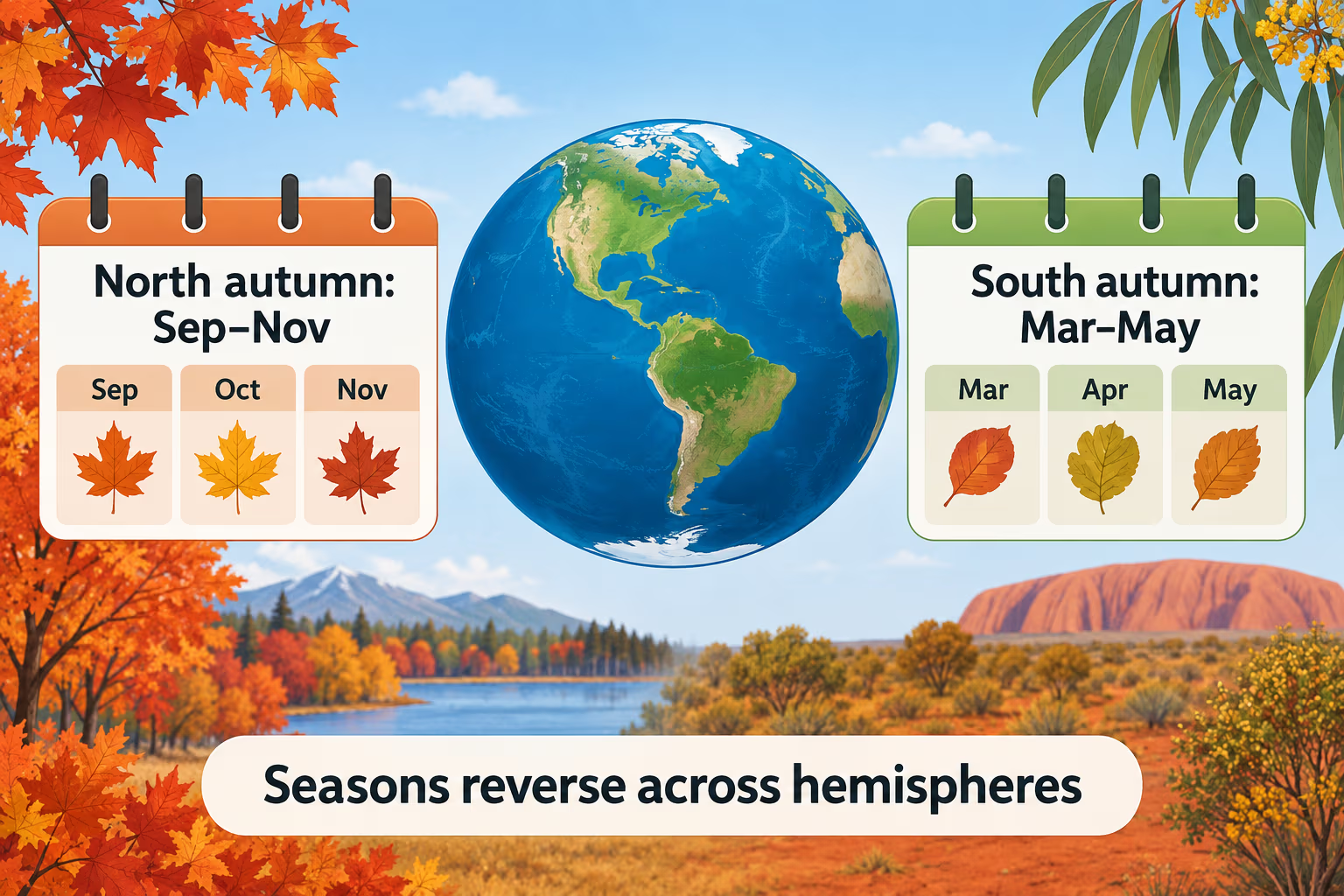
In the Northern Hemisphere, meteorological fall is September through November; the corresponding Southern Hemisphere autumn is commonly March through May.
“Chilly” is context-dependent; report a temperature and location when precision matters.
“Windy” can be supported by measured wind speed, while “cozy,” “beautiful,” and “miserable” record a person’s impression.
Some regions follow wet/dry seasons or have less pronounced four-season patterns, so leaf color and cold weather are not universal signs of fall.
Autumn is a noun for the season between summer and winter; fall is another name for it, particularly in US usage. Autumnal is the adjective meaning characteristic of or associated with autumn, as in “autumnal light” or “an autumnal landscape.” It does not by itself mean cold, colorful, or rainy.
Season names and seasonal cues depend on where the writer is describing.
When is fall, and does the season look the same everywhere?
Season labels depend on hemisphere and on the convention being used. The US National Weather Service and other weather agencies commonly group Northern Hemisphere meteorological fall into September, October, and November; astronomical autumn begins near the September equinox. These are distinct conventions, so exact start dates depend on whether the writer means meteorological or astronomical autumn. Seasons are reversed south of the equator, where autumn commonly falls in March, April, and May; Australia’s Bureau of Meteorology defines southern Australian autumn as March through May. Near the equator, wet and dry seasons may describe local patterns better than the four-season model.
The month ranges are a common temperate-zone convention, not a universal climate description.
“Leaf-strewn,” “golden,” and “crisp” may fit a particular place and day, but they should not be treated as facts about every autumn. Evergreen vegetation, local rainfall, elevation, latitude, and urban heat can change what people actually see or feel.
Which fall adjectives describe measurable conditions?
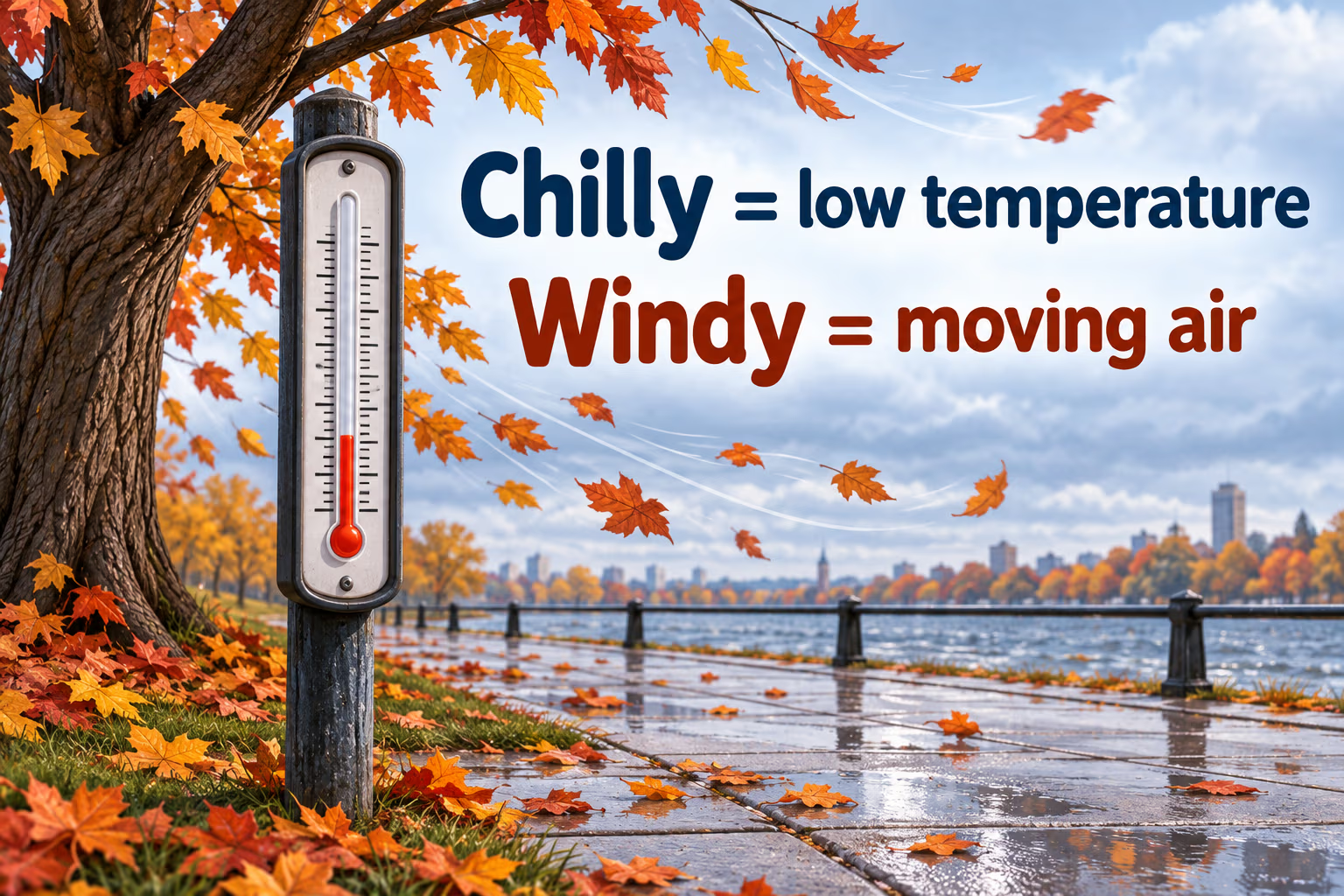
Weather adjectives become more precise when paired with an observation, measurement, time, and place. The adjective chilly has no single universal temperature cutoff; a report such as “8°C at 7 a.m. in Boston” gives readers a measurable context, while “chilly” conveys how that condition felt to the writer.
Use a reading or observed condition when a descriptive word could mean different things to different readers.
Word
What it describes
More precise example
Chilly
A subjective sense of low temperature; no single threshold applies everywhere.
“The thermometer read 8°C (46°F) at 7 a.m.; I found it chilly.”
Windy
Air moving noticeably; weather reports can quantify wind speed and gusts.
“A 30 km/h wind pushed dry leaves across the path.”
Rainy
Rain occurring or frequent during a stated period.
“Rain fell on four of the seven days we recorded.”
Frosty
Frost present, or conditions cold enough for frost; specify which meaning.
“Frost covered the grass at sunrise.”
Colorful
A visible range of colors, which can be described rather than assumed.
“Maple leaves on this street were red and orange.”
These examples distinguish what can be observed or measured from the writer’s evaluation. A word may bridge both: “crisp air” often conveys cool, fresh-feeling air, but “crisp” can also describe texture, sound, or clear detail. Let the surrounding sentence show which sense is intended.
Which fall adjectives express a personal impression?
Words such as cozy, beautiful, festive, dreary, and miserable communicate an impression rather than a standard weather measurement. The same gray afternoon can feel peaceful to one person and gloomy to another, so name the concrete details behind the reaction.
Subjective adjectives are useful when the sentence makes clear whose impression they express.
Impression word
What it adds
Ground it with
Cozy
Comfort, warmth, and a sheltered setting.
A wool blanket, a lit room, or a warm drink.
Beautiful
The writer’s positive evaluation.
Specific colors, light, shapes, or sounds.
Festive
A celebratory mood or event.
The gathering or holiday being described; traditions differ by community.
Dreary
A low-energy or gloomy impression.
Persistent cloud, dim light, or the writer’s response to them.
For a vivid sentence, combine one observable detail with one chosen impression: “A steady rain darkened the pavement, making the afternoon feel dreary.” This keeps the image concrete without claiming every reader will react the same way.
How can you choose a more accurate fall adjective?
Identify the subject: temperature, wind, leaf color, sound, food, setting, or mood.
Ask whether the word states an observation or a reaction; add a unit, date, place, or point of view when it improves clarity.
Check the season’s location. A September scene may be spring in the Southern Hemisphere.
Replace a broad cliché with evidence from the scene: “windy and 12°C” is clearer than “bad fall weather.”
“Pumpkin spice” is a noun phrase naming a flavor or flavor blend, not a standard adjective by itself. It can modify a noun informally (“pumpkin-spice latte”), but use it as a hyphenated modifier only where that compound reads naturally.
Original fall adjective article
The complete source article follows exactly as captured, including all alphabet tables, repeated entries, spelling variants, examples, and original inline images. The explanations above add context without silently deleting or rewriting those source elements.
When the leaves start to change color and the weather gets cooler, that can only mean one thing: fall is here! This season is one of the best times of year, and there are so many reasons why. From the food to the activities, there’s just something about fall that makes it special.
And of course, fall wouldn’t be complete without its own set of adjectives. These descriptive words are perfect for capturing the essence of autumn. So whether you’re writing about the season or just looking to add a little flavor to your speech, here are some great adjectives for fall.
Adjectives For Fall
As the leaves begin to change color and the weather gets cooler, people often start to use different adjectives to describe the fall season. Here are some of the most popular adjectives used to describe fall:
Beautiful: The crisp air and colorful leaves make fall a beautiful time of year.
Cozy: Fall is the perfect time to cozy up by the fire with a cup of hot chocolate.
Festive: Fall is a festive time of year, with Halloween and Thanksgiving celebrations.
Pumpkin Spice: One of the most popular fall flavors is pumpkin spice.
Autumnal: Another word for fall, often used to describe the colors of the leaves.
What are some of your favorite adjectives to describe fall?
A
Aboriginal
Abrupt
Absolute
Abundant
Accidental
Actual
Affected
Aggressive
Alive
Amazing
Amber
Annual
Apparent
Appellant
Arly
Artificial
Asleep
Assignable
Astonishing
Auspicious
Autumnal
Average
Awful
Awkward
B
Back-To-School
Backward
Beautiful
Beloved
Bitter
Black
Blank
Blind
Blonde
Bloody
Blue
Blustery
Bountiful
Brave
Breezy
Bright
Brilliant
Brisk
British
Broken
Brown
C
Careless
Cautious
Certain
Changing
Chief
Chilly
Clean
Cold
Colder
Coldness
Colored
Colorful
Comfortable
Complete
Conclusive
Concrete
Consequent
Considerable
Constant
Continual
Continued
Continuous
Copious
Cozy
Crackling
Crippling
Crisp
Crunchy
Curious
D
Daily
Dangerous
Dead
Deadly
Decided
Deciduous
Decisive
Deeper
Definite
Definitive
Deliberate
Delicate
Delightful
Dense
Desertful
Desperate
Didst
Difficult
Disastrous
Dismal
Distant
Distinct
Distressing
Dizzy
Downright
Dramatic
Drastic
Dreadful
Dreadfull
Dry
Dubious
Dull
E
Earthy
Eastward
Easy
Electrical
Embarrassing
Enchanting
Endless
Enjoyable
Entire
Ere
European
Eventual
Everlasting
Excessive
Explosive
Extraordinary
Extreme
Eyed
Eyelid
F
Faint
Fake
Fall-Inspired
Fallen
Famous
Fancy
Farm-Grown
Fatal
Fearful
Fellow
Female
Final
Fine
Fireside
Flannel
Flat
Foggy
Following
Foraging
Forced
Forward
Foul
Fourth
Fragment
Frequent
Fresh
Frightening
Frosty
Furious
Future
G
Generational
Gentle
Giant
Gigantic
Glorious
Gold
Graceful
Gracious
Gradual
Gray
Green
Greenhide
Grievous
Guilty
Gusty
H
Hamlet
Hard
Hardy
Harvested
Headlong
Heavy
Hibernating
Hilarious
Hit
Howling
Huge
Humiliating
Hush
I
Ignominious
Immediate
Immense
Immortal
Imperial
Incessant
Increased
Indian
Indolent
Industrious
Inevitable
Inexplicable
Infamous
Insignificantto
Inspirational
Instant
Insufficient
Intercourse
Invalid
Iroquois
Italian
J | L
Joyless
Lamentable
Lamented
Lantern
Large
Late
Leaf-Strewn
Leastto
Lettest
Lifeless
Light
Loosened
Lost
Loud
Lowly
M
Magnificent
Marked
Massive
Mellow
Mere
Meteoric
Mighty
Miniature
Minor
Miraculous
Moderate
Momentary
Monotonous
Monthly
Monumental
Moonlit
Moral
Mournful
Musical
N | O
Nasty
Natural
Nearer
Nice
Noble
Nominative
Normal
Northern
Numerous
Nuts
Obstructed
Occasional
Open
Orange
Original
Overall
Overgrown
P
Painful
Past
Pathetic
Peaceful
Pebble
Peculiar
Perceptible
Perfect
Perilous
Perpendicular
Perverse
Petal
Phantom
Picturesque
Piteous
Pitiful
Plentiful
Poor
Precipitous
Present
Previous
Principal
Probable
Progressive
Promising
Pumpkin-Flavored
Pumpkin-Spiced
Pure
Q | R
Quarterly
Quick
Quiet
Rainy
Raked
Rapid
Real
Reckless
Red
Redoubled
Regular
Related
Relaxing
Remarkable
Requisite
Respectable
Rich
Ripe
Rotten
Rough
Rude
Rust-Colored
Rustling
S
Sad
Scary
Seasonal
Severe
Sharp
Sheer
Shoppinghe
Short
Sick
Sideways
Significant
Silent
Silver
Simple
Simultaneous
Single
Sleeper
Slight
Slow
Snowy
Sodain
Soft
Soggy
Sonorous
Spectacular
Speedier
Spiritual
Splendid
Spooky
Steady
Stealthy
Steep
Straggling
Straight
Strained
Striking
Subsequent
Substantial
Subterraneous
Successful
Successive
Sudden
Supplementary
Supportivelast
Surprising
Swift
T
Tear
Tempest
Temporary
Terrible
Thankfulness
Thee
Thick
Thin
Thirteenth
Thou
Thundering
Thunderous
Timely
Timethe
Tiny
Topmost
Trebble
Treble
Tremendous
Trifling
Tropical
Tumultuous
Turning
Twofold
U
Ugly
Ultimate
Unavoidable
Unbroken
Uncertain
Uncharacteristic
Uncontrolled
Underdown
Unexampled
Unexpected
Unforced
Unfortunate
Unheeded
Unlamented
Unlucky
Unmodified
Unnumbered
Unpredictable
Unspending
Untimely
Unusual
Unwary
Upcoming
Upper
Useless
Usual
Utmost
V
Vain
Vast
Vertical
Vibrant
Violent
Virtual
Virtuous
Visual
Vivid
Voluntary
W | Y
Wa
Wather
Weekly
Wet
Wholesale
Wide
Widespread
Wild
Wilted
Wilting
Windy
Withered
Wonderful
Wondrous
Woodland
Yellow
Final verdict
As the leaves begin to change color and fall from the trees, we are reminded of the beauty of autumn. This season is a time for cozy fires, warm drinks, and spending time with loved ones. It is a time to reflect on the year that has passed and to prepare for the year ahead.
Autumn is a special time of year, and it is important to choose your words carefully when describing it. These ten adjectives are the perfect way to capture the essence of fall.
Frequently Asked Questions About Fall Adjectives
Are “fall” and “autumn” different seasons?
No. Fall and autumn are names for the same season between summer and winter. Fall is common in US English, while autumn is widely used in British English and elsewhere. A word’s regional preference can vary, so use the term that fits your audience.
When is autumn in the Southern Hemisphere?
In the Southern Hemisphere, autumn commonly falls around March through May under the meteorological calendar, about six months opposite the Northern Hemisphere’s September–November fall. Exact local weather and climate patterns vary, and some places are better described by wet and dry seasons than by four temperate seasons.
Is “chilly” an objective temperature?
No universal temperature defines chilly. The word expresses a context-dependent perception influenced by wind, humidity, clothing, activity, and acclimatization. For a precise report, give the temperature, unit, place, and time, then use chilly to describe how it felt to a person.
Is “cozy” a measurable adjective?
Cozy usually describes a subjective sense of comfort or a setting that seems warm and sheltered; it has no standard measurement. A concrete example such as “a small, warm room with a blanket and a fire” helps readers understand what the writer found cozy.
Does autumn always mean colorful leaves and cold weather?
No. Leaf color, rainfall, and temperature depend on location, species, altitude, and weather. Some landscapes remain green, and tropical regions may emphasize wet and dry seasons. Describe what was observed in the particular place instead of treating one temperate-region picture of autumn as universal.
Robin founded StartsWithy in 2022 to make English words easier to understand and use. Robin oversees our 30,000+ guides, checks meanings and grammar against trusted dictionaries such as Cambridge, Oxford Learner’s and Collins, and is accountable for every correction we make.